
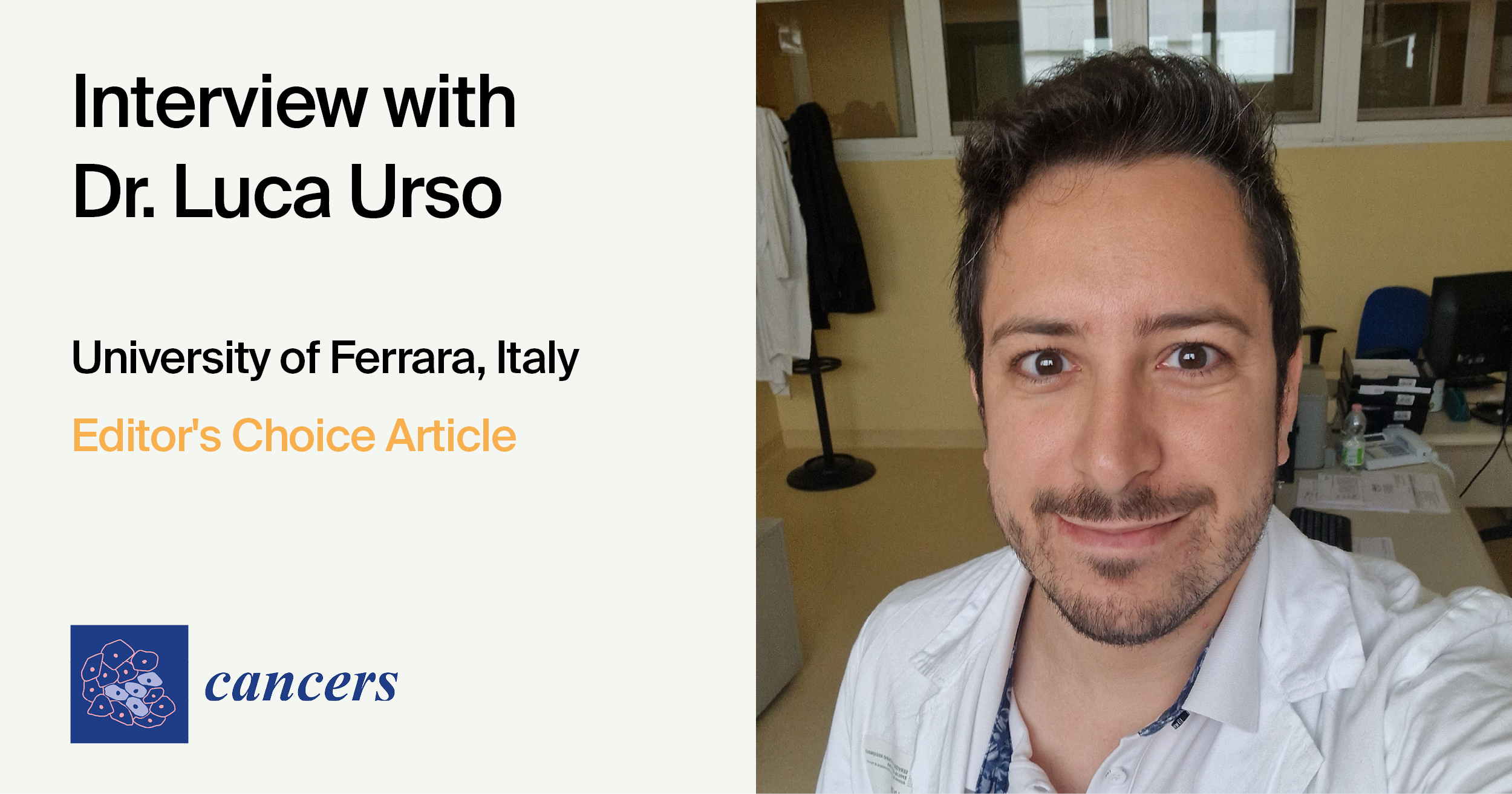
Cancers | Interview with One of the Authors of the Editor’s Choice Article—Dr. Luca Urso
We had the pleasure of speaking with Dr. Luca Urso, first author of the Editor’s Choice Article in Cancers (ISSN 2072-6694). Below, he shares insights into his research, paper, challenges, and advice.
“68Ga-Trivehexin: Current Status of αvβ6-Integrin Imaging and Perspectives”
by Luca Urso, Rebecca Napolitano, Giorgia Speltri, Murat Tuncel, Ilham Badrane, Licia Uccelli, Francesca Porto, Petra Martini, Alessandro Niorettini, Corrado Cittanti et al.
Cancers 2025, 17(9), 1504; https://doi.org/10.3390/cancers17091504
Available online: https://www.mdpi.com/2072-6694/17/9/1504
The following is an interview with Dr. Luca Urso:
1. Could you briefly introduce yourself and describe your main research focus?
I am an Assistant Professor (tenure track) and Nuclear Medicine Physician at the University of Ferrara, where I also serve as Deputy Director of the Postgraduate School in Nuclear Medicine and Principal Investigator in several clinical and translational research projects. My work focuses primarily on oncologic molecular imaging and theranostics, with a particular interest in radiopharmaceutical development and integration of imaging biomarkers into precision oncology.
2. What inspired you to pursue this particular area of cancer research?
I first became aware of 68Ga-Trivehexin during the 37th Annual Congress of the European Association of Nuclear Medicine (EANM’24), held in Hamburg, on October 19–23, 2024, where the early data about this radiotracer immediately caught my attention. The tracer appeared to have remarkable potential: a highly selective molecular target, a solid radiochemical design, and promising preliminary clinical images. This combination motivated me to explore its capabilities more deeply and to contribute to clarifying its role in both oncologic and non-oncologic disease.
3. In your own words, what are the key findings or main messages of your Editor’s Choice paper?
Our review highlights three main messages:
- A strong theranostic potential: 68Ga-Trivehexin improves lesion detectability in αvβ6-expressing tumors, especially where 18F-FDG is limited by inflammation—for example, in head and neck cancer, where inflammatory lymph nodes often complicate interpretation;
- A major step forward in radiochemistry and pharmacokinetics: The optimized multimeric system has substantially enhanced the radiotracer’s pharmacokinetic properties, binding affinity, and selectivity for αvβ6 integrin, demonstrating up to an 18-fold improvement compared to previous monomeric tracers. The synthesis protocol has been refined to achieve high radiochemical purity (>95%), essential for safe clinical use;
- A dual oncologic and non-oncologic applicability: Beyond pancreatic and head-and-neck cancers, the tracer shows promise in idiopathic pulmonary fibrosis and primary hyperparathyroidism, expanding its potential clinical impact.
Overall, the paper positions 68Ga-Trivehexin as a highly promising candidate for future theranostic strategies, including the possible development of αvβ6-targeted radioligand therapy.
4. How do you see this research evolving or influencing future studies in the field?
This work lays the foundation for future original studies exploring αvβ6-integrin imaging in larger cohorts, in treatment-response assessment, and in the design of αvβ6-targeted therapeutic radiopharmaceuticals.
I expect the next steps to include:
- prospective clinical trials in pancreatic adenocarcinoma and head and neck cancer;
- comparative studies with 18F-FDG and other emerging tracers;
- development of αvβ6-directed radioligand therapy;
- further exploration of fibrotic diseases as a new imaging frontier.
In this sense, 68Ga-Trivehexin may become a platform tracer that stimulates both diagnostic and therapeutic innovation.
5. What advice would you give to early career researchers who aim to publish impactful work in oncology?My main advice is to always remain curious and never give up! Oncology is a rapidly evolving field, and impactful research often emerges from unexpected questions and persistent exploration. Cultivate scientific curiosity, embrace multidisciplinary collaboration, and do not be discouraged by setbacks—they are an essential part of the research process. Above all, remain committed to producing rigorous, transparent, and clinically meaningful work. Impact follows naturally when science is solid and the motivation is genuine.