
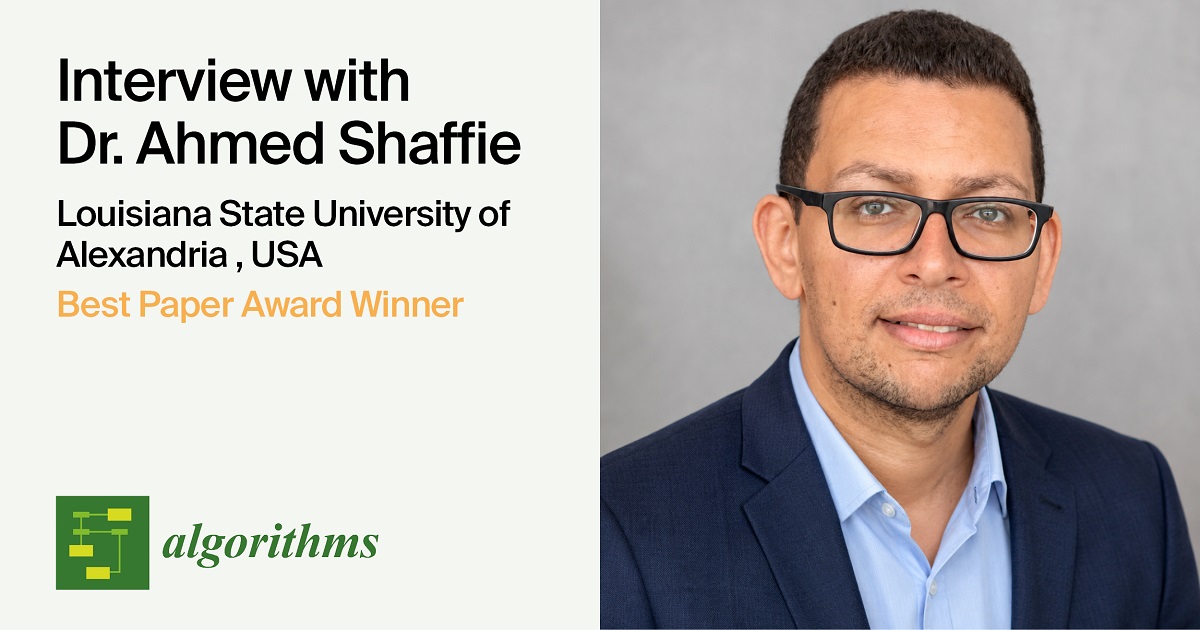
Interview with Dr. Ahmed Shaffie—Winner of the Algorithms Best Paper Award
1. Preparing a high-quality manuscript often requires several iterations. What were the main challenges you faced during the preparation of this paper, and how did you address them to clearly communicate your methodology and findings?
One of the main challenges during the preparation of this paper was effectively integrating engineered features with deep learning-based features in a way that was both technically rigorous and easy to understand. The motivation behind the work was to take advantage of the complementary strengths of traditional feature engineering and modern deep learning techniques for pulmonary nodule diagnosis. Explaining why these two approaches should be combined and demonstrating the value of each component within the framework, required careful presentation and multiple rounds of refinement. To achieve this, we focused on designing intuitive, block-diagram conceptual frameworks that visually mapped out how the traditional geometric features and abstract deep features complemented each other, moving away from dense mathematical text where possible.
Another challenge was presenting the experimental results in a concise yet comprehensive manner. Medical imaging studies often involve extensive validation, multiple performance metrics, and comparisons with existing methods. We wanted to ensure that readers could clearly understand not only the performance improvements achieved by the proposed framework but also the practical significance of those improvements in a clinical setting.
Throughout the writing process, we focused on maintaining a balance between technical depth and readability. Our goal was to make the paper accessible to researchers from different backgrounds, including artificial intelligence, medical imaging, and healthcare, while still providing sufficient detail to support reproducibility and scientific rigor.
2. The peer-review and editorial process plays an important role in shaping a final publication. How did the review process at Algorithms help you refine or improve your work?
The review process at Algorithms was highly constructive and played an important role in strengthening the final manuscript. The reviewers provided thoughtful comments that encouraged us to clarify several methodological aspects and improve the presentation of our findings.
In particular, the feedback helped us enhance the explanation of our feature extraction and fusion strategies, improve the organization of the manuscript, and provide clearer comparisons with related approaches in the literature. The reviewers also challenged us to more rigorously justify our fusion boundaries and explicitly compare our accuracy measures against standard state-of-the-art architectures. This encouraged us to further emphasize the novelty and significance of integrating engineered and deep features for pulmonary nodule diagnosis, shifting our manuscript layout from a pure performance overview to a more clinically relevant comparative discussion.
We greatly appreciated both the professionalism of the reviewers and the efficiency of the editorial process. Their feedback ultimately helped us produce a stronger and more polished publication. As researchers, we often become very familiar with our own work, and an independent review process provides valuable perspectives that can significantly improve the quality and clarity of a manuscript.
3. As an author, what do you consider the most important qualities of a strong research paper, regardless of the specific scientific field?
In my view, a strong research paper should demonstrate originality, clarity, methodological rigor, and practical significance. A high-quality paper should not only introduce a novel idea but also clearly explain the motivation behind the work, the methodology used, and the significance of the findings.
Reproducibility and transparency are also essential. Researchers should provide sufficient detail to allow others to understand, validate, and build upon their work. Strong experimental validation, meaningful comparisons with existing methods, and an honest discussion of limitations all contribute to the credibility of a study.
In fields such as artificial intelligence and medical imaging, it is particularly important that research addresses real-world challenges and provides solutions that can ultimately benefit patients and healthcare providers. Research has the greatest impact when it advances scientific knowledge while also contributing to meaningful societal outcomes.
Finally, researchers in artificial intelligence possess powerful tools that have the potential to influence many aspects of modern life. With that influence comes a responsibility to ensure that research is rigorous, transparent, and ethically grounded. We should aim to develop technologies that solve meaningful problems, improve people's lives, and contribute positively to society while remaining vigilant against misinformation, bias, and the misuse of AI systems.
4. Publishing in an open access journal increases visibility and accessibility. How do you feel the open access model of Algorithms will support the dissemination and impact of your research?
The open access model of Algorithms significantly increases the visibility and accessibility of our research by making it available to anyone with an interest in the topic, regardless of institutional or geographic barriers. Researchers, students, clinicians, and industry professionals can access the work freely, which helps accelerate the exchange of ideas and promotes collaboration across disciplines.
This is particularly important in interdisciplinary fields such as artificial intelligence and medical imaging, where progress often depends on researchers from different backgrounds building upon each other's work. Open access publishing facilitates faster dissemination of scientific discoveries and increases the likelihood that research findings will be adopted, extended, and translated into practical applications.
We believe that the accessibility provided by Algorithms increases the likelihood that our work will reach a broader audience and contribute to future advances in medical imaging and AI-based healthcare technologies.
5. As a Best Paper Award recipient, what message or advice would you share with future authors who aim to submit high-quality research to Algorithms?
First, I would like to express my sincere appreciation to Algorithms and the award committee for recognizing our work. It is truly an honor to receive the Best Paper Award, and I am grateful that our research has been acknowledged in this way.
As an Assistant Professor at Louisiana State University of Alexandria, I am especially honored by this recognition. LSUA places a strong emphasis on student success and undergraduate education, and I am grateful for the opportunity to pursue meaningful research while contributing to that mission. This award reinforces my belief that high-quality teaching and impactful scholarship can complement one another and create valuable opportunities for both faculty and students.
My advice to future authors is to focus on conducting research that is both technically sound and meaningful in its practical impact. A strong paper begins with a well-defined problem, a clear motivation, and a rigorous methodology. It is important not only to demonstrate strong performance but also to explain why the proposed approach matters and how it advances the field.
I would also encourage authors to invest significant effort in communicating their work clearly. Even the most innovative research can lose impact if it is difficult for readers to understand. Clear writing, logical organization, and effective presentation of results are just as important as the technical contributions themselves.
Finally, I encourage researchers to view the peer-review process as an opportunity for growth. Constructive feedback from reviewers and editors can often lead to valuable improvements and ultimately result in a stronger publication. Most importantly, pursue research questions that genuinely matter. When research addresses important scientific or societal challenges, its impact can extend far beyond the publication itself. As a practical rule of thumb when writing: aim to build your methodology for the skeptic who wants to duplicate and test your work, but write your introduction and results for the busy multidisciplinary reader who wants to apply your tool to a real-world problem tomorrow.