
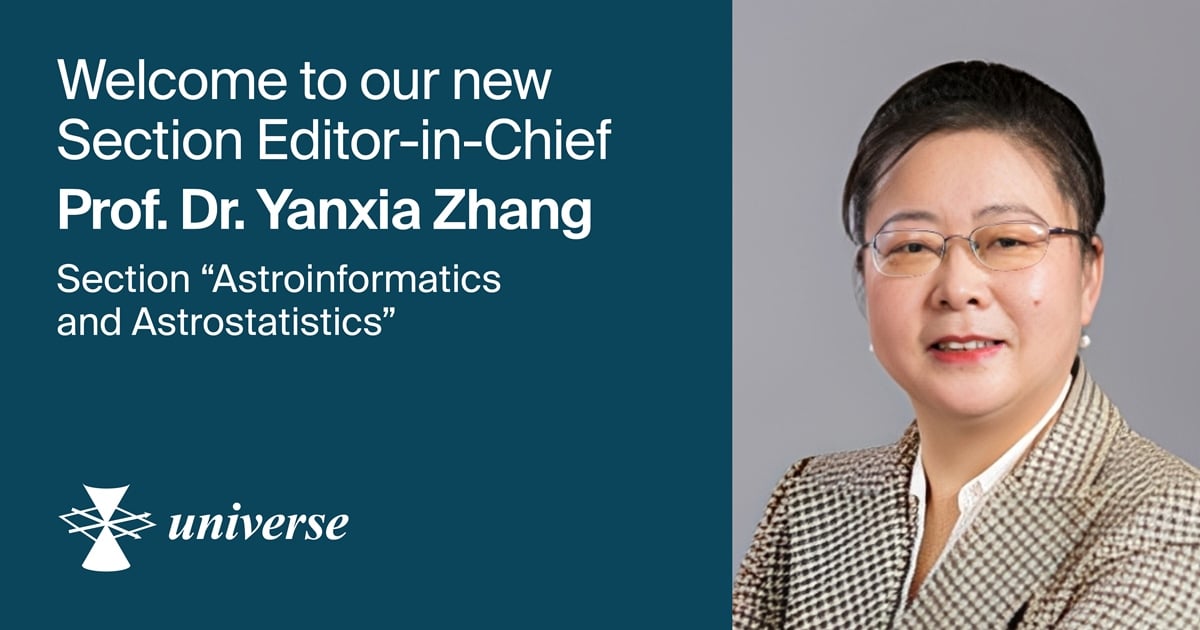
Prof. Dr. Yanxia Zhang Appointed Section Editor-in-Chief of Section “Astroinformatics and Astrostatistics” in Universe
We are pleased to announce that Prof. Dr. Yanxia Zhang has been appointed Editor-in-Chief of the Section “Astroinformatics and Astrostatistics”. We look forward to her contributions to Universe (ISSN 2218-1997).
Prof. Dr. Yanxia Zhang is a Professor and PhD supervisor at the National Astronomical Observatories, Chinese Academy of Sciences. She received her PhD in astrophysics from the National Astronomical Observatories in 2004. She is a Fellow of the International Astrostatistics Association and currently serves as Deputy Secretary-General of the Beijing Astronomical Society.
She has also held several positions within the International Astronomical Union, including Secretary of Commission B3 Astroinformatics and Astrostatistics since 2024, Organizing Committee Member of Commission B3 Astroinformatics and Astrostatistics from 2015 to 2021, and Organizing Committee Member of the Commission 5 Working Group on Astrostatistics and Astroinformatics from 2012 to 2015. She has published nearly 200 scientific papers in domestic and international journals. Her main research interests include astroinformatics, astrostatistics, multi-wavelength astronomy, time-domain astronomy, quasars, and active galactic nuclei (AGNs).
The following is a short Q&A with Prof. Dr. Yanxia Zhang, who shared her vision for the journal with us, as well as her views of the research area and open access publishing:
1. What initially attracted you to take on this editorial leadership role for this particular Section? How does it align with your own expertise and research interests in astroinformatics and astrostatistics?
What attracted me most to this editorial leadership role was the strongly interdisciplinary nature of the Section. Astroinformatics and astrostatistics lie at the intersection of astronomy, data science, information technology, statistics, and artificial intelligence. This is precisely the area in which I have been working for many years.
My research has long focused on astroinformatics and astrostatistics, astronomical big data, machine learning and artificial intelligence in astronomy, multi-wavelength astronomy, astronomical object classification, and photometric redshift estimation for galaxies and quasars. With the rapid development of large sky surveys and massive astronomical databases, this field has become increasingly important for discovery-oriented astronomy.
Serving as Section Editor-in-Chief provides an excellent opportunity to help build a high-quality platform for researchers working on data-intensive astronomy and methodologically innovative topics. I hope to contribute to the growth of this Section by encouraging rigorous, interdisciplinary, and impactful research that advances both astronomical discovery and data-driven methodology.
2. From your vantage point as Section Editor-in-Chief, what are the most exciting and promising emerging trends or “hot topics” currently emerging within the astroinformatics and astrostatistics field?
From my perspective as Section Editor-in-Chief, several emerging directions in astroinformatics and astrostatistics are particularly exciting and promising.
First, artificial intelligence and deep learning are reshaping the way we classify spectra, identify rare objects, estimate physical parameters, and mine large astronomical archives. These methods are becoming indispensable as modern surveys continue to produce increasingly complex and high-dimensional datasets.
Second, time-domain astronomy is driving the development of new statistical and computational methodologies, especially in the study of variable stars, transients, and multi-survey data fusion. The ability to detect, characterize, and interpret rapidly changing astronomical phenomena will be one of the key challenges in the coming years.
I also see great potential in multimodal learning, which integrates spectra, images, light curves, catalog data, multi-wavelength observations, and even multi-messenger information. Such approaches can provide a more comprehensive understanding of astronomical sources than any single data type alone.
Another important trend is explainable and trustworthy AI. In astronomy, high predictive accuracy is not sufficient; we also need physical interpretability, reliable uncertainty estimation, and robust validation to ensure that AI-driven discoveries are scientifically meaningful.
Finally, scalable statistical inference, open data platforms, virtual observatory technologies, and reproducible workflows will become increasingly central as large-scale projects such as LAMOST, Gaia, DESI, LSST/Rubin, CSST, and other major surveys continue to generate enormous volumes of data.
3. As the Section Editor-in-Chief of Universe, what qualities do you consider essential for high-impact manuscripts in your Section?
As Section Editor-in-Chief of Universe, I believe that high-impact manuscripts should be driven by clear scientific questions rather than simply by the use of fashionable methods. A strong paper should explain not only what method or data product is being introduced, but also why it matters for astronomy and what new knowledge or capability it enables.
For this Section, I particularly value manuscripts that combine methodological rigor with strong astronomical relevance. Authors should provide careful validation, meaningful comparisons with existing approaches, robust uncertainty analysis, and, where possible, open data, open code, or reproducible workflows.
Papers that successfully connect advanced statistical, computational, or AI-based methods with real astronomical discovery, large-survey applications, or community-oriented resources are especially welcome. In my view, clarity, transparency, reproducibility, and scientific relevance are essential qualities for manuscripts that aim to make a lasting impact in astroinformatics and astrostatistics.
4. Looking ahead, what developments or collaborations would you like to see within the Universe community to further strengthen the journal’s impact and visibility?
Looking ahead, I would like to see Universe become an even more active international platform for the astroinformatics and astrostatistics community. I have already organized one Special Issue for Universe and am currently organizing another, and this experience has further strengthened my belief that Special Issues are an effective way to bring researchers together around timely and focused topics.
In the future, I hope to see more Special Issues and collaborative activities devoted to emerging areas such as AI for astronomical discovery, time-domain data mining, multimodal astronomical data analysis, photometric redshift estimation, virtual observatory technologies, and statistical inference for large sky surveys.
I would also like to encourage closer collaboration among astronomers, statisticians, computer scientists, and data engineers. In my view, the most exciting advances often occur when deep domain knowledge meets methodological innovation. By fostering such interdisciplinary exchanges, Universe can further enhance its academic impact, international visibility, and contribution to the broader astronomical community.
5. What advice would you give to early career researchers?
My advice to early career researchers is to build a solid foundation in both astronomy and quantitative methods. It is important to understand the astrophysical questions deeply, while also developing strong skills in statistics, machine learning, programming, and data management.
At the same time, young researchers should not treat AI or data science as a black box. A model is truly useful only when it is scientifically meaningful, interpretable, robust, and reliable. High accuracy alone is not enough; the results must also be connected to physical understanding.
I would also encourage early career researchers to work with real astronomical data, participate actively in collaborations, publish reproducible research, and remain curious. Astroinformatics and astrostatistics are evolving rapidly, so the ability to keep learning, adapt to new tools, and think across disciplinary boundaries is just as important as mastering any single technique.
6. What is your vision for the journal?
My vision is for Universe, and particularly the “Astroinformatics and Astrostatistics” Section, to become a trusted, visible, and influential venue for data-driven astronomy. I hope the Section will publish papers that are not only technically advanced, but also scientifically significant and valuable to the broader astronomical community.
I would like the journal to promote openness, interdisciplinarity, and reproducibility. It should serve as a platform where new methods, data resources, software tools, statistical frameworks, and astronomical discoveries can be shared efficiently and evaluated rigorously.
In the long term, I hope this Section will help shape best practices for the use of artificial intelligence, statistics, and big data in astronomy. By supporting high-quality, transparent, and impactful research, Universe can contribute meaningfully to the future development of data-driven astronomical science.
7. What do you think of the development of open access in the publishing field?
Open access has played an important role in improving the visibility, accessibility, and dissemination of scientific research. For fields such as astroinformatics and astrostatistics, where data, methods, software, and computational tools are often valuable to researchers across disciplines, open access can greatly accelerate communication, collaboration, and reuse.
At the same time, open access publishing must be developed responsibly and must maintain high academic standards. Rigorous peer review, editorial responsibility, publication ethics, transparency, and quality control are essential to ensuring the credibility and long-term value of published research.
In my view, the future of open access should not only mean open papers, but also greater openness in data, code, methods, workflows, and reproducible science. When implemented responsibly, open access can make research more inclusive, efficient, transparent, and impactful, while strengthening communication within the global scientific community.
We wish Prof. Dr. Yanxia Zhang every success in her new position, and we look forward to her contributions to the journal.