
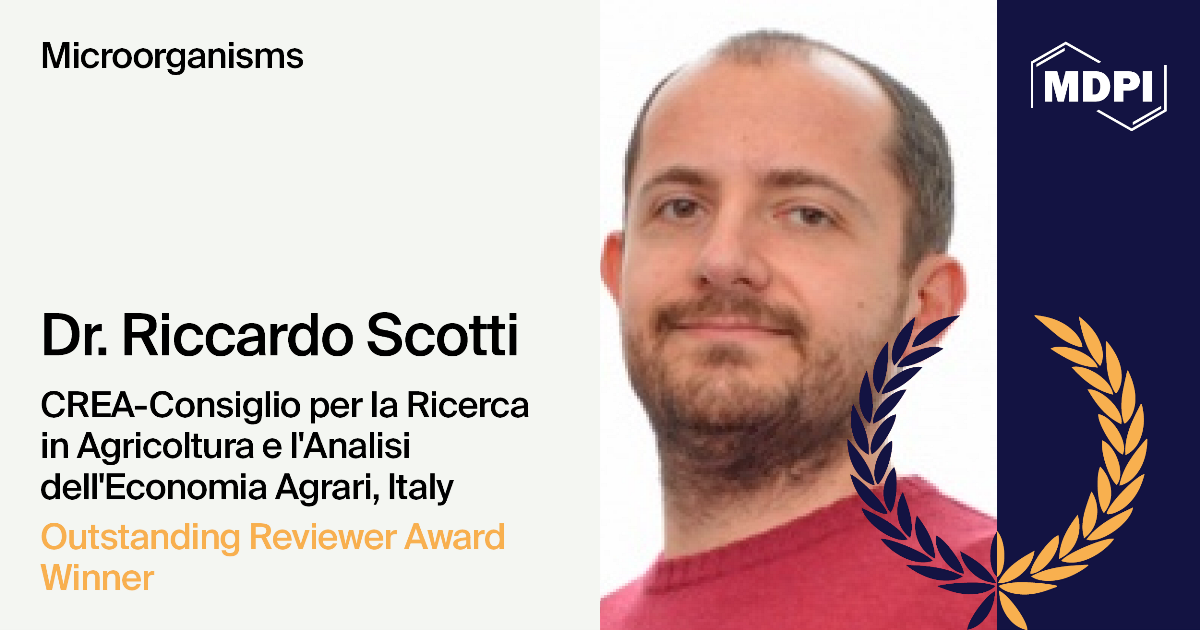
Interview with Dr. Riccardo Scotti—Winner of the Microorganisms Outstanding Reviewer Award
1. Could you introduce yourself to our readers? What is your current research area?
My name is Riccardo Scotti, and I am a researcher at Council for Agricultural Research and Economics, Research Centre for Vegetable and Ornamental Crops. I mainly focus my activity on the area of soil microbiology and microbial ecology. My main research interests are plant–microbe interactions, soil microbial communities, and the role of beneficial microorganisms in sustainable agriculture. In particular, I am interested in how microbial communities in soil and plant roots respond to different agronomic practices and microbial treatments. I also work with sequencing-based approaches to better understand the structure and function of the plant and soil microbiome. My general goal is to support more sustainable and resilient agricultural systems through a better understanding of microbial processes.
2. How was your experience reviewing for Microorganisms, and what motivated you to participate actively in the peer review process?
My experience reviewing Microorganisms has been very positive. I had the opportunity to evaluate manuscripts from different areas of microbiology, and this was both interesting and professionally rewarding. What motivates me most is the idea that peer review is an important service to the scientific community. Good reviews can really help improve a manuscript, not only in terms of scientific quality, but also in terms of clarity and impact. I also believe that reviewing helps me as a researcher, because it keeps me updated and pushes me to think critically about experimental design, interpretation of results, and scientific writing.
3. In your opinion, what key qualities should an excellent manuscript have? From what perspectives will you help authors improve the quality of their papers?
In my opinion, an excellent manuscript should first have a clear research question and a solid experimental design. The methods should be appropriate and described clearly, the results should be presented in a logical way, and the conclusions should be fully supported by the data.
As a reviewer, I usually try to help authors from different perspectives: scientific soundness, clarity of presentation, interpretation of results, and overall structure of the paper. I pay attention to whether the conclusions are balanced, whether the discussion is well connected to the data, and whether the manuscript can be made clearer and more useful for readers.
4. How do you balance the comprehensiveness and efficiency of review? Can you share some specific methods or principles for reviewing?
I try to be thorough, but also practical. Usually, I first read the manuscript to understand the general objective, the main findings, and the overall quality of the work. Then I go back more carefully to evaluate the study design, methods, results, and interpretation. I normally focus first on the major points that affect the scientific value of the paper, and then on minor points such as clarity, wording, or formatting.
5. How do you view the role of a reviewer in shaping the quality and integrity of newly submitted research?
I think reviewers have an important role in protecting the quality and integrity of scientific publishing. A good reviewer helps make sure that the research is sound, that the interpretation is fair, and that the conclusions are not overstated. Reviewers also help improve transparency, clarity, and reproducibility. At the same time, I believe the reviewer’s role should be constructive, not punitive. The aim should not be only to judge a manuscript, but also to help improve it when possible.
6. What advice would you give to early career researchers who want to become strong peer reviewers, or do you have any suggestions for the current peer-review process? Would you like to recommend that more scholars join us as reviewers to promote the scientific quality of peer review?
My advice to early career researchers is to approach peer review seriously, but also with confidence. Reviewing is a skill that improves with experience. It is important to read the manuscript carefully, stay objective, and focus on science. I would also suggest that early career researchers read good papers critically and compare their own opinions with published peer-reviewed work. This is a good way to build judgement over time.
Microorganisms Editorial Office