
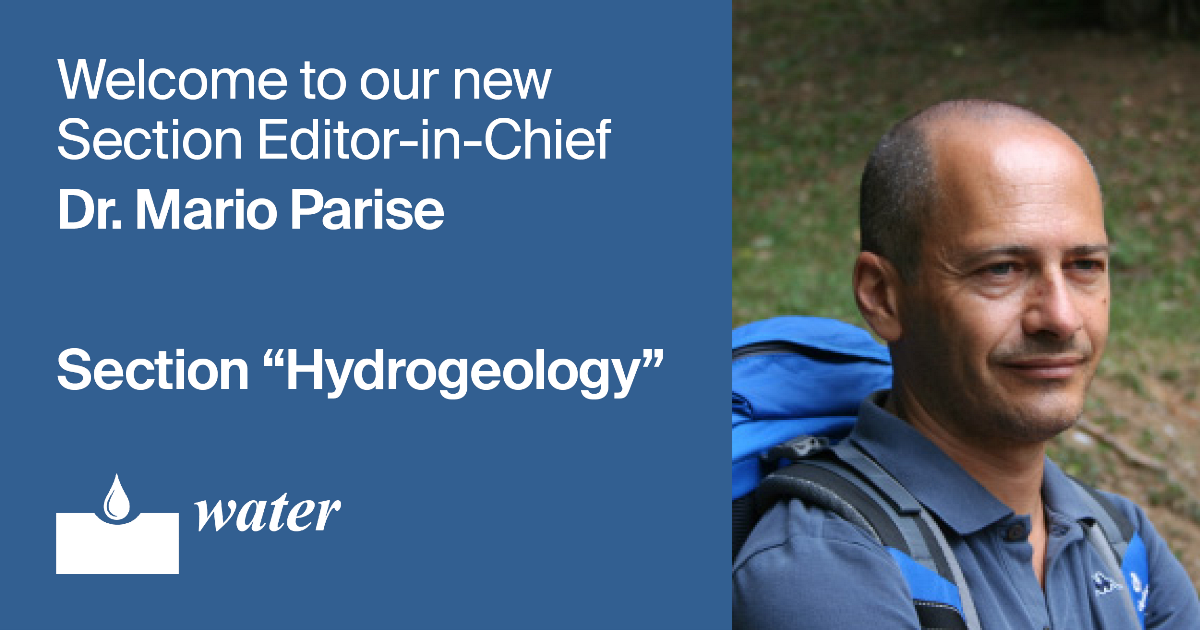
Dr. Mario Parise Appointed Section Editor-in-Chief of the Section “Hydrogeology” in Water
We are pleased to announce that Dr. Mario Parise has been appointed Section Editor-in-Chief of the Section “Hydrogeology” in Water (ISSN: 2073-4441).
Dr. Mario Parise graduated in geological sciences at the University Federico II in Naples (Italy), and had several experiences of work, scientific expeditions and teaching abroad, from the United States of America to Madagascar, Albania and Cuba. At present, he is an Associate Professor in engineering geology and in hydrogeology at the University Aldo Moro in Bari (Italy). For several decades, he has developed research mainly into the geological and geomorphological analysis of slope movements, in topics such as:
- Identification of the areas susceptible to different types of slope movement (from debris flows, to deep-seated gravitational slope deformations, to general mass wasting processes);
- Multi-temporal analysis of landslides, and their relationship with anthropogenic activities, and/or as a consequence of specific triggering events (rainfall, earthquakes, etc.);
- Influence of weathering in the predisposition of slope movements;
- Occurrence of debris flows and erosional processes in areas recently affected by wildfires.
He is also an expert in karst research, with a specific focus on the evaluation of natural and anthropogenic hazards occurring in karst territories, including sinkholes and flash floods, and their effect on the human environment. He has acted as chairman in Eurokarst 2024, the European bi-annual Conference on the Hydrogeology of Karst and Carbonate Reservoirs, held in Rome (Italy) in June 2024.
Dr. Parise is the author of over two hundred articles published on international journals and proceedings of international conferences, has acted as Guest Editor in 15 Special Issues for ISI international journals, and has published three books with the Geological Society of London. He is the national coordinator of the Italian network of the International Consortium on Landslides (ICL) and Vice-President of the International Union of Speleology (UIS).
He is Associate Editor of the journal Natural Hazards, Editor-in-Chief of the section Hydrogeology of the journal Water, and a member of the Editorial Board of other international journals, including Natural Hazards and Earth System Sciences, Journal of Mountain Sciences, Bulletin of Engineering Geology and the Environment, Carbonates and Evaporites, Geosciences, and Journal of Cave and Karst Studies.
The following is a short Q&A with Dr. Mario Parise, who shared his vision for the journal with us, as well as his views on the research area and open access publishing:
1. What appealed to you about the journal that made you want to take the role as its Section Editor-in-Chief?
Water is among the main issues of my research, as regards hydrogeology, but also karst processes, and the development of ground instabilities. Thus, I felt that taking this role could further contribute to being updated with the most recent advances in worldwide research on water.
2. What are the most significant emerging challenges and innovations in the field, and how do these shape current research trends?
The role of water is crucial in many different aspects, and actually, many different disciplines are involved in studies and research dealing with water in some ways. In times where there are still difficulties in water availability in many countries, the events of pollution are increasing, and the tendency to desertification is becoming more and more a threat, I feel there is a huge need to promote interdisciplinary works aimed at evaluating the above issues, and at looking for sustainable solutions.
3. What is your vision for the journal?
I see Water in the near future as a journal promoting inter-disciplinary research, particularly among young researchers from different parts of the world, to stimulate all scholars toward sustainable approaches in the use of water resources, and in producing all possible efforts in order to protect and safeguard these very precious natural resources.
4. What advice would you give to early career researchers?
I would suggest that they be very careful in using AI, and to start their careers in more traditional ways, by reading many papers, and talking with experts from different fields. The use of modern technologies and AI is extremely important but young researchers need to use them in the proper way, without depending entirely on them.
We wish Dr. Mario Parise every success in his new position, and we look forward to his contributions to the journal.