
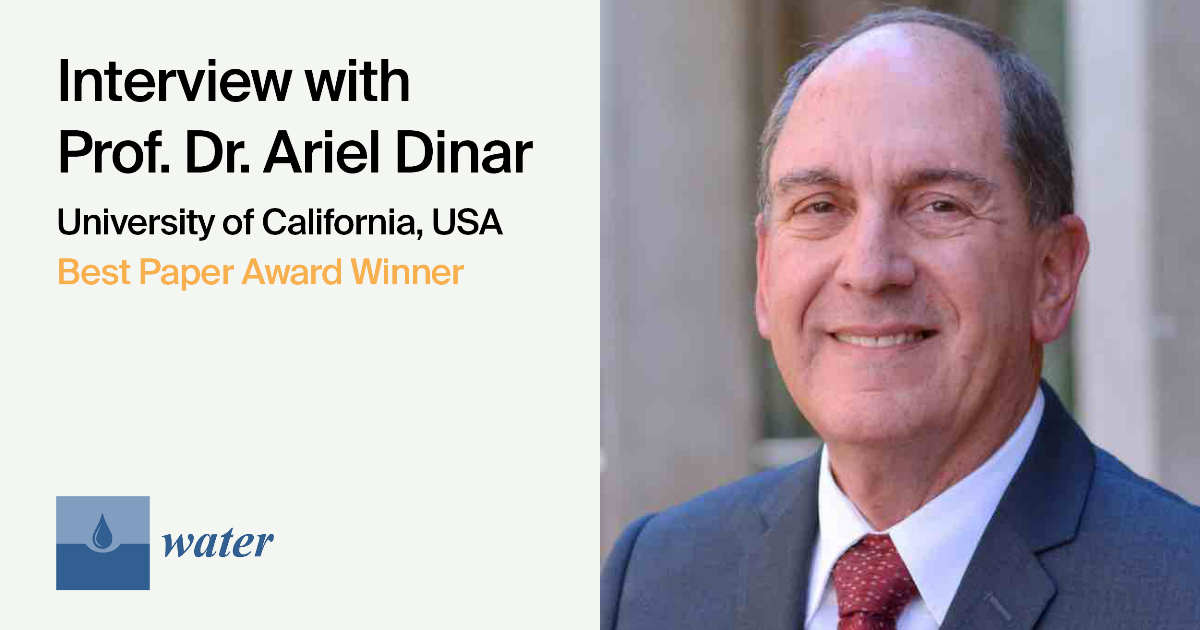
Interview with Prof. Dr. Ariel Dinar—Winner of the Water Best Paper Award
The following is an interview with Prof. Dr. Ariel Dinar:
1. Congratulations on winning the Water 2024 Best Paper Award! Could you please briefly introduce yourself?
I am Ariel Dinar, now an Emeritus Distinguished Professor of Environmental Economics and Policy at the School of Public Policy, University of California, Riverside. My work on water economics goes nearly 40 years back when I started working on field level water decisions, moved overtime to farm-level water decisions, and later to regional- and international-level issues. I also started incorporating political economy and institutional economics into the work dealing with optimal decision making at regional and international levels. I have worked mainly for the World Bank and for the University of California, Davis and Riverside in the past 40 years until my retirement.
2. Could you introduce the research focus and the key findings of this award-winning paper?
The work is based on the premise that water management analysis is subject to disciplinary developments and inter-disciplinary interactions. This research leading to this paper aims to close such a gap I observed over the years in the literature where such developments are not well documented in the literature. Initial observations in the interdisciplinary literature suggest that results are fragmented, implying that a state-of-the-art review is needed. The findings in this paper identify changes to water use patterns by including and co-managing water of different sources, such as surface and groundwater, reclaimed wastewater, and desalinated water. Findings also suggest that political, institutional principles play an important role in managing water of different scarcity levels and qualities at local regional and international levels. In addition, the finding suggests that methodologies such as experimental economics, game theory, institutional economics, and valuation methods, as well as modeling approaches, including hydro-economic and computable general equilibrium models, help deal with water challenges.
3. What were the biggest challenges you faced during this research, and how did you overcome them?
My biggest challenge during the work on the paper was the number of publications that I identified as relevant and how to focus only on works that demonstrate exactly the innovation of the approaches reviewed, rather than focusing on case studies that demonstrate the usefulness of the approaches to a specific set of conditions. The way I overcame this challenge is by developing a matric to rank the relevance of the papers to my research question and objectives in this research. It was time consuming but allowed me to end up with a feasible size of observations.
4. What advice would you give to young researchers who aspire to produce high-impact research results?
My main advice to young researchers who aspire to produce good research that can be published in high-impact outlets is, first, to dare and ask research questions outside of the box, but with relevance to the water community—water engineers, water economists, water scientists. Second, share their ideas with more experienced researchers to get feedback about the possible relevance and even to invite a more senior researcher to jointly develop the idea. My last piece of advice is not to give up even if the paper is rejected—just look for a different outlet.
5. Could you tell us what attracted you to submit your paper to Water, and what your experience with the publication process was?
Water—MDPI attracted me because I had previous experience with Water, publishing previous work of mine with colleagues. I was indeed attracted to the methodological review process and the promotion of the accepted papers.