
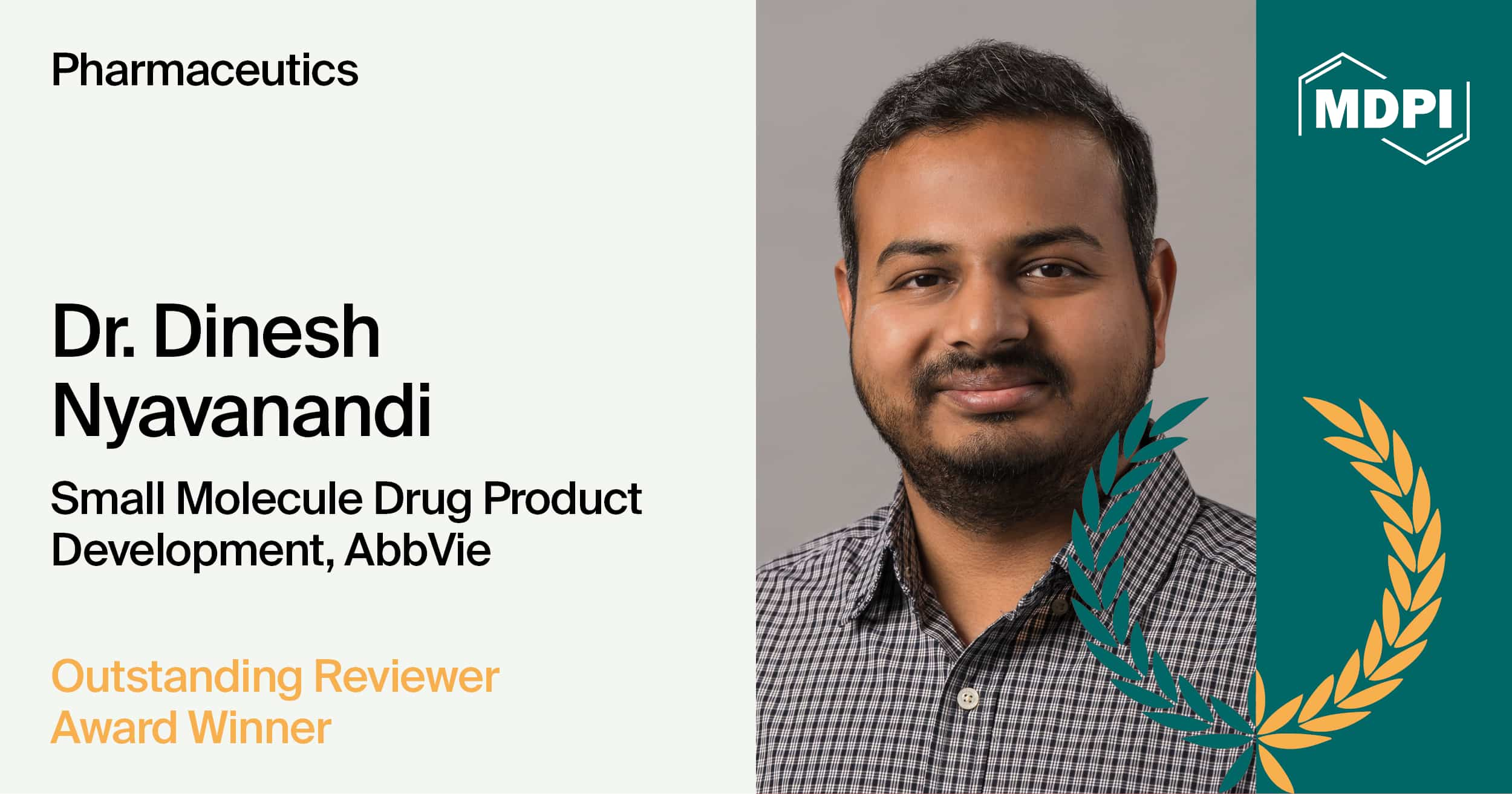
Interview with Dr. Dinesh Nyavanandi—Winner of the Pharmaceutics Outstanding Reviewer Award
Pharmaceutics (ISSN: 1999-4923) is proud to announce the winner of the 2025 Pharmaceutics Outstanding Reviewer Award—Dr. Dinesh Nyavanandi. We would like to express our profound gratitude to Dr. Dinesh Nyavanandi for his invaluable contributions to the peer-review process in Pharmaceutics.
Name: Dinesh Nyavanandi
Affiliation: Small Molecule Drug Product Development, AbbVie
The following is an interview with Dr. Dinesh Nyavanandi:
1. Congratulations on receiving the Pharmaceutics Outstanding Reviewer Award! To begin, could you briefly introduce yourself and tell us about your primary research interests within pharmaceutics?
Thank you very much. I am a formulation scientist working in small-molecule drug development, with a primary interest in translational pharmaceutics—especially the design of formulations that can bridge early discovery, clinical development, and eventual commercialization. My work has focused on challenges such as solubility enhancement, bioavailability improvement, dosage form design, excipient selection, and manufacturing approaches for oral drug products. I am particularly interested in how formulation strategies can be used not only to solve technical problems, but also to accelerate development timelines and improve the likelihood of clinical and commercial success.
2. In your view, what are the essential qualities of a constructive and high-quality peer review? How do you approach crafting a review that is both rigorous and helpful?
A high-quality peer review should be fair, objective, technically rigorous, and ultimately useful to the authors and editors. I believe a constructive review does not simply identify weaknesses; it explains why those weaknesses matter and, when possible, suggests practical ways to strengthen the work.
When I prepare a review, I try to balance critical evaluation with respect for the authors’ effort. My goal is not to “reject” a paper, but to assess whether the science is sound, whether the conclusions are supported by the data, and whether the manuscript meaningfully advances the field. I also try to separate major scientific concerns from minor presentation issues, so the authors can clearly understand what is essential to address. In my view, the most valuable reviews are those that are honest and rigorous, but also specific, professional, and solution-oriented.
I usually begin by reading the manuscript once from a broad perspective to understand the central question, the novelty, and the claimed contribution. On a second pass, I evaluate the work in more detail.
I typically focus on several key elements:
- Scientific rationale and originality – Is the research question important, and does the manuscript offer something genuinely new or useful?
- Study design and methodological rigor – Are the experiments appropriate, sufficiently controlled, and described clearly enough to allow reproducibility?
- Data quality and interpretation – Are the data internally consistent, statistically sound, and interpreted without overstating the findings?
- Connection between results and conclusions – Do the conclusions truly follow from the evidence presented?
- Relevance to the field – Will the work be informative to researchers in pharmaceutics, and does it advance scientific understanding or practical application?
- Clarity of presentation – Is the manuscript organized logically, and are the figures, tables, and discussion clear and effective?
I find it especially important to evaluate whether the manuscript provides mechanistic insight or practical translational value, rather than only reporting a set of observations.
4. How has serving as a reviewer influenced your own approach to writing manuscripts and preparing submissions? Have you learned lessons from reviewing that you’ve applied to your own work?
Serving as a reviewer has had a significant influence on how I write manuscripts. Reviewing exposes recurring issues very clearly—unclear objectives, incomplete method descriptions, weak data presentation, unsupported conclusions, or insufficient discussion of limitations. Seeing these issues repeatedly has made me much more deliberate in my own writing.
One important lesson I have applied is the need to make the manuscript easy for the reviewer and reader to follow. That means having a clear scientific story, a logical flow, transparent methods, and figures that communicate the key findings efficiently. I have also become more careful about aligning claims with evidence and anticipating the questions a reviewer may raise. In many ways, reviewing has helped me become a more disciplined author because it trains you to look at a manuscript from the outside, with a critical but fair perspective.
5. What do you see as the most significant challenges facing peer review today, and how might the community address them?
One major challenge is reviewer fatigue. The volume of submissions has increased substantially, while the pool of experienced reviewers is limited. This can place pressure on the system and sometimes affect turnaround time or review depth. Another challenge is inconsistency in reviews—different reviewers may apply different standards, especially in interdisciplinary areas where expectations can vary.
I also think the community is facing a challenge in maintaining rigor while keeping pace with the speed of modern publishing. Authors, reviewers, and editors all operate under time constraints, but scientific quality cannot be compromised.
Addressing these challenges will require a shared effort. Journals can continue to improve reviewer guidance, recognize reviewer contributions, and support early-career researchers in developing reviewing skills. Senior scientists can help by mentoring younger reviewers on how to perform balanced and thoughtful evaluations. Authors also play an important role by submitting well-prepared, transparent manuscripts that reduce avoidable review burden. Peer review works best when it is treated as a collective responsibility to uphold scientific quality.
6. Finally, what message would you like to share with the Pharmaceutics community, particularly with authors who submit their work to the journal and the editorial team who manage the review process?
To the authors, I would say that peer review should be viewed as part of the scientific process, not just as a gatekeeping step. Even critical comments are often an opportunity to strengthen the work, improve clarity, and increase the impact of the final manuscript. The strongest submissions are usually those that are scientifically rigorous, transparent in their limitations, and written with the reader in mind.
To the editorial team, I would like to express my appreciation for the tremendous effort involved in managing a fair and efficient review process. Editors play an essential role in maintaining quality, matching manuscripts with appropriate reviewers, and helping move the field forward.
More broadly, I believe Pharmaceutics serves an important role in connecting fundamental research with practical pharmaceutical applications. I am honored to contribute as a reviewer, and I look forward to continuing to support the journal and the broader Pharmaceutics community.