
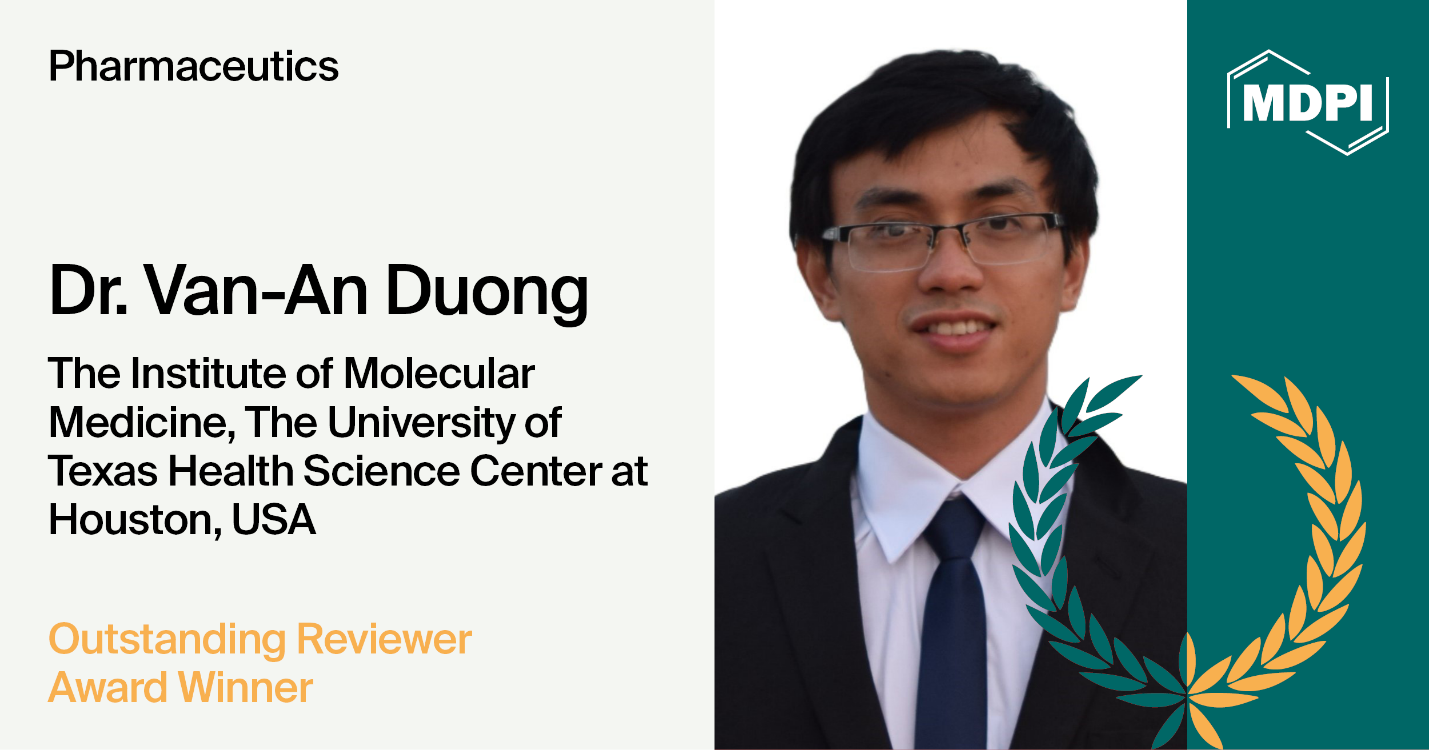
Interview with Dr. Van-An Duong—Winner of the Pharmaceutics Outstanding Reviewer Award
24 April 2026
Pharmaceutics (ISSN: 1999-4923) is proud to announce the winner of the 2025 Pharmaceutics Outstanding Reviewer Award: Dr. Van-An Duong. We would like to express our profound gratitude to Dr. Van-An Duong for his invaluable contributions to the peer-review process in Pharmaceutics.
Name: Van-An Duong
Affiliation: The Institute of Molecular Medicine, The University of Texas Health Science Center at Houston, USA
The following is a short interview with Dr. Van-An Duong:
- Congratulations on receiving the Pharmaceutics Outstanding Reviewer Award! To begin, could you briefly introduce yourself and tell us about your primary research interests within pharmaceutics?
Hi. My name is Van-An Duong. I am currently working at The Institute of Molecular Medicine, The University of Texas Health Science Center at Houston. My research focuses on drug development and analytical characterization, particularly using advanced analytical techniques such as LC-MS/MS. Within pharmaceutics, I am especially interested in formulation strategies and drug delivery systems to improve drug stability, bioavailability, and therapeutic efficacy. - In your view, what are the essential qualities of a constructive and high-quality peer review? How do you approach crafting a review that is both rigorous and helpful?
A high-quality peer review should be objective, constructive, and actionable. It should not only evaluate the scientific rigor of a manuscript but also help authors improve the clarity and impact of their work. When reviewing a manuscript, I aim to assess the scientific soundness of the study, provide specific and constructive feedback rather than general criticism, and distinguish between major concerns (e.g., methodology, interpretation) and minor issues (e.g., clarity, presentation). I believe a good review should guide authors toward improvement while maintaining a respectful and professional tone. - Once you agree to a review, how do you structure your evaluation? What key elements do you focus on when assessing a manuscript's quality, rigor, and contribution to the field?
When reviewing a manuscript, I typically follow a structured approach to ensure a comprehensive and balanced evaluation. I begin by assessing the novelty and overall significance of the study, considering whether it addresses a meaningful research question and contributes new insights or practical value to the field. I then examine the methodological rigor, including whether the experimental design, formulation strategies, and analytical methods are appropriate and sufficiently described. Next, I evaluate the quality and interpretation of the data to determine whether the results are robust and reproducible and whether the conclusions are justified by the data. I also assess the quality and clarity of the tables and figures, ensuring they effectively present the data. Finally, I review the organization and readability of the manuscript to confirm that the content is clearly structured and communicated. - How has serving as a reviewer influenced your own approach to writing manuscripts and preparing submissions? Have you learned lessons from reviewing that you have applied to your own work?
Serving as a reviewer has significantly influenced my own approach to manuscript preparation. Through reviewing, I have become more attentive to the clarity and transparency of methodological descriptions, ensuring that experiments are described in sufficient detail for reproducibility. It has also improved my ability to structure manuscripts with a clear logical flow, particularly in aligning results with conclusions and avoiding overinterpretation of data. Additionally, reviewing has helped me anticipate common concerns raised during peer review, allowing me to critically evaluate my own work before submission and strengthen it accordingly. - What do you see as the most significant challenges facing peer review today, and how might the community address them?
One of the most significant challenges in peer review today is the increasing volume of submissions, which places a substantial burden on reviewers and can affect both the quality and timeliness of the review process. To address this issue, it is important to expand and better prepare the reviewer pool. Providing short courses on conducting high-quality peer reviews could equip early-career researchers with the necessary skills and confidence. In addition, encouraging PhD students to participate in the review process under their supervisors' guidance would not only distribute the workload more effectively but also provide valuable training. Recognizing these contributions, for example, through co-reviewer acknowledgment, could further motivate broader participation and support the sustainability of the peer review system. - Finally, what message would you like to share with the Pharmaceutics community—particularly with authors who submit their work to the journal and the editorial team who manage the review process?
I would like to thank the Pharmaceutics editorial team for their efforts in maintaining an efficient and constructive peer review process. To authors, I encourage clear and transparent reporting of experimental design and methods, as well as careful alignment between results and conclusions, both of which are essential to ensuring reproducibility and scientific rigor. I believe that peer review is an important collaboration between authors, reviewers, and editors to maintain the quality and integrity of published research.