
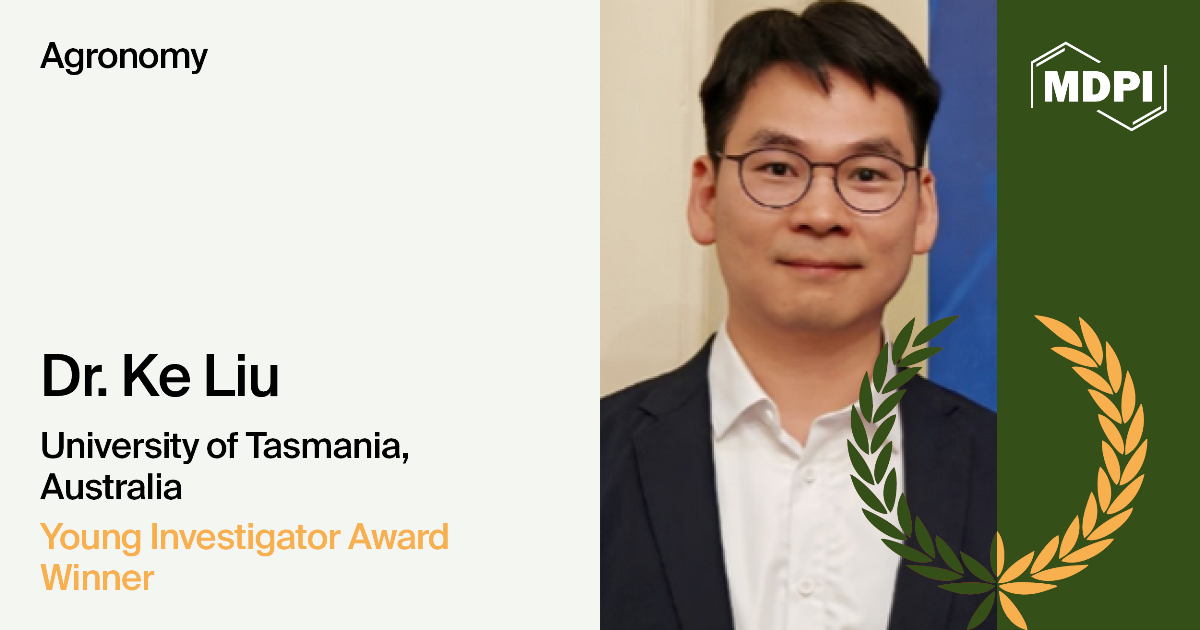
Interview with Dr. Ke Liu—Winner of the Agronomy Young Investigator Award
The Agronomy journal (ISSN: 2073-4395) is proud to present the winner of Agronomy Young Investigator Award—Dr. Ke Liu!
The following is an interview with Dr. Ke Liu:
1. Could you please share your current research direction and the latest progress?
My research focuses on climate change impacts and mitigation in agricultural systems. I am especially interested in soil waterlogging, which is an increasingly important constraint in many regions under changing climate conditions. Recently, I have been developing new adaptation strategies, including improved crop modelling approaches and management interventions to reduce waterlogging impacts. This work combines process-based models, field experiments, and emerging data-driven methods to better quantify risks and evaluate solutions. Ultimately, my goal is to support more climate-resilient and sustainable agricultural production systems.
2. How did you become interested in your current research field?
My interest in this field developed from recognizing the strong influence of climate variability on agricultural production. Early in my career, I realized that many yield losses are driven by environmental stresses rather than management alone. This motivated me to explore how climate, soil, and crop processes interact. Agricultural system modelling offered a way to connect fundamental science with practical applications. The growing challenges posed by climate change have further strengthened my commitment to this area.
3. Could you please share the most impressive breakthrough in your research career, either in terms of ideas or research results?
One key breakthrough in my research has been the development of waterlogging response functions within crop models. These functions have been successfully integrated into several internationally renowned modelling platforms, including APSIM (Classic and Next Generation), DSSAT, and SWAGMAN Destiny. This advancement enables more accurate simulation of crop responses to soil waterlogging, which has historically been underrepresented in modelling frameworks. It also provides a stronger foundation for evaluating adaptation strategies under future climate scenarios.
4. Do you have any other suggestions on how journals and publishers can further support young researchers and the academic community?
The open access model has become increasingly common, but article processing charges (APCs) continue to rise, placing significant financial pressure on early-career researchers (ECRs), particularly those with limited funding. Journals and publishers could help them by offering more APC waivers or discounts for ECRs, so that they can boarder participate more fully in the academic community. In addition, providing sponsorships or travel grants for ECRs would greatly enhance their visibility, networking, and collaboration opportunities. Some publishers, such as MDPI, have already made commendable efforts in this area, and expanding such support would further strengthen inclusivity and sustainability in research.
5. Based on your experience, which research topics in this field do you think will be of particular interest to the academic community in the next few years?
Artificial intelligence will undoubtedly continue to hold a central position as a rapidly evolving research area. In my field, one of the most important directions will be the development of hybrid modelling frameworks that tightly integrate AI with process-based crop models, moving beyond simple prediction toward more interpretable and decision-relevant systems. Another key focus will be translating these advances into operational decision-support tools for farmers and policy-makers, ensuring that scientific innovations can be effectively applied in real-world settings. This will be essential for bridging the gap between research and practice, particularly under increasing climate variability and uncertainty.
6. What qualities do you think are necessary for young scientists?
Curiosity and critical thinking are essential for developing innovative research ideas. Persistence is equally important, as scientific progress often involves overcoming challenges and setbacks. Interdisciplinary thinking helps address complex real-world problems. Strong analytical and quantitative skills are increasingly necessary in modern research. Finally, integrity and clear communication are fundamental to building a credible and impactful scientific career.