
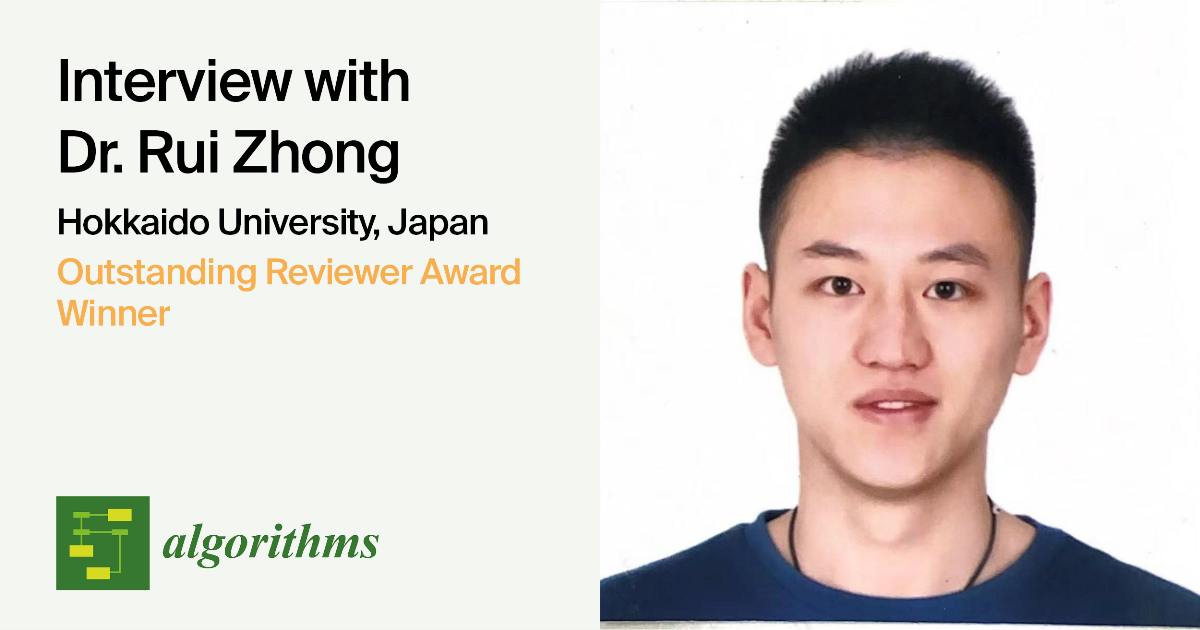
Interview with Dr. Rui Zhong—Winner of the Algorithms Outstanding Reviewer Award
Name: Dr. Rui Zhong
Affiliation: Hokkaido University, Japan
We wish to congratulate Dr. Rui Zhong on winning the Algorithms Outstanding Reviewer Award. We had the pleasure of inviting him for this interview, in which we learned more about his background, views, and interests.
1. Could you start by introducing yourself to our readers? What are your main research interests within the field of algorithms and related areas?
I received the BEng degree from Huazhong Agricultural University, China, in 2019, the MEng degree from Kyushu University, Japan, in 2022, and a PhD from Hokkaido University, Japan, in 2024. I am now a Specifically Appointed Assistant Professor at the Information Initiative Center, Hokkaido University. I have published more than 50 articles in highly reputable journals. My research interests include computational intelligence, evolutionary computation, large-scale optimization, meta-/hyper-heuristics, and real-world applications. My profile on Google Scholar can be found at https://scholar.google.com/citations?hl=en&user=xd1vrwIAAAAJ&view_op=list_works&sortby=pubdate.
2. What motivates you to serve as a reviewer for Algorithms?
I am always more than happy to review papers for various international journals. In my view, peer review is not only vital for fostering global academic exchange but also essential for the rapid dissemination of scientific discovery. My journey with Algorithms began when I received my first invitation to review for them. Upon seeing that the manuscript was closely aligned with my own research interests, I gladly accepted. This is the initial experience that I had as a reviewer for Algorithms.
3. Could you share your experience reviewing manuscripts for Algorithms? Are there any aspects of the process that you find especially meaningful or rewarding?
To date, I have reviewed over 50 manuscripts for various MDPI journals, including Algorithms. One of my most notable observations is that with the widespread adoption of Large Language Models, there has been a marked improvement in both the originality of research content and the overall quality of writing.
If I were to define the meaning or sense of achievement in being a reviewer, it is undoubtedly seeing a manuscript successfully published after the authors have meticulously addressed the feedback provided. There is deep professional satisfaction in knowing that my peer-review contributions helped elevate the final work.
4. When reviewing a submission for Algorithms, what key elements do you focus on to assess the quality and relevance of the manuscript?
First and foremost, my primary focus is on originality. I am most excited to see manuscripts that propose novel methodologies to tackle emerging problems. However, I also find great value in research that applies new methods to traditional challenges or develops innovative problem-oriented models; both contribute significantly to the scientific community.
Beyond the research, the quality of the writing is also important. As a reviewer, I pay attention to whether the paper is logically structured, follows academic conventions, and utilizes appropriate formal English.
5. As the recipient of this Outstanding Reviewer Award, would you like to share any thoughts with our readers or express appreciation to colleagues, collaborators, or mentors who have supported your academic journey?
As a researcher, I am deeply committed to the Open Access community for my academic findings and research data. I strongly encourage more scholars to join the Open Access community, as I believe it is vital for the global advancement and rapid dissemination of science.
Furthermore, I would like to express my sincere gratitude to my supervisor, Prof. Munetomo, my colleagues Dr. Jun Yu and Dr. Enzhi Zhang, and all of my collaborators. Receiving this Outstanding Reviewer Award would not have been possible without their support.