
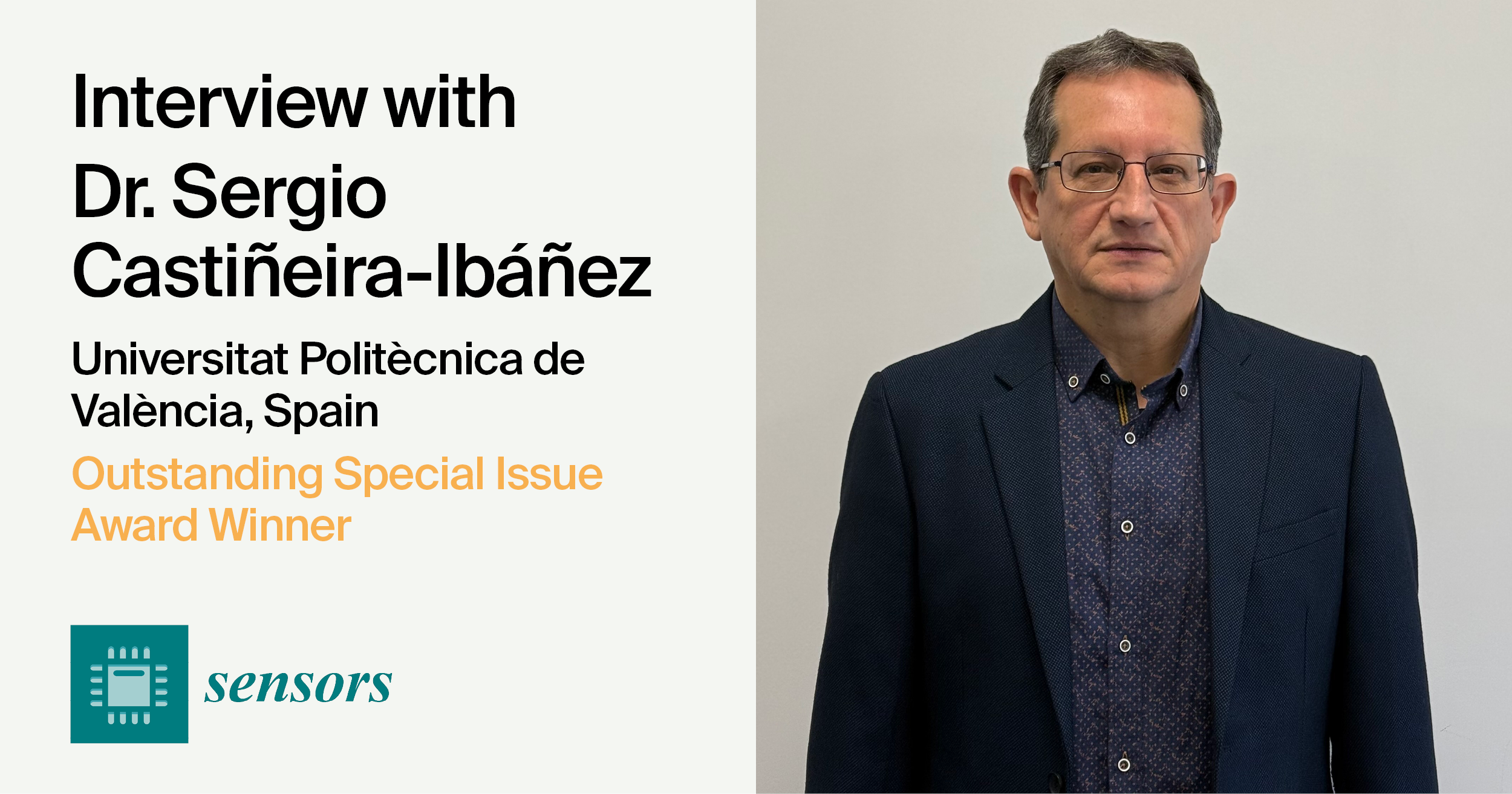
Interview with Dr. Sergio Castiñeira-Ibáñez—Winner of the Sensors Outstanding Special Issue Award
1. Congratulations on winning the Sensors Outstanding Special Issue Award! Could you tell us about your current research interests? What initially inspired or motivated you to embark on this particular field of study?
Thank you very much to Sensors for this recognition. This award is shared with my colleagues, Prof. Dr. Constanza Rubio and Dr. Daniel Tarrazó‑Serrano, with whom I work on research focused on the advanced control of acoustic wave propagation. Together, we design and develop structured materials and devices that precisely manipulate the sound field. Our approach combines numerical modeling, additive manufacturing, experimental validation, and acoustic characterization to create compact, efficient, and adaptable solutions for wave‑control applications.
My interest in this field began with a fascination for the possibility of controlling and manipulating acoustic waves using engineered structures specifically designed to alter their propagation with high precision. The convergence of fundamental physics, materials engineering, and experimental design motivated me to explore metastructures, resonators, and advanced sensing systems as powerful tools for shaping acoustic behavior. Over time, this combination of disciplines has revealed a wide range of opportunities for innovation in acoustic wave control, a field that continues to evolve and inspire new research directions.
2. How do you view the role of Special Issues in today’s academic communication landscape? In your opinion, what are the main differences between contributing to a Special Issue and submitting to a regular journal issue?
Special Issues play an important role in academic communication by bringing together recent, thematically coherent contributions around a specific topic, helping readers identify emerging advances and trends more easily. They also provide greater visibility and dissemination for the research included. However, their increasing number requires strong editorial rigor and robust quality control to avoid thematic fragmentation and ensure that they truly contribute to scientific progress.
The main difference is that a Special Issue demands strict alignment with a clearly defined topic and follows a specific timeline, typically managed by Guest Editors. In contrast, regular issues accept a broader range of submissions within the journal’s scope and follow the standard editorial process. While Special Issues often offer heightened thematic visibility, they also require a closer fit with their focus.
3. The Special Issue you edited, “Acoustic and Ultrasonic Sensing Technology in Non-Destructive Testing”, has proven to be a great success. Could you share your experience of serving as a Guest Editor? What aspects of the editorial process did you find most valuable?
My experience as a Guest Editor has been particularly enriching. First, I would highlight the opportunity to engage directly with cutting‑edge research, which provides a privileged view of emerging trends in the field. Equally valuable is the constructive dialog with authors and reviewers, which helps ensure scientific quality and significantly improves the submitted manuscripts. Finally, the editorial process offers a deeper appreciation of collaborative work, methodological rigor, and the academic responsibility required to coordinate a high‑level Special Issue.
4. From a Guest Editor's perspective, what qualities do you value most when reviewing submissions? What specific advice would you offer to researchers considering contributing to a Special Issue?
From a Guest Editor’s perspective, the qualities I value most when reviewing submissions include strict alignment with the theme of the Special Issue, clarity and methodological soundness, and the originality of the contribution. Equally essential are coherence in the presentation, rigor in interpreting the results, and full adherence to the journal’s guidelines.
My advice to researchers considering submitting to a Special Issue is to read the thematic scope carefully, ensure their work provides a genuine and meaningful advancement related to the proposed focus, and prepare a methodologically sound and well-contextualized manuscript. It is also important to follow the author’s instructions rigorously, respect the Special Issue's specific deadlines, and explicitly highlight the study's relevance to the monographic theme.
5. In light of current trends in academic publishing, how do you perceive the role of open access journals, such as Sensors, in facilitating scholarly communication?
Open access journals, such as Sensors, play an essential role in scholarly communication by facilitating the immediate and unrestricted dissemination of scientific results. This model increases the visibility, citation, and real impact of research outputs while promoting greater equity in access to knowledge. In a context where scientific progress advances rapidly, open access accelerates the transfer of research findings, fosters interdisciplinary collaboration, and ensures that scientific work remains accessible to researchers, professionals, and organizations without institutional subscriptions.
6. What key advice would you like to share with early-career researchers who are just beginning their journey and aspire to make a meaningful impact in their respective fields?
I would recommend focusing on three fundamental aspects. First, it is essential to develop a solid methodological foundation and maintain a critical and rigorous attitude toward one’s own work. Second, building a coherent research trajectory is key, identifying relevant questions and contributions that provide real added value within the field. Finally, I would encourage active participation in the scientific community through collaborations, conference attendance, and publishing in high‑quality venues, as these activities greatly strengthen long‑term visibility and impact.