
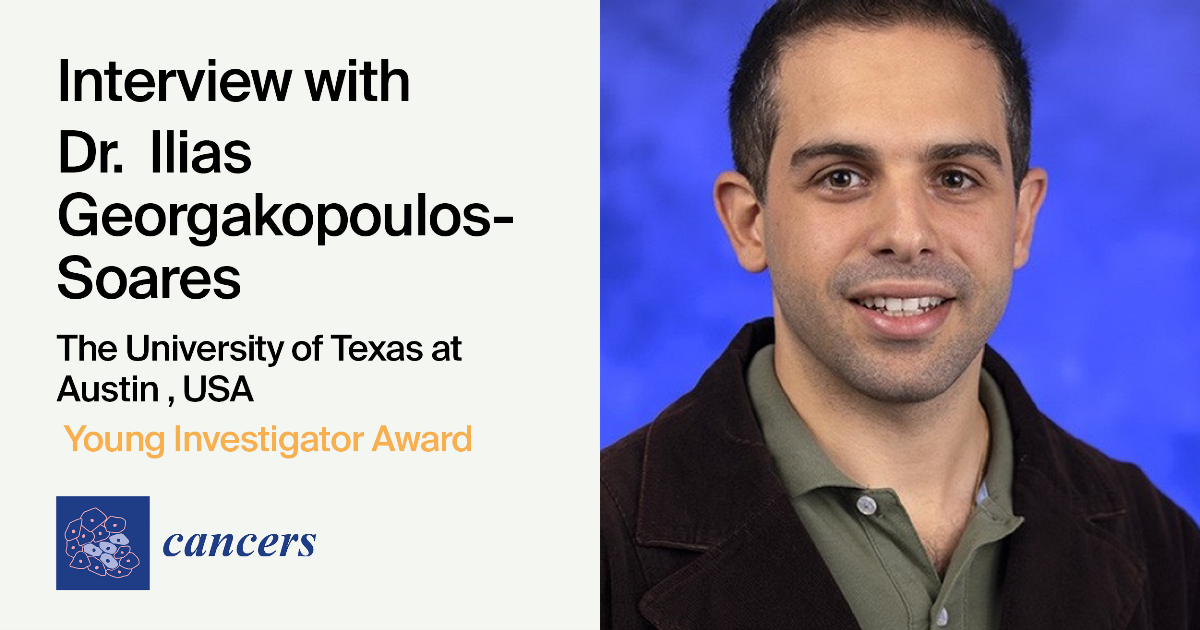
Interview with Dr. Ilias Georgakopoulos-Soares—Winner of the Cancers Young Investigator Award
Dr. Ilias Georgakopoulos-Soares is an Assistant Professor working at the intersection of cancer genomics, bioinformatics, and artificial intelligence. His research focuses on understanding how mutations shape cancer development, with a particular emphasis on uncovering previously overlooked mechanisms in the cancer genome and on developing technologies for early cancer detection. His academic background is interdisciplinary: he earned a degree in biology from Imperial College London and a degree in mechanical engineering from the National Technical University of Athens. He completed his PhD in bioinformatics at the University of Cambridge, where he studied the structural determinants of mutability in cancer genomes, and subsequently conducted postdoctoral research at UCSF, focusing on cancer biomarkers. He now leads a research group developing computational approaches to improve cancer diagnosis, patient stratification, and therapeutic decision-making.
The following is an interview with Dr. Ilias Georgakopoulos-Soares:
1. What initially inspired your research interest in this field?
My interest in cancer genomics emerged from a fascination with how complex biological systems can be understood through quantitative and computational approaches. During my PhD, I became particularly interested in the patterns governing mutations across the genome and how these patterns could reveal fundamental principles of cancer biology.
2. What current developments in your area of expertise are most exciting to you?
One of the most exciting developments is the shift toward a more nuanced understanding of cancer mutations beyond the traditional driver-passenger dichotomy. In our recent work, we argue that passenger mutations, long considered neutral, can have cumulative and context-dependent effects that influence cancer progression and treatment response. We are also excited by the potential of neomers, novel sequences generated by cancer-specific mutations, which could expand the repertoire of highly specific biomarkers for cancer detection and patient stratification. Additionally, the integration of artificial intelligence with large-scale genomic and functional datasets is opening unprecedented opportunities. The ability to build explainable AI models that can predict patient outcomes based on mutational profiles represents a major step toward truly personalized oncology.
3. How do you feel about receiving this award?
I am deeply honored to receive the Cancers Young Investigator Award. It is especially meaningful because it recognizes not only past contributions but also the potential of emerging research directions. I see this award as encouragement to continue pursuing unconventional ideas, such as rethinking the combined effects of passenger mutations and developing novel biomarkers for early cancer detection, and to push toward translating these insights into clinical applications.
4. What qualities do you believe are most essential for a young researcher today?
I believe three qualities are particularly important: creativity, resilience, and interdisciplinarity. Scientific challenges require integrating ideas from biology, computer science, and engineering. Equally important is the willingness to question established assumptions and to persist through uncertainty, as impactful discoveries often lie beyond well-explored paths.
5. Have you encountered significant challenges in your research, and if so, how did you overcome them?
One recurring challenge has been working on ideas that challenge prevailing paradigms. These ideas can initially face skepticism, both conceptually and in terms of funding or publication. We have addressed this by collecting evidence and ensuring that hypotheses are supported by multiple lines of evidence. Building interdisciplinary collaborations has also been critical in overcoming technical and conceptual barriers.
6. What advice would you give to early-career researchers aiming to make an impact in oncology?
I would encourage early-career researchers to focus on questions that are both fundamental and translational. Oncology is a field where deep biological insights can directly influence patient care. It is important to develop strong technical skills but also to think critically about how your work fits into the broader clinical landscape. Finally, don’t be afraid to pursue bold ideas, especially those that challenge established frameworks, as these often lead to the most impactful advances.