
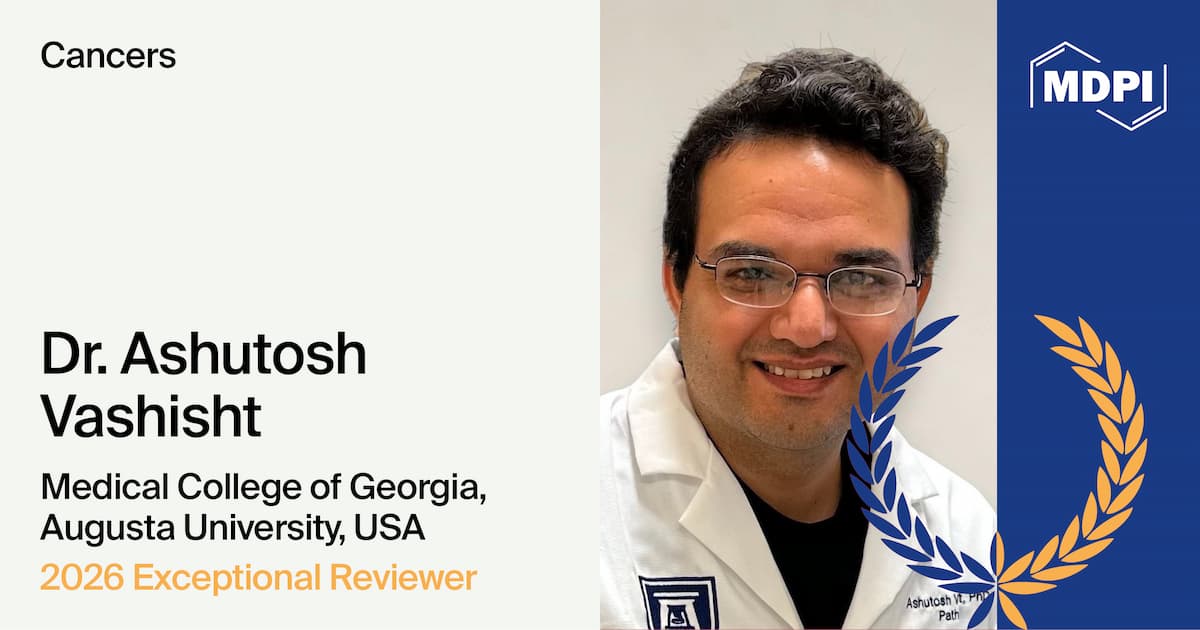
Interview with Dr. Ashutosh Vashisht—Cancers Exceptional Reviewer 2026
Dr. Ashutosh Vashisht is a Postdoctoral fellow in the Department of Pathology at the Medical College of Georgia, Augusta University. He holds a PhD in Molecular Biology and biochemistry and is a board-certified Scientist in Molecular Biology techniques by the American Society for Clinical Pathology (MB(ASCP)CM).
Dr. Vashisht’s work focuses on the application of next-generation sequencing and complementary genomic technologies in both solid tumors and hematologic malignancies. He has experience with a range of technologies, including NGS-based assays, microarrays, and optical genome mapping. Research interests include the identification and clinical interpretation of cancer biomarkers and advancing the integration of comprehensive genomic data into precision oncology.
The following is an interview with Dr. Ashutosh Vashisht:
- What initially inspired your research interest in this field?
I was drawn to cancer genomics because of its direct impact on patient care. The ability of NGS to uncover clinically relevant alterations from single-nucleotide variants to structural changes and guide diagnosis, prognosis, and therapy makes it a uniquely powerful tool. This intersection of molecular biology, technology, and clinical application is what initially sparked my interest.
- What current developments in your area of expertise are most exciting to you?
I am particularly excited by the expanding scope of technologies in oncology. Advances in detecting a wide range of biomarkers, such as mutations, gene fusions, copy number alterations, and emerging signatures, are transforming how we classify and treat cancers. In addition, improvements in bioinformatics and data integration are enabling more comprehensive and rapid interpretation of genomic data in clinical settings.
- Could you tell us a little bit more about yourself and your current research?
My current research focuses on the analytical and clinical validation of NGS-based assays for cancer profiling. This includes evaluating different classes of genomic alterations and their clinical relevance across tumor types. I am also interested in improving workflows and interpretation frameworks to ensure that genomic findings are accurate, reproducible, and meaningful for clinical decision making.
- Have you encountered significant challenges in your research, and if so, how did you overcome them?
One of the key challenges is the interpretation of complex genomic data, particularly variants with uncertain clinical significance and discordant findings across platforms. Addressing this requires a combination of robust bioinformatics pipelines, adherence to standardized guidelines, and close collaboration with clinicians and molecular tumor boards. These approaches help ensure that genomic data is interpreted in a clinically meaningful and responsible way.
- What advice would you give to early-career researchers aiming to make an impact in oncology?
I would advise them to build a strong foundation in both the technical and clinical aspects of oncology. Cancer research today is highly interdisciplinary, so the ability to integrate genomics, bioinformatics, and clinical knowledge is critical. Staying adaptable, collaborating across fields, and focusing on translational impact can help drive meaningful contributions to patient care.