
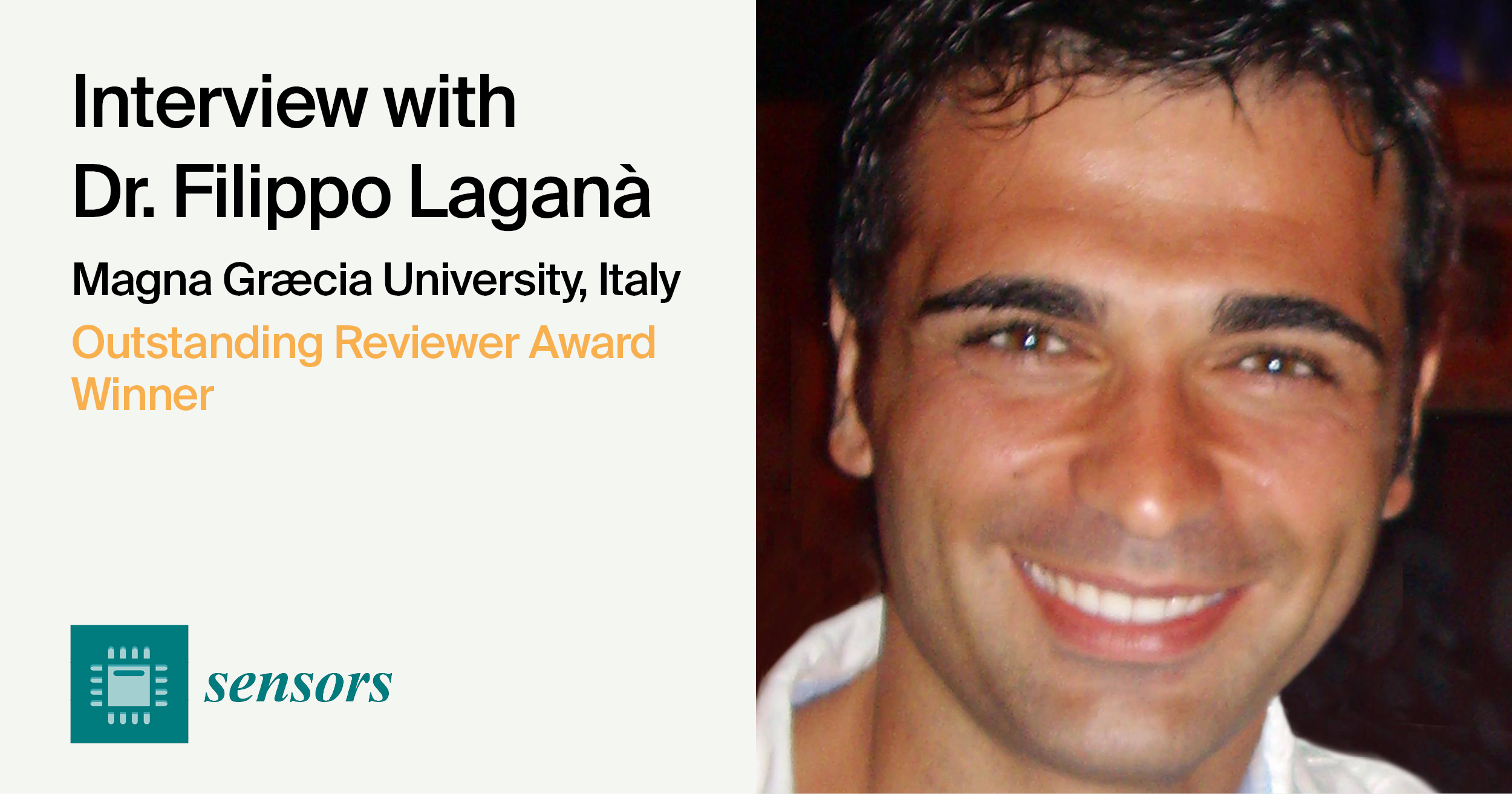
Interview with Dr. Filippo Laganà—Winner of the Sensors Outstanding Reviewer Award
9 April 2026
- Could you briefly introduce yourself and tell us about your field of research?
I began my passion for research while writing my thesis for a degree in electronic engineering at the Mediterranean University of Reggio Calabria. In March 2015, I obtained my PhD in biomedical and computer engineering at the Magna Græcia University of Catanzaro. In April 2019, still not fully satisfied with research, I obtained my second doctorate in civil, environmental, and safety engineering at the Mediterranean University of Reggio Calabria. Currently, I’m continuing my research at the Department of Health Sciences at the “Magna Graecia” University of Catanzaro, Italy. My research interests include the study of digital electronics, embedded systems, thermal and ultrasonic sensors, and thermographic analysis on biomedical and industrial applications and devices. - What key aspects do you typically focus on during the review process?
My priorities concern the scientific robustness and methodological rigor of the study; the level of novelty compared to the state of the art; the coherence between objectives, methods, results, and conclusions; and the reproducibility and transparency of the proposed approach. In the field of biomedical engineering, I focus on validation protocols, robustness, and the practical relevance of the presented solutions. - Based on your reviewing experience, what are some common problems that authors face?
Common problems include insufficient methodological details, which limit reproducibility; the exaggeration of contributions without adequate comparison to existing approaches; and weak experimental validation, often based on limited datasets or unrepresentative scenarios. In interdisciplinary fields, I frequently observe a lack of balance between theoretical development and practical validation. - For young scholars who are just beginning to participate in peer review, what specific advice would you offer?
Reviewers should approach this task with constructive responsibility rather than evaluating the work aseptically. The role of a reviewer should positively contribute to research by providing suggestions that can improve the proposed work. - How has serving as a reviewer shaped your perspective on manuscript quality and improved your own writing or research practices?
It has improved my ability to critically evaluate methodological consistency, identify potential weaknesses early on, and emphasize clarity and reproducibility in my work. - How do you see the role of reviewers evolving with advancements in artificial intelligence and automated tools in research publishing?
Artificial intelligence should be understood as a support tool and not as a substitute for the reviewer. The evaluation of scientific originality, conceptual robustness, and the broader impact of research must remain in human hands.