

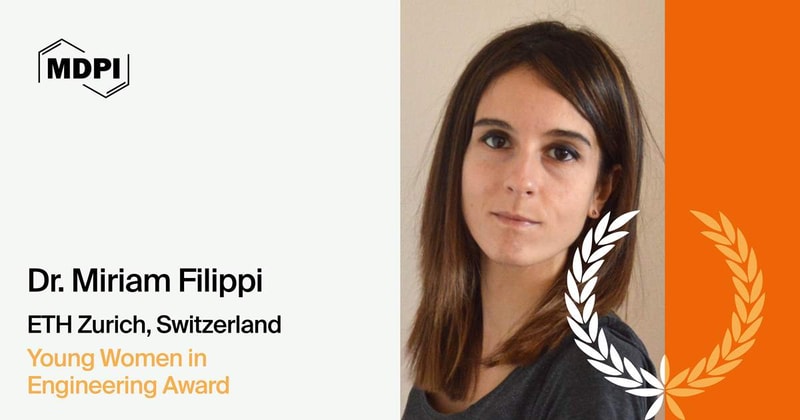
Interview with Dr. Miriam Filippi—Winner of the Young Women in Engineering Award
We are honored to announce that Dr. Miriam Filippi has been selected as a winner of the first edition of the Young Women in Engineering Award.
The following is an interview with Dr. Miriam Filippi:
1. Could you briefly introduce yourself and share your current research focus?
My name is Miriam Filippi, and I am an Established Researcher at ETH Zurich. My current research focuses on bio-hybrid robots, which integrate synthetic materials with living cells to create machines with dynamic functionalities. Specifically, I work on bioactuators made from engineered contractile muscle tissue, with the goal of advancing these systems toward real-world applications by improving their scalability, energy-efficient performance, control autonomy, and ability to operate outside controlled environments. In addition, I also cover the Principal Investigator role for a project that focuses on engineering disease models based on engineered neuromuscular tissue.
2. Can you tell us about the research that led to this recognition and its potential impact?
The research recognized by the MDPI Young Women in Engineering Award highlights my contributions to advancing biohybrid systems at the interface of living tissues, biosensing, and robotics. My research journey has been highly interdisciplinary: beginning in the life sciences, progressing through molecular imaging and materials science, moving into tissue engineering, and ultimately entering the male-dominated realms of mechanical engineering, robotics, and computational sciences, including AI-guided modeling. Along this path, I have developed robots powered by actuable muscle tissue, engineered feedback-based motion control for biological machines, and created responsive biomaterials, bioelectronics, and metamaterial-based implantables.
My muscle-powered bioactuators integrated with soft, tissue-embedded biosensors, providing the first evidence of real-time feedback and control in living devices, advancing simple “actuators” toward the intelligent robots of the future. My bio-integrated sensing platforms address mechanical, thermal, hypoxia, and glucose sensing, using semi-rigid soft bioelectronic strain sensors, piezoresistive hydrogel-based sensors, and thermic-reporter microgels embedded within engineered tissues to monitor contraction, stress, and local environmental changes. These technologies enable closed-loop control, opening new opportunities for adaptive biohybrid robotics, intelligent bioreactors, and predictive tissue engineering. Beyond robotics, my work extends to advanced biofabrication—including 3D bioprinting—nanomedicine, and in vivo biosensing with multifunctional nanoparticles for imaging, diagnostics, and therapy. Collectively, this research bridges fundamental science and application, creating multifunctional, responsive systems that advance regenerative medicine, biomedical devices, and sustainable, scalable bio-integrated technologies.
3. How does it feel to be recognized with the Young Women in Engineering Award?
Being recognized with the Young Women in Engineering Award is both an honor and a powerful psychological boost. I feel deeply grateful and excited, but above all, it gives me a sense of being truly seen and heard—both as an individual navigating a demanding professional path and as a scientist whose vision and work are valued. This recognition strengthens my motivation to continue despite challenges and reassures me that the community is increasingly aware of, and responsive to, the barriers many women face. Across cultures and academic environments, many talented women encounter difficult paths, and too often their potential is lost along the way. Awards like this send an important message: that these challenges are acknowledged, and that meaningful progress toward a more inclusive and supportive scientific community is possible.
4. What inspired you to pursue a career in engineering research?
I was inspired to pursue engineering research by a desire to create multicellular assemblies and biomimetic tissue or multi-organ systems, which require precise architectural design and advanced biofabrication, including fluidics and manufacturing. Building on this foundation, I became motivated to apply these capabilities to more visionary goals such as biohybrid robotics, integrating bioelectronics, mechanics, and dynamic control to move beyond traditional robotics toward truly “living machines”.
During my scientific journey, I became fascinated by the striking similarities between biological systems and man-made ones—for example, how cell–cell communication and collective behaviors resemble software architectures and signaling mechanisms, and how multicellular systems can be viewed as machines whose motility parallels that of dynamic robotic systems. These observations further convinced me that my trajectory should span multiple engineering disciplines.
Overall, my commitment to this direction stems from a drive to conduct high-impact, transformative research and to use my opportunity in science to develop bold, multidisciplinary solutions that push boundaries and inspire others.
5. As a woman in engineering, what challenges have you encountered in your work, and how did you overcome them?
Throughout my career, I have encountered a range of challenges that many women in engineering may recognize, including disparities in recognition, unequal access to opportunities, and navigating environments that are not always fully inclusive. I also faced difficult situations, including instances of inappropriate harassing behavior and bias, which are unfortunately realities for some women in STEM. While these challenges were often difficult to address directly, they gave me a deeper understanding of the structural barriers that can limit the progression of talented women and other underrepresented groups in science and engineering. Rather than letting these experiences define my career, I chose to channel them into positive action. I became actively involved in mentoring and advocacy, supporting women and other underrepresented groups in STEM through inclusive supervision, outreach initiatives, and community engagement. Through my involvement with organizations such as AVETH Diversity at ETH and other women-in-science networks, I have worked to raise awareness, share experiences, and provide guidance to early-career researchers, helping them navigate their own paths with confidence. These experiences also consolidated my commitment to becoming a better leader—one who understands the challenges people face, actively avoids creating unnecessary hardship, and fosters fairness and support in every environment. This insight has strongly reinforced my advocacy for equitable, empathetic, and effective leadership in science and engineering. Mentoring young scientists and sharing my insights allows me to contribute to a culture where diverse talent is recognized and empowered, and where societal biases do not limit opportunity. Opening my agenda to female-promoting counseling and developing careers in unconventional engineering has been one of the most satisfying privileges of my life. By transforming personal challenges into opportunities for advocacy and education, I hope to inspire others to pursue ambitious paths in STEM and to help shape a community where excellence is accessible to all.
6. What advice would you give to young researchers starting their careers in this field?
My advice to young researchers is twofold. First, be aware that many academic engineering environments are still shaped by societal biases that can affect career progression, particularly for women and other underrepresented groups. While these differences may be less visible at junior levels, they often emerge as one advances through the career stages. It is important not to internalize these challenges as personal shortcomings. Instead, reflect on your own environment, understand the systemic factors at play, and cultivate empathy for the experiences of colleagues. Use this awareness to promote inclusion and equity in your working environment, contributing to a gradual improvement of academia for everyone.
Second, be bold in your scientific development: tackle ambitious questions, explore connections across disciplines, and embrace a multidisciplinary approach. The most transformative research often comes from integrating perspectives across fields and pushing beyond conventional boundaries.
7. Looking ahead, what are your main goals or projects for the coming years?
Looking ahead, my scientific goals focus on advancing biohybrid robotics, particularly by demonstrating the usability and autonomy of these systems and exploring novel designs that rely not only on bioactuators but also on integrated biosensors and bio-processors. I also aim to develop more strategies for sustainable tissue engineering, addressing societal needs for scalable, responsible, and efficient biomedical solutions. Another priority is continuing to give my personal contribution to the 3Rs principle through the creation of advanced biomedical models, like systemic multi-organ platforms, including platforms to improve understanding of gender-related differences in physiology, metabolism, and factors such as nutrition and exercise, helping to reduce bias in biomedical research. In parallel, I am deeply committed to mentoring and inspiring talented students, supporting them to grow scientifically and achieve their own career goals. Personally, I will continue to strive for long-term research independence, ensuring the time and resources necessary to bring these ambitious objectives to fruition.