
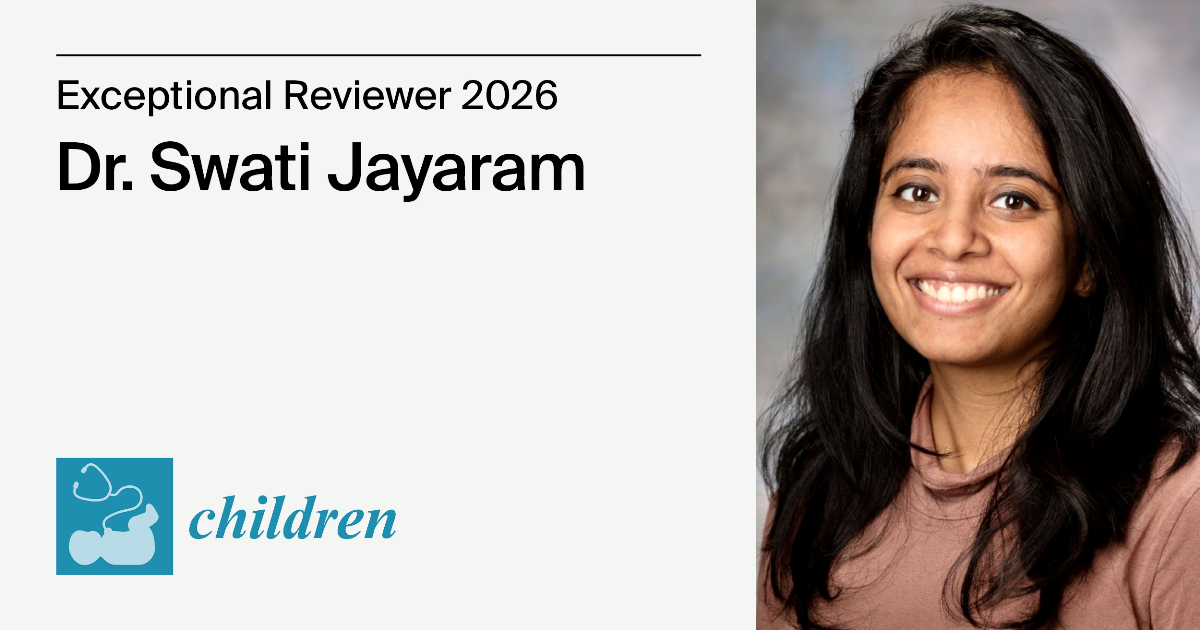
Children | An Interview with Exceptional Reviewer—Dr. Swati Jayaram
To thank our reviewers, the Children Editorial Office will announce our Exceptional Reviewers each month. You can get the award list here: https://www.mdpi.com/about/announcements/15639.
We wish to congratulate Dr. Swati Jayaram (Nationwide Children’s Hospital) for being featured on this list. She shared with us some professional opinions about the current peer-review process.
The following is an interview with Dr. Swati Jayaram:
1. Could you briefly introduce yourself and your current research topic to our readers, as well as the important role of your research area in promoting children's health?
I specialize in pediatric pulmonary and sleep medicine, with particular interest in children’s sleep disorders. My current research focuses on understanding sleep related movement disorders, especially in children with chronic pulmonary conditions like cystic fibrosis. My research aims to improve the identification of these conditions using objective measures and to better understand their clinical implications.
2. What criteria do you consider most important when evaluating a manuscript?
I focus on scientific rigor, clinical relevance, and clarity. I also consider whether the methods are transparent and reproducible, if the results are presented clearly, and if the conclusions are well supported by the data.
3. How do you view the role of a reviewer in shaping the quality and integrity of newly submitted research? What are your thoughts on the use of AI tools in the academic publishing industry, and what are your recommendations for ensuring quality control in the future?
Reviewers play an essential role in maintaining the quality, credibility and integrity of scientific research. They not only evaluate manuscripts for accuracy and ethics but also help authors strengthen their work through constructive feedback. AI tools may be useful for tasks such as language support and preliminary screening, but they cannot replace human expertise, critical thinking, and ethical judgement.
4. What advice would you give to early career researchers who want to become strong peer reviewers, or do you have any suggestions for the current peer-review process? Would you like to recommend that more scholars join us as reviewers to promote the scientific quality of peer review?
I would suggest developing a structured approach when reviewing manuscripts, focusing on constructive feedback, staying within your area of expertise, and keeping up with the current literature.
To continue helping the journal improve the peer-review process, the Editorial office encourages scholars related to Children (ISSN: 2227-9067) to join us via the following link: https://www.mdpi.com/reviewers.
Children Editorial Office