
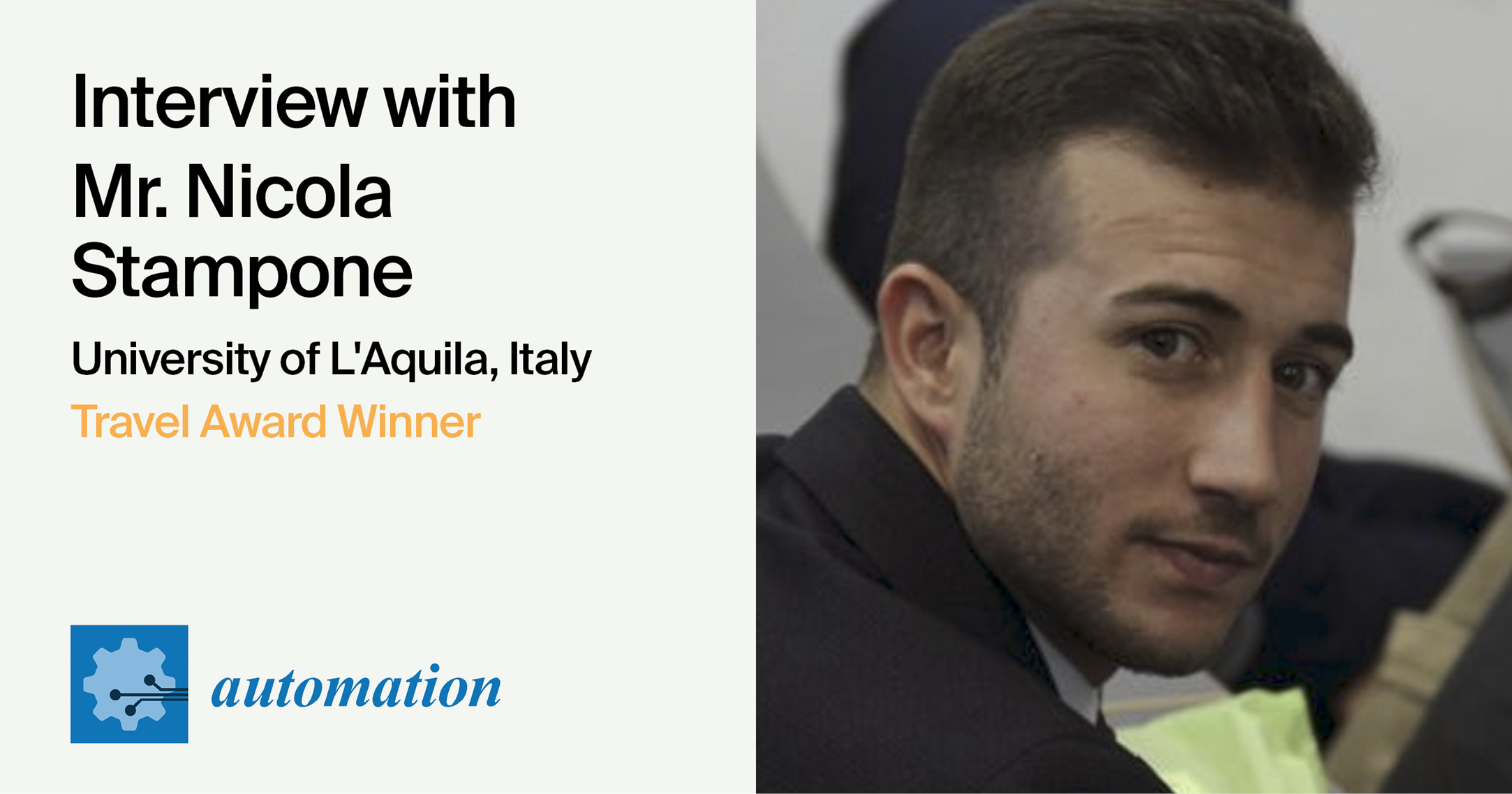
Interview with Mr. Nicola Stampone—Winner of the Automation Travel Award
1. Award Reception & Background
Congratulations on receiving the Automation Travel Award! What was your first reaction when you heard the news? Could you briefly introduce yourself? For example, your research focus, your lab or advisor, and how you became interested in the field of automation? How did you first learn about the Automation journal and this Travel Award? What motivated you to apply?
I felt truly honored and very excited to receive the Automation Travel Award. It is rewarding to have my PhD research in adaptive manipulation recognized, and the news gave me a real boost of motivation to continue pursuing my work in this field.
My name is Nicola Stampone, I am a mechanical engineer, and I am currently working in the field of soft robotics at the Industrial Fluid Automation and Mechatronics Laboratory at the University of L’Aquila. My research focuses on the development of soft grippers for adaptive manipulation. Specifically, I work on designing gripping systems that can adapt the soft pneumatic actuators, which act as fingers to the shape of a wide variety of objects, allowing safe and effective grasping without causing damage.
I became interested in this field thanks to my supervisor, Professor Gabrio Antonelli, who was already working on these topics. Through his guidance, I developed a strong interest in soft robotics and its potential applications in automation.
I first learned about the Automation journal and this Travel Award through my familiarity with MDPI journals. I have published several scientific papers with MDPI, and I regularly follow their calls for opportunities, including awards and recognitions.
What motivated me to apply was the opportunity to support my participation in an international conference and to further engage with the research community. I also see it as valuable recognition of my work and a chance to increase the visibility of my research in the field of automation.
2. Research & Academic Contributions
In simple terms, can you describe your current research project? What do you consider its most innovative aspects or potential real-world applications? What challenges have you encountered during your research? Was there a moment when you felt stuck, and how did you overcome it? You have already published several papers related to your research area. Can you share your experience with the submission process?
My current research focuses on developing soft robotic grippers for adaptive manipulation. In the paper “Adaptive Manipulation: Development of a Reconfigurable Three-Fingered Soft Pneumatic Gripper with Integrated Sensing”, a new three-fingered gripper that can handle a wide variety of objects has been presented. The gripper is composed of two levels of reconfigurability—radial and angular—allowing the adjustment of the position and orientation of the three fingers for different object shapes. Both a flex sensor and a force sensor are integrated directly into the external reinforcement that guides finger bending, enabling sensing and control. The external reinforcement also limits the “balloon effect” typical of soft pneumatic actuators, increasing their fatigue life. Moreover, the system can be quickly reconfigured depending on the object to be manipulated, achieving a payload of up to 662 grams. These features make the gripper particularly suitable for real-world applications where delicate and adaptive handling is required, such as in automated assembly, food handling, or other tasks involving fragile objects.
The main challenge in my research has been integrating the sensors directly into the external reinforcement of the soft pneumatic actuators. This was complex because we needed to maintain the flexibility and performance of the gripper while adding sensing capabilities. I wouldn’t say I ever really got “stuck,” because I’m always excited by the idea of overcoming challenges. For me, this is the essence of research—searching, experimenting, and iterating to solve a problem. That mindset keeps me motivated even when a task is difficult.
My experience with the submission process has been good. The system is always ready to support the authors with any issues or questions that arise. Overall, it has been a smooth and efficient process, which makes publishing and sharing our research much easier.
3. Conferences & International Experience
Which conference do you plan to attend with the Travel Award, and why did you choose it? What are you most looking forward to? Is there any support or promotional material you would like from Automation to help you spread the word about the journal? For instance, brochures, sample issues, flyers, or a poster to display at your presentation? What do you think is the biggest benefit of attending international conferences for PhD students? Are there any specific talks you are excited about or researchers you hope to meet? What advice would you give to first-time conference attendees, especially regarding presentations, networking, and making the most of the experience?
I will attend the 6th IFToMM Conference, which will be held in Foligno, Italy. At the conference, I will present my research titled “Adaptive Manipulation: Development of a Reconfigurable Three-Fingered Soft Pneumatic Gripper with Integrated Sensing”.
Since there is no poster session, I plan to acknowledge the support from Automation at the end of my oral presentation. I am really looking forward to discussing my work with other researchers in the field of robotics and automation, exchanging ideas, and learning about the latest developments in mechanical and mechatronic systems.
Regarding promotional material, I think adding a mention in my presentation is the most suitable way in this case, given the conference format.
I think the biggest benefit of attending international conferences for PhD students is the opportunity to connect with the global research community. Conferences allow us to exchange ideas, get feedback on our work, and learn about the latest advances in our field, which can inspire new directions in our research.
I’m especially excited about talks related to soft robotics, adaptive manipulation, and pneumatic actuators. I also hope to meet researchers who are working on innovative gripper designs and sensor integration, as it would be a great opportunity to discuss challenges, share experiences, and potentially establish future collaborations.
For first-time conference attendees, I would say: Be prepared, but stay curious and open. Practice your presentation so you can communicate your main ideas clearly, and don’t be afraid to show enthusiasm about your work. For networking, introduce yourself, ask questions, and connect with other researchers—even short conversations can be very valuable. Finally, attend talks outside your immediate field; it’s a great way to get new ideas.
4. Thoughts on Automation Journal
Before applying for the Travel Award, were you familiar with the journal Automation? How do you view its role and development in the field? Would you consider submitting your future work to Automation? Why or why not? What kind of support do you think would be most valuable for early-career researchers from journals like Automation (e.g., awards, training, or academic events)?
Before applying for the Travel Award, I was aware of the journal Automation, although I had not published in it before. I view it as a growing and important platform in the field, providing high-quality research on automation, robotics, and related areas. I think the journal plays a valuable role in disseminating innovative work and connecting researchers across different disciplines. Yes, I would consider submitting my future work to Automation, largely for the reasons I just mentioned. I see it as a high-quality platform that reaches a wide audience in the field of automation and robotics, and it provides good visibility for innovative research. Its fast and efficient publication process is also a strong incentive.
I think early-career researchers benefit most from opportunities that increase visibility and provide guidance. Travel awards are very valuable because they support participation in international conferences. Training programs or workshops on scientific writing and peer review would also be very helpful. Additionally, academic events organized by the journal can create networking opportunities and foster collaboration with other researchers in the field.
5. Advice for Future Applicants
What advice would you give to other PhD students considering applying for this Travel Award (e.g., how to prepare materials, highlight strengths, etc.)? As a third-year PhD student, what are your goals for the coming year? Are there any specific milestones you’re aiming to achieve? Finally, if you could sum up your current mindset as a researcher in one sentence—or share a message with fellow PhD students—what would it be?
My advice for other PhD students considering this Travel Award would be to prepare their materials carefully and clearly. Highlight the significance of your research and its potential impact, and explain why attending the conference is important for your work and professional growth. Be concise but specific, and make sure you show enthusiasm and motivation.
I recently defended my PhD thesis on February 19, and over the coming year, my goal is to continue building a career in academia. I’m particularly motivated by interacting with people from different research backgrounds, as it inspires new ideas and perspectives.
If I were to sum up my current mindset as a researcher in one sentence, it would be: Stay curious, stay motivated, and take every opportunity to learn and share your knowledge.
6. Is there a book, paper, or researcher that has had a significant influence on your academic journey? What activities do you enjoy outside of research, and how do you maintain a healthy work–life balance?
Several people have had a significant influence on my academic journey. My research group, Professor Pierluigi Zobel, and my supervisor, Professor Gabrio Antonelli, were particularly important. I was also inspired by leading figures in soft robotics and manipulation, such as Professor Cecilia Laschi, and I continue to study and follow their research closely.
Maintaining a healthy work–life balance is very important, especially in research where there’s no clear endpoint. I make sure to stay active through sports, like going to the gym and swimming, which helps me stay calm and focused. I also spend time with friends and take breaks from work, because it’s really important to have an equilibrium in life.