

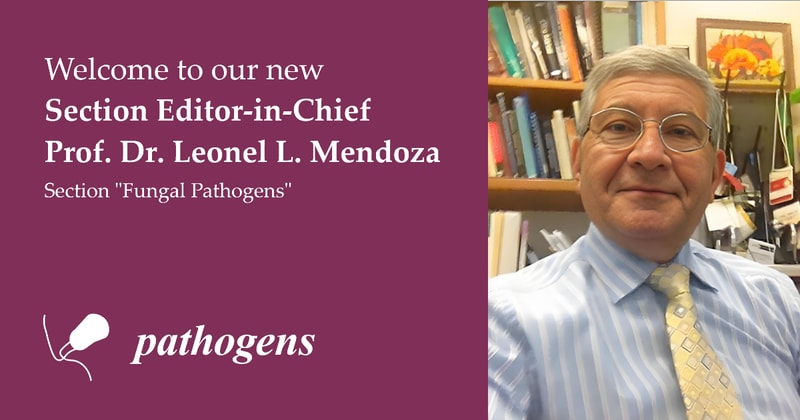
Prof. Dr. Leonel L. Mendoza Appointed Section Editor-in-Chief of Section “Fungal Pathogens” in Pathogens
We are pleased to announce the appointment of Prof. Dr. Leonel L. Mendoza as the new Section Editor-in-Chief of the Section “Fungal Pathogens” in Pathogens (ISSN: 2076-0817).
Prof. Dr. Leonel L. Mendoza is a Professor in the Biomedical Laboratory Diagnostics Program and the Department of Microbiology, Genetics, & Immunology, Michigan State University. His primary research interests focus on infections caused by fungi and fungal-like organisms, such as Pythium, Lagenidium sp., and Rhinosporidium, particularly in individuals suffering from debilitating diseases or undergoing immunosuppressive therapy. In addition, his research interests include uncultivable fungal pathogens such as Paracoccidioides ceti affecting dolphins and Paracoccidioides lobogeorgii infecting humans. His work addresses the challenges posed by emerging opportunistic pathogens, for whom customary antifungal drugs often have little effect or are highly toxic. Over the last decade, he has investigated the epidemiology, pathogenesis, and life cycle of fungus-like organisms, developing a serologic test for diagnosis and an immunotherapeutic vaccine for treatment. Currently, his research aims to identify and characterize genes encoding proteins with immunotherapeutic features for the production of genetically engineered vaccines, and to develop new molecular techniques for diagnosing and monitoring infections caused by traditional pathogenic fungi.
The following is a short Q&A with Prof. Dr. Leonel L. Mendoza, who shared his vision for the journal with us, as well as his views on the research area.
1. What appealed to you about the journal that made you want to take on the role as its Section Editor-in-Chief?
To encourage investigators in medical myology to publish in Pathogens.
2. What is your vision for the journal?
Pathogens is a general term that involves practically all etiologic agents of disease in humans and animals. As such, we offered investigators in different scientific areas the opportunity to publish in a journal that has a wide audience and a high level of professionalism.
3. What does the future of this field of research look like?
Technological advances in AI and new tools for diagnostics have had an impact on the way we approach research. Therefore, we offered the opportunity to many investigators to publish their results in Pathogens using the latest tools to explore new ways to diagnose and treat human and animal pathogens.
4. What do you think of the development of open access in the publishing field?
This model emerged a few years ago and has been widely adopted by higher education institutions. I appreciate that institutions cover the publication fees for their employees, as it benefits both the institution and the journals. While some criticize the cost, nothing is free. I believe the current model works well and, most importantly, the community is accepting it
We wish Prof. Dr. Leonel L. Mendoza every success in his new position, and we look forward to seeing his contributions to the journal.
Pathogens Editorial Office