
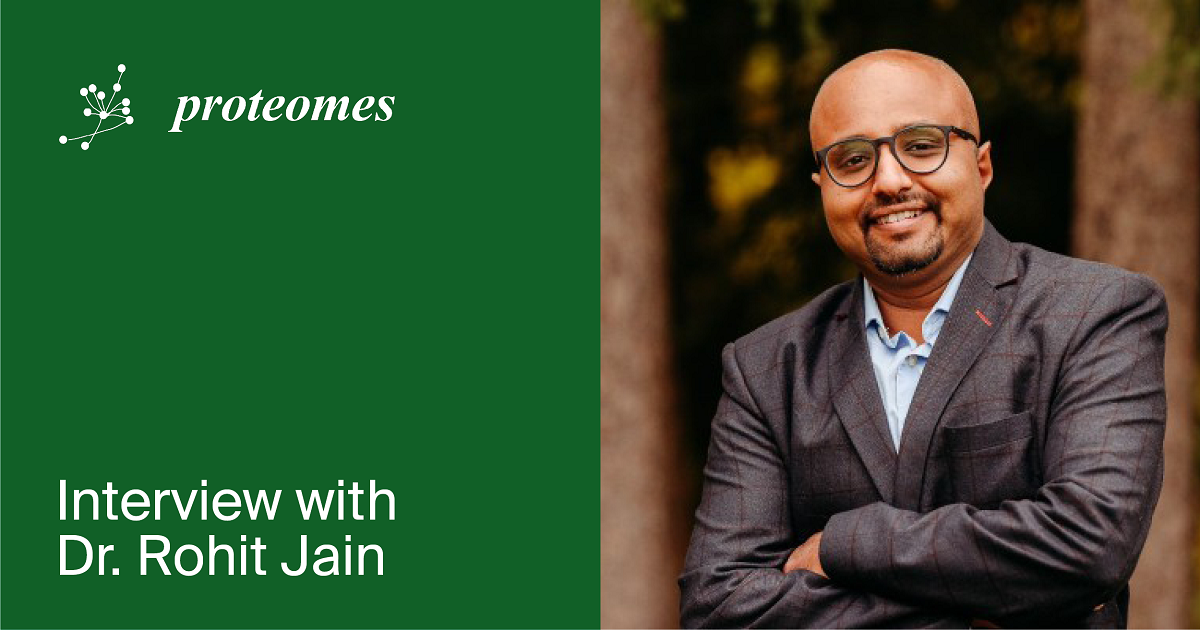
Proteomes | Interview with One of the Reviewers—Dr. Rohit Jain
Name: Rohit Jain
Affiliation: School of Medicine, Case Western Reserve University, Cleveland, OH, USA
Interest: structural biology; protein folding; mass spectrometry; biosensors; protein footprinting
We recently had the opportunity to interview Dr. Rohit Jain, who reviewed manuscripts for Proteomes (ISSN: 2227-7382). Through the interview, he generously provided the following insights into his research, challenges, and personal journey.
The following is a short interview with Dr. Jain:
1. Could you please introduce yourself to our readers?
My name is Rohit Jain, and I completed my doctorate at the Max Planck Institute for Multidisciplinary Sciences in Germany. I later moved to the United States for my postdoctoral research at the UMass Chan Medical School, and I am currently a Staff Research Scientist at Case Western Reserve University in Cleveland.
2. Could you introduce your current research direction and share an update on your progress?
My current research focuses on using mass spectrometry to study protein structure and dynamics. While techniques such as X-ray crystallography, cryo-electron microscopy, and NMR spectroscopy provide high-resolution structures, many proteins remain challenging to characterize using these methods.
To bridge this gap, I use hydroxyl radical protein footprinting (HRPF) to probe protein structures. This technique involves generating hydroxyl radicals from X-rays to modify solvent-accessible amino acids, which can then be detected by mass spectrometry. By comparing proteins in free form and in complex with ligands or other proteins, we can gain valuable insight into their structural dynamics.
Working with Prof. Mark Chance, who pioneered this technique, my research has focused on increasing the resolution of HRPF. We recently developed a multiplex labeling approach that combines hydroxyl and trifluoromethyl radicals in a single reaction. This advancement effectively doubles the labeling coverage, allowing us to map nearly all solvent-accessible residues in small proteins—significantly improving our understanding of protein structures.
3. What do you see as the main challenges and future directions in this area of research?
Currently, mass spectrometry instruments are incredibly sensitive, enabling us to detect peptides present in very low abundance. However, as we move from studying single proteins to increasingly complex systems—such as chromatin remodeling complexes or even whole-cell lysates—we face new challenges.
These include generating sufficient labelling radicals for large systems and handling the vast, highly dynamic datasets that result. Developing new analytical tools and improving data processing methods will be crucial to overcoming these challenges and advancing our understanding of complex protein systems.
4. Which tools or software have been particularly helpful in your research and writing?
In the lab, we rely heavily on Thermo Scientific mass spectrometers, particularly the Eclipse system, along with Vanquish chromatography platforms and high-resolution separation columns.
For data analysis and visualization, I frequently use OriginLab for graphing and statistical plotting—it’s user-friendly and well-supported through online tutorials. During the writing process, I also find Grammarly useful to refine my language and phrasing.
5. What advice would you give to young scholars entering academia or seeking to publish their work?
In research, persistence is key. Talent alone is not enough—experiments fail, reviewers challenge your work, and progress can be slow. It’s important to take criticism constructively and stay motivated.
Writing, in particular, requires patience. Every manuscript feels like the first one all over again. My advice is to start writing early and write consistently, even a little every day. Treat writing and publishing as an integral part of research, not just an afterthought. Peer review helps us refine our work and often brings valuable new perspectives.
6. How was your experience reviewing for Proteomes?
Reviewing for Proteomes has been a valuable learning experience. Working with proteome-level datasets made me appreciate the complexity of large-scale biological systems. Compared with some other journals, I found Proteomes to have a well-organized and streamlined review process, and the papers I reviewed were of high scientific quality, making it a rewarding experience overall.
7. How do you balance your research with your daily life?
I’m married and have a five-year-old daughter and a newborn, so time management has become even more important! Research is demanding and requires continuous motivation, so prioritization is essential.
I try to focus on a few high-impact tasks each day—the ones that make the biggest difference. I’ve also learned the importance of collaboration and teamwork; research thrives when we work together. Finally, I believe that loving what you do makes it much easier to give your best effort, even when life gets busy.
8. Do you have any final thoughts?
The questions in this interview are very relevant to researchers, and I hope sharing my experience will help others navigate their own scientific journeys.