
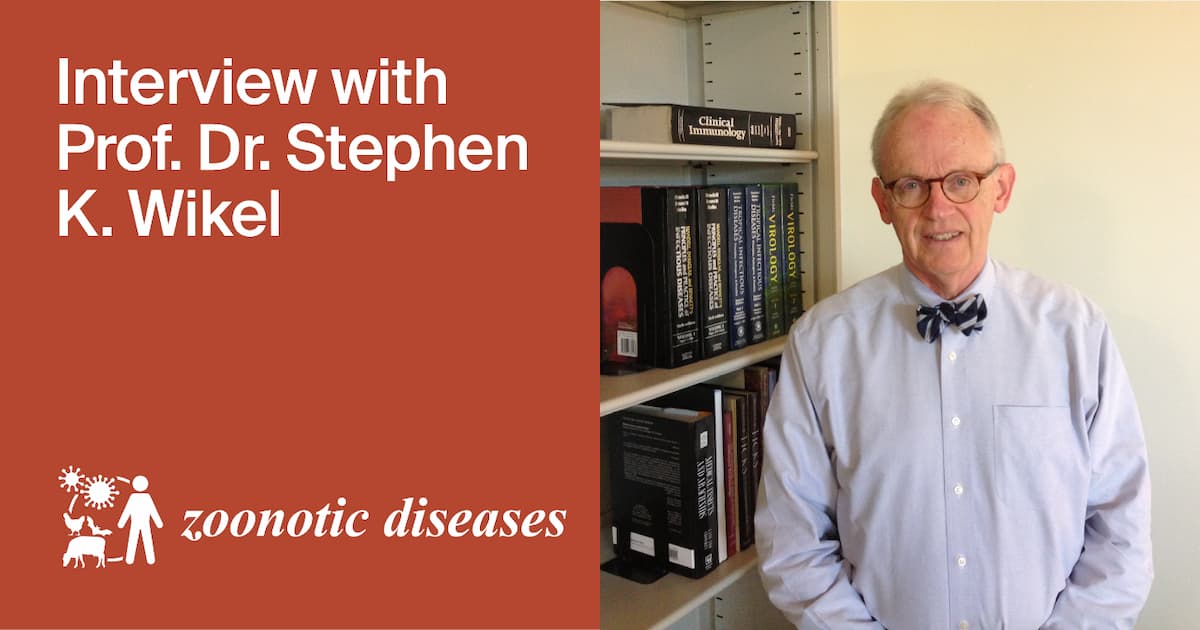
Zoonotic Diseases | Interview with Editor-in-Chief—Prof. Dr. Stephen K. Wikel
We are pleased to share the following interview with Prof. Dr. Stephen K. Wikel, founding Editor-in-Chief of Zoonotic Diseases (ISSN: 2813-0227) and Editorial Board Member of Veterinary Sciences (ISSN: 2306-7381).
Prof. Dr. Wikel received his PhD in veterinary microbiology from the University of Saskatchewan. He was appointed Senior Associate Dean, Professor and Chairman, Department of Medical Sciences, and St. Vincent’s Medical Center Endowed Chair, School of Medicine, Quinnipiac University, as one of four deans tasked with establishing the new medical school from the ground up. Prof. Dr. Wikel has authored 146 publications, including several invited reviews and book chapters, and has been a featured speaker for 75 national and international symposia. He has extensive service experience as a member of advisory panels, research study sections, editorial boards, and in academic institution administration.
We thank Prof. Dr. Stephen K. Wikel for meeting with us to discuss his current research and his role as Editor-in-Chief. We wish him every success in his research and his work with zoonotic diseases.
1. Can you share with us some information about your academic background and your current research focus?
My research interests, stemming back probably 55 plus years, have been looking at the interactions—the interface between—blood-feeding arthropods, and my work is focused predominantly on ticks in this period, although we've done some work with mosquitoes and sucking lice in the past and published on that, looking at the immunological responses that are elicited by the arthropod. But early on, we also discovered that blood-feeding ticks could manipulate the immune response of the host upon which they're feeding. So the idea here was to look at these interactions and how those relate to feeding success and ultimately the development of host responses that could limit the feeding of the blood-feeding arthropods, and really what their relationship is to pathogen transmission.
So this is an area that was largely unexplored, but from the standpoint of looking at an immunoparasitology aspect, this was important.
I received my PhD in veterinary microbiology from the University of Saskatchewan, Canada. I had a strong focus; initially, my interest was really veterinary parasitology and the immunology related to those parasites, but I was fortunate to be in a department that at the time had a very heavy focus on the interface between veterinary medicine and human health, long before it was probably widely touted as a One Health approach. So, this was really zoonotic diseases, and, fortunately, we had a faculty that was very broad in these areas, and it was beneficial in terms of my training. When I defended my dissertation, I was hired as an assistant professor in the department where I remained for approximately a year before moving to the Rocky Mountain Laboratories, so the National Institute of Allergy and Infectious Diseases in the United States. I ultimately moved on to an academic career. The highlight of that was being a professor and acting Chair of the Department of Immunology at the School of Medicine at the University of Connecticut. I subsequently ended up at the University of Texas Medical Branch, where I was Professor of Pathology.
I had been specifically recruited there; this was after 9/11 in the United States, when the National Institute of Allergy and Infectious Diseases developed the Galveston National Laboratory, which was a maximum biocontainment lab, all the way to BSL-4, where I was, in addition to being Professor of Pathology, a senior scientist in the Center for Biodefense and Emerging Infectious Diseases.
Subsequently, I was approached by colleagues, three of my colleagues from the University of Connecticut, and asked if I would return to Connecticut to help found a new Medical School at Quinnipiac University, which I did, basically at the end of my career. At this point, it was basically starting a school from the ground up. So, I hired faculty for the basic sciences in the clinical skills area, wrote a curriculum, did a lot of the documentation for accreditation, and that's now an established, accredited medical school moving along quite nicely.
Over the years, I have produced over 146 publications. I've been a featured speaker at over 75 national and international symposia. My research was funded by the National Institutes of Health, Centers for Disease Control, U.S. Department of Defense, U.S. Department of Agriculture, and by private industry, the pharmaceutical industry.
I've had extensive experience over the years serving on advisory councils, panels, NIH study sections, and at one point, I chaired what was called the ICIDERS, or the International Centers for Infectious Disease Research Study section of the NIH.
So I think this gave me a broad background combined with a lot of administrative experience at the medical school level to be able to go forward and produce and provide some productive leadership in some of these areas.
2. What was your motivation to become the Editor-in-Chief of a new journal?
Well, I think this provides an opportunity, really, to be of service to the community of researchers, clinicians, public health workers, individuals, and particularly, in the cases of zoonotic diseases, One Health scientists and the various stakeholders and decision makers in the area of zoonosis. That's a good opportunity to provide service at this point.
3. Which research topics about zoonotic diseases do you think will be of particular interest to the research community in the coming years?
Well, I think the full spectrum. If we start out with most of the journals in this area, the companion journals to Zoonotic Diseases, in the era of rapid change, we're looking, you know, largely at disseminating new information, ranging from the very basic science studies to clinical studies, providing up-to-date comprehensive reviews, which I think is very important to not only established researchers, but for those that might not be focused primarily on those topics, but certainly for students and fellows coming along.
I think the critical role of providing a forum for these perspectives is important. It's foundational to advancing global research and responsiveness to zoonotic diseases.
I think this journal is deliberately broad in that it captures and offers new insights into areas that are emerging, and I think particularly public policy.
The impact of how zoonoses are affected by what we see as a changing world, whether that's societal changes, economics, technology, or environmental, is very important. So, I see that there's a very broad opportunity here to present a large amount of information that is beneficial to a broad audience, not just within the zoonotic disease area, but beyond, in terms of policymakers.
4. What part do you think our journal Zoonotic Diseases will play in this research?
Well, I think what we've just discussed in response to your last question carries over into this as well. I think it provides a global forum for research in terms of all the various areas that we discussed, manuscripts on One Health, eco health, public health, diagnosis, pathogenesis, the whole spectrum, and it really provides an opportunity to bring in researchers from all over the world.
I think one of the aspects of this journal that I think we would all like to see is to really bring along discussions, debates about national, local, international policies or the infrastructure that's needed for preparedness. This journal can create a particularly important forum for that. These diseases are transboundary, so I think it's absolutely critical to bring together the inclusiveness of programs from all over the world. I'm particularly interested in what's happening in what we would consider potentially more resource-limited areas, so that we have a voice. This is where many of these diseases develop, and they're going to impact all of us. It's a global issue. Transboundary means that, as we by the definition know, there are no limitations as to how these diseases can actually be spread and their impact globally. So, I think the journal provides a valuable forum for that.
5. What criteria do you consider most important when evaluating a manuscript?
Well, I think this really comes to what Zoonotic Diseases provides—as we know, a timely review process, and the time from first decision to rapid publication. But I think thoughtful, thorough, accurate assessments are the objective of the entire assessment process. Peer review, having individuals who will review a manuscript, be thoughtful and detailed, providing guidance to the authors in this area, is key. It all begins really with the excellent MDPI staff, the professional staff that manage the processes from receiving the submitted manuscript to publication. Their competence, their diligence, and commitment underpin the entire operation. So, the important criteria I think in looking at these manuscripts include originality, clarity of ideas, organization and soundness of interpretation and conclusions, and again, being able to think broadly in terms of the entire themes of what zoonotic diseases are, so something that might give us a unique perspective becomes important in this as well.
6. How about what constitutes a thorough peer review process?
Well, I think this really again starts with the excellent MDPI professional staff and in our case, with Miss You as the managing editor, and the people that she's working with and individuals such as yourself.
It's really using the various criteria, such as “iThenticate”, when checking submissions against previous publications. In addition, manuscripts may be assessed relative to the degree to which, potentially, artificial intelligence platforms might have been used in the manuscript preparation.
Peer reviewers are the critical element, and my policy is to allow the Assistant Editors to do that, because I think they have better access to the data of the individuals that we can call upon. From that pool of individuals, we need appropriate expertise, and in many cases, for papers, we will look to utilize individuals from across several areas that are relevant to the topics and themes of the manuscript, and as we look at papers that might be coming from different areas, we really will reach out into other fields where people might have expertise, not necessarily totally focused on zoonosis, but that is highly relevant to assessing a manuscript. So, after initial review, the assistant editor or the Editor-in-Chief will examine and evaluate the findings of the peer reviewers, making a decision about the appropriate manner to move forward. On occasion, we might ask for an additional peer reviewer to be brought in.
In the Editor-in-Chief role, I believe, what I am trying to do is to say that the best policy is to provide an opportunity to authors to respond to reviewer comments before any decision is made to reject a manuscript based upon an initial review. What I really look for in this case is reviewers who provide authors with a detailed road map of their thinking and guidance to the authors to improve the manuscript. So, I believe it's really critical to give every individual an opportunity to revise the manuscript, have it brought back, and reviewed again. Sometimes this requires multiple processes like this, but I think it's the fairest way to approach it for individuals who are submitting, and almost universally, will look at these constructive comments and advance the quality of their manuscript and hence advance the quality of the journal and its impact.
7. What role do you play as Editor-in-Chief in maintaining and promoting research integrity as well as in the development of this journal?
Well, I think what we have just talked about in the last question is relevant to that. But also, there's the additional aspect of something that the journal asks for, and I think is critical, that we always need to look at, and that is the institutional vetting of research activities that would be related to that particular manuscript. So, I think this becomes important in research integrity. Institutional review board policies relating to human subjects could be Animal Care and Use Committee approvals for any research that's reported relating to the use of other species. So, these all become important in terms of vetting. Also, the idea of access to data, data accessibility, becomes an important step. So, all of these factors are related to that. We do get a number of papers that involve surveys. I believe it is critically important if someone is talking about a survey instrument, that that instrument be accessible, whether it be online as a supplemental material to the manuscript, when it is ultimately published, so that readers can look at that instrument and assess to their standards of what they feel are the appropriate responses and how they interpreted the appropriate responses in this case.
8. Do you have a message you would like to share with the current board members of the journal Zoonotic Diseases?
Yes, the professional staff and I personally are deeply appreciative and thank you for sharing your experience and knowledge as editorial board members to significantly advance the growth of this journal, Zoonotic Diseases.
You generously make time in your busy schedules to provide thoughtful, thorough, fair, and rapid reviews of the diverse manuscripts submitted to the journal. Your expertise, commitment, and diligence are foundational for the increasingly recognized role of our journal as a platform for the dissemination of new knowledge about these pathogens, the diseases they cause, and the wide range of interrelated topics that we address.
Zoonotic Diseases will continue to adapt in scope to meet the needs of our contributors and readers, as the disciplines and forces that are impacting zoonoses evolve. Our collective goal is to publish high-quality submissions. This is something that you have been critical in ensuring.
Reviewing the submissions of our colleagues is vital to achieving that goal, as well as advancing knowledge and progress in our fields of professional interest and endeavor.
Your ideas regarding the advancement and improvement of the journal are critical. Your contributions are meaningful.
Our success is collective and an ongoing effort, and for this, I thank you and thank you on behalf of our professional staff.
9. What advice can you give to young researchers who are just starting in this field?
Well, this is really challenging and it's a time of change, rapid change, but this is something that goes on through all sorts of cycles of development of careers in particular areas.
I would say if you're a young researcher, develop as broad a skill base as possible. There has been a tendency over time to be more focused, let's say on one particular area or one particular skill set.
But develop a broad skill base. If you're going to be focusing on the molecular aspects of something, think also broadly about epidemiology, the clinical aspects, all these broader particular features.
Keep an open mind as you approach challenges and opportunities. Read the literature broadly and even outside of your area to look for various tools and approaches are being used that might be applicable to your area of science.
Think globally. Read the older scientific literature.
Very often there's been the attitude, at least of graduate students over the years, that I've trained and trained fellows, that anything older than five years is probably not meaningful.
That's far from the truth.
Read the older scientific literature. The tools might not be as sophisticated as today, but there are lessons to be learned and avenues to consider for future research. Also, in increasing competitiveness, consider combined degree programs, which would basically be a professional degree plus your research oriented PhD.
This might seem to a younger person as an eternity in terms of the training processes, but throughout your career it'll provide you with the opportunity, to apply research and access maybe translational or clinical settings and expand the scope of your knowledge relative to what you're working on.
And I guess the fundamental thing at the end is never give up, and enjoy the journey. It actually goes a lot faster than you might anticipate.
You can access more journal information via the following link: https://www.mdpi.com/journal/zoonoticdis.
Zoonotic Diseases Editorial Office