
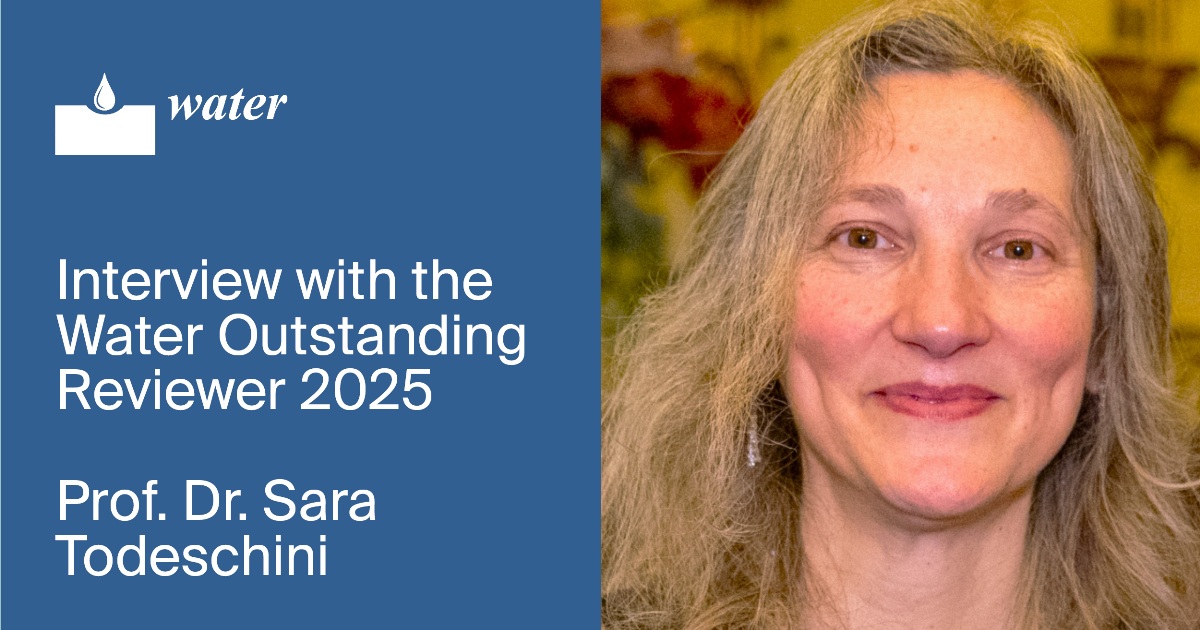
Interview with Prof. Dr. Sara Todeschini—Winner of the Water Outstanding Reviewer Award
Name: Prof. Dr. Sara Todeschini
Affiliation: Department of Civil Engineering and Architecture (DICAr), University of Pavia, Pavia, Italy
Interests: hydraulic infrastructures; urban hydrology and hydraulics; stormwater; monitoring; numerical modelling; design; management; uncertainty; urban flooding
I am an Associate Professor of Hydraulic Structures at the Department of Civil Engineering and Architecture (DICAr) of the University of Pavia and a Member of the Technical Scientific Committee of the Interdepartmental Centre for Water Research (CRA) of the University of Pavia. I am involved in research projects and scientific consulting activities in the field of hydrology, hydraulics, and hydraulic structures, with a particular focus on integrated urban water cycle management and modelling of water flows and contaminant transport in natural and anthropogenic environments, including uncertainty.
2. What key aspects do you typically focus on during the review process?When reviewing a manuscript, I use a two-step approach. The first phase consists of reading the manuscript in its entirety to check overall consistency, scientific soundness and novelty. The second phase involves a more in-depth reading with a systematic evaluation of each section. In the review process, I address the following key aspects: originality and relevance of the study’s aim, quality of scientific content, rigor and precision, clarity of presentation, and completeness of research design.
3. In your opinion, what qualities are essential for a reviewer to possess?A reviewer must be aware that his or her contribution is essential to maintaining a healthy and vibrant editorial cycle. The reviewer must know and respect the journal's ethical guidelines, adhere to review process procedures, meet deadlines and have confidence in the editorial team. A reviewer should provide an honest and rigorous evaluation of the work, demonstrating a proactive and respectful spirit even when identifying gaps and critical issues that may preclude a favorable recommendation. In summary, in my opinion, the essential qualities for a reviewer should be honesty, objectivity, rigor, a spirit of collaboration, and a constructive attitude.
4. As an exceptional reviewer for MDPI, do you have any tips or experiences to share that could help other reviewers improve the quality of their reviews?First of all, I firmly believe that serving as a reviewer is a valuable experience that brings both professional and personal advantages. I recommend carrying out revisions with curiosity and an open perspective. To effectively meet review deadlines, it is essential for me to set a manageable number of revisions to be completed in a given period, taking into account scheduled teaching, institutional, and research commitments. It is also helpful to mark on my calendar intermediate review deadlines consistent with the distribution of all commitments. I usually prepare reviews that conform to the journal's peer review checklist and, as a basis, follow standard or structured peer review question banks. I try to be clear in my requests to the authors, specifying the corrections and additions that need to be implemented to address my concerns. I usually provide my impressions on the significance, interest and possible impact of the work and summarize the novelty and main criticisms of the paper in order to objectively justify my decision to the editor.
5. What do you think about AI being used in writing manuscripts or review reports?AI represents a great technological and social revolution at the service of humanity. However, it is necessary to use AI with critical awareness to mitigate related risks. Human intellectual contribution must prevail in the conduct of scientific research, in the writing of manuscripts and in the preparation of review reports. I believe that AI tools can be helpful in the editing and polishing phase of human-written documents to improve syntax, grammar, and overall textual clarity, both in manuscripts and in review reports. In my opinion, AI could be used to support authors and reviewers who need to maintain a critical judgement based on solid knowledge and holistic reasoning.
6. Based on your experience reviewing manuscripts, what advice would you give to authors?Even if writing a scientific paper is a creative intellectual process, I recommend that authors adhere to the guidelines of the target journal. It is advisable to draft a first version of the manuscript and revise it to ensure consistency, accuracy and logical flow. In my opinion, the golden rule of scientific writing is clarity through simplicity, as complex ideas, elaborate data, and complex graphs usually need to be condensed into a single article. Presenting scholarly work that is easily understandable and readable is essential for effective communication between authors, reviewers, editors, and readers.
7. Water is an open access journal, as you know. What is your opinion of the open access model of publication?Open access (OA) is becoming an increasingly important reality in the scientific publishing landscape. I believe that OA has great potential, as it allows immediate, free, and global access to scientific information, increasing visibility, networking possibilities and citation rates, which are crucial aspects for publicly funded studies. Furthermore, OA contributes concretely to a more dynamic and effective relationship between the scientific community and society. It fosters greater scientific literacy, a fundamental requirement for the active involvement of citizens in science and in influencing public policy.