

- Brief Report

The Effect of Increased Temperature on Dengue Virus in the Vector Aedes aegypti from New Caledonia
- Méryl Delrieu,
- Olivia O’Connor and
- Francesca D. Frentiu
- + 8 authors
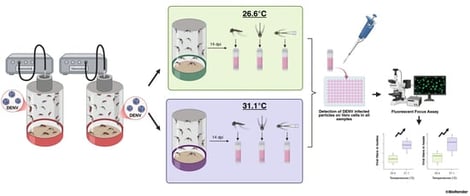
Dengue virus (DENV) is a major public health concern in tropical and subtropical regions, including the Pacific. Temperature is recognised as a major driver of transmission under climate change. Understanding how higher temperatures may alter DENV transmission is essential to anticipate future dengue risk. Therefore, we assessed the effect of temperature on DENV-1 in Aedes aegypti from New Caledonia. Mosquitoes were orally infected and maintained for 14 days at 26.6 °C (average temperatures during recent outbreaks) or 31.1 °C (SSP5-8.5 scenario projected temperatures). Mosquito bodies, heads, and saliva were analysed separately to determine infection, dissemination, and transmission rates as well as transmission efficiencies. Infectious virus was detected by using a fluorescent focus assay, and viral titres were quantified via TCID50 assays. No significant differences were observed in infection, dissemination, and transmission rates or transmission efficiencies between the two temperatures. However, DENV titres in mosquito bodies and heads were significantly higher at 31.1 °C than 26.6 °C. Our results indicate that elevated temperature increases viral loads within the insect but not the proportion of infectious mosquitoes, highlighting the importance of considering temperature as a key parameter in assessing dengue risk under climate change. Further studies are needed to investigate the effects of temperature on virus–mosquito interactions.
14 February 2026