


You are currently on the new version of our website. Access the old version .

Nanomaterials

Nanomaterials is an international, interdisciplinary, peer-reviewed, open access journal published semimonthly online by MDPI, and that publishes reviews, regular research papers, communications, and short notes that are relevant to any field of study that involves nanomaterials with respect to their science and applications.
The Spanish Carbon Group (GEC) and The Chinese Society of Micro-Nano Technology (CSMNT) are affiliated with Nanomaterials and their members receive discounts on the article processing charges.
Indexed in PubMed | Quartile Ranking JCR - Q2 (Physics, Applied | Chemistry, Multidisciplinary | Materials Science, Multidisciplinary | Nanoscience and Nanotechnology)

All Articles (21,646)

Shale oil reservoirs are complex multi-scale nanoporous media where fluid transport is governed by coupled micro-mechanisms, demanding a robust modeling framework. This study presents a novel fluid–solid coupling (FSC) numerical model that rigorously integrates the three primary scale-dependent transport phenomena: adsorption in organic nanopores, slip effects in inorganic micropores, and stress-sensitive conductivity in fractures. The model provides essential quantitative insights into the dynamic interaction between fluid withdrawal and reservoir deformation. Simulation results reveal that microstructural properties dictate the reservoir’s mechanical stability. Specifically, larger pore diameters and higher porosity enhance stress dissipation, promoting long-term stress relaxation and mitigating permeability decay. Crucially, tortuosity governs the mechanical response by controlling pressure transmission pathways: low tortuosity causes localized stress concentration, leading to rapid micro-channel closure, while high tortuosity ensures stress homogenization, preserving long-term permeability. Furthermore, high fracture conductivity induces a severe, heterogeneous stress field near the wellbore, which dictates early-stage mechanical failure. This work provides a powerful, mechanism-based tool for optimizing micro-structure and production strategies in unconventional resources.

21 January 2026
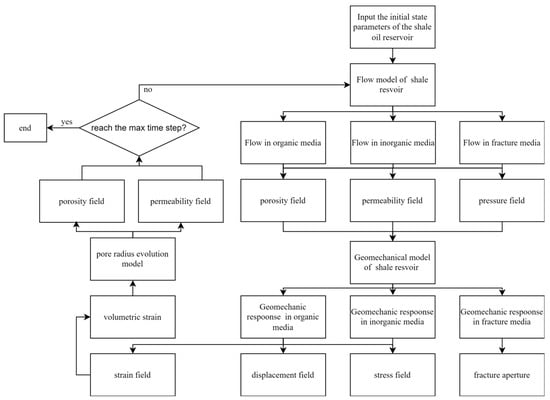
Microscale fluid–structure interaction process in shale reservoirs.

The combination of nanogenerator technology and traditional textile materials has given rise to textile-based triboelectric nanogenerators (T-TENGs) structured from fibers, yarns, and fabrics. Due to their lightweight, flexibility, washability, and cost-effectiveness, T-TENGs offer a promising platform for powering and sensing in next-generation wearable electronics, with particularly significant potential in smart healthcare and sports monitoring. However, the inherent electrical and structural limitations of textile materials often restrict their power output, signal stability, and sensing range, making it challenging to achieve both high electrical performance and high sensing sensitivity. This review focuses on the application of T-TENGs in smart healthcare and sports. It systematically presents recent developments in textile material selection, sensing structure, fabric design, working mechanisms, accuracy optimization, and practical application scenarios. Furthermore, it provides a critical analysis of the recurring structural and material limitations that constrain performance and offers constructive pathways to address them. Key challenges such as the low charge density of textile interfaces may be mitigated by selecting low-hygroscopicity materials, applying hydrophobic treatments, and optimizing textile structures to enhance contact efficiency and environmental stability. Issues of signal instability under dynamic deformation call for advanced structural designs that accommodate strain without compromising electrical pathways, coupled with robust signal processing algorithms. By providing a comparative analysis across materials and structures, this review aims to inform future designs and accelerate the translation of high-performance T-TENGs from laboratory research to real-world implementation.

21 January 2026

(a) (i) Schematic illustration of the ultraflexible sensor (UFS). (ii) Dynamic pressure response of the UFS under static conditions at applied forces of 500, 1000, and 1500 mN. Adapted with permission from Ref. [84]. Copyright 2003 John Wiley and Sons. (b) A flexible sensing array composed of an Ecoflex film and a TPU nanofiber composite layer. (i) Structural schematic of a single sensor unit. (ii) Measured signals of pulse monitoring at multiple localized positions on the wrist. Adapted from Ref. [88]. (c) Fabrication process of the TENG for smart fabric (SF) applications and its corresponding response signals. Adapted with permission from Ref. [90]. Copyright 2021 American Chemical Society. (d) Structure, sensitivity, and pulse wave experimental measurements of a triboelectric all-fiber-structured pressure sensor for pulse wave monitoring. (i) Design schematic of the textile-based sensor. (ii) Real-time output signals when the sensor fabric is worn on the wrist. Adapted with permission from Ref. [84]. Copyright 2020 American Chemical Society.

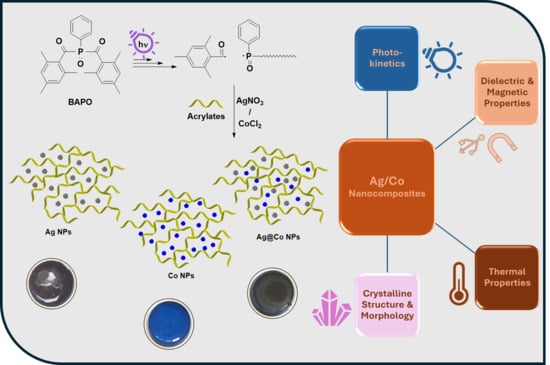
In this study, we report a reproducible in situ photochemical method for the simultaneous synthesis of metallic and hybrid metal/metal oxide nanoparticles (NPs) within a UV–curable polymer matrix. A series of epoxy diacrylate-based formulations (BEA) was prepared, consisting of Epoxy diacrylate, Di(Ethylene glycol)ethyl ether acrylate (DEGEEA), and Phenylbis (2,4,6-trimethylbenzoyl) phosphine oxide (BAPO), which served as a Type I photoinitiator. These formulations were designed to enable the simultaneous photopolymerization and photoreduction of metal precursors at various Ag+/Co2+ ratios, resulting in nanocomposites containing in situ-formed Ag NPs, cobalt oxide NPs, and hybrid Ag–Co3O4 nanostructures. The photochemical, magnetic, and dielectric properties of the resulting nanocomposites were evaluated in comparison with those of the pure polymer using UV–Vis and Fourier Transform Infrared Spectroscopy (FT-IR), Photo-Differential Scanning Calorimetry (Photo-DSC), Thermogravimetric Analysis (TGA), Scanning Electron Microscopy (SEM), X-Ray Diffraction (XRD), Impedance Analysis, and Vibrating Sample Magnetometry (VSM). Photo-DSC studies revealed that the highest conversion values were obtained for the BEA-Ag1Co1, BEA-Co, and BEA-Ag1Co2 samples, demonstrating that the presence of Co3O4 NPs enhances polymerization efficiency because of cobalt species participating in redox-assisted radical generation under UV irradiation, increasing the number of initiating radicals and leading to faster curing and higher final conversion. On the other hand, the Ag NPs, due to the SPR band formation at around 400 nm, compete with photoinitiator absorbance and result in a gradual decrease in conversion values. Crystal structures of the NPs were confirmed by XRD analyses. The dielectric and magnetic characteristics of the nanocomposites suggest potential applicability in energy-storage systems, electromagnetic interference mitigation, radar-absorbing materials, and related multifunctional electronic applications.

21 January 2026

Changes observed during the curing process of EA/DEGEEA-based nanocomposite films within silicone molds: (a) BEA, (b) BEA-Ag, (c) BEA-Co, (d) BEA-Ag1Co1, (e) BEA-Ag1Co2, (f) BEA-Ag2Co1.

Applications of Nano-Selenium in the Poultry Industry: An Overview

  • Aya Ferroudj,
  • Hassan El-Ramady and
  • József Prokisch

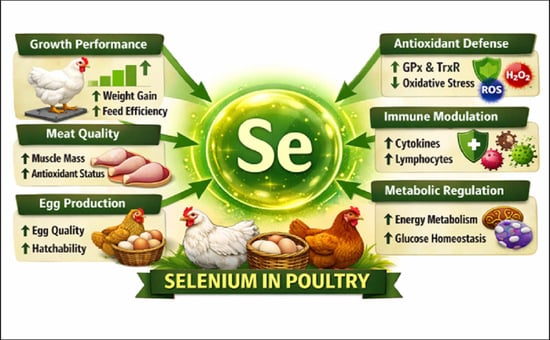
Nanotechnology has emerged as a transformative tool in animal production, offering novel strategies to enhance productivity, health, and product quality. Among trace elements, selenium (Se) plays an essential role in antioxidant defence, immune regulation, and redox balance through its incorporation into selenoproteins. Selenium nanoparticles (SeNPs), synthesized via chemical, physical, or biological methods, have shown superior bioavailability, stability, and lower toxicity compared to traditional organic and inorganic selenium forms. This review explores the synthesis, physicochemical properties, and metabolic fate of SeNPs, emphasizing their advantages in poultry production systems. In poultry, SeNPs exhibit potent antioxidant and anti-stress effects by enhancing the activity of glutathione peroxidase, superoxide dismutase, and thioredoxin reductase, thereby mitigating lipid peroxidation and oxidative tissue damage. Their immunomodulatory effects are linked to improved lymphocyte proliferation, cytokine regulation, and increased immunoglobulin levels under normal and stress conditions. SeNP supplementation has been associated with enhanced growth performance, feed efficiency, carcass quality, and reproductive outcomes in broilers, layers, and quails. Furthermore, selenium nanoparticles have demonstrated therapeutic potential in preventing or alleviating chronic diseases such as cancer, diabetes, cardiovascular dysfunction, and neurodegenerative disorders. SeNPs also serve as biofortification agents, increasing selenium deposition in poultry meat and eggs, thus improving their nutritional value for human consumption. However, selenium’s narrow safety margin requires careful dose optimization to avoid potential toxicity. This review highlights the multifaceted benefits of selenium nanoparticles in poultry nutrition and health, while underscoring the need for further studies on grey SeNPs, long-term safety, and regulatory frameworks. Integrating SeNPs into poultry production represents a promising strategy to bridge animal health, food security, and public nutrition.

21 January 2026

Aggregation of purified red selenium nanoparticles (Se0) spherical particles observed using scanning electron microscopy (SEM).

News & Conferences

Issues

Open for Submission

Editor's Choice

Get Alerted

Add your email address to receive forthcoming issues of this journal.

XFacebookLinkedIn
Nanomaterials - ISSN 2079-4991