
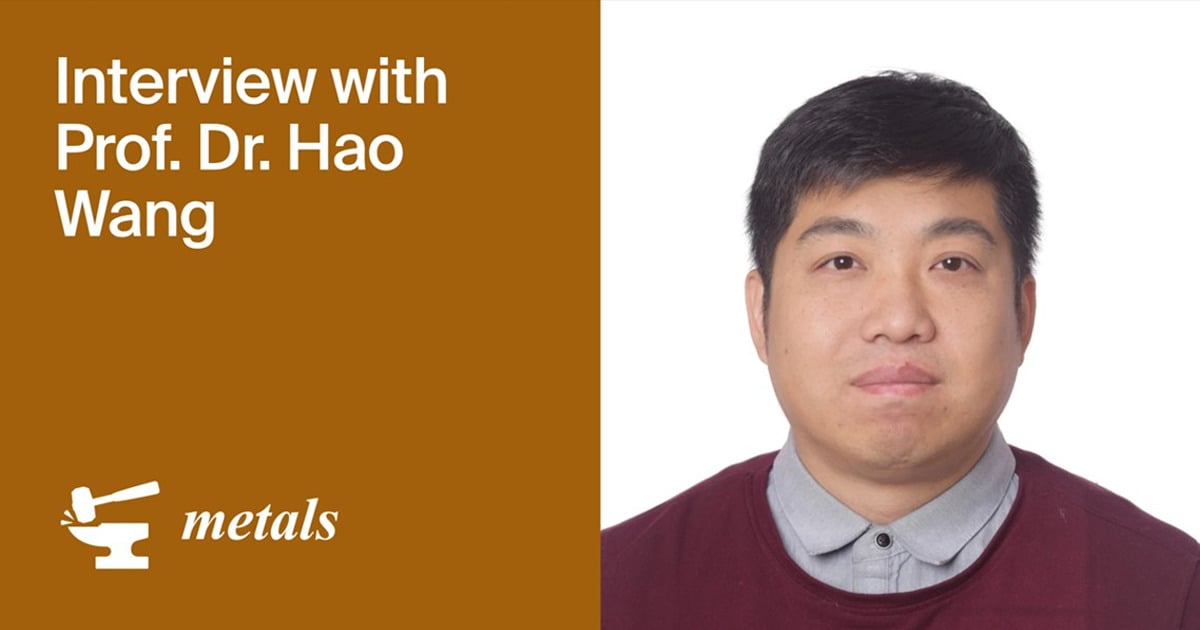
Metals | Interview with the Editorial Board Member—Prof. Dr. Hao Wang
We are pleased to share the following interview with Prof. Dr. Hao Wang, Editorial Board Member of Metals (ISSN 2075-4701).
Prof. Dr. Hao Wang is a professor at the Institute of Metal Research, Chinese Academy of Sciences, Shenyang, China. His research focuses on material genome approaches to the design of advanced metallic materials, including the design and additive manufacturing of porous structures with high-performance titanium alloys (Ti-6Al-4V). He was previously affiliated with the Interdisciplinary Center for Additive Manufacturing at the University of Shanghai for Science and Technology.
Prof. Wang’s work has applications in aerospace engineering, where high impact resistance combined with low density is essential, and in biomedical engineering, which he notes is more demanding and still requires further investigation. He has served as a Guest Editor for several Special Issues in Metals and joined its Editorial Board in October 2026. He is currently co-editing the Special Issue “Properties, Microstructure and Forming of Intermetallics—2nd Edition” for Metals.
The following is an interview with Prof. Dr. Hao Wang:
Could you tell us about your main research interests and current work?
One of my research directions is the additive manufacturing of high-performance materials and parts, including porous structures. I have been working in this field for several years, exploring different materials and approaches to improving their mechanical performance and structural properties. My broader research interests also include material genome approaches, which help to accelerate the design and screening of new metallic materials.
What are the main applications of your research, and what challenges do you encounter?
One of the key application areas is aerospace engineering, where materials must combine high impact resistance with low density. Additively manufactured porous structures offer interesting possibilities for achieving these properties through careful structural design. Biomedical applications are another area of interest, although they present additional challenges and require further investigation to meet their specific performance requirements.
Which of your publications has received particular attention, and why do you think it has been widely cited?
One paper that has attracted considerable attention is “Predictability of Different Machine Learning Approaches on the Fatigue Life of Additive-Manufactured Porous Titanium Structure”, published in Metals. In my opinion, its strong citation performance is related to the growing interest in titanium alloys, porous structures, and their mechanical properties. The study also addresses the application of machine learning to fatigue-life prediction, connecting materials science with artificial intelligence methods. I have also been working for about two years on another manuscript in this area, which I hope to complete in the near future.
What do you think journals can do to strengthen their reputation and visibility?
From my own experience, Metals offers a fast publication process and is well accepted by the wider scientific community. Although open access journals were previously perceived as being of lower quality, Metals has built a good reputation over the years. I believe that inviting well-recognized scholars in their respective fields to contribute to the journal is important. Their expertise and involvement can help strengthen the journal’s scientific standing and encourage further contributions from researchers.
Organizing seminars and academic events would also be beneficial, as these activities provide opportunities to exchange ideas, establish collaborations, and introduce the journal to a broader audience. In addition, more active promotion could help increase its visibility and engagement within the research community.
What factors do you consider when choosing a journal for your research?
My main considerations are the relevance of the journal to the research topic, its reputation, and its impact factor. Since my work focuses primarily on computational design of structural metallic materials, I look for journals that are well established in these fields and reach the appropriate scientific audience. I consider reputation more important than impact factor alone.
You are currently editing the Special Issue “Properties, Microstructure and Forming of Intermetallics—2nd Edition”. From your perspective as a Guest Editor, what potential value do you think this Special Issue can bring to research or industrial practice in your field?
The study of intermetallic compounds has garnered significant attention due to their unique properties, which include high melting points, excellent oxidation resistance, and superior mechanical strength. These characteristics make intermetallics ideal for applications in aerospace, automotive, and high-temperature environments. The aim of the present Special Issue is to bring the latest scientific advances, and by focusing the properties, microstructures and forming, it is supposed to bridge the gap between fundamental science and practical applications, paving the way for innovative solutions in materials engineering.
Finally, what would you like to see from academic journals in the future?
I would like to see journals continue to strengthen their scientific reputation by prioritizing high-quality research, constructive peer review, and meaningful engagement with researchers. A balanced approach that combines an efficient editorial process with rigorous scientific assessment would benefit both authors and the wider research community. I also believe that greater visibility, stronger academic networks, and opportunities for collaboration can help journals develop and maintain their standing within their respective fields. I would also encourage journals to protect the quality of reviewer reports, even when the editorial process has to be fast. Excessively long reports containing comments that are not particularly meaningful do not really help authors, and editors should feel confident about setting such reports aside and requesting additional ones when necessary.