



Journal Menu
► ▼ Journal Menu-
- Metals Home
- Aims & Scope
- Editorial Board
- Reviewer Board
- Topical Advisory Panel
- Early Career Editorial Board
- Instructions for Authors
- Special Issues
- Topics
- Sections
- Article Processing Charge
- Indexing & Archiving
- Editor’s Choice Articles
- Most Cited & Viewed
- Journal Statistics
- Journal History
- Journal Awards
- Society Collaborations
- Conferences
- Editorial Office
Journal Browser
► ▼ Journal BrowserNeed Help?
Announcements
12 September 2026
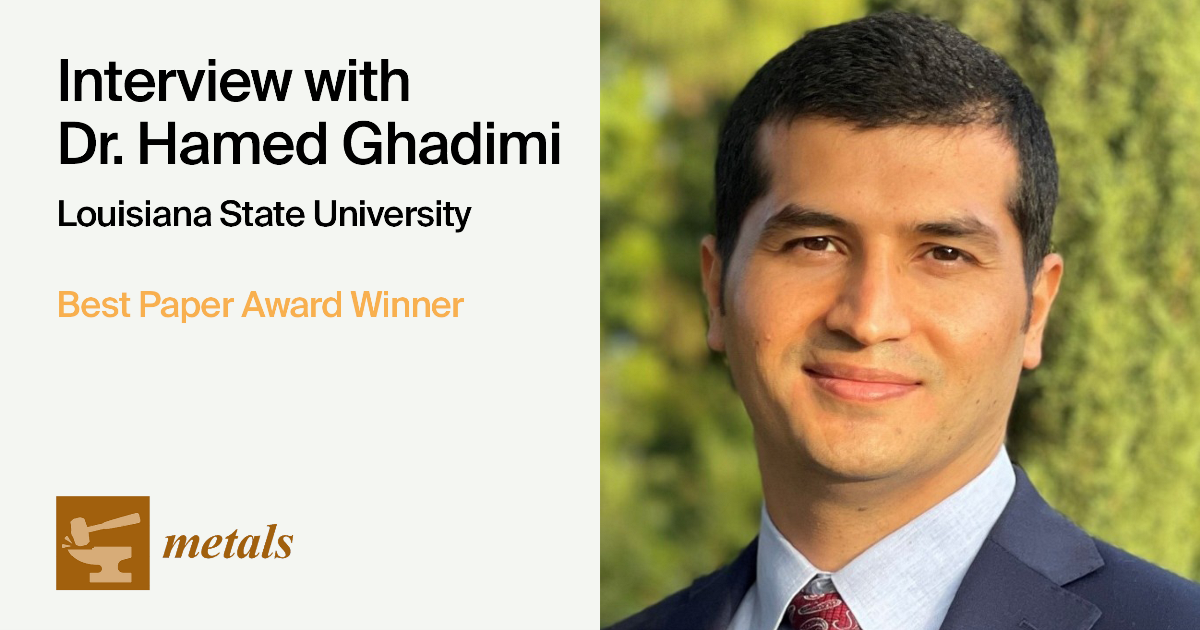
Interview with Dr. Hamed Ghadimi–Winner of the Metals Best Paper Award
“The Effects of Layer Thickness on the Mechanical Properties of Additive Friction Stir Deposition-Fabricated Aluminum Alloy 6061 Parts”
by Hamed Ghadimi, Mojtaba Talachian, Huan Ding, Selami Emanet and Shengmin Guo
Metals 2024, 14(1), 101; https://doi.org/10.3390/met14010101
1. Congratulations on winning the Metals 2024 Best Paper Award! Could you please briefly introduce yourself?
Thank you! I am Hamed Ghadimi. I hold a PhD in materials science and engineering, and my research focuses on understanding the mechanical and microstructural properties of metal additive manufacturing (AM) components and how processing parameters influence those properties.
My PhD research began with the development of a test methodology for high-frequency bending fatigue testing of AM components, which I applied to a stainless-steel alloy produced by bound powder extrusion method. My focus then shifted to aluminum alloys processed by additive friction stir deposition (AFSD). I first published a study on the microstructural and mechanical properties of AFSD-fabricated AA2050, followed by this award-winning paper examining the effects of deposition layer thickness on the mechanical properties of AFSD-fabricated AA6061. In total, four journal articles from this line of research formed the core of my PhD dissertation. I also contributed as a co-author to multiple publications from our research team.
Alongside my PhD, I pursued a master’s degree in computer science at Louisiana State University (LSU) because I believe researchers should be equipped to integrate advanced data analytics and artificial intelligence into their work. For my master’s thesis, I applied data analysis and machine learning techniques to two years of in-process deposition data I collected to predict defects in AFSD components.
Since graduating, I have worked in several capacities as an additive manufacturing materials and process engineer. I currently work at Seurat Technologies, a company developing advanced laser powder bed fusion technology. Throughout my career, I have focused on advancing AM for mission-critical applications. I have also remained connected to academia by reviewing journal manuscripts and continuing to collaborate with my former research group on publications.
2. How does it feel to receive the Metals Best Paper Award? What does this recognition mean to you?
It is an honor, and it means a great deal to me personally. This paper required careful planning, extensive hands-on experimental work, data collection, mechanical testing, statistical analysis, rigorous interpretation, and writing. Having that effort recognized by Metals validates not only the conclusions we reached, but also the rigor we brought to the entire research process. It also recognizes the collaborative effort behind the paper: my co-authors, our research group, and our funding and institutional partners were essential to completing this work. Dr. Michael (Mojtaba) Talachian, now at the University of Arizona, made a major contribution by performing more than one hundred tensile tests using a unique Digital Image Correlation (DIC) setup that he developed. Dr. Huan Ding, an expert in materials characterization, provided critical microscopic characterization and insights that helped us understand the microstructure-property relationships in the AFSD-fabricated materials. Dr. Selami Emanet contributed his specialized expertise in electrical discharge machining (EDM), which was essential for precisely fabricating the specimens required for mechanical testing. Finally, Dr. Guo provided excellent supervision and research leadership throughout the project, bringing together the team’s complementary expertise and guiding the work from experimental design through analysis and publication. In addition, this research was conducted with support from the Center for Innovations in Structural Integrity Assurance (CISIA), a National Science Foundation (NSF) Industry/University Cooperative Research Center at LSU. The authors also used instruments housed within the LSU Advanced Microscopy and Analytical Core (AMAC), a part of the Louisiana Materials Design Alliance (LAMDA) Core User Facilities supported by NSF Grant No. OIA-1946231 and Louisiana Board of Regents. These shared research capabilities and collaborative resources were important to the successful completion of the work.
3. Could you introduce the research focus and the key findings of this award-winning paper?
The paper examines additive friction stir deposition (AFSD), a solid-state metal AM process that builds components layer by layer by frictionally softening and depositing feedstock rod without melting it. We fabricated three types of AA6061 aluminum blocks using deposition layer thicknesses of 1 mm, 2 mm, and 3 mm and systematically characterized their properties through uniaxial tensile testing and Vickers microhardness mapping, with the results evaluated using statistical analysis tools.
The key finding was that layer thickness has a clear, statistically significant effect on tensile properties in the build (Z) direction, but not in the in-plane X and Y directions. Z-direction specimens from the 1 mm block exhibited noticeably lower fracture strain and ultimate tensile strength than their counterparts from the 2 mm and 3 mm blocks. Vickers microhardness also decreased nonlinearly along the build height in every block, more steeply near the top and then leveling off toward the bottom, and the average hardness of the 1 mm block was measurably lower than that of the 2 mm and 3 mm blocks.
We linked these trends to the thermomechanical history of each build. Because the deposition tool’s protrusions are taller than a 1 mm layer, thinner-layer builds are re-stirred into the previous one or two layers on every pass, whereas in the 3 mm block, the tool does not contact the previously deposited layer. This difference changes how heat is generated and retained, affecting dynamic aging and precipitate behavior in this precipitation-strengthened alloy. These mechanisms ultimately produce the location- and direction-dependent mechanical response we measured. Overall, the as-deposited material was consistently softer and more ductile, but less strong, than the wrought AA6061 feedstock.
4. As an author, what do you consider the most important qualities of a strong research paper, regardless of the specific scientific field?
A few things stand out to me. First, a strong paper should identify a clear research gap: the reader should immediately understand what was not known before and why it matters. Second, methodological rigor and transparency are essential: authors should report sufficient detail, including process parameters, specimen counts, statistical assumptions, and analysis methods, so that another group could reproduce the work. Third, the data should drive the narrative, with conclusions supported by appropriate statistical evidence rather than by overstating trends that are not significant. Fourth, the findings should be connected to the underlying physical mechanisms. A strong paper tells the reader not only what happened, but also why it happened.
Finally, I believe strong research papers are increasingly multidisciplinary and collaborative. Researchers with different areas of expertise can come together around a common problem and produce work that is genuinely greater than the sum of their individual contributions. This paper is a good example: it benefited from the collaborative research environment at LSU, including CISIA and the advanced characterization capabilities available through the LSU Advanced Microscopy and Analytical Core (AMAC).
5. Which research topics do you think will be of particular interest to the research community in the coming years?
In metal additive manufacturing specifically, I expect continued growth in solid-state processes such as AFSD and related technologies. Because these processes avoid melting, they can mitigate fusion-related defects such as porosity and hot cracking and may also enable the use of recycled or lower-cost feedstock, both of which are attractive from sustainability and cost perspectives. I also expect process-structure-property linkage research to expand, increasingly supported by in situ process monitoring, nondestructive evaluation techniques such as neutron imaging and diffraction, and AI- and machine learning-based defect prediction. The field is moving from demonstrating that a process works toward qualifying and certifying it for mission-critical applications in the medical, aerospace, defense, and energy sectors. Fatigue behavior, residual stress, and location- and orientation-dependent property variation will remain central themes as industry pushes toward broader qualification of additively manufactured components for service.
6. Publishing in an open access journal increases visibility and accessibility. How do you feel the open access model of Metals will support the dissemination and impact of your research?
Open access matters a great deal in a field like metal additive manufacturing, where the audience spans academic researchers, industry process engineers, and students who may not have institutional journal access. Publishing with Metals means that our methodology, results, and statistical analyses are freely available to anyone working on AFSD or related solid-state AM processes, without a paywall limiting access. Our raw and processed data are also publicly available on GitHub. I believe this combination of open access publication and openly available research data can accelerate understanding, reproducibility, and ultimately wider adoption of a relatively young technology such as AFSD.
