
Skip to Content

Materials

Materials is an international peer-reviewed, open access journal on materials science and engineering published semimonthly online by MDPI.
The Spanish Materials Society (SOCIEMAT), Manufacturing Engineering Society (MES) and Chinese Society of Micro-Nano Technology (CSMNT) are affiliated with Materials and their members receive discounts on the article processing charges.
Indexed in PubMed | Quartile Ranking JCR - Q2 (Metallurgy and Metallurgical Engineering | Physics, Applied | Physics, Condensed Matter)

All Articles (54,812)

The surface quality and production efficiency of continuous-casting steel slabs are predominantly determined by the performance of the mold. To address slab corner defects and enhance operational stability, this study systematically optimized two key components: the broad-face clamping mechanism and the narrow-face copper plate. A disk spring–hydraulic composite clamping mechanism was designed and subjected to mechanical analysis to ensure sufficient and reliable clamping force under high-load casting conditions. Meanwhile, based on the principle of solidification shrinkage, an external chamfer structure for the narrow-face copper plate was proposed to improve heat transfer uniformity at the slab corner. Engineering design calculations and practical application in an export-oriented wide-and-heavy slab continuous-casting project (specification: 250 mm × 2500 mm) demonstrated that the optimized clamping mechanism provides enhanced structural rigidity, while the new narrow-face copper plate effectively mitigates corner cracks and reduces wear. This integrated design approach significantly improves slab surface quality and extends component service life, yielding substantial economic benefits.

25 February 2026
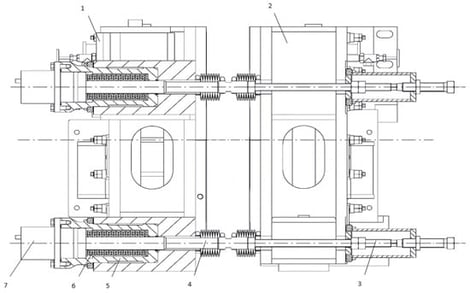
Structure and installation method of the clamping mechanism: 1. outer arc side cooling water tank; 2. inner arc side cooling water tank; 3. adjusting device; 4. pull rod; 5. sleeve; 6. disk spring; 7. hydraulic cylinder.

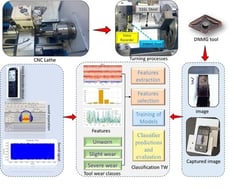
Reliable tool-wear monitoring is essential for maintaining machining quality and preventing unscheduled downtime in manufacturing. This investigation presents a sound-based classification framework for identifying wear states in the turning of AISI 316L stainless steel using advanced gradient-boosting models. Acoustic signals were recorded under constant cutting parameters to eliminate process-induced variability, and each recording was divided into standardized 2 s segments. A total of 540 multidomain features—including RMS, ZCR, spectral descriptors, Mel-spectrogram statistics, MFCCs and their derivatives, and discrete wavelet energies—were extracted to capture both stationary and transient characteristics of tool–workpiece interactions. Feature selection was performed using a three-stage pipeline comprising Boruta, LASSO, and SHAP analysis, resulting in a compact subset of highly informative descriptors. LightGBM, XGBoost, and CatBoost classifiers were trained using stratified 10-fold cross-validation across three wear states: Unworn, Slight wear, and Severe wear. LightGBM and XGBoost achieved the best performance, with mean accuracies above 0.96 and strong PRC–AUC and ROC–AUC values (0.98–1.00). Although Slight wear remained the most difficult class due to its transitional acoustic characteristics, all models showed clear separability for Unworn and Severe wear conditions. The results confirm that boosted decision-tree methods combined with SHAP-enhanced feature selection provide an effective, low-cost, and non-contact solution for tool-wear classification in 316L turning.

25 February 2026

AISI 316L stainless steel used in turning.

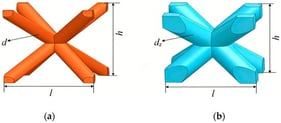
Lattice structures are the ideal choice for lightweight, high-strength, and energy-absorbing applications. In this study, the mechanical response of Stretching–Bending Synergistic Lattices (SBSLs) fabricated from 316L stainless steel is investigated under dynamic compression at high strain rates using finite element modeling (FEM), which has been experimentally validated. The results show that the strain rate has a significant influence on specific strength and specific energy absorption (SEA). When the strain rate increases from 100 s−1 to 1000 s−1, the specific strength increases by 75.6%. A smaller cell height enhances overall impact resistance. The increase in the diameter of the backbone cell rod can simultaneously enhance the SEA and specific strength. To maximize SEA, optimization models for uniform SBSLs and gradient SBSLs are respectively constructed. When the relative density varies, the SEA of the optimized uniform SBSLs has increased by 275.4% and 368.8% compared with the initial SBSL and uniform lattice (UL) designs, respectively. Similarly, the SEA of the gradient SBSLs is enhanced by 154% and 217% compared to the initial design of SBSLs and ULs, respectively. This work deepens understanding of rate-dependent deformation in multi-layer lattices, guiding their design for dynamic loading.

25 February 2026

Structure diagram of lattice cells: (a) matrix cells of SBSLs, (b) backbone cells of SBSLs.

As nanofabrication advances toward atom-by-atom control of surface morphology, plasmonic electrodes and nanogap devices are being pushed into a regime where atomic-scale protrusions and sub-nanometer separations become accessible. In this extreme limit, classical electrodynamics becomes unreliable because it cannot capture quantum effects. To this end, we compute the optical response of metallic sub-nanometer nanogaps containing atomic-scale protrusions by employing quantum hydrodynamic theory (QHT), and benchmark the predictions against the classical local-response approximation (LRA). We revealed that atomic-scale variations in protrusion can leave the far-field scattering spectrum nearly unchanged while profoundly reshaping tnear-field nanofocusing. Upon a continuous decrease in the nanogap, QHT successfully predicts non-monotonic spectral evolution with a redshift-to-blueshift deflection point accompanied via a suppression of field enhancement, whereas LRA yields a continuous redshift and a monotonic increase in field enhancement. We further demonstrated that such an inflection point is tunable, as determined by the atomic morphology of the electrodes, which provide a theoretical foundation for the experimental observation of varied inflection points. These results provide a practical route to optically diagnose and engineer tunneling-enabled charge exchange and quantum-regulated nanofocusing in extreme plasmonic nanogaps, and offer design guidance for molecular-scale optoelectronic and nanophotonic devices.

25 February 2026

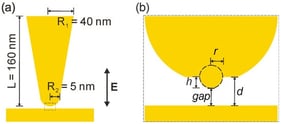
Geometry and parameter definitions for the tip–substrate nanogap. (a) Schematic of the tip–substrate geometry: a conical top electrode terminated by a spherical apex (apex radius 5 nm; cone base radius 40 nm; cone length 160 nm) facing a planar bottom electrode. (b) Enlarged view of the junction region highlighting an atomic-scale protrusion at the apex center. The protrusion is parameterized by its radius r and height h. The nominal electrode separation d is defined between the bottom of the spherical apex (excluding the protrusion) and the substrate surface, while the physical gap is defined as gap = d − h between the protrusion apex and the substrate surface.

News & Conferences

Issues

Open for Submission

Editor's Choice

Reprints of Collections

Feature Papers in Materials Physics (2nd Edition)
Reprint

Feature Papers in Materials Physics (2nd Edition)

Editors: Vlassios Likodimos, Andres Sotelo
Recent Research in Restorative Dental Materials
Reprint

Recent Research in Restorative Dental Materials

Editors: Leszek Szalewski, Ingrid K. Różyło-Kalinowska

Get Alerted

Add your email address to receive forthcoming issues of this journal.

XFacebookLinkedIn
Materials - ISSN 1996-1944