




materials-logo

Journal Browser

Journal Browser

Advanced Polymers and Composites for Multifunctional Applications, 2nd Edition

A special issue of Materials (ISSN 1996-1944). This special issue belongs to the section "Polymeric Materials".

Deadline for manuscript submissions: 31 January 2027 | Viewed by 1776
Editors


E-Mail Website
Guest Editor
Department of Glass Technology and Amorphous Coatings, Faculty of Materials Science and Ceramics, AGH University of Krakow, Al. Mickiewicza 30, 30-059 Krakow, Poland
Interests: polymers; (nano)composites; polysaccharides; biomaterials; phase change materials; thermal analysis; material characterization
Special Issues, Collections and Topics in MDPI journals

E-Mail Website
Guest Editor
Department of Glass Technology and Amorphous Coatings, Faculty of Materials Science and Ceramics, AGH University of Krakow, Al. Mickiewicza 30, 30-059 Krakow, Poland
Interests: polymers; (nano)composites; biomaterials; material characterization; magnetic nanoparticles
Special Issues, Collections and Topics in MDPI journals

E-Mail Website
Guest Editor
Department of Glass Technology and Amorphous Coatings, Faculty of Materials Science and Ceramics, AGH University of Krakow, Al. Mickiewicza 30, 30-059 Krakow, Poland
Interests: polymers; biocomposites; material characterization
Special Issues, Collections and Topics in MDPI journals

Special Issue Information

Dear Colleagues,

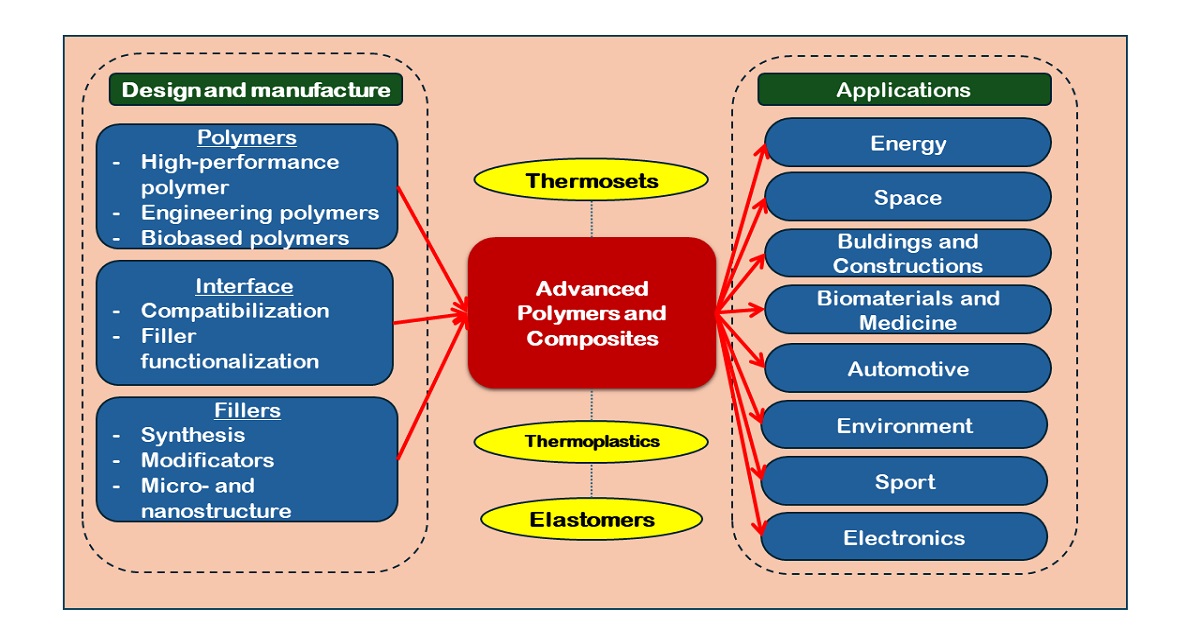
Advanced polymers and composites are an interesting and rapidly growing class of novel multifunctional materials with desirable properties, intended for specialized applications. They are considered promising materials for multifunctional applications, including biomedical,  aerospace, automotive, electronics, energy, construction, and buildings, as well as in the chemical industry.

The structure and properties of advanced polymers and their composites strongly depend not only on the type of polymer matrix; its average molar mass, dispersity, and structure; and the architecture of the polymer chains, but also on the filler’s type and content, shape, size, and compatibility with the polymer matrix. Both fillers and nanofillers can strongly influence thermal and mechanical properties, flame retardancy, and thermal and electrical conductivity. However, further functionalization and modifications can provide new properties and allow for the development of multifunctional systems for advanced applications.

This Special Issue of Materials will attempt to cover the most recent progress in advanced and high-performance multifunctional polymer (nano)composites, including their preparation, compatibilization, and processing, along with the properties and methods of their characterization. Papers on the applications of advanced multifunctional polymer (nano)composites, ranging from automotive and buildings, mechanical engineering, and energy to electronics and biomedicine, are welcome. We hope that this Special Issue will present perspectives on advanced multifunctional polymer systems.

In this Special Issue, full research papers and reviews will be published.

Prof. Dr. Kinga Pielichowska
Dr. Katarzyna Nowicka
Dr. Piotr Szatkowski
Guest Editors

Manuscript Submission Information

Manuscripts should be submitted online at www.mdpi.com by registering and logging in to this website. Once you are registered, click here to go to the submission form. Manuscripts can be submitted until the deadline. All submissions that pass pre-check are peer-reviewed. Accepted papers will be published continuously in the journal (as soon as accepted) and will be listed together on the special issue website. Research articles, review articles as well as short communications are invited. For planned papers, a title and short abstract (about 250 words) can be sent to the Editorial Office for assessment.

Submitted manuscripts should not have been published previously, nor be under consideration for publication elsewhere (except conference proceedings papers). All manuscripts are thoroughly refereed through a single-anonymized peer-review process. A guide for authors and other relevant information for submission of manuscripts is available on the Instructions for Authors page. Materials is an international peer-reviewed open access semimonthly journal published by MDPI.

Please visit the Instructions for Authors page before submitting a manuscript. The Article Processing Charge (APC) for publication in this open access journal is 2600 CHF (Swiss Francs). Submitted papers should be well formatted and use good English. Authors may use MDPI's English editing service prior to publication or during author revisions.

Keywords

  • polymer composites
  • nanocomposites
  • advanced polymers
  • high-performance polymers
  • multifunctional systems
  • properties and structure of functional polymer composites
  • degradation and stability of polymer composites
  • functional polymer composites for the environment

Benefits of Publishing in a Special Issue

  • Ease of navigation: Grouping papers by topic helps scholars navigate broad scope journals more efficiently.
  • Greater discoverability: Special Issues support the reach and impact of scientific research. Articles in Special Issues are more discoverable and cited more frequently.
  • Expansion of research network: Special Issues facilitate connections among authors, fostering scientific collaborations.
  • External promotion: Articles in Special Issues are often promoted through the journal's social media, increasing their visibility.
  • Reprint: MDPI Books provides the opportunity to republish successful Special Issues in book format, both online and in print.

Further information on MDPI's Special Issue policies can be found here.

Related Special Issue

Published Papers (3 papers)

Order results
Result details
Select all
Export citation of selected articles as:

Research

19 pages, 12611 KB  
Article
Candidate Biopolymer Composite Membranes for Carbonic Anhydrase Immobilization in Enzymatic Direct Air Capture
by Spas Kerimov, Victoria Atanassova, Georgi Yankov, Radostin Stefanov, Ekaterina Iordanova, Georgi Marinov, Hristo Kalaydzhiev and Albert Krastanov
Materials 2026, 19(13), 2869; https://doi.org/10.3390/ma19132869 - 5 Jul 2026
Abstract
Direct air capture (DAC) requires carbon capture interfaces that operate under highly dilute CO2 conditions while minimizing thermal and chemical regeneration penalties. Carbonic anhydrase (CA) accelerates the reversible hydration of CO2 to bicarbonate and is therefore a strong biocatalytic candidate for [...] Read more.
Direct air capture (DAC) requires carbon capture interfaces that operate under highly dilute CO2 conditions while minimizing thermal and chemical regeneration penalties. Carbonic anhydrase (CA) accelerates the reversible hydration of CO2 to bicarbonate and is therefore a strong biocatalytic candidate for low-temperature CO2 capture, but its implementation depends on candidate support materials that combine wet-state accessibility, chemical reactivity, mechanical processability and compatibility with membrane architectures. This study reports the preparation and screening of N-(3-dimethylaminopropyl)-N′-ethylcarbodiimide hydrochloride/N-hydroxysuccinimide (EDC/NHS)-reactive biopolymer composite membranes for future carbonic anhydrase (CA) immobilization. Chitosan particles were precipitated with citrate or tripolyphosphate under high-shear homogenization and compared after lyophilization or convective drying. Chitosan-, shellac-, agarose- and cellulose-acetate-based films plasticized with glycerol and/or polyethylene glycol 400 (PEG-400) were then evaluated by optical microscopy, dry-state penetrometric puncture testing, qualitative EDC/NHS-reactivity mapping and Fourier-transform infrared spectroscopy (FTIR). Freshly precipitated chitosan particles showed dendrite-like high-surface morphologies, while lyophilization preserved porous flocculated aggregates and convective drying produced denser collapsed structures. Neat chitosan showed the highest dry-state puncture force (2.230 ± 0.173 N), whereas chitosan/shellac (0.377 ± 0.044 N) and agarose/chitosan/PEG-400 (0.386 ± 0.038 N) provided the strongest reactive-composite compromise between dry-state puncture resistance and EDC/NHS compatibility. The EDC/NHS reactivity map identified chitosan- and shellac-containing films as the chemically most relevant supports because they provide amine and/or carboxyl functionality, whereas agarose and cellulose acetate alone were not directly suitable for zero-length amidation. FTIR spectra confirmed polymer-specific functional signatures and EDC/NHS-associated changes in carbonyl, amide and C-O/C-O-C regions, especially in shellac- and chitosan-containing composites. The results identify chitosan/shellac as the lead candidate membrane and agarose/chitosan/PEG-400 as a hydration-rich comparator for subsequent carbonic anhydrase immobilization studies. This work should be interpreted as a first-stage materials-screening study of candidate membranes for enzyme immobilization. Full article
Show Figures

Graphical abstract

19 pages, 5381 KB  
Article
Dielectric and Mechanical Properties of Cyanate Ester-Based Composites Embedded with Different Glass Powders
by Caner Başaran and Neslihan Tamsü Selli
Materials 2026, 19(5), 902; https://doi.org/10.3390/ma19050902 - 27 Feb 2026
Cited by 2 | Viewed by 634
Abstract
Cyanate ester resins are widely recognized for their excellent thermal stability, low dielectric loss, and high glass transition temperature, making them attractive for advanced electronic and communication applications. However, their inherent brittleness and limited filler compatibility restricts broader use. In this study, cyanate [...] Read more.
Cyanate ester resins are widely recognized for their excellent thermal stability, low dielectric loss, and high glass transition temperature, making them attractive for advanced electronic and communication applications. However, their inherent brittleness and limited filler compatibility restricts broader use. In this study, cyanate ester composites were developed by incorporating transparent and opaque borosilicate glass powders modified with silane coupling agents—3-Triethoxysilylpropyl isocyanate (TESPI) and 3-Isocyana-topropyl trimethoxysilane (IPTMS)—to enhance interfacial adhesion and crosslink density. The transparent (CTF) and opaque (COF) composite systems were fabricated with varying filler contents (5–20 wt%), and their structural, mechanical, and dielectric performances were systematically characterized through X-ray Diffraction, Fourier Transform Infrared Spectroscopy, Scanning Electron Microscopy, Energy-Dispersive X-ray Spectroscopy (EDX) and dielectric performance analyses. The results revealed that both filler types enhanced the dielectric and mechanical stability of the cyanate ester matrix; however, the COF-15 composite, containing 15 wt% opaque glass, exhibited the highest tensile strength of approximately 125.70 ± 1.50 MPa, and the dielectric constant increased from 2.86 ± 0.1 (neat matrix) to about 5.0 ± 0.1 while maintaining a low loss tangent (0.007@1 MHz). These improvements were attributed to the zirconium-enriched opaque glass phase, which promoted strong interfacial bonding, compact microstructure, and effective polarization control. Full article
Show Figures

Graphical abstract

25 pages, 10529 KB  
Article
Valorization of Cork Waste in Particleboards Production with Innovative Binder
by Aleksander Hejna, Mateusz Barczewski, Jacek Andrzejewski, Adam Piasecki, Paulina Kosmela and Marek Szostak
Materials 2026, 19(3), 630; https://doi.org/10.3390/ma19030630 - 6 Feb 2026
Viewed by 776
Abstract
Annual cork production exceeds 300,000 tons, of which over 85% is produced in Europe. Approximately 70% of cork is triturated, of which around 30% is sent to landfill and further used for energy production, which does not utilize its potential. Among potential solutions, [...] Read more.
Annual cork production exceeds 300,000 tons, of which over 85% is produced in Europe. Approximately 70% of cork is triturated, of which around 30% is sent to landfill and further used for energy production, which does not utilize its potential. Among potential solutions, mention should be made of cork valorization in particleboard production and of taking advantage of its exceptional properties. Herein, the study assessed the potential to manufacture novel particleboards with possible applications in the construction, building, or furniture sectors from cork waste. To enhance the innovative character and reduce environmental impact, a novel binder composed of a commonly used diisocyanate and ammonium bicarbonate was introduced. Unlike conventional resins, novel resins comprise only solid components, which makes the mixing process more straightforward. Using inexpensive inorganic salts enabled the manufacture of particleboards with increased hydrophobicity, reduced density, and enhanced thermal insulation performance, while simultaneously reducing the required amount of diisocyanate. However, these benefits were accompanied by the deterioration of mechanical performance. The obtained data suggested that by properly adjusting the materials’ composition, a compromise between density, mechanical performance, and other functionalities required by the particular applications can be achieved. Full article
Show Figures

Figure 1

Back to TopTop