

materials-logo

Journal Browser

Journal Browser

Recent Advances in Nanomaterials for Biomedical Applications

A special issue of Materials (ISSN 1996-1944). This special issue belongs to the section "Biomaterials".

Deadline for manuscript submissions: 20 August 2026 | Viewed by 7336

Special Issue Editor


E-Mail Website
Guest Editor
Department of Materials and Production, Aalborg University, DK-9220 Aalborg, Denmark
Interests: nanotechnology; self-assembly; DNA; AFM; drug delivery; biosensors; molecular electronics; batteries
Special Issues, Collections and Topics in MDPI journals

Special Issue Information

Dear Colleagues,

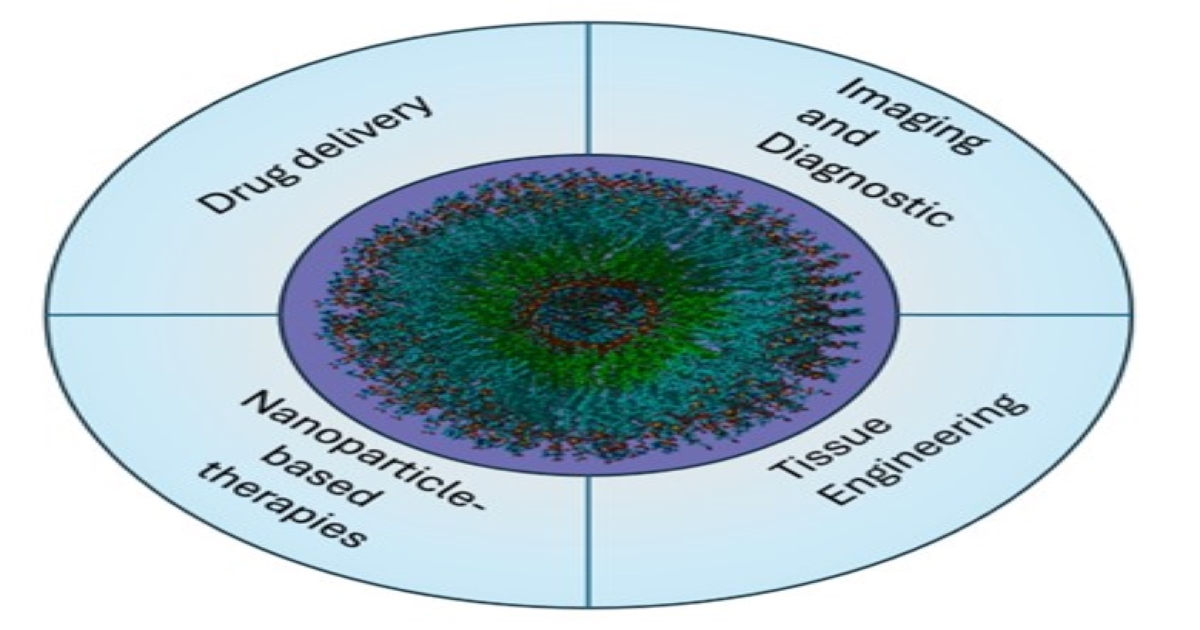
Biomedical applications of nanomaterials are extremely versatile. New ideas, breakthrough results and novel technological developments are appearing on a near-daily basis. Functionalized metal nanoparticles, polymer nanoaggregates, liposomes and carbon-based nanomaterials find ever increasing applications in drug and gene delivery. Such nanomaterials possess advantages of controlled release, targeted delivery, co-delivery of several therapeutic or protective agents for combination therapies, improved treatment efficacy and reduced side effects. Furthermore, the plasmonic, fluorescent and magnetic properties of nanomaterials can be used to enhance imaging of cells, tissues and organs. On the other hand, the same properties can be used to achieve enhanced and localized photothermal and photodynamic therapies or magnetic hyperthermia. Nanomaterials also provide important advantages in the field of tissue engineering. They allow us to extend the functionality of scaffolds by modifying their mechanical and electrical properties, creating anisotropy and releasing single molecules and drugs in response to a change in environmental conditions. The toolbox of nanomaterials in biomedicine keeps expanding, with recent additions of electrospun nanofibers, metal–organic frameworks (MOFs), DNA origami and DNA robots, carbon quantum dots and MXenes being just a few of the many recently emerging technologies that can be used alongside the already established applications of nanomaterials. We invite researchers to report on different aspects of this truly multidisciplinary field and contribute their findings to this Special Issue.

Dr. Leonid Gurevich
Guest Editor

Manuscript Submission Information

Manuscripts should be submitted online at www.mdpi.com by registering and logging in to this website. Once you are registered, click here to go to the submission form. Manuscripts can be submitted until the deadline. All submissions that pass pre-check are peer-reviewed. Accepted papers will be published continuously in the journal (as soon as accepted) and will be listed together on the special issue website. Research articles, review articles as well as short communications are invited. For planned papers, a title and short abstract (about 250 words) can be sent to the Editorial Office for assessment.

Submitted manuscripts should not have been published previously, nor be under consideration for publication elsewhere (except conference proceedings papers). All manuscripts are thoroughly refereed through a single-blind peer-review process. A guide for authors and other relevant information for submission of manuscripts is available on the Instructions for Authors page. Materials is an international peer-reviewed open access semimonthly journal published by MDPI.

Please visit the Instructions for Authors page before submitting a manuscript. The Article Processing Charge (APC) for publication in this open access journal is 2600 CHF (Swiss Francs). Submitted papers should be well formatted and use good English. Authors may use MDPI's English editing service prior to publication or during author revisions.

Keywords

  • nanomaterials
  • nanoparticles
  • nanocomposites
  • drug delivery
  • gene delivery
  • tissue engineering
  • responsive scaffolds
  • electrospun scaffolds and fibers
  • micro- and nanogels
  • DNA origami

Benefits of Publishing in a Special Issue

  • Ease of navigation: Grouping papers by topic helps scholars navigate broad scope journals more efficiently.
  • Greater discoverability: Special Issues support the reach and impact of scientific research. Articles in Special Issues are more discoverable and cited more frequently.
  • Expansion of research network: Special Issues facilitate connections among authors, fostering scientific collaborations.
  • External promotion: Articles in Special Issues are often promoted through the journal's social media, increasing their visibility.
  • Reprint: MDPI Books provides the opportunity to republish successful Special Issues in book format, both online and in print.

Further information on MDPI's Special Issue policies can be found here.

Published Papers (2 papers)

Order results
Result details
Select all
Export citation of selected articles as:

Research

Jump to: Review

13 pages, 3124 KB  
Article
Near-Field Direct Write Electrospinning of PET-Carbon Quantum Dot Solutions
by Fatemeh Mohtaram, Michael Petersen, Maria Ahrenst-Mortensen, Liva Skou Boysen, Frederik Hejgaard Gram, Helene Halsen Malling, Noah Frederik Hallundbæk Bang, Yan Jurg Hess and Peter Fojan
Materials 2024, 17(24), 6242; https://doi.org/10.3390/ma17246242 - 20 Dec 2024
Cited by 6 | Viewed by 2936
Abstract
Electrospinning of polymer material has gained a lot of interest in the past decades. Various methods of electrospinning have been applied for different applications, from needle electrospinning to needleless electrospinning. A relatively new variation of electrospinning, namely near-field electrospinning, has been used to [...] Read more.
Electrospinning of polymer material has gained a lot of interest in the past decades. Various methods of electrospinning have been applied for different applications, from needle electrospinning to needleless electrospinning. A relatively new variation of electrospinning, namely near-field electrospinning, has been used to generate well-defined patterns. This variation of electrospinning, also known as near-field direct-write electrospinning, allows for precise control of the fiber deposition, sacrificing on the thickness of the resulting fibers. Typically, for this method, melt electrospinning is preferred, since it provides a higher viscosity of the polymer and thereby better control of the fiber deposition. However, when mixing additives into the spinning dope, a solution spinning approach is preferable since it provides a more homogeneous distribution of the additives in the spinning dope. A fluorescent spinning dope of dissolved PET with fluorescent carbon quantum dots has been used to generate the fluorescent patterns. These can be used to generate logos, bar codes, or QR codes to encode information about the material, such as watermarks or counterfeiting tags. Full article
(This article belongs to the Special Issue Recent Advances in Nanomaterials for Biomedical Applications)
Show Figures

Figure 1

Review

Jump to: Research

31 pages, 2223 KB  
Review
Nanocarrier-Based Delivery Systems for Natural Compounds Across Research Stages
by Antonella Antonelli and Francesco Palma
Materials 2025, 18(21), 4960; https://doi.org/10.3390/ma18214960 - 30 Oct 2025
Cited by 19 | Viewed by 3413
Abstract
Natural compounds such as polyphenols, flavonoids, and terpenoids have long been explored for their therapeutic potential. They can act as antioxidants, limit inflammation, and influence cancer or neurodegenerative pathways. However, these benefits rarely translate directly into medical practice, as their solubility is poor, [...] Read more.
Natural compounds such as polyphenols, flavonoids, and terpenoids have long been explored for their therapeutic potential. They can act as antioxidants, limit inflammation, and influence cancer or neurodegenerative pathways. However, these benefits rarely translate directly into medical practice, as their solubility is poor, chemical stability is fragile, and metabolism is too fast. In recent years, nanotechnology has offered an alternative route. A wide range of materials, polymeric, inorganic, hybrid, or responsive to external stimuli, were designed to protect and deliver such molecules. Each platform features different preparation methods and release behaviors; all intended to extend circulation and increase tissue selectivity. Considerable attention was paid to targeting strategies, both passive and ligand-mediated, that enhance accumulation in diseased tissues. Preclinical studies have confirmed that encapsulation can raise the therapeutic index of phytochemicals against various conditions, including cancer, inflammation, microbial infections, and neurodegeneration. Still, translation to the clinic is far from resolved, limited by uncertainties over safety, manufacturing scale, and regulation. A parallel line of research now investigates biomimetic carriers, including vesicles derived from red blood cells and whole erythrocytes, which offer immune evasion and versatile loading capacity. The convergence of nanotechnology and natural product pharmacology, enriched by such biologically inspired designs, may open the way to more precise, multifunctional, and patient-tailored therapies. Full article
(This article belongs to the Special Issue Recent Advances in Nanomaterials for Biomedical Applications)
Show Figures

Graphical abstract

Back to TopTop