Skip Content
You are currently on the new version of our website. Access the old version .

Laboratories

Laboratories is an international, peer-reviewed, open access journal on laboratory management published quarterly online by MDPI.

All Articles (41)

A point-of-care (POC) HIV drug resistance (HIV-DR) test is needed for low- and middle-income countries (LMICs). Oligonucleotide Ligation Assay (OLA)-Simple, designed as a near-POC HIV-DR test, was assessed for its overall usability in Kenya by technicians with and without molecular laboratory PCR experience. Further, its diagnostic accuracy was evaluated by PCR-experienced technicians utilizing 147 plasma samples with known Sanger sequence genotypes—based on seven major HIV-DR mutations of nucleotide and non-nucleoside reverse transcriptase inhibitors. Thirteen laboratory technicians were recruited, including five with prior PCR experience. Twelve technicians completed the training and attained OLA-Simple testing competency, ten of whom were able to perform the OLA-Simple test within 6 h. Technicians’ survey feedback indicated the user-friendliness of OLA-Simple, citing straightforward reagent reconstitution, concise instructions in prompts, and a shorter sample-to-result test time compared to standard genotyping assays. Of the 147 archived plasma samples tested, 132 (90%) yielded interpretable results. OLA-Simple assay demonstrated a sensitivity of 97.3% (95% CI 94.5, 98.9), a specificity of 97.2% (95% CI 95.5, 98.3), and a percent agreement of 97.1% (95% CI 95.9, 98.2) compared to Sanger sequencing. This evaluation found that OLA-Simple was user-friendly among intended end-users and performed well. LMIC HIV programs would benefit from strategizing on case-use scenarios for such near-POC HIV-DR assays to improve HIV outcomes.

4 February 2026
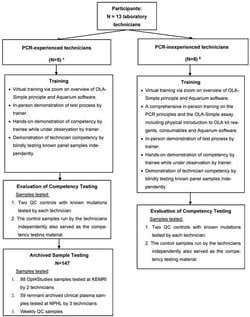
Diagrammatic representation of laboratory personnel training, competency, and testing schedule in the validation of the OLA-Simple assay for HIV-DR testing. This flowchart provides a diagrammatic representation of the laboratory personnel training, competency assessment, and testing involving technicians from various research institutions and hospital laboratories, who participated in the validation of OLA-Simple. The diagram indicates the number of PCR-experienced and PCR-inexperienced technicians and the training they received, and the competency testing and the testing of archived samples for the clinical in-field validation of OLA-Simple. Abbreviations: PCR, polymerase chain reaction; QC, quality control; NPHL, National Public Health Laboratory; Key: * National Public Health Reference Laboratory (N = 3) technicians; HIV Research Laboratory, KEMRI, Kisumu (N = 2) technicians. $ Technicians from hospital-based diagnostic laboratories: Kisumu County Referral Hospital, Jaramogi Oginga Odinga Teaching and Referral Hospital, Nyakach Sub-County Hospital, and Ahero Sub-County Hospital.

The Joint Committee for Guides in Metrology (JCGM) today presents a definition of measurement uncertainty that modifies the previous one and improves the management of scenarios other than scalar (quantitative) measurements, such as classificatory or qualitative (nominal and ordinal) properties. Nominal results are often found in biology and medicine. For the accreditation of medical laboratories and testing laboratories, both ISO 15189 and ISO 17025 require the management of these situations, using the professional expertise of specialists with the support of manufacturers. Some of the members of JCGM WG2 developed a discussion on the concept of measurement uncertainty and raised some criticisms. ISO produces detailed guides for this purpose, such as ISO 20914, ISO 27877, ISO 16393, ISO 20397-2, and ISO 22692. Laboratories now have all the tools they need to meet accreditation requirements on uncertainty.

4 February 2026

The development of an immersive virtual reality laboratory in the facilities of a private Mexican university is presented. This laboratory contemplates the use of different disciplines and different student profiles, for which it was developed considering technological, ergonomic, educational, and disciplinary requirements. A primary assessment of a selected group of students was developed to find out the initial level of satisfaction with the user experience in the laboratory and the improvements to be proposed for future adaptations.

3 February 2026

Exposure to chemical irritants in laboratory and medical environments poses significant health risks to workers, particularly in relation to asthma-like symptoms. Routine cleaning practices, which often involve the use of strong chemical agents to maintain hygienic settings, have been shown to contribute to respiratory issues. Laboratories, where chemicals such as hydrochloric acid and ammonia are frequently used, represent an underexplored context in the study of occupational asthma. While much of the research on chemical exposure has focused on industrial and high-risk occupations or large cohort populations, less attention has been given to the risks in laboratory and medical environments, particularly for professional cleaning staff. Given the growing reliance on cleaning agents to maintain sterile and safe workspaces in scientific research and healthcare facilities, this gap is concerning. This study developed an exploratory simulation tool, using a simulated cohort based on key demographic and exposure patterns from foundational research, to assess the impact of chemical exposure from cleaning products in laboratory environments. Four supervised machine learning models were applied to evaluate the relationship between chemical exposures and asthma-like symptoms: (1) Decision Trees, (2) Random Forest, (3) Gradient Boosting, and (4) XGBoost. High exposures to hydrochloric acid and ammonia were found to be significantly associated with asthma-like symptoms, and workplace type also played a critical role in determining asthma risk. This research provides a data-driven framework for assessing and predicting asthma-like symptoms in professional cleaning workers exposed to cleaning agents and highlights the potential for integrating predictive modeling into occupational health and safety monitoring. Future work should explore dose–response relationships and the temporal dynamics of chemical exposure to further refine these models and improve understanding of long-term health risks.

9 January 2026

News & Conferences

Issues

Open for Submission

Editor's Choice

Get Alerted

Add your email address to receive forthcoming issues of this journal.

XFacebookLinkedIn
Laboratories - ISSN 2813-8856