Skip Content
You are currently on the new version of our website. Access the old version .
  • 25 days
    Time to First Decision

Journal of Nanotheranostics

Journal of Nanotheranostics is an international, peer-reviewed, open access journal on nanotheranostics published quarterly online by MDPI.

All Articles (110)

From Words to Frameworks: Transformer Models for Metal–Organic Framework Design in Nanotheranostics

  • Cristian F. Rodríguez,
  • Paula Guzmán-Sastoque and
  • Juan C. Cruz
  • + 2 authors

Metal–organic frameworks (MOFs) are among the most structurally diverse classes of crystalline nanomaterials, offering exceptional tunability, porosity, and chemical modularity. These characteristics have positioned MOFs as promising platforms for nanomedicine, bioimaging, and integrated nanotheranostic applications. However, the rational design of MOFs that satisfy stringent biomedical requirements, including high drug loading capacity, controlled and stimuli responsive release, selective targeting, physiological stability, biodegradability, and multimodal imaging capability, remains challenging due to the vast combinatorial design space and the complex interplay between physicochemical properties and biological responses. The objective of this review is to critically examine recent advances in artificial intelligence approaches based on Transformer architectures for the design and optimization of MOFs aimed at next-generation nanotheranostics. In contrast to prior reviews that broadly survey machine learning methods for MOF research, this article focuses specifically on Transformer-based models and their ability to capture long-range, hierarchical, and multiscale relationships governing MOF structure, chemistry, and functional behavior. We review state-of-the-art models, including MOFormer, MOFNet, MOFTransformer, and Uni MOF, and discuss graph-based and sequence-based representations used to encode MOF topology and composition. This review highlights how Transformer-based models enable predictive assessment of properties directly relevant to nanotheranostic performance, such as adsorption energetics, framework stability, diffusion pathways, pore accessibility, and surface functionality. By explicitly linking these predictive capabilities to drug delivery efficiency, imaging performance, targeted therapeutic action, and combined diagnostic and therapeutic applications, this work delineates the specific contribution of Transformer-based artificial intelligence to biomedical translation. Finally, we discuss emerging opportunities and remaining challenges, including generative Transformer models for inverse MOF design, self-supervised learning on hybrid experimental and computational datasets, and integration with autonomous synthesis and screening workflows. By defining the scope, novelty, and contribution of Transformer-based design strategies, this review provides a focused roadmap for accelerating the development of MOF-based platforms for next-generation nanotheranostics.

6 February 2026
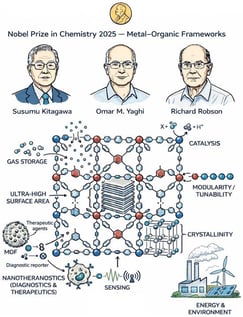
Schematic overview of metal–organic frameworks (MOFs) and their transformative impact on chemistry. The illustration highlights the foundational contributions of Susumu Kitagawa, Omar M. Yaghi, and Richard Robson, whose work established the principles of reticular chemistry and MOF design, and who were awarded the 2025 Nobel Prize in Chemistry for these contributions.

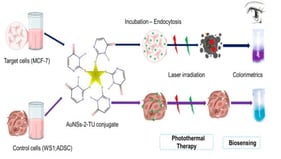
This study presents a multifunctional theranostic platform based on anisotropic gold nanostars (AuNSs) functionalized with 2-thiouracil (2-TU) for cancer diagnostics and photothermal therapy (PTT). The unique plasmonic properties of AuNSs, combined with the anticancer and photothermal potential of 2-TU, were harnessed to create a system capable of simultaneous colorimetric biosensing and therapeutic action. Under dual-wavelength irradiation (660 nm and 525 nm), the AuNSs–2-TU conjugate demonstrated enhanced photothermal conversion efficiency, selective cancer cell targeting, and signal amplification, resulting in a significant reduction in the IC50 for MCF-7 breast cancer cells. The system exhibited minimal cytotoxicity to normal fibroblasts (WS1), ensuring therapeutic precision. Compared to conventional spherical gold nanoparticles, this platform provides superior multifunctionality, including real-time biosensing with simple, naked-eye colorimetric readouts. These results highlight the potential of the AuNSs–2-TU conjugate as an innovative, minimally invasive nanotheranostic platform suitable for integrated cancer detection and treatment, particularly in resource-constrained settings.

8 January 2026

Characterization of functionalized AuNSs–2-TU: (A) UV–Vis absorption spectra; (B) FT-IR spectra; (C) 1H NMR spectra; (D) XRD pattern.

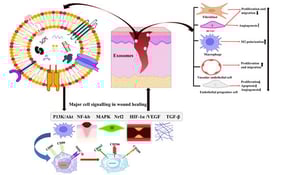
Diabetic wounds remain chronically non-healing due to impaired angiogenesis, persistent inflammation, and defective extracellular matrix remodelling. In recent years, stem cell-derived exosomes have emerged as a potent cell-free regenerative strategy capable of recapitulating the therapeutic benefits of mesenchymal stem cells while avoiding risks associated with direct cell transplantation. This review critically evaluates the preclinical evidence supporting the use of exosomes derived from adipose tissue, bone marrow, umbilical cord, and induced pluripotent stem cells for diabetic wound repair. These exosomes deliver bioactive cargos such as microRNAs, proteins, lipids, and cytokines that modulate key signalling pathways, including Phosphatidylinositol 3-kinase/Protein kinase (PI3K/Akt), Nuclear factor kappa B (NF-κB), Mitogen-activated protein kinase (MAPK), Transforming growth factor-beta (TGF-β/Smad), and Hypoxia inducible factor-1α/Vascular endothelial growth factor (HIF-1α/VEGF), thereby promoting angiogenesis, accelerating fibroblast and keratinocyte proliferation, facilitating re-epithelialization, and restoring immune balance through M2 macrophage polarization. A central focus of this review is the recent advances in exosome-based delivery systems, including hydrogels, microneedles, 3D scaffolds, and decellularized extracellular matrix composites, which significantly enhance exosome stability, retention, and targeted release at wound sites. Comparative insights between stem cell therapy and exosome therapy highlight the superior safety, scalability, and regulatory advantages of exosome-based approaches. We also summarize progress in exosome engineering, manufacturing, quality control, and ongoing clinical investigations, along with challenges related to standardization, dosage, and translational readiness. Collectively, this review provides a comprehensive mechanistic and translational framework that positions stem cell-derived exosomes as a next-generation, cell-free regenerative strategy with the potential to overcome current therapeutic limitations and redefine clinical management of diabetic wound healing.

6 January 2026

Illustration of the sequential phases of wound healing, beginning with hemostasis to control bleeding, followed by inflammation involving immune cell infiltration. It then shows the proliferation phase with granulation tissue formation and fibroblast activity, and finally the remodelling phase where collagen is reorganized and the scar matures.

Cancer remains a severe global health threat, with traditional therapies often plagued by limited efficacy and significant side effects. The emergence of nanotechnology, particularly metal-doped nanomaterials, offers a promising avenue for integrating diagnostic and therapeutic functions into a single platform, enabling a theranostic approach to oncology. This article explores the design and application of various metal-doped nanosystems, including gadolinium-doped selenium molybdenum nanosheets for magnetic resonance/photoacoustic dual-mode imaging and photothermal therapy, and metal-doped hollow mesoporous silica nanoparticles that leverage the tumor’s acidic microenvironment to release ions for catalytic generation of reactive oxygen species. Despite their promise, the limited enzyme-like activity of some nanozymes, insufficient endogenous hydrogen peroxide in tumors, and the tumor microenvironment’s defensive mechanisms, such as high glutathione levels, can restrict therapeutic efficacy. Looking forward, the outlook for the field is contingent upon advancing material engineering strategies. Future research should prioritize the development of intelligent, multifunctional nanoplatforms that can dynamically respond to and remodel the tumor microenvironment. Innovations in surface modification for enhanced targeting, alongside rigorous preclinical studies focused on safety and standardized manufacturing, are crucial for bridging the gap between laboratory research and clinical application, ultimately paving the way for personalized cancer medicine.

17 December 2025

(A) Schematic illustration for the synthesis of Mn-MSN@Met-M NPs. (B) Mn-MSN@Met-M NPs increase the local Mn2+ ion and metformin concentration; further promote the activation of STING. Adapted from ref. [20], https://doi.org/10.1016/j.isci.2024.110150 (19 July 2024), under the terms of the CC BY NC 4.0 license, http://creativecommons.org/licenses/by-nc/4.0/. (19 July 2024).

News & Conferences

Issues

Open for Submission

Editor's Choice

Reprints of Collections

New Challenges in Ocular Drug Delivery
Reprint

New Challenges in Ocular Drug Delivery

Editors: Rosario Pignatello, Hugo Almeida, Debora Santonocito, Carmelo Puglia

Get Alerted

Add your email address to receive forthcoming issues of this journal.

XFacebookLinkedIn
J. Nanotheranostics - ISSN 2624-845X