


Abstract
This study presents a multifunctional theranostic platform based on anisotropic gold nanostars (AuNSs) functionalized with 2-thiouracil (2-TU) for cancer diagnostics and photothermal therapy (PTT). The unique plasmonic properties of AuNSs, combined with the anticancer and photothermal potential of 2-TU, were harnessed to create a system capable of simultaneous colorimetric biosensing and therapeutic action. Under dual-wavelength irradiation (660 nm and 525 nm), the AuNSs–2-TU conjugate demonstrated enhanced photothermal conversion efficiency, selective cancer cell targeting, and signal amplification, resulting in a significant reduction in the IC50 for MCF-7 breast cancer cells. The system exhibited minimal cytotoxicity to normal fibroblasts (WS1), ensuring therapeutic precision. Compared to conventional spherical gold nanoparticles, this platform provides superior multifunctionality, including real-time biosensing with simple, naked-eye colorimetric readouts. These results highlight the potential of the AuNSs–2-TU conjugate as an innovative, minimally invasive nanotheranostic platform suitable for integrated cancer detection and treatment, particularly in resource-constrained settings.
1. Introduction
Breast cancer, a leading cause of cancer-related deaths worldwide, poses significant challenges despite advances in prevention and early detection strategies [1,2]. Current therapeutic and diagnostic (theranostic) approaches are hindered by two critical limitations: the emergence of drug resistance and collateral damage to healthy cells [3,4]. Addressing these hurdles requires innovative solutions, and noble metal nanoparticles have emerged as a transformative platform in breast cancer theranostics [5,6,7]. Their unique physicochemical properties enable dual functionality: acting as highly effective photothermal contrast agents and potent antineoplastic agents [8,9,10,11]. These advancements offer a promising avenue for precise, targeted, and minimally invasive cancer management, ushering in a new era in breast cancer theranostics research.
Building on the remarkable properties of gold nanostars (AuNSs), their hybridized localized surface plasmon resonance (LSPR) characteristics have made them invaluable tools in advancing cancer theranostics [12,13,14,15,16,17,18,19,20,21]. The unique structural design of AuNSs, with their sharp protuberant tips and nanoscale core, facilitates targeted interactions with cancer cells, enabling highly localized thermal and optical effects [13,22]. In photothermal therapy (PTT), AuNSs exploit the Enhanced Permeability and Retention (EPR) effect to selectively accumulate in tumor tissues [23,24,25,26]. The unique physiology of solid tumors, characterized by wider vascular gaps (200 nm–1.2 µm) compared to normal tissues (<10 nm), allows nanoparticles (NPs) like AuNSs to pass through the leaky vascular walls and remain in the tumor microenvironment [13,27,28]. This accumulation, combined with the tumor’s inefficient lymphatic drainage, enables site-specific heat generation under near-infrared (NIR) light exposure, making PTT a targeted and effective cancer treatment [12,13,29,30]. This selective heating not only spares healthy tissues but also capitalizes on the tumor microenvironment’s inherent vulnerabilities, such as hypoxia and acidity, for enhanced efficacy [30,31,32]. Furthermore, when functionalized with therapeutic agents or targeting ligands, AuNSs transcend traditional therapeutic limitations by combining multimodal imaging, drug delivery, and precise thermal ablation in a single platform [12,13,33,34]. The convergence of these attributes’ positions AuNSs as a cornerstone in developing next-generation cancer therapies with reduced toxicity and improved patient outcomes.
The functional versatility of AuNSs, particularly their strong affinity for biomolecules containing amines, disulfide bonds, and thiol groups, makes them an ideal platform for conjugation with therapeutic agents like 2-thiouracil (2-TU) [35,36]. 2-TU, a thiol-containing compound with significant biological and pharmacological importance, has garnered attention for its chemotherapeutic potential against various cancers, including skin, lung, and breast cancers [36,37,38]. Its mechanism of action involves interfering with DNA and RNA synthesis, effectively inhibiting tumor growth and proliferation [39,40]. 2-TU also exhibits antineoplastic properties by inducing apoptosis in cancer cells while sparing normal tissues [41,42]. When conjugated with nanoparticles, 2-TU’s stability, bioavailability, and targeted delivery are enhanced, making it a promising candidate for advanced cancer therapies with reduced systemic toxicity [13,36,37].
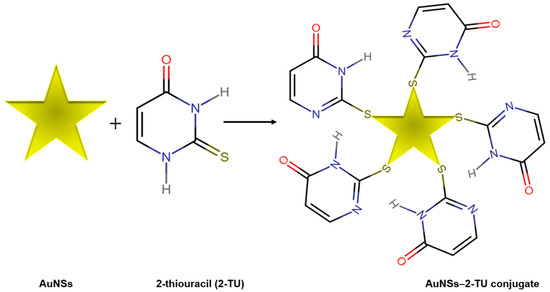
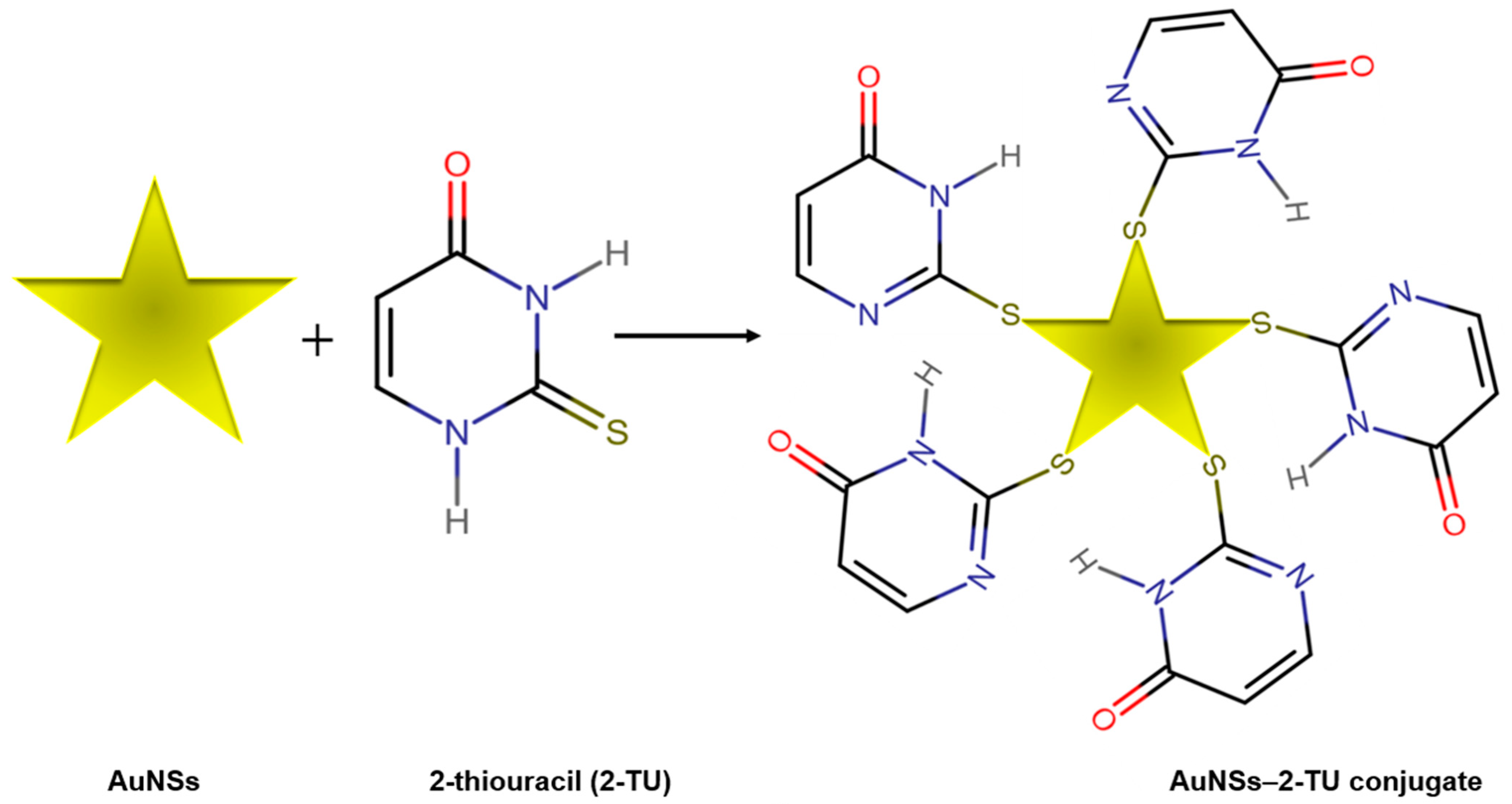
This study developed a novel nanotheranostic platform by synthesizing biocompatible 2-[4-(2-hydroxyethyl)piperazin-1-yl]ethanesulfonic acid (HEPES)-mediated AuNSs and functionalizing them with 2-TU via covalent thiol-gold interactions (Scheme 1). Leveraging the strong affinity of AuNSs for thiol-containing biomolecules, the AuNSs–2-TU conjugates were designed to enhance PTT efficacy in the visible range while improving antiproliferative activity against cancer cells. The PTT capabilities of unfunctionalized AuNSs and AuNSs–2-TU were evaluated under clinically relevant green light (525 nm) and red light (660 nm) irradiation, while their antiproliferative effects were tested on MCF-7 breast cancer cell line using the MTT (3-(4,5-Dimethylthiazol-2-yl)-2,5-Diphenyltetrazolium Bromide) assay. This synergistic approach demonstrates the potential of integrating the photothermal colorimetric properties of AuNSs with the chemotherapeutic efficacy of 2-TU, offering a promising strategy for targeted breast cancer therapy that minimizes systemic toxicity while maximizing therapeutic effectiveness.
Scheme 1.
Surface functionalization of gold nanostars (AuNSs) with 2-thiouracil (2-TU).
2. Materials and Methods
2.1. Materials
All materials were obtained from Sigma-Aldrich (St. Louis, MO, USA) unless stated otherwise. 4-(2-hydroxyethyl)-1-piperazineethanesulfonic acid (HEPES, C8H18N2O4S), gold (III) chloride hydrate (HAuCl4·xH2O), 2-thiouracil (C4H4N2OS), silver nitrate (AgNO3), sodium hydroxide (NaOH), and hydrochloric acid (HCl). Gibco BRL (Carlsbad, CA, USA) supplied the Rosewell Park Memorial Institute (RPMI) 1640 medium, fetal bovine serum (FBS), Minimum Essential Medium (MEM), Dulbecco’s Modified Eagle Medium (DMEM), and 0.25% trypsin. The American Type Culture Collection (Manassas, VA, USA) supplied the MCF-7 and WS1 cell lines. Metabion International AG (Planegg, Germany) produced 5′ amino-modified MUC1 DNA Aptamer S2.2 with the sequence 5′ GCAGTTGATCCTTTGGATACCCTGG 3′. The plastic ware materials used were sterile 50 mL screw cap tubes and flasks (Ascendis Medical, Johannesburg, South Africa), carbon mesh copper grids (Agar Scientific, Rotherham, UK), and clear, flat-bottomed 96-well plates (Corning, Glendale, AZ, USA).
Instrumentation
Various advanced instruments were employed in this study to ensure precise characterization and analysis. Transmission electron microscopy (TEM) images were obtained using a Tecnai F20 transmission electron microscope (JEOL, Freising, Bayern, Germany), while scanning electron microscopy and energy-dispersive X-ray spectroscopy (SEM-EDS) were performed using the Bruker Quanta 200 (Bruker, Billerica, MA, USA). Inductively coupled plasma mass spectrometry (ICP-MS) was conducted with the Agilent 7700ce (Agilent Technologies, Santa Clara, CA, USA). Fourier transform infrared (FT-IR) spectra were acquired using the UATR FT-IR spectrometer (PerkinElmer, Hopkinton, MA, USA). Confocal imaging was carried out with a Zeiss LSM 710 microscope (Carl Zeiss, Jena, Germany), and nuclear magnetic resonance (NMR) spectra were recorded on a Bruker Avance III HD 500 MHz system (Bruker, Billerica, MA, USA). UV–Vis absorption spectra (200–900 nm) were measured using the HT Synergy microplate reader (Agilent Technologies, Santa Clara, CA, USA). Electrophoresis was performed with a Baygene BG-power Vacutec apparatus (Vacutec, Johannesburg, South Africa), and gel imaging was completed using a Bio-Rad gel imager (Hercules, CA, USA). ImageJ software (version 1.54p) (University of Wisconsin at Madison, Madison, WI, USA) was used to measure average particle core diameter and arm counts on a sample size of 100 particles.
2.2. Methods
2.2.1. Synthesis of Gold Nanostars
A seedless one-pot HEPES-mediated synthesis method was employed for the preparation of AuNSs. In this approach, 20 mL of 100 mM HEPES buffer (pH 7.44) was combined with 30 mL of deionized water, followed by the addition of 25 μL of 50 mM HAuCl4·xH2O solution and 40 μL of 1 mM AgNO3 [43,44]. The solution was mixed by end-to-end inversion and incubated at room temperature for 25 min, resulting in the formation of a turquoise blue colloidal solution. Subsequently, 5 mL of freshly prepared 10.5 mM 2-TU was added to the AuNSs colloidal solution, and the mixture was again inverted several times. After standing at ambient temperature for 1 h to facilitate complete surface functionalization, the AuNSs–2-TU colloidal solution was subjected to a two-step purification process by centrifugation at 2170× g for 35 min per cycle. The resulting supernatant was carefully discarded after each cycle to remove unbound molecules and reaction by-products, and the purified AuNSs–2-TU conjugate was finally resuspended in 5 mL of deionized water for subsequent characterization and application.
2.2.2. Surface Functionalization of AuNSs–2-TU with MUC1 S2.2 Aptamers
Mucin 1 (MUC1) S2.2 aptamers were conjugated to AuNSs–2-TU using a DTSSP-mediated crosslinking strategy. Briefly, the AuNSs–2-TU suspension was purified by two consecutive centrifugation steps at 2170× g for 35 min, after which the supernatant was discarded and the pellet resuspended in 500 µL of 100 mM HEPES buffer (pH 6.9). Subsequently, 100 µL of freshly prepared 5 mM DTSSP crosslinker was added to the AuNSs–2-TU suspension, and the mixture was gently mixed on a rotator for 30 min at room temperature [44].
Following activation, 100 µL of MUC1 S2.2 aptamer solution (10 mg/mL) was added to the DTSSP-functionalized AuNSs–2-TU, along with 10 µL of a 1 µg/µL aptamer solution prepared in DNase/RNase-free water, and the reaction mixture was incubated at 4 °C for 2 h to allow for aptamer conjugation and immobilization [45]. The resulting AuNSs–2-TU –S2.2 aptamer conjugates were purified by centrifugation twice at 2170× g for 35 min, resuspended in 500 µL of de-ionized water, and stored at 4 °C until further use.
2.2.3. Stability Assessment of the AuNSs–2-TU Conjugate
The stability of the AuNSs–2-TU conjugate was evaluated to ensure its robustness and reproducibility for biosensing applications. Instability was defined as any change in the LSPR band ODmax exceeding 30%, monitored using UV–Vis spectroscopy [46]. The conjugate was assessed under varying storage temperatures (room temperature and 4 °C), pH levels, and assay matrices. For long-term evaluation, it was stored at room temperature and 4 °C for up to 4 weeks. Short-term stability was tested in saline, HCl, serum, and supplemented cell culture medium at room temperature for 3 h and at 37 °C [47,48]. These matrices were selected to represent physiologically relevant conditions (serum and culture medium), potential storage environments (saline and HCl), and standard experimental assay conditions.
2.3. Cell Culture Studies
Breast cancer (MCF-7) cells were cultured in RPMI 1640 media with 10% FBS and 1% penicillin-streptomycin, while WS1 fibroblast cells were cultured in MEM media. The cells were incubated at 37 °C with 5% CO2 and 85% humidity to reach 90% confluence. After discarding the spent medium, cells were rinsed three times with Hank’s balanced salt solution (HBSS) and detached using TrypLE (Invitrogen, Waltham, MA, USA, 12605–028) with end-to-end swirling. The detached cells were centrifuged at 1200× g for 5 min to obtain cell pellets, which were then resuspended in complete medium at a concentration of 5.6 × 10⁶ cells/mL.
2.3.1. Proliferation Studies
The proliferative activity of AuNSs, 2-TU, and AuNSs–2-TU was evaluated using the MTT (3-[4,5-dimethylthiazol-2-yl]-2,5-diphenyl tetrazolium bromide) colorimetric assay, with slight modifications based on established methods. Viable cells with active metabolism reduce MTT to a purple formazan product through mitochondrial enzymatic activity. Cells were seeded in 96-well plates at 5 × 10³ cells per well and incubated for 24 h in DMEM to allow cell adhesion. The half-maximal inhibitory concentration (IC50) was determined based on cell viability at different sample concentrations, with viability expressed as a percentage relative to control cells, which were considered to have 100% viability.
2.3.2. Photothermal Treatment and TEM Analysis of AuNSs–2-TU-Treated Cells
WS1 fibroblasts and MCF-7 cells were seeded at 5 × 10³ cells/well, with untreated cells as controls. Cells were sequentially irradiated with red (660 nm) and green (525 nm) light at 5 J/cm2, separated by a 5 s interval. Red irradiation was fixed at 20 s to ensure uniform AuNSs excitation [49], while green irradiation duration was varied to exploit plasmonic damping–induced LSPR blue-shifting toward, but distinct from, the 2-TU absorption band, enabling controlled dual activation [35,50,51]. The microplate position was fixed, and total irradiation per set ranged 95–120 s, followed by 24 h incubation prior to antiproliferative assessment.
Treated MCF-7 and WS1 cells were harvested and washed three times with phosphate-buffered saline (PBS, pH 7.4) to remove non-internalized nanoparticles. Cells were mildly fixed with 2% glutaraldehyde in PBS (pH 7.4) for 15 min to preserve nanoparticle–cell interactions, then lysed gently in PBS (pH 7.4) to release intracellular contents [52,53]. Aliquots (4 μL) of each treated cell lysate were drop-cast onto carbon-coated copper TEM grids. After adsorption for 5–10 min, excess liquid was gently wicked off using filter paper, and the grids were air-dried at room temperature prior to HR-TEM imaging.
2.4. Statistical Analysis
The experiments were conducted at least three times for each sample, and statistical differences were analyzed using analysis of variance (ANOVA). A p-value of less than 0.05 was considered statistically significant.
2.5. Photothermal Colorimetric Analysis
The potential of AuNSs–2-TU to induce colorimetric and UV-visible spectrum changes in the presence of analytes was evaluated. To ensure optimal results, reagents were pipetted and mixed in water to a final volume of 200 μL, following this sequence: 15 μL of 10 mM Tris buffer (pH 8.5), followed by 20 μL of AuNSs–2-TU. MCF-7 and WS1 cells, cultured and tested for cell viability, were introduced at different concentrations before and 24 h after irradiation. The assay mixtures were incubated at 37 °C for 5 min. Then, the detection solution (2 μL of 5 mM AgNO3 + 10 μL of 75 mM NaOH) was added, followed by a further 5-min incubation at 37 °C. UV-Vis spectral readings were taken, and visible colorimetric changes were observed with the naked eye.
3. Results
3.1. Characterization of Functionalized Gold Nanostars
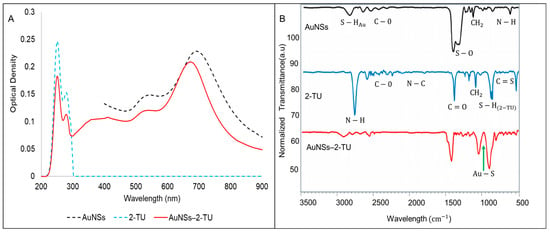
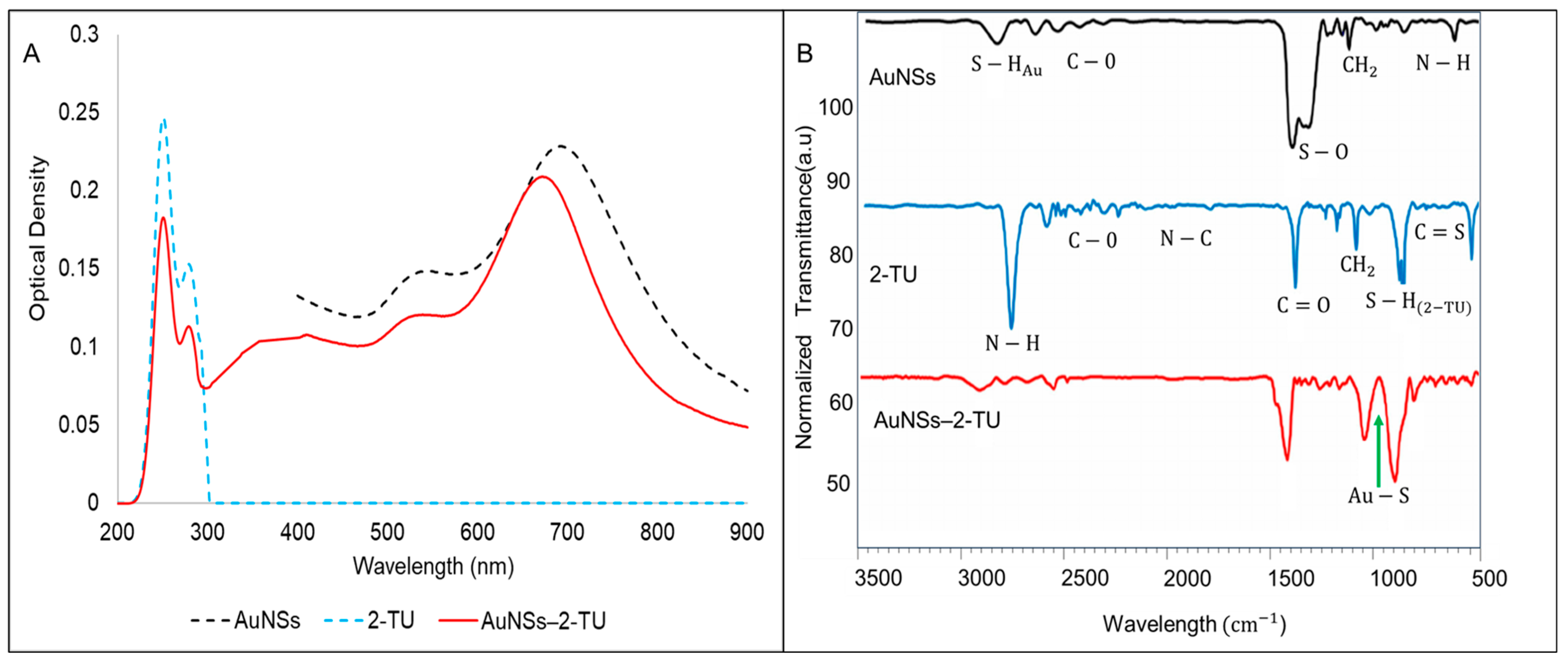
The 2-thiouracil (2-TU) functionalized gold nanostars (AuNSs) were synthesized via the direct conjugation of 2-TU onto HEPES-mediated AuNSs, as illustrated in Scheme 1. Figure 1A presents the UV-Vis spectra of free 2-TU, characterized by a dominant absorption peak in the UV range at 250 nm. Upon functionalization of AuNSs with 2-TU, a slight blue shift was observed in the characteristic surface plasmon resonance (SPR) band of AuNSs, indicating successful conjugation. Notably, the UV-Vis absorption spectrum of the 2-TU functionalized AuNSs (AuNSs–2-TU) retained both the LSPR peaks at 520 nm and 700 nm, corresponding to the formation of AuNSs, as well as the characteristic fingerprint band of 2-TU.
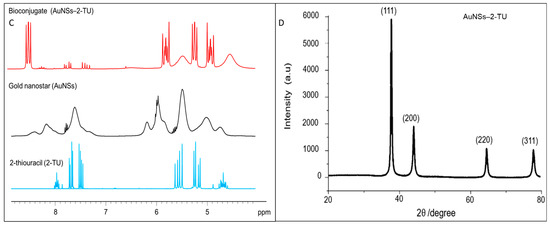
Figure 1.
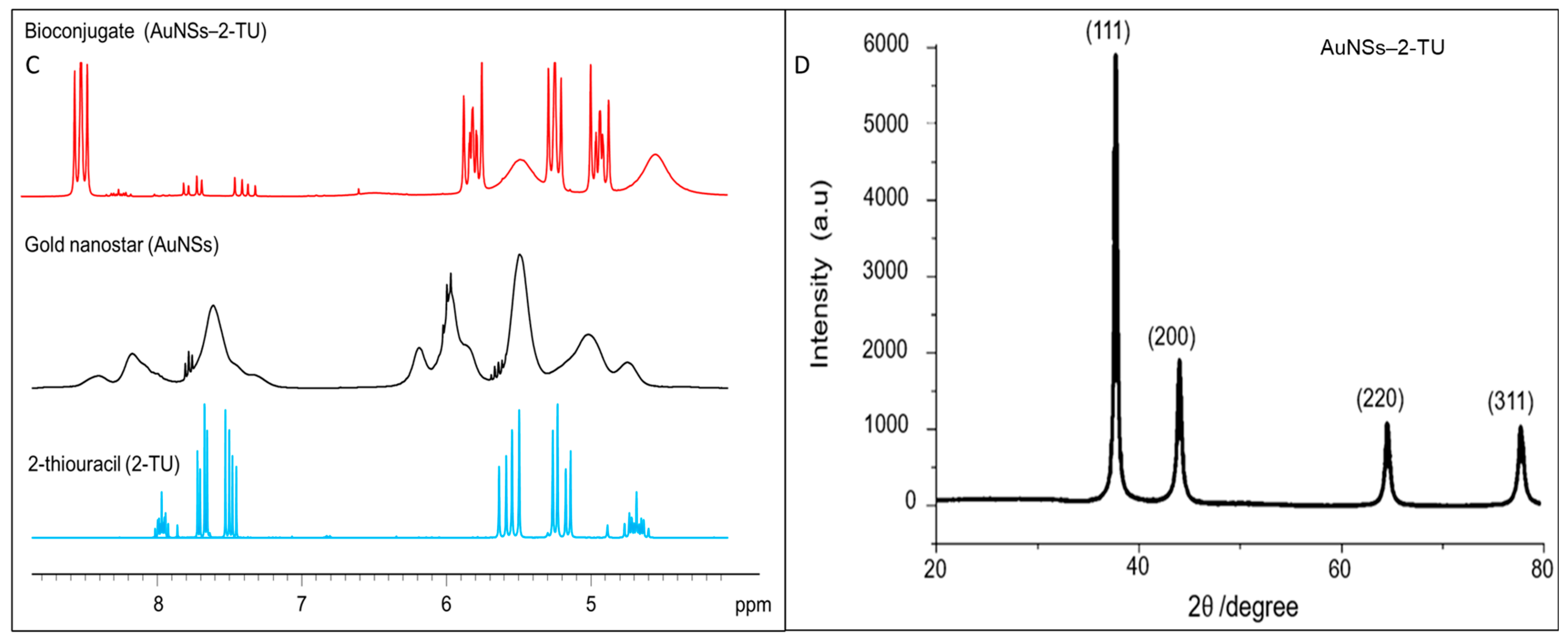
Characterization of functionalized AuNSs–2-TU: (A) UV–Vis absorption spectra; (B) FT-IR spectra; (C) 1H NMR spectra; (D) XRD pattern.
The FT-IR spectrum (Figure 1B) of AuNSs–2-TU displayed a complementary profile, incorporating all major peaks observed in both free AuNSs and 2-TU. Stretching vibrations corresponding to N-H and S-H groups from the AuNSs were found in the 2850–3000 cm−1 region, along with stretching modes for C=O and S=O in the 1200–1500 cm−1 range. Additional stretching vibrations for C=S, N-C, and C-O bonds were detected, and lower wavenumber stretches (500–1000 cm−1) were observed, corresponding to the C=S and S-H groups of 2-TU. The metal–sulfur bond produced a distinct peak between 800–1000 cm−1, attributed to the Au-S bond, confirming successful functionalization.
Chemical shifts in the 1H NMR spectra (Figure 1C) provide further evidence of effective functionalization. Significant shifts were observed in the 7.65–9.21 ppm and 4.55–6.10 ppm regions for AuNSs–2-TU, compared to distinct peaks in the 4.51–6.20 ppm region of AuNSs alone. These shifts are attributed to the interactions between the -SH and -NH groups of 2-TU and the -SH and C=O groups of the AuNSs, confirming the conjugation process. The crystallinity of the AuNSs–2-TU bioconjugate was investigated using X-ray diffraction (XRD), and the corresponding diffraction pattern (Figure 1D) confirms the face-centered cubic (fcc) lattice structure of gold nanocrystals. The intense diffraction peak at 38.13° confirms the (111) plane as the dominant growth orientation of Au0 nanocrystals, indicating a preferred atomic arrangement of bioconjugate’s fcc lattice structure.
These findings collectively confirm the successful synthesis, covalent functionalization, and integration of 2-TU onto the AuNSs surface, rather than simply indicating the presence of 2-TU in the samples.
No significant spectral changes were observed for the AuNSs–2-TU complex in the UV region (200–399 nm). Therefore, all stability and colorimetric results were focused on and presented in the visible to near-infrared (Vis-NIR) range of 400–900 nm, where the LSPR properties are most pronounced and relevant for biosensing applications.
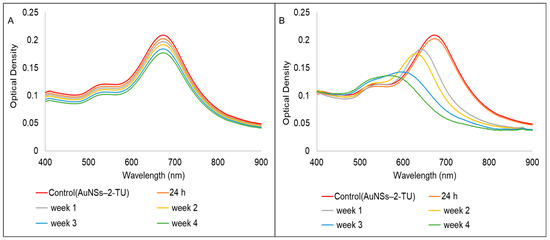
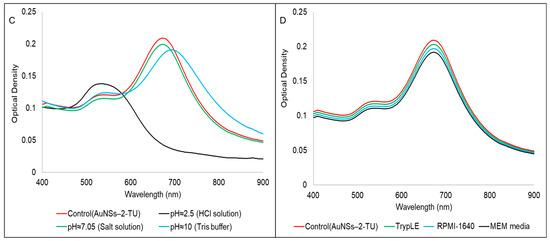
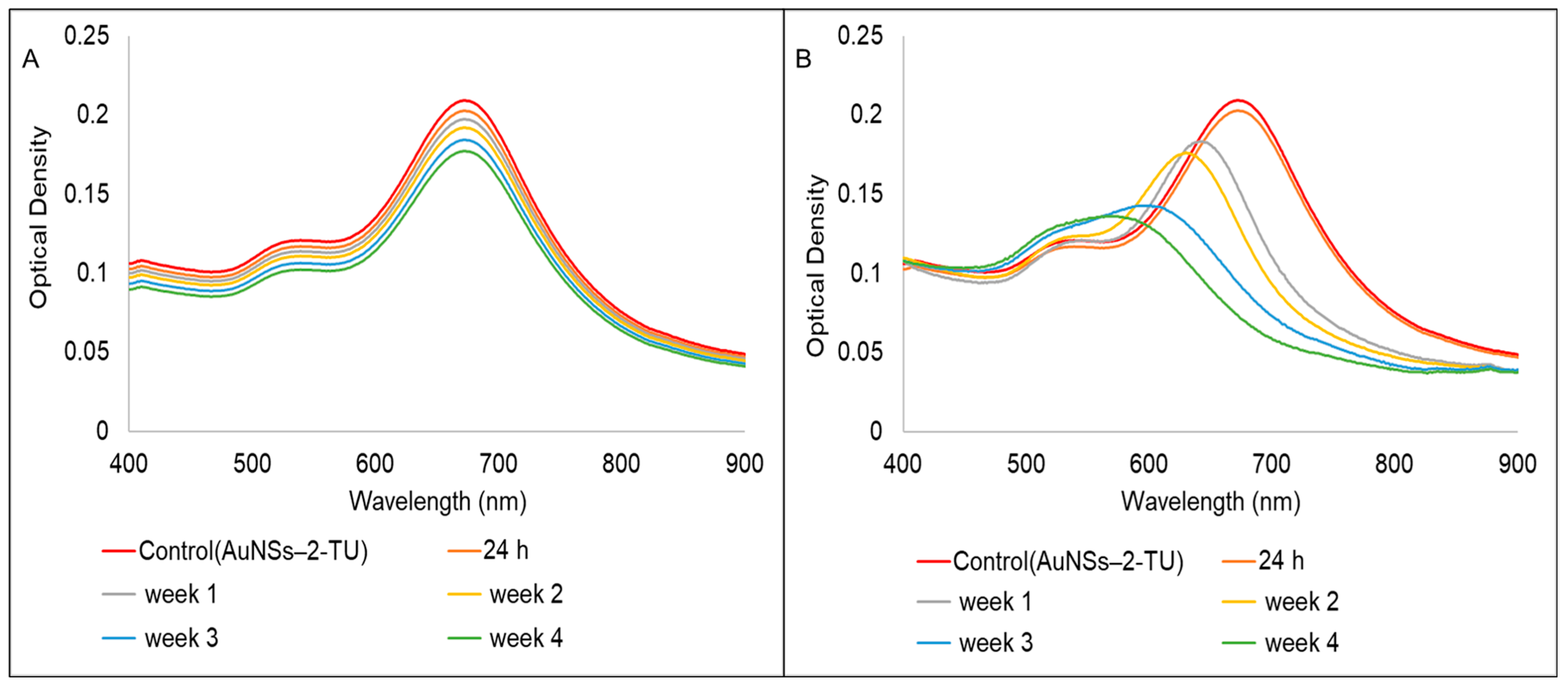
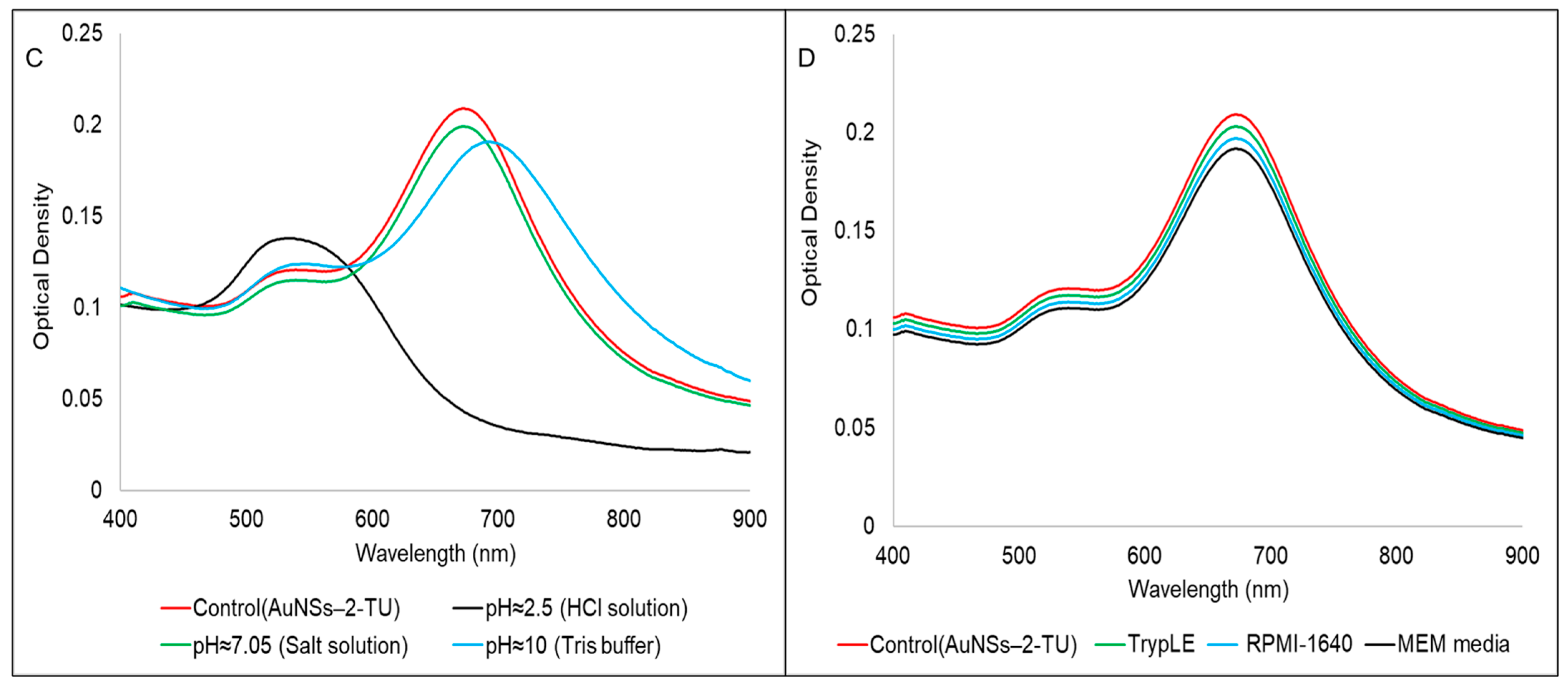
The AuNSs–2-TU conjugate remained stable when stored at 4 °C (Figure 2A), whereas storage at room temperature led to progressive instability within one week (Figure 2B), evidenced by a blue shift, attenuation and eventual loss of the longitudinal LSPR band, and a corresponding colorimetric transition from turquoise blue to wine red (Figure S1). The conjugate also remained stable in alkaline and neutral pH environments, exhibiting no significant LSPR shifts (Figure 2C). However, it lost stability in acidic conditions (e.g., HCl solution), as indicated by the disappearance of the longitudinal LSPR peak in the spectrum.
Figure 2.
Evaluation under various conditions to determine robustness for biosensing: (A) storage at 4 °C; (B) room temperature; (C) different pH levels; (D) assay matrices (saline, HCl, serum, and supplemented cell culture medium) at 37 °C. Stability was monitored by LSPR band ODmax, with changes >30% indicating instability. The control (AuNSs–2-TU) was maintained in a water matrix.
In all tested assay matrices at 37 °C (Figure 2D), the AuNSs–2-TU conjugate remained stable, showing minimal changes in the longitudinal resonance ODmax (<30%), confirming its compatibility with physiologically relevant conditions. These results indicate that the pH and ionic strength of the surrounding medium significantly influence the conjugate’s shelf life, stability, and structural integrity. Notably, storage at 4 °C was found to be optimal for long-term preservation, maintaining conjugate stability in saline, water, and Tris buffer (pH 10).
3.2. Colorimetric Response and Morphological Changes in AuNSs–2-TU Conjugates and Cells
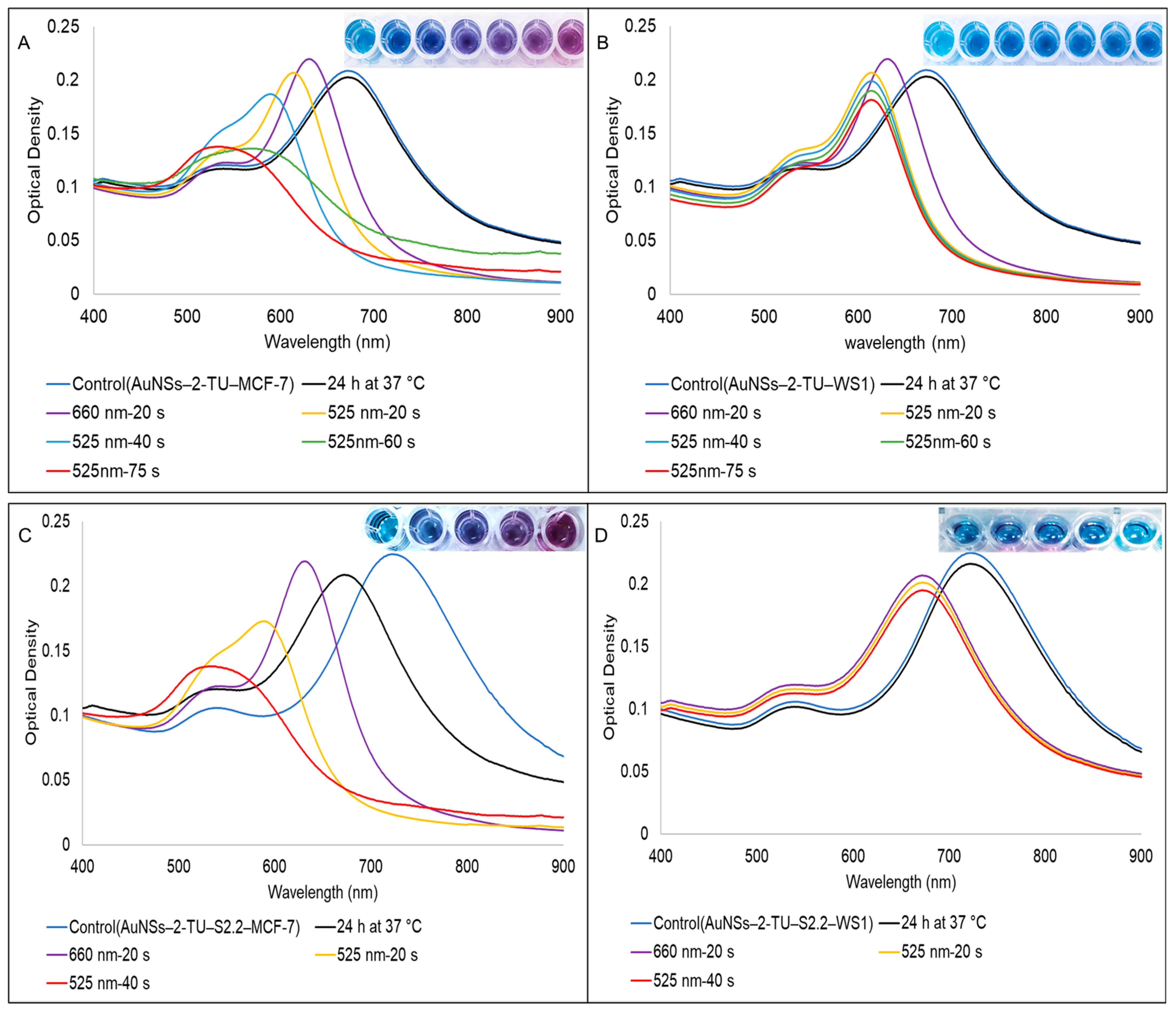
Figure 3 illustrates the morphology and optical behavior of AuNSs–2-TU conjugates in MCF-7 breast cancer cells and WS1 fibroblasts 24 h after dual-wavelength irradiation (constant 660 nm with variable 525 nm exposure). In all cases, AuNSs–2-TU conjugates incubated for 24 h at 37 °C without irradiation served as controls and retained their characteristic turquoise-blue coloration. The AuNSs–2-TU-treated MCF-7 samples exhibited a pronounced, irradiation time-dependent blue shift in the LSPR toward the visible region, accompanied by attenuation of the longitudinal plasmon band and dominance of the transverse mode, resulting in a distinct colorimetric transition from turquoise blue to wine red (Figure 3A). In contrast, the AuNSs–2-TU-treated WS1 fibroblast samples displayed only minor LSPR blue-shifts and a hypochromic response, with no significant plasmonic reconfiguration or visible color change, indicating minimal interaction between the AuNSs–2-TU conjugates and non-malignant cells (Figure 3B).
Figure 3.
UV–Vis and colorimetric response of AuNSs–2-TU-treated cells at varying durations. (A) AuNSs–2-TU–MCF-7, (B) AuNSs–2-TU–WS1, (C) AuNSs–2-TU–S2.2 aptamer–MCF-7, (D) AuNSs–2-TU–S2.2 aptamer–WS1. Controls consist of 5 × 10³ untreated cells in supplemented DMEM medium. Colorimetric inserts correspond to the observed LSPR shifts.
A clear colorimetric response was observed for the AuNSs–2-TU–MCF-7 system following approximately 3 min of incubation with the detection solution. Under optimized irradiation conditions (20 s at 660 nm followed by 40 s at 525 nm), AuNSs–2-TU–S2.2-treated MCF-7 cells exhibited a pronounced LSPR blue shift accompanied by a vivid colorimetric transition, consistent with aptamer-mediated targeting of MUC1 (Figure 3C). In contrast, AuNSs–2-TU–S2.2-treated WS1 fibroblast cells showed only minimal LSPR perturbations, characterized by a hypochromic response attributable to AuNSs excitation, while retaining the characteristic turquoise coloration (Figure 3D). These results confirm the high specificity and efficacy of the AuNSs–2-TU–S2.2 aptamer system for selective detection and targeting of MUC1-positive cancer cells while minimizing off-target effects.
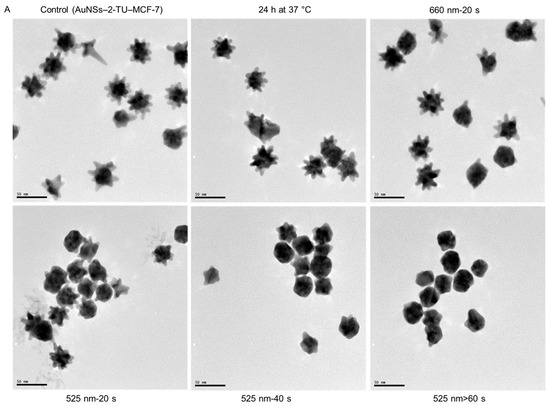
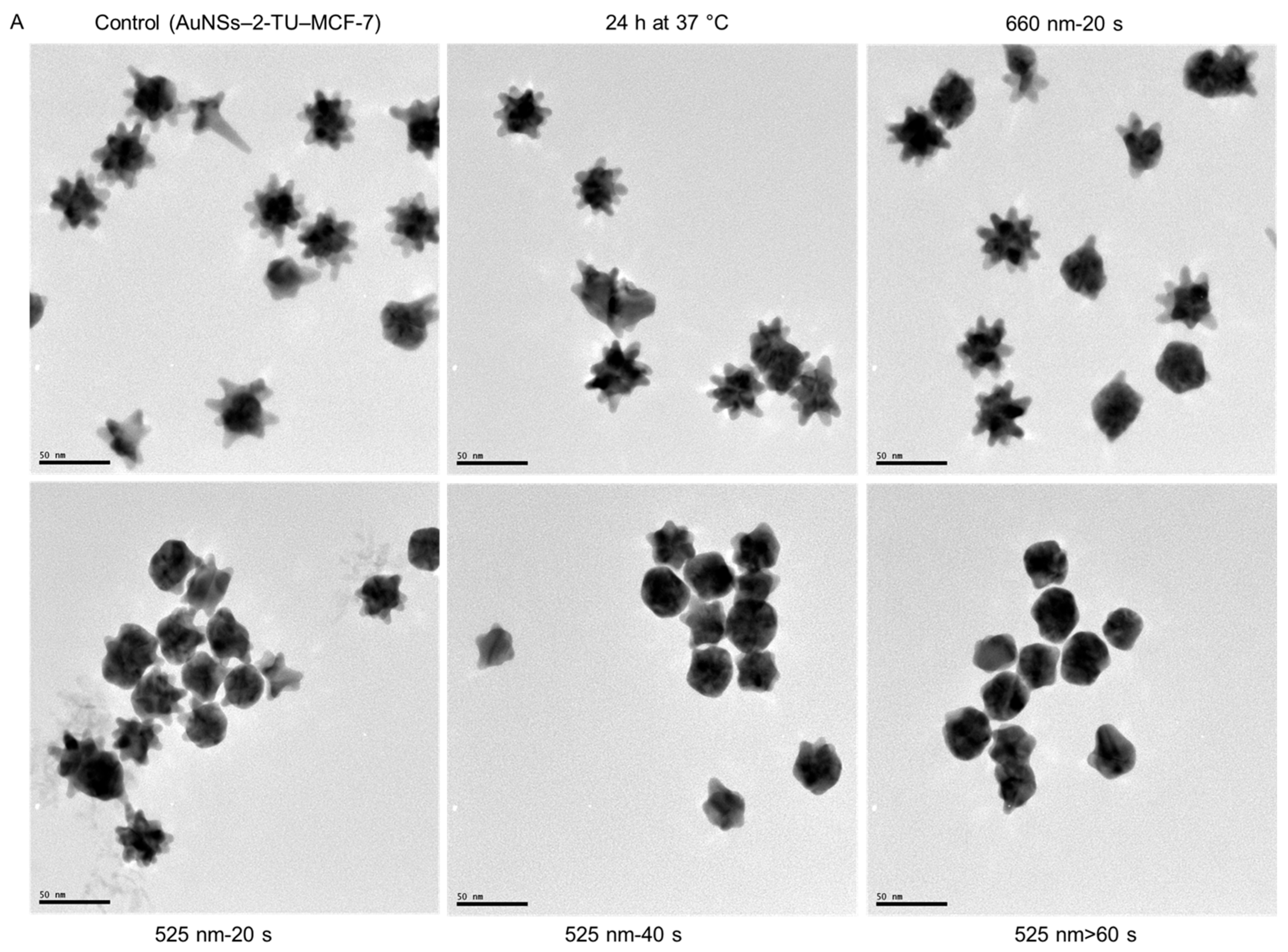
HR-TEM imaging (Figure 4A) revealed that the AuNSs–2-TU conjugates were monodispersed, with an average size of 28–36 nm and approximately ten well-defined protuberant spikes per particle. Drop-cast lysates of AuNSs–2-TU-treated MCF-7 cells were imaged by HR-TEM, revealing cell-associated and internalized nanoparticles, as well as their aggregation (Figure 4A). TEM allowed detailed visualization of AuNSs–2-TU before and after interaction with MCF-7 and WS1 cells, highlighting particle size, spike morphology, and aggregation behavior. Minimal morphological changes were observed in AuNSs–2-TU–WS1 cells before and after irradiation, with nanostar protuberances largely preserved, consistent with the UV–Vis LSPR results (Figure 3B,D and Figure S2). In contrast, the AuNSs–2-TU-treated MCF-7 system exhibited pronounced morphological transformations, with dispersed, spiked nanostars aggregating into quasi-spherical structures of varying sizes. These structural changes correlate directly with the LSPR shifts and colorimetric transitions observed in Figure 3A, confirming a strong coupling between AuNSs morphological evolution and optical response driven by enhanced photothermal interactions at the cancer cell interface.
Figure 4.
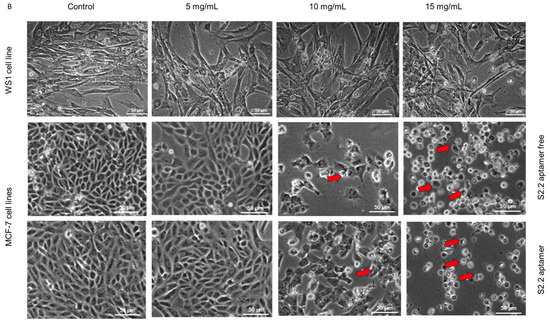
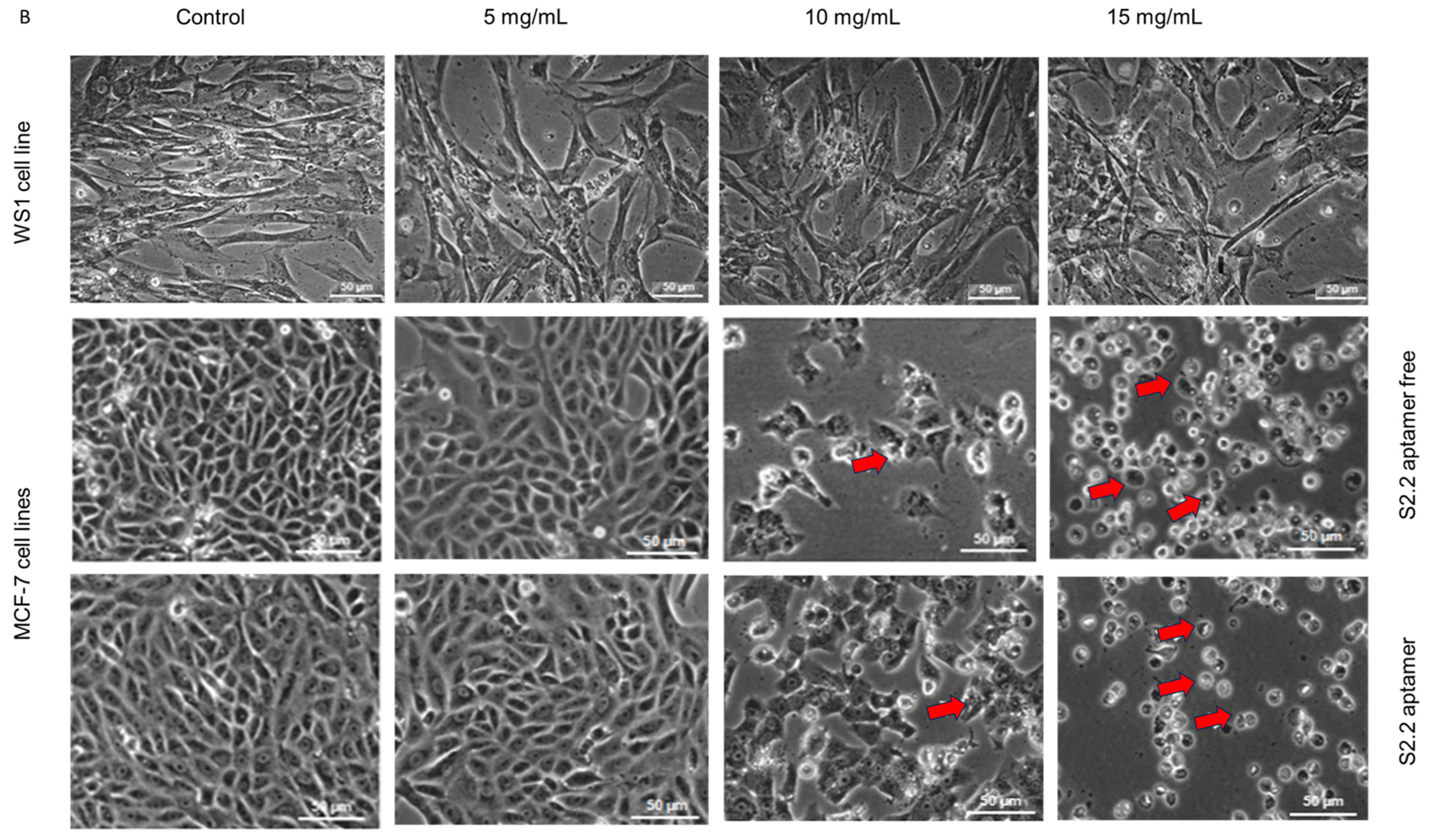
Morphological analysis of AuNSs–2-TU-treated cells. (A) HR-TEM images of AuNSs–2-TU incubated with MCF-7 cells 24-h post-irradiation at varying durations. Controls consist of 5 × 10³ untreated cells in supplemented DMEM. (B) Phase-contrast images of WS1 fibroblasts and MCF-7 cells 24-h post-irradiation, captured at 10× magnification with a 50 μm scale bar. Images illustrate cell morphology and viability under experimental conditions, with 5 × 10³ untreated cells in supplemented DMEM serving as controls. Red arrows highlight dead cells.
Phase-contrast imaging (Figure 4B) revealed dose- and irradiation time-dependent cytotoxic effects of AuNSs–2-TU on MCF-7 and WS1 cells at 5, 10, and 15 mg/mL 2-TU (AuNSs maintained at 40 mM). MCF-7 cells exhibited pronounced apoptotic features, including shrinkage, membrane blebbing, fragmentation, and detachment, with a progressive decline in cell number at higher 2-TU concentrations. Introduction of the MUC1 S2.2 aptamer enhanced specificity, and colorimetric analysis showed a distinct response exclusively in MCF-7 cells. These results demonstrate that the AuNSs–2-TU–S2.2 system selectively targets MUC1-positive cancer cells while minimizing off-target effects on non-cancerous WS1 fibroblasts. Based on these findings, the optimized treatment combination (40 mM AuNSs + 15 mg/mL 2-TU) with MCF-7 cells was selected for further evaluation.
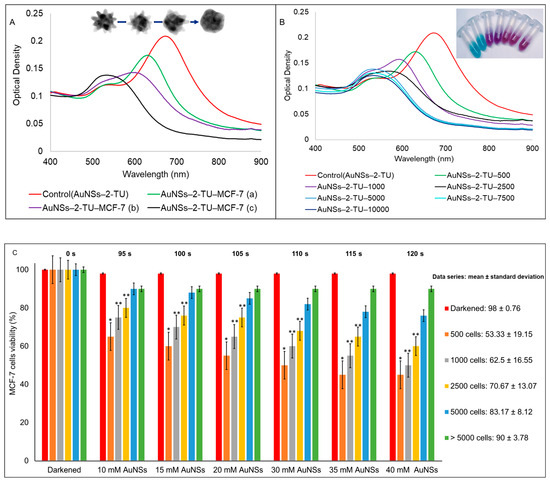
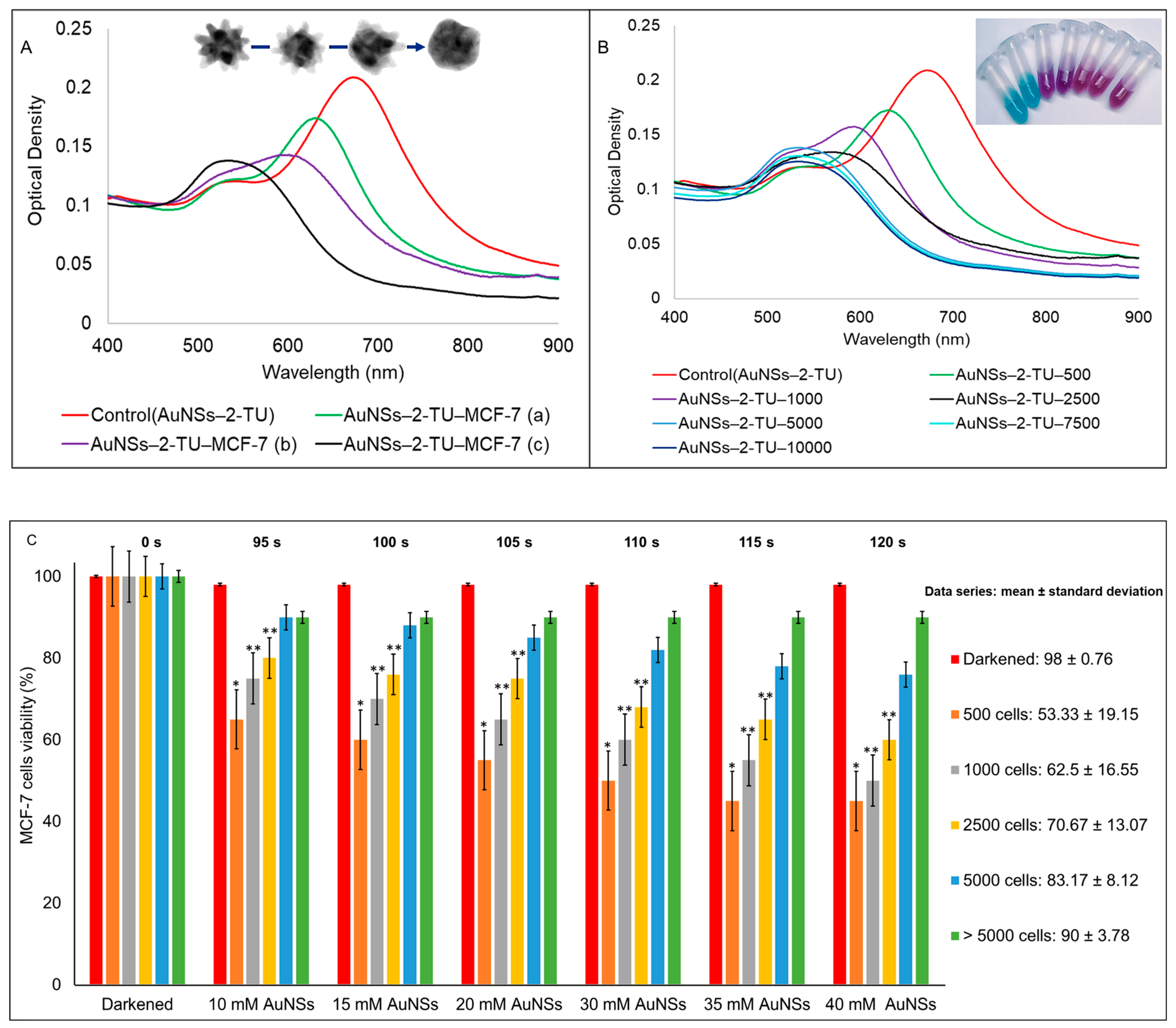
Figure 5A,B present UV–Vis and HR-TEM analyses confirming irradiation-induced structural and plasmonic evolution of the AuNSs–2-TU conjugates following sequential excitation at 660 nm and 525 nm and a rapid 5-min incubation with the detection solution. The AuNSs–2-TU conjugate exhibited a detection limit of 500 MCF-7 cells per well, below which no measurable LSPR shift or colorimetric response was observed (Figure 5A). Increasing cell density (500–1 × 10⁴ cells/well) produced progressive LSPR blue-shifts accompanied by intensified colorimetric responses, indicative of enhanced nanoparticle aggregation and plasmonic coupling. At cell densities exceeding 5 × 10³ cells/well, a hypochromic decrease in LSPR intensity was observed, yielding colorimetric responses comparable to those at 5 × 10³ cells/well, consistent with signal saturation (Figure 5B).
Figure 5.
Detection limit of AuNSs–2-TU. (A) UV–Vis spectra and HR-TEM images of AuNSs–2-TU: free conjugate, (a) 660 nm, 20 s post-irradiation; (b) 525 nm, 20 s post-irradiation; (c) 525 nm, 40 s post-irradiation. (B) UV–Vis and colorimetric responses at varying MCF-7 cell densities (500–1 × 10⁴ cells per well). Colorimetric insert corresponds to the observed LSPR shifts. (C) Cell viability assessment under UV light exposure. The viability of MCF-7 cells following exposure to UV irradiation at varying time intervals and AuNSs–2-TU concentrations was analyzed using a two-way ANOVA (irradiation time × AuNSs–2-TU concentration), followed by Tukey’s Honestly Significant Difference (HSD) post hoc test (* p < 0.05, ** p < 0.01, n = 3 replicates per condition). MCF-7 cell viability data are presented as mean ± standard deviation (SD).
Collectively, the AuNSs–2-TU platform couples photothermal plasmonic excitation with chemically driven aggregation, modulated by AgNO3/NaOH, to produce LSPR blue-shifts and a visible turquoise-to-wine-red colorimetric response enabling sensitive cancer cell detection.
The anti-proliferative activities of the AuNSs–2-TU conjugates on MCF-7 cells were evaluated using the MTT assay, with AuNSs–2-TU–5000 cells (5 mM AuNSs and 10.5 ± 0.2 mM 2-TU) serving as the darkened/negative control for all experiments (red bar) (Figure 5C). A two-way ANOVA was performed to assess the combined effects of irradiation time (0, 95, 100, 105, 110, 115, and 120 s) and AuNSs–2-TU concentration (5–40 mM) on MCF-7 cell viability (n = 3). Both irradiation duration and AuNSs concentration produced significant main effects on cell growth inhibition, with a significant interaction observed between the two factors (* p < 0.05). Tukey’s HSD post hoc comparisons confirmed that all irradiated AuNSs–2-TU-treated groups exhibited significantly greater cytotoxicity than their non-irradiated counterparts (* p < 0.05). The highest cytotoxicity was observed at ≥30 mM AuNSs–2-TU under prolonged irradiation (≥110 s), demonstrating a synergistic photothermal–biochemical effect on MCF-7 cells. Furthermore, with n = 3 and * p < 0.05, the data revealed that AuNSs–2-TU efficacy was significantly influenced by MCF-7 cell density.
The conjugate showed reduced performance at lower cell densities (≤1000 cells) but progressively regained and stabilized near-control efficacy at higher densities (≥2500 cells), reflecting enhanced nanoparticle–cell interactions and signal uniformity at increased cellular concentrations. Additionally, irradiation time exhibited a significant inverse, dose-dependent reduction in MCF-7 cell viability, achieving below 50% viability only at lower cell densities (<2500 cells). Overall, dual irradiation of fewer than 2500 MCF-7 cells for 95 s, using the AuNSs–2-TU conjugate (40 mM AuNSs and 10.50 ± 0.02 mM 2-TU), was identified as the optimal condition for delineating the IC50 concentrations required for effective cell inhibition.
Collectively, the AuNSs–2-TU conjugate demonstrated pronounced, dose-, time-, and cell-density-dependent inhibition of MCF-7 cell proliferation under dual-wavelength photothermal irradiation, highlighting its synergistic colorimetric, biochemical, and photothermal-based signal generation. The laser-induced morphological transformation of AuNSs from sharp protuberant spikes to quasi-spherical nanoparticles together with the accompanying visible colorimetric shift, further confirms their superior sensing attributes and environmental responsiveness. These results underscore the potential of the AuNSs–2-TU conjugate as an effective colorimetric and photothermal nanobiosensor.
4. Discussion
The zwitterionic compound HEPES was employed in a seedless one-pot synthesis approach to produce anisotropic AuNSs with varying diameters. Acting as both a reducing agent and stabilizer, HEPES facilitated the synthesis process through its unique chemical properties [21,54]. With an isoelectric point of 5.0, HEPES features sulfonate and hydroxide groups that undergo deprotonation and protonation across a wide pH range (1–14), influencing the protonation state of the tertiary amines in its piperazine ring [19,21]. This dynamic behavior, combined with the molecule’s ability to form Au-thiol bonds (Au-S) through weak interatomic interactions such as covalent, ionic, and van der Waals forces, governs the structural and spectroscopic properties of the Au-S interface [21,55,56]. Although Au-N formation via dative or hydrogen bonding is possible, the Au-S interaction takes precedence in HEPES-mediated AuNSs functionalization with 2-TU [55,57]. This preference for Au-S bonding likely results from the strong affinity between the AuNSs surface and the sulfur atom in the 2-TU molecule, ensuring more stable and efficient functionalization [21,35,54].
Post-synthesis analysis revealed the incorporation of HEPES within the AuNSs lattice, as confirmed by elemental and 1H NMR studies (Figure 1C), consistent with previous studies [21]. The XRD analysis (Figure 1D) of the synthesized AuNSs bioconjugate confirms its fcc structure, displaying distinct Bragg reflections at 2θ = 38.13°, 44.32°, 64.53°, and 77.74°, corresponding to the (111), (200), (220), and (311) crystal planes, respectively. This result is consistent with typical AuNPs studies [58,59,60], validating the crystallinity and structural integrity of the nanostars. The XRD analysis confirms the high crystallinity and purity of the synthesized AuNSs bioconjugates, which is crucial for plasmonic and biosensing applications. The dominance of the (111) crystal plane enhances SPR properties, improving biomolecule binding efficiency in bioconjugation. The resulting AuNSs bioconjugates exhibited a hybrid LSPR absorbance peak, with a transverse LSPR at ~540 nm for the solid core and a longitudinal LSPR at ~720 nm for the protuberant spikes (Figure 1A). AuNSs exhibit superior photothermal conversion efficiency (PCE) compared to spherical nanoparticles due to their star-shaped morphology, where sharp, protruding spikes create a “rod-lightning” effect that concentrates electromagnetic fields [61,62,63]. These sharp, protruding spikes generate “hot spots”, significantly enhancing sensitivity and signal amplification, making AuNSs highly effective for biosensing and theranostic applications [17,64,65,66]. Additionally, AuNSs exhibit tunable light absorption, particularly in the near-infrared (NIR) region, which is ideal for in vivo applications due to minimal tissue absorption [12,19,64]. Their larger surface area-to-volume ratio facilitates efficient bioconjugation, enhancing their functionality while minimizing biological interference [12,17,64]. These distinct physicochemical characteristics, along with their structural versatility and tunable plasmonic properties, position AuNSs as a superior tool for advanced nanotheranostics and biosensing, surpassing other gold nanoparticle shapes.
The AuNSs–2-TU bioconjugate demonstrated remarkable stability during long-term storage, in various assay matrices, and under neutral and alkaline pH conditions, with no significant shifts in the LSPR band (Figure 2). However, the conjugate exhibited instability in acidic conditions and at room temperature, characterized by the loss of the longitudinal peak and a pronounced blue shift in the spectrum compared to controls. The AuNSs–2-TU conjugate exhibited a slight hypochromic shift at 4 °C, reflecting minimal aggregation and reduced plasmonic coupling, whereas at room temperature, increased particle interactions induced partial aggregation, resulting in a blue shift in the longitudinal LSPR (Figure 2A,B) [44,67]. These temperature-dependent effects underscore the conjugate’s sensitivity and stability in different storage conditions. This instability in HCl solution was likely due to fluctuations in the protonation states of surface ligands and increased ionic strength, which diminished electrostatic repulsion and promoted aggregation [16,17,20,68,69]. Additionally, competition between HCl ions and HEPES for stabilizing interactions with the AuNSs may have contributed to the observed loss of stability.
Numerous studies have demonstrated that 2-Thiouracil and its derivatives exhibit significant anticancer, antineoplastic, and antibacterial properties, making them highly versatile therapeutic agents [36,37,38,40]. 2-TU primarily exerts its cytotoxic effects in cancer cells when conjugated to nanocarriers such as AuNSs, leveraging their enhanced cellular uptake and photothermal properties (Figure 3) [35,70,71]. While 2-TU alone has limited efficacy in non-cancerous cells due to their lower metabolic rate and efficient repair mechanisms, its conjugation with AuNSs significantly amplifies its impact on malignant cells [72,73]. This occurs through LSPR-induced ROS generation, oxidative stress, and disruption of nucleic acid synthesis, leading to selective cancer cell apoptosis while sparing normal fibroblasts [35,36,37,38,40,74]. Furthermore, the specificity of the AuNS-2-TU bioconjugate can be significantly enhanced by incorporating aptamers that selectively bind to overexpressed cancer biomarkers, a technique widely utilized in nano-based photodynamic therapy (PDT) and photothermal therapy (PTT) [75,76,77,78,79].
Mucin 1 (MUC1) is a well-established biomarker for breast cancer [80,81,82,83,84]. The incorporation of the S2.2 aptamer (Figure 3), which exhibits high affinity for MUC1, ensures precise targeting of cancer cells while minimizing false positives [45]. This targeted approach not only enhances the selectivity and efficacy of the treatment but also improves biostability and cellular uptake, making AuNSs–2-TU a highly efficient and specific nanotheranostic platform for MUC1-positive cancers. Overall, the synergistic interaction between AuNSs photothermal therapy (PTT) and 2-TU-induced cytotoxicity reinforces selective cancer cell death (Figure 4B), highlighting the efficacy of this nanotheranostic approach.
AuNSs markedly enhance the anticancer efficacy of 2-thiouracil (2-TU) against MCF-7 breast cancer cells by improving intracellular delivery, stability, and photothermally assisted cytotoxicity, consistent with previous studies (Figure 4B) [35,70]. Their anisotropic star-shaped architecture generates strong localized surface plasmon resonance (LSPR) “hot spots”, which facilitate efficient cellular uptake and light-to-heat conversion [12,85,86]. When AuNSs cluster on or inside MCF-7 cells, plasmonic coupling at their spikes further amplifies local heat generation, enhancing hyperthermia and, in combination with 2-TU activity, promoting cell death, consistent with previous studies [17,87,88]. Conjugation of 2-TU to AuNSs not only promotes endocytosis-mediated internalization, protects the drug from premature degradation, and increases intracellular bioavailability relative to free 2-TU, but also, upon aggregation, amplifies local heating and optical changes, correlating with nanoparticle–cell binding, internalization, and localized cytotoxic effects [89,90].
The biodistribution of anisotropic gold nanoparticles with comparable geometry, surface charge, and coating has been extensively characterized in previous studies using confocal and electron microscopy [13,34,42,61,87]. Delgado’s group highlighted that AuNSs and nanourchins (AuNUs) possess unique physicochemical properties alongside favorable biological characteristics, including low cytotoxicity and high cellular uptake [13]. Li’s group further demonstrated the high cellular uptake, internalization, and perinuclear accumulation of AuNSs, confirming their efficient interaction with cancer cells [34]. In vivo, the localization of AuNSs was visualized through non-invasive magnetic resonance (MR) imaging, while intravital two-photon luminescence (TPL) imaging enabled real-time assessment of nanoparticle behaviour within tumors at the microscopic level. These investigations consistently demonstrate efficient cellular uptake and perinuclear accumulation of anisotropic gold nanoparticles. Accordingly, our interpretation aligns with this well-established and reproducible uptake profile, reducing the need to replicate previously documented imaging results within the scope of the present study. Consequently, our work focused primarily on functional assay-based biological endpoints.
The colorimetric response of AuNSs–2-TU conjugates upon laser irradiation of MCF-7 cells provides a direct readout of photothermal and biochemical efficacy, reflecting the extent of cellular damage (Figure 4) [91]. Plasmonic shifts and controlled aggregation of the nanostars are not merely physical phenomena but functional indicators of nanoparticle–cell interactions [45]. Laser-induced photothermal heating at the AuNS tips, combined with modulation of pH and ionic strength by the detection solution (2 μL, 5 mM AgNO3 + 10 μL, 75 mM NaOH), promotes partial aggregation and clustering, producing a blue-shift in the longitudinal LSPR band and a visible color transition from turquoise to wine red (Figure 3) [92,93]. Selectivity toward MUC1-positive MCF-7 cells is likely mediated by 2-TU, whose thiol and carbonyl functionalities can engage in hydrogen-bonding and coordination interactions with MUC1 residues, promoting preferential localization of the AuNSs–2-TU conjugate at the cancer cell surface [35,71,94]. Higher cell densities and nanoparticle concentrations amplify local photothermal heating, inducing membrane disruption, ROS generation, nucleic acid damage, and apoptosis, while non-malignant WS1 cells remain largely unaffected [95].
Increasing MCF-7 cell density in the presence of the AuNSs–2-TU conjugate intensified the colorimetric response, consistent with enhanced nanoparticle aggregation and pronounced plasmonic shifts that amplify localized photothermal effects (Figure 5B). This concentration-dependent behavior significantly reduced the IC50 value, indicating improved anticancer potency (Figure 5C). Prolonged irradiation further synergized with higher conjugate concentrations to maximize ROS generation and induce DNA/RNA damage, thereby promoting apoptotic cell death [95]. In contrast, lower doses or shorter irradiation times attenuated both photothermal and cytotoxic efficacy, highlighting the critical interplay between nanoparticle dosage, irradiation duration, and therapeutic outcomes [35,38]. Overall, further investigation is warranted to quantitatively resolve the local temperature rise experienced by MCF-7 cells during AuNSs–2-TU–mediated photothermal heating, including thermal dosimetry at the cell–nanoparticle interface and its relationship to ROS generation thresholds and established photothermal safety limits. Such analysis is essential to distinguish sub-lethal hyperthermia from irreversible thermal damage and to define a safe and effective therapeutic window.
In comparison to Meléndez group’s use of citrate-reduced AuNPs functionalized with 2-TU for enhanced antiproliferative activity in MDA-MB-231 cells, this study employs anisotropic AuNSs functionalized with 2-TU to leverage their unique plasmonic properties for superior biosensing and photothermal therapy in MCF-7 cells [35]. While both studies highlight the synergistic effects of 2-TU and AuNP-based PTT in reducing IC50, this work demonstrated enhanced signal amplification and photothermal targeting, positioning AuNSs as more effective than spherical AuNPs for both therapeutic and diagnostic applications. Furthermore, in the AuNSs–2-TU bioconjugate system, AuNSs serve a dual role as a conjugation scaffold and signal transducer, while 2-TU acts as both a capping agent and a PTT agent. In contrast to Kazuki et al.’s study [18], which used extracellular vesicles (EVs) conjugated with AuNSs for PTT under red laser irradiation against A549 lung cancer cells, our work offers a dual advantage. Their approach relied solely on a single irradiation mode without generating colorimetric signals, whereas our study integrates visual biosensing with dual-mode photothermal therapy. This dual functionality highlights the superiority and broader applicability of our AuNSs–2-TU system for both cancer detection and treatment. Furthermore, 2-TU is an excellent PTT agent, with its efficacy further enhanced when coupled to nanoparticles of varying morphologies, a result consistent with previous findings [18,35,36,37,38,96]. This nanoparticle conjugation not only improves the delivery and bioavailability of 2-TU but also amplifies its photothermal and therapeutic effects, offering a powerful approach for targeted treatments across multiple applications.
5. Conclusions
This study demonstrates the selective cytotoxic efficacy of the AuNSs–2-TU conjugate in specifically targeting MCF-7 breast cancer cells, while maintaining the viability of non-cancerous cells. By integrating the unique plasmonic properties and superior photothermal conversion efficiency of gold nanostars with the synergistic chemotherapeutic potential of 2-thiouracil (2-TU), the developed nanoplatform exhibits remarkable dual functionality as both a colorimetric biosensor and a photothermal therapeutic agent. This integrated system enables real-time visualization of cellular interactions and concentration-dependent optical responses, offering precise photothermal control during treatment. The combination of rapid, visual detection with targeted cytotoxic activity underscores the versatility of AuNSs–2-TU as an advanced nanotheranostic platform. Collectively, these findings position the AuNSs–2-TU conjugate as a promising candidate for selective, minimally invasive, and effective breast cancer diagnostic and therapeutic applications.
Supplementary Materials
The following supporting information can be downloaded at: https://www.mdpi.com/article/10.3390/jnt7010002/s1, Figure S1: Colorimetric and stability assessment of AuNSs–2-TU under various conditions to evaluate biosensor robustness. (A) Storage at 4 °C; (B) storage at room temperature; (C) exposure to different pH levels; (D) stability in assay matrices (saline, HCl, serum, and supplemented cell culture medium) at 37 °C. Stability was monitored by changes in the LSPR band ODmax, with varia-tions greater than 30% indicating instability. The control (AuNSs–2-TU) was maintained in a water matrix, Figure S2: Morphological analysis of AuNSs–2-TU–treated cells. HR-TEM images of AuNSs–2-TU incubated with WS1 fibro-blast cells 24 h post-irradiation at varying durations. Controls consisted of 5 × 10³ untreated WS1 cells cultured in supplemented DMEM medium.
Author Contributions
T.A.M. Conceptualization, data curation, formal analysis, investigation, methodology, validation, visualization, writing—review and editing; A.C. Conceptualization, data curation, formal analysis, resources, supervision, validation, writing—review and editing; H.A. formal analysis, funding acquisition, project administration, resources, supervision, validation, writing—review and editing. All authors have read and agreed to the published version of the manuscript.
Funding
The authors were funded by the National Research Foundation of South Africa Thuthuka Instrument, grant number TTK2205035996; the Department of Science and Innovation (DSI) funded African Laser Centre (ALC), grant number HLHA23X task ALC-R007; the University Research Council, grant number 2022URC00513; Department of Science and Technology’s South African Research Chairs Initiative (DST-NRF/SARChI), grant number 98337.
Institutional Review Board Statement
Not Applicable.
Informed Consent Statement
Not Applicable.
Data Availability Statement
The original contributions presented in this study are included in the article/Supplementary Materials. Further inquiries can be directed to the corresponding authors.
Acknowledgments
The authors would like to acknowledge the University of Johannesburg for their facilities.
Conflicts of Interest
The authors declare no conflict of interest.
References
- Łukasiewicz, S.; Czeczelewski, M.; Forma, A.; Baj, J.; Sitarz, R.; Stanisławek, A. Breast Cancer-Epidemiology, Risk Factors, Classification, Prognostic Markers, and Current Treatment Strategies—An Updated Review. Cancers 2021, 13, 4287. [Google Scholar] [CrossRef] [Scilit]
- Weerarathna, I.N.; Luharia, A.; Uke, A.; Mishra, G. Challenges and Innovations in Breast Cancer Screening in India: A Review of Epidemiological Trends and Diagnostic Strategies. Int. J. Breast Cancer 2024, 2024, 6845966. [Google Scholar] [CrossRef] [Scilit]
- Saeed, A.; Jabeen, A.; Mushtaq, I.; Murtaza, I. Cancer: Insight and Strategies to Reduce the Burden. In Pathophysiology of Cancer: An Interdisciplinary Approach; Rezaei, N., Ed.; Springer Nature: Cham, Switzerland, 2025; pp. 49–70. [Google Scholar]
- Chehelgerdi, M.; Chehelgerdi, M.; Allela, O.Q.B.; Pecho, R.D.C.; Jayasankar, N.; Rao, D.P.; Thamaraikani, T.; Vasanthan, M.; Viktor, P.; Lakshmaiya, N.; et al. Progressing nanotechnology to improve targeted cancer treatment: Overcoming hurdles in its clinical implementation. Mol. Cancer 2023, 22, 169. [Google Scholar] [CrossRef] [Scilit] [PubMed]
- Sakore, P.; Bhattacharya, S.; Belemkar, S.; Prajapati, B.G.; Elossaily, G.M. The theranostic potential of green nanotechnology-enabled gold nanoparticles in cancer: A paradigm shift on diagnosis and treatment approaches. Results Chem. 2024, 7, 101264. [Google Scholar] [CrossRef] [Scilit]
- Pratihar, S.; Bhagavath, K.K.; Govindaraju, T. Small molecules and conjugates as theranostic agents. RSC Chem. Biol. 2023, 4, 826–849. [Google Scholar] [CrossRef] [Scilit]
- Luobin, L.; Wanxin, H.; Yingxin, G.; Qinzhou, Z.; Zefeng, L.; Danyang, W.; Huaqin, L. Nanomedicine-induced programmed cell death in cancer therapy: Mechanisms and perspectives. Cell Death Discov. 2024, 10, 386. [Google Scholar] [CrossRef] [Scilit] [PubMed]
- Manivasagan, P.; Joe, A.; Han, H.-W.; Thambi, T.; Selvaraj, M.; Chidambaram, K.; Kim, J.; Jang, E.-S. Recent advances in multifunctional nanomaterials for photothermal-enhanced Fenton-based chemodynamic tumor therapy. Mater. Today Bio 2022, 13, 100197. [Google Scholar] [CrossRef] [Scilit]
- Omidian, H.; Dey Chowdhury, S. Advances in Photothermal and Photodynamic Nanotheranostics for Precision Cancer Treatment. J. Nanotheranostics 2024, 5, 228–252. [Google Scholar] [CrossRef] [Scilit]
- Wang, R.; Huang, Z.; Xiao, Y.; Huang, T.; Ming, J. Photothermal therapy of copper incorporated nanomaterials for biomedicine. Biomater. Res. 2023, 27, 121. [Google Scholar] [CrossRef] [Scilit]
- Bhattacharya, T.; Preetam, S.; Mukherjee, S.; Kar, S.; Roy, D.S.; Singh, H.; Ghose, A.; Das, T.; Mohapatra, G. Anticancer activity of quantum size carbon dots: Opportunities and challenges. Discov. Nano 2024, 19, 122. [Google Scholar] [CrossRef] [Scilit]
- Fabris, L. Gold Nanostars in Biology and Medicine: Understanding Physicochemical Properties to Broaden Applicability. J. Phys. Chem. C 2020, 124. [Google Scholar] [CrossRef] [Scilit]
- Delgado-Corrales, B.J.; Chopra, V.; Chauhan, G. Gold nanostars and nanourchins for enhanced photothermal therapy, bioimaging, and theranostics. J. Mater. Chem. B 2025, 13, 399–428. [Google Scholar] [CrossRef] [Scilit]
- Ngo, N.M.; Tran, H.-V.; Lee, T.R. Plasmonic Nanostars: Systematic Review of their Synthesis and Applications. ACS Appl. Nano Mater. 2022, 5, 14051–14091. [Google Scholar] [CrossRef] [Scilit]
- Xi, Z.; Zhang, R.; Kiessling, F.; Lammers, T.; Pallares, R. Role of Surface Curvature in Gold Nanostar Properties and Applications. ACS Biomater. Sci. Eng. 2023, 10, 38–50. [Google Scholar] [CrossRef] [Scilit] [PubMed]
- Dallari, C.; Capitini, C.; Calamai, M.; Trabocchi, A.; Pavone, F.S.; Credi, C. Gold Nanostars Bioconjugation for Selective Targeting and SERS Detection of Biofluids. Nanomaterials 2021, 11, 665. [Google Scholar] [CrossRef] [Scilit]
- Donoso-González, O.; Hengsbach, R.; Ohlerth, T.; Noyong, M.; Sierpe, R.; Rozas-Castro, N.; Lodeiro, L.; Bolaños, K.; Melo, F.; Yutronic, N.; et al. Impact of Ligand Exchange on Gold Nanostars’ Reshaping, Stabilization, Photothermal Efficiency, and Cell Viability. ACS Appl. Nano Mater. 2024, 7, 1437–1449. [Google Scholar] [CrossRef] [Scilit]
- Sato, K.; Ogawa, K.; Tagami, T.; Ozeki, T. Photothermal therapeutic effect by gold nanostars/extracellular vesicles nanocomplex on melanoma cells. J. Pharm. Sci. 2024, 114, 1391–1397. [Google Scholar] [CrossRef] [Scilit] [PubMed]
- Saverot, S.; Geng, X.; Leng, W.; Vikesland, P.J.; Grove, T.Z.; Bickford, L.R. Facile, tunable, and SERS-enhanced HEPES gold nanostars. RSC Adv. 2016, 6, 29669–29673. [Google Scholar] [CrossRef] [Scilit]
- Siegel, A.L.; Baker, G.A. Bespoke nanostars: Synthetic strategies, tactics, and uses of tailored branched gold nanoparticles. Nanoscale Adv. 2021, 3, 3980–4004. [Google Scholar] [CrossRef] [Scilit]
- Xi, W.; Haes, A.J. Elucidation of HEPES Affinity to and Structure on Gold Nanostars. J. Am. Chem. Soc. 2019, 141, 4034–4042. [Google Scholar] [CrossRef] [Scilit]
- Vines, J.B.; Yoon, J.-H.; Ryu, N.-E.; Lim, D.-J.; Park, H. Gold Nanoparticles for Photothermal Cancer Therapy. Front. Chem. 2019, 7, 167. [Google Scholar] [CrossRef] [Scilit]
- Fan, D.; Cao, Y.; Cao, M.; Wang, Y.; Cao, Y.; Gong, T. Nanomedicine in cancer therapy. Signal Transduct. Target. Ther. 2023, 8, 293. [Google Scholar] [CrossRef] [Scilit] [PubMed]
- Gupta, N.; Malviya, R. Understanding and advancement in gold nanoparticle targeted photothermal therapy of cancer. Biochim. Biophys. Acta (BBA) Rev. Cancer 2021, 1875, 188532. [Google Scholar] [CrossRef] [Scilit]
- Islam, W.; Niidome, T.; Sawa, T. Enhanced Permeability and Retention Effect as a Ubiquitous and Epoch-Making Phenomenon for the Selective Drug Targeting of Solid Tumors. J. Pers. Med. 2022, 12, 1964. [Google Scholar] [CrossRef] [Scilit]
- Zhao, L.; Zhang, X.; Wang, X.; Guan, X.; Zhang, W.; Ma, J. Recent advances in selective photothermal therapy of tumor. J. Nanobiotechnol. 2021, 19, 335. [Google Scholar] [CrossRef] [Scilit]
- Zhang, X.; Ma, Y.; Shi, Y.; Jiang, L.; Wang, L.; ur Rashid, H.; Yuan, M.; Liu, X. Advances in liposomes loaded with photoresponse materials for cancer therapy. Biomed. Pharmacother. 2024, 174, 116586. [Google Scholar] [CrossRef] [Scilit] [PubMed]
- Panikkanvalappil, S.R.; Hooshmand, N.; El-Sayed, M.A. Intracellular Assembly of Nuclear-Targeted Gold Nanosphere Enables Selective Plasmonic Photothermal Therapy of Cancer by Shifting Their Absorption Wavelength toward Near-Infrared Region. Bioconjugate Chem. 2017, 28, 2452–2460. [Google Scholar] [CrossRef] [Scilit]
- Karthikeyan, L.; Vivek, R. Synergistic anti-cancer effects of NIR-light responsive nanotherapeutics for chemo-photothermal therapy and photothermal immunotherapy: A combined therapeutic approach. Adv. Cancer Biol. Metastasis 2022, 4, 100044. [Google Scholar] [CrossRef] [Scilit]
- Beniwal, N.; Verma, A.; Putta, C.L.; Rengan, A.K. Recent Trends in Bio-nanomaterials and Non-invasive Combinatorial Approaches of Photothermal Therapy against Cancer. Nanotheranostics 2024, 8, 219–238. [Google Scholar] [CrossRef] [Scilit]
- Zeng, W.; Li, Z.; Chen, H.; Zeng, X.; Mei, L. An optimal portfolio of photothermal combined immunotherapy. Cell Rep. Phys. Sci. 2022, 3, 100898. [Google Scholar] [CrossRef] [Scilit]
- Han, H.S.; Choi, K.Y. Advances in Nanomaterial-Mediated Photothermal Cancer Therapies: Toward Clinical Applications. Biomedicines 2021, 9, 305. [Google Scholar] [CrossRef] [Scilit] [PubMed]
- Zeng, Z.; Gao, H.; Chen, C.; Xiao, L.; Zhang, K. Bioresponsive Nanomaterials: Recent Advances in Cancer Multimodal Imaging and Imaging-Guided Therapy. Front. Chem. 2022, 10, 881812. [Google Scholar] [CrossRef] [Scilit]
- Li, M.; Li, L.; Zhan, C.; Kohane, D. Core-Shell Nanostars for Multimodal Therapy and Imaging. Theranostics 2016, 6, 2306–2313. [Google Scholar] [CrossRef] [Scilit] [PubMed]
- Lorenzana-Vázquez, G.; Pavel, I.; Meléndez, E. Gold Nanoparticles Functionalized with 2-Thiouracil for Antiproliferative and Photothermal Therapies in Breast Cancer Cells. Molecules 2023, 28, 4453. [Google Scholar] [CrossRef] [Scilit]
- El-Etrawy, A.-A.S.; Sherbiny, F.F. Design, synthesis, biological evaluation and molecular modeling investigation of new N′-(2-Thiouracil-5-oyl) hydrazone derivatives as potential anti-breast cancer and anti-bacterial agents. J. Mol. Struct. 2021, 1232, 129993. [Google Scholar] [CrossRef] [Scilit]
- Alcolea Palafox, M.; Franklin Benial, A.M.; Rastogi, V.K. Biomolecules of 2-Thiouracil, 4-Thiouracil and 2,4-Dithiouracil: A DFT Study of the Hydration, Molecular Docking and Effect in DNA:RNAMicrohelixes. Int. J. Mol. Sci. 2019, 20, 3477. [Google Scholar] [CrossRef] [Scilit]
- Bomfim, L.M.; Neves, S.P.; Coelho, A.M.R.M.; Nogueira, M.L.; Dias, R.B.; Valverde, L.d.F.; Rocha, C.A.G.; Soares, M.B.P.; Batista, A.A.; Correa, R.S.; et al. Ru(II)-based complexes containing 2-thiouracil derivatives suppress liver cancer stem cells by targeting NF-κB and Akt/mTOR signaling. Cell Death Discov. 2024, 10, 270. [Google Scholar] [CrossRef] [Scilit]
- Laham-Karam, N.; Pinto, G.P.; Poso, A.; Kokkonen, P. Transcription and Translation Inhibitors in Cancer Treatment. Front. Chem. 2020, 8, 276. [Google Scholar] [CrossRef] [Scilit]
- Fatahala, S.S.; Sayed, A.I.; Mahgoub, S.; Taha, H.; El-Sayed, M.K.; El-Shehry, M.F.; Awad, S.M.; Abd El-Hameed, R.H. Synthesis of Novel 2-Thiouracil-5-Sulfonamide Derivatives as Potent Inducers of Cell Cycle Arrest and CDK2A Inhibition Supported by Molecular Docking. Int. J. Mol. Sci. 2021, 22, 11957. [Google Scholar] [CrossRef] [Scilit]
- El-Kalyoubi, S.; Elbaramawi, S.S.; Zordok, W.A.; Malebari, A.M.; Safo, M.K.; Ibrahim, T.S.; Taher, E.S. Design and synthesis of uracil/thiouracil based quinoline scaffolds as topoisomerases I/II inhibitors for chemotherapy: A new hybrid navigator with DFT calculation. Bioorganic Chem. 2023, 136, 106560. [Google Scholar] [CrossRef] [Scilit]
- Carneiro, B.A.; El-Deiry, W.S. Targeting apoptosis in cancer therapy. Nat. Rev. Clin. Oncol. 2020, 17, 395–417. [Google Scholar] [CrossRef] [Scilit] [PubMed]
- Mulder, D.W.; Phiri, M.M.; Jordaan, A.; Vorster, B.C. Modified HEPES one-pot synthetic strategy for gold nanostars. R. Soc. Open Sci. 2019, 6, 190160. [Google Scholar] [CrossRef] [Scilit]
- Munyayi, T.A.; Vorster, B.C.; Mulder, D.W. The Effect of Capping Agents on Gold Nanostar Stability, Functionalization, and Colorimetric Biosensing Capability. Nanomaterials 2022, 12, 2470. [Google Scholar] [CrossRef] [Scilit]
- Munyayi, T.A.; Crous, A. Colorimetric Biosensor for Early Detection of MUC1-Positive Cells Using Aptamer-Conjugated Plasmonic Gold Nanostars. ACS Appl. Nano Mater. 2024, 7, 24886–24896. [Google Scholar] [CrossRef] [Scilit]
- Blessy, M.; Patel, R.D.; Prajapati, P.N.; Agrawal, Y.K. Development of forced degradation and stability indicating studies of drugs—A review. J. Pharm. Anal. 2014, 4, 159–165. [Google Scholar] [CrossRef] [Scilit]
- Kontopidis, G.; Patergiannakis, I.-S. Comparative Analysis of Biochemical and Cellular Assay Conditions and the Need for a Buffer That Mimics Cytoplasmic Environments. Molecules 2025, 30, 3630. [Google Scholar] [CrossRef] [Scilit] [PubMed]
- Cantor, J.R. The Rise of Physiologic Media. Trends Cell Biol. 2019, 29, 854–861. [Google Scholar] [CrossRef] [Scilit]
- Dam, D.H.; Culver, K.S.; Kandela, I.; Lee, R.C.; Chandra, K.; Lee, H.; Mantis, C.; Ugolkov, A.; Mazar, A.P.; Odom, T.W. Biodistribution and in vivo toxicity of aptamer-loaded gold nanostars. Nanomedicine 2015, 11, 671–679. [Google Scholar] [CrossRef] [Scilit]
- Chen, H.; Zhang, X.; Dai, S.; Ma, Y.; Cui, S.; Achilefu, S.; Gu, Y. Multifunctional gold nanostar conjugates for tumor imaging and combined photothermal and chemo-therapy. Theranostics 2013, 3, 633–649. [Google Scholar] [CrossRef] [Scilit]
- Stone, J.; Jackson, S.; Wright, D. Biological applications of gold nanorods. WIREs Nanomed. Nanobiotechnol. 2011, 3, 100–109. [Google Scholar] [CrossRef] [Scilit]
- Feng, B.; Zhou, F.; Xu, Z.; Wang, T.; Wang, D.; Liu, J.; Fu, Y.; Yin, Q.; Zhang, Z.; Yu, H.; et al. Versatile Prodrug Nanoparticles for Acid-Triggered Precise Imaging and Organelle-Specific Combination Cancer Therapy. Adv. Funct. Mater. 2016, 26, 7431–7442. [Google Scholar] [CrossRef] [Scilit]
- Marshall, S.K.; Angsantikul, P.; Pang, Z.; Nasongkla, N.; Hussen, R.S.D.; Thamphiwatana, S.D. Biomimetic Targeted Theranostic Nanoparticles for Breast Cancer Treatment. Molecules 2022, 27, 6473. [Google Scholar] [CrossRef] [Scilit] [PubMed]
- Sharma, V.; Javed, B.; Estrada, G.; Byrne, H.J.; Tian, F. In situ tuning and investigating the growth process of size controllable gold nanoparticles and statistical size prediction analysis. Colloids Surf. A Physicochem. Eng. Asp. 2024, 681, 132733. [Google Scholar] [CrossRef] [Scilit]
- Kokkin, D.L.; Zhang, R.; Steimle, T.C.; Wyse, I.A.; Pearlman, B.W.; Varberg, T.D. Au–S Bonding Revealed from the Characterization of Diatomic Gold Sulfide, AuS. J. Phys. Chem. A 2015, 119, 11659–11667. [Google Scholar] [CrossRef] [Scilit] [PubMed]
- Yu, M.; Ascolani, H.; Zampieri, G.; Woodruff, D.P.; Satterley, C.J.; Jones, R.G.; Dhanak, V.R. The Structure of Atomic Sulfur Phases on Au(111). J. Phys. Chem. C 2007, 111, 10904–10914. [Google Scholar] [CrossRef] [Scilit]
- Verma, S.K.; Zahid, Z.; Kumar, P.; Tauqeer, M.; Ansari, S.N.; Mobin, S.M. Insight into a Unique Au···H-X (X = N, C, and O) Bonding Interaction. Cryst. Growth Des. 2024, 24, 8354–8369. [Google Scholar] [CrossRef] [Scilit]
- Eshun, G.B.; Osonga, F.J.; Erdogan, T.; Gölcü, A.; Sadik, O.A. Controlled synthesis and computational analysis of gold nanostars for the treatment of Fusarium oxysporum. RSC Adv. 2023, 13, 21781–21792. [Google Scholar] [CrossRef] [Scilit]
- Sneha, K.; Esterle, A.; Sharma, N.; Sahi, S. Yucca-derived synthesis of gold nanomaterial and their catalytic potential. Nanoscale Res. Lett. 2014, 9, 627. [Google Scholar] [CrossRef] [Scilit]
- Ren, X.; Song, Y.; Liu, A.; Zhang, J.; Yang, P.; Zhang, J.; An, M. Experimental and Theoretical Studies of DMH as Complexing Agent for Cyanide-free Gold Electroplating Electrolyte. RSC Adv. 2015, 5, 64997–65004. [Google Scholar] [CrossRef] [Scilit]
- Shukla, N.; Das, R.; Rodriguez, C.Y.C.; Mukhanova, E.; Soldatov, A.; Bathla, A.; Kumari, I.; Hauserao, N.; Belbekhouche, S. Optimizing near-infrared-activated gold nanostructures for targeted combination cancer therapy. Colloids Surf. B Biointerfaces 2025, 253, 114687. [Google Scholar] [CrossRef] [Scilit]
- Zhu, Y.; Sun, Q.; Liu, Y.; Ma, T.; Su, L.; Liu, S.; Shi, X.; Han, D.; Liang, F. Decorating gold nanostars with multiwalled carbon nanotubes for photothermal therapy. R. Soc. Open Sci. 2018, 5, 180159. [Google Scholar] [CrossRef] [Scilit]
- Shang, Y.; Yi, X.; Xiang, D.; Zhou, L. Nanoagent-Mediated Photothermal Therapy: From Delivery System Design to Synergistic Theranostic Applications. Int. J. Nanomed. 2025, 20, 6891–6927. [Google Scholar] [CrossRef] [Scilit]
- Becerril-Castro, I.B.; Calderon, I.; Pazos-Perez, N.; Guerrini, L.; Schulz, F.; Feliu, N.; Chakraborty, I.; Giannini, V.; Parak, W.J.; Alvarez-Puebla, R.A. Gold Nanostars: Synthesis, Optical and SERS Analytical Properties. Anal. Sens. 2022, 2, e202200022. [Google Scholar] [CrossRef] [Scilit] [PubMed]
- Wang, C.; Zhao, X.-P.; Xu, Q.-Y.; Nie, X.-G.; Younis, M.R.; Liu, W.-Y.; Xia, X.-H. Importance of Hot Spots in Gold Nanostructures on Direct Plasmon-Enhanced Electrochemistry. ACS Appl. Nano Mater. 2018, 1, 5805–5811. [Google Scholar] [CrossRef] [Scilit]
- Le, N.T.; Boskovic, T.J.M.; Allard, M.M.; Nick, K.E.; Kwon, S.R.; Perry, C.C. Gold Nanostar Characterization by Nanoparticle Tracking Analysis. ACS Omega 2022, 7, 44677–44688. [Google Scholar] [CrossRef] [Scilit]
- Pu, Y.; Zhao, Y.; Zheng, P.; Li, M. Elucidating the Growth Mechanism of Plasmonic Gold Nanostars with Tunable Optical and Photothermal Properties. Inorg. Chem. 2018, 57, 8599–8607. [Google Scholar] [CrossRef] [Scilit] [PubMed]
- Taha, M.; e Silva, F.A.; Quental, M.V.; Ventura, S.P.M.; Freire, M.G.; Coutinho, J.A.P. Good’s buffers as a basis for developing self-buffering and biocompatible ionic liquids for biological research. Green Chem. 2014, 16, 3149–3159. [Google Scholar] [CrossRef] [Scilit] [PubMed]
- Gu, Y.; Tang, S.; Liu, X.; Liang, X.; Zhu, Q.; Wu, H.; Yang, X.; Jin, W.; Chen, H.; Liu, C.; et al. Stability prediction of gold nanoclusters with different ligands and doped metals: Deep learning and experimental tests. J. Mater. Chem. A 2024, 12, 4460–4472. [Google Scholar] [CrossRef] [Scilit]
- Lorenzana-Vázquez, G.; Adams, D.G.; Reyna, L.G.; Meléndez, E.; Pavel, I.E. Experimental and Theoretical Screening of Core Gold Nanoparticles and Their Binding Mechanism to an Anticancer Drug, 2-Thiouracil. Molecules 2024, 29, 121. [Google Scholar] [CrossRef] [Scilit]
- Marinova, P.E.; Tamahkyarova, K.D. Synthesis and Biological Activities of Some Metal Complexes of 2-Thiouracil and Its Derivatives: A Review. Compounds 2024, 4, 186–213. [Google Scholar] [CrossRef] [Scilit]
- Zuo, J.; Zhang, Z.; Li, M.; Yang, Y.; Zheng, B.; Wang, P.; Huang, C.; Zhou, S. The crosstalk between reactive oxygen species and noncoding RNAs: From cancer code to drug role. Mol. Cancer 2022, 21, 30. [Google Scholar] [CrossRef] [Scilit]
- Nelson, V.K.; Nuli, M.V.; Mastanaiah, J.; Saleem, T.S.M.; Birudala, G.; Jamous, Y.F.; Alshargi, O.; Kotha, K.K.; Sudhan, H.H.; Mani, R.R.; et al. Reactive oxygen species mediated apoptotic death of colon cancer cells: Therapeutic potential of plant derived alkaloids. Front. Endocrinol. 2023, 14, 1201198. [Google Scholar] [CrossRef] [Scilit] [PubMed]
- Nakamura, H.; Takada, K. Reactive oxygen species in cancer: Current findings and future directions. Cancer Sci. 2021, 112, 3945–3952. [Google Scholar] [CrossRef] [Scilit]
- Salve, R.; Haldar, N.; Shaikh, A.; Samanta, R.; Sengar, D.; Patra, S.; Gajbhiye, V. MUC1 aptamer-tethered H40-TEPA-PEG nanoconjugates for targeted siRNA-delivery and gene silencing in breast cancer cells. Front. Bioeng. Biotechnol. 2024, 12, 1383495. [Google Scholar] [CrossRef] [Scilit] [PubMed]
- Gavas, S.; Quazi, S.; Karpiński, T.M. Nanoparticles for cancer therapy: Current progress and challenges. Nanoscale Res. Lett. 2021, 16, 173. [Google Scholar] [CrossRef] [Scilit] [PubMed]
- Gharehbaba, A.M.; Omidi, Y.; Barar, J.; Eskandani, M.; Adibkia, K. Synergistic pH-responsive MUC-1 aptamer-conjugated Ag/MSN Janus nanoparticles for targeted chemotherapy, photothermal therapy, and gene therapy in breast cancer. Biomater. Adv. 2025, 166, 214081. [Google Scholar] [CrossRef] [Scilit]
- Taghavi, S.; Tabasi, H.; Zahiri, M.; Abnous, K.; Taghdisi, S.M.; Nekooei, S.; Nekooei, N.; Ramezani, M.; Alibolandi, M. Surface engineering of hollow gold nanoparticle with mesenchymal stem cell membrane and MUC-1 aptamer for targeted theranostic application against metastatic breast cancer. Eur. J. Pharm. Biopharm. 2023, 187, 76–86. [Google Scholar] [CrossRef] [Scilit]
- Kadkhoda, J.; Aghanejad, A.; Safari, B.; Barar, J.; Rasta, S.H.; Davaran, S. Aptamer-conjugated gold nanoparticles for targeted paclitaxel delivery and photothermal therapy in breast cancer. J. Drug Deliv. Sci. Technol. 2022, 67, 102954. [Google Scholar] [CrossRef] [Scilit]
- Khan, H.; Makwana, V.; Santos, S.N.d.; Bonacossa de Almeida, C.E.; Santos-Oliveira, R.; Missailidis, S. Development, characterization, and in vivo evaluation of a novel aptamer (Anti-MUC1/Y) for breast cancer therapy. Pharmaceutics 2021, 13, 1239. [Google Scholar] [CrossRef] [Scilit]
- Abdihalim, T.S.; Idris, A.A.A. Mucin level as a potential biomarker for breast cancer diagnosis. Mol. Cell. Biomed. Sci. 2022, 6, 117–120. [Google Scholar] [CrossRef] [Scilit]
- Huebner, H.; Häberle, L.; Müller, V.; Schrader, I.; Lorenz, R.; Forstbauer, H.; Fink, V.; Schochter, F.; Bekes, I.; Mahner, S. MUC1 (CA27. 29) before and after chemotherapy and prognosis in high-risk early breast cancer patients. Cancers 2022, 14, 1721. [Google Scholar] [CrossRef] [Scilit] [PubMed]
- Ahirwar, R.; Khan, N.; Kumar, S. Aptamer-based sensing of breast cancer biomarkers: A comprehensive review of analytical figures of merit. Expert Rev. Mol. Diagn. 2021, 21, 703–721. [Google Scholar] [CrossRef] [Scilit]
- Kargar, M.; Fardid, R.; Farhadi, A. Muc-1 Family Tumor Markers and Their Role in the Diagnosis of Breast Cancer, Review Article. J. Adv. Biomed. Sci. 2022, 12, 336–345. [Google Scholar] [CrossRef] [Scilit]
- Hang, Y.; Wang, A.; Wu, N. Plasmonic silver and gold nanoparticles: Shape- and structure-modulated plasmonic functionality for point-of-caring sensing, bio-imaging and medical therapy. Chem. Soc. Rev. 2024, 53, 2932–2971. [Google Scholar] [CrossRef] [Scilit]
- Sousa Castillo, A.; Comesana-Hermo, M.; Rodríguez-González, B.; Pérez-Lorenzo, M.; Wang, Z.; Kong, X.-T.; Govorov, A.; Correa-Duarte, M. Boosting Hot Electron-Driven Photocatalysis through Anisotropic Plasmonic Nanoparticles with Hot Spots in Au-TiO2 Nanoarchitectures. J. Phys. Chem. C 2016, 120, 11690–11699. [Google Scholar] [CrossRef] [Scilit]
- Naik, G.A.R.R.; Gupta, A.; Datta, D.; More, M.; Roy, A.A.; Kudarha, R.; Hedayat, P.; Moorkoth, S.; Mutalik, S.; Dhas, N. Synergistic combinational photothermal therapy-based approaches for cancer treatment. FlatChem 2025, 50, 100834. [Google Scholar] [CrossRef] [Scilit]
- Cao, H.; Li, C.; Qi, W.; Meng, X.; Tian, R.; Qi, Y.; Yang, W.; Li, J. Synthesis, cytotoxicity and antitumour mechanism investigations of polyoxometalate doped silica nanospheres on breast cancer MCF-7 cells. PLoS ONE 2017, 12, e0181018. [Google Scholar] [CrossRef] [Scilit]
- Gu, Q.; Zhu, L. Heating Induced Nanoparticle Migration and Enhanced Delivery in Tumor Treatment Using Nanotechnology. Bioengineering 2024, 11, 900. [Google Scholar] [CrossRef] [Scilit]
- Bravo, M.; Fortuni, B.; Mulvaney, P.; Hofkens, J.; Uji-i, H.; Rocha, S.; Hutchison, J.A. Nanoparticle-mediated thermal Cancer therapies: Strategies to improve clinical translatability. J. Control. Release 2024, 372, 751–777. [Google Scholar] [CrossRef] [Scilit]
- Faid, A.H.; Shouman, S.A.; Badr, Y.A.; Sharaky, M. Enhanced photothermal heating and combination therapy of gold nanoparticles on a breast cell model. BMC Chem. 2022, 16, 66. [Google Scholar] [CrossRef] [Scilit] [PubMed]
- Munyayi, T.A.; Mulder, D.W.; Conradie, E.H.; Vorster, B.C. Feasibility of NAD(P)/NAD(P)H as redox agents in enzymatic plasmonic gold nanostar assays for galactose quantification. R. Soc. Open Sci. 2023, 10, 230825. [Google Scholar] [CrossRef] [Scilit] [PubMed]
- Tukova, A.; Hnit, S.S.T.; Wang, D.; Lord, M.; Rodger, A.; Wang, Y. Improved biostability of gold nanostars for enhanced intercellular interactions. J. Mater. Chem. B 2025, 13, 10973–10981. [Google Scholar] [CrossRef] [Scilit] [PubMed]
- Mai, S.; Marquetand, P.; González, L. Intersystem Crossing Pathways in the Noncanonical Nucleobase 2-Thiouracil: A Time-Dependent Picture. J. Phys. Chem. Lett. 2016, 7, 1978–1983. [Google Scholar] [CrossRef] [Scilit]
- Hu, Z.; Chen, Y.; Yang, S.; Diao, S.; Ma, L.; Shi, C. Radiation-Induced Biological Effects: Molecular and Cellular Mechanism, and Applications to Radiation/Nuclear Emergency and Cancer Therapy. MedComm 2025, 6, e70478. [Google Scholar] [CrossRef] [Scilit]
- Kumar, P.; Das, S. Kinetics and adsorption isotherm model of 2-thiouracil adsorbed onto the surface of reduced graphene oxide-copper oxide nanocomposite material. J. Mol. Struct. 2022, 1268, 133723. [Google Scholar] [CrossRef] [Scilit]
Disclaimer/Publisher’s Note: The statements, opinions and data contained in all publications are solely those of the individual author(s) and contributor(s) and not of MDPI and/or the editor(s). MDPI and/or the editor(s) disclaim responsibility for any injury to people or property resulting from any ideas, methods, instructions or products referred to in the content. |
© 2026 by the authors. Licensee MDPI, Basel, Switzerland. This article is an open access article distributed under the terms and conditions of the Creative Commons Attribution (CC BY) license.