


Journal Menu
► ▼ Journal Menu-
- Hydrology Home
- Aims & Scope
- Editorial Board
- Topical Advisory Panel
- Early Career Editorial Board
- Instructions for Authors
- Special Issues
- Topics
- Sections & Collections
- Article Processing Charge
- Indexing & Archiving
- Editor’s Choice Articles
- Most Cited & Viewed
- Journal Statistics
- Journal History
- Journal Awards
- Society Collaborations
- Conferences
- Editorial Office
Journal Browser
► ▼ Journal BrowserNeed Help?
Announcements
2 September 2026
Interview with Dr. Konglong He—Winner of the Hydrology Travel Award
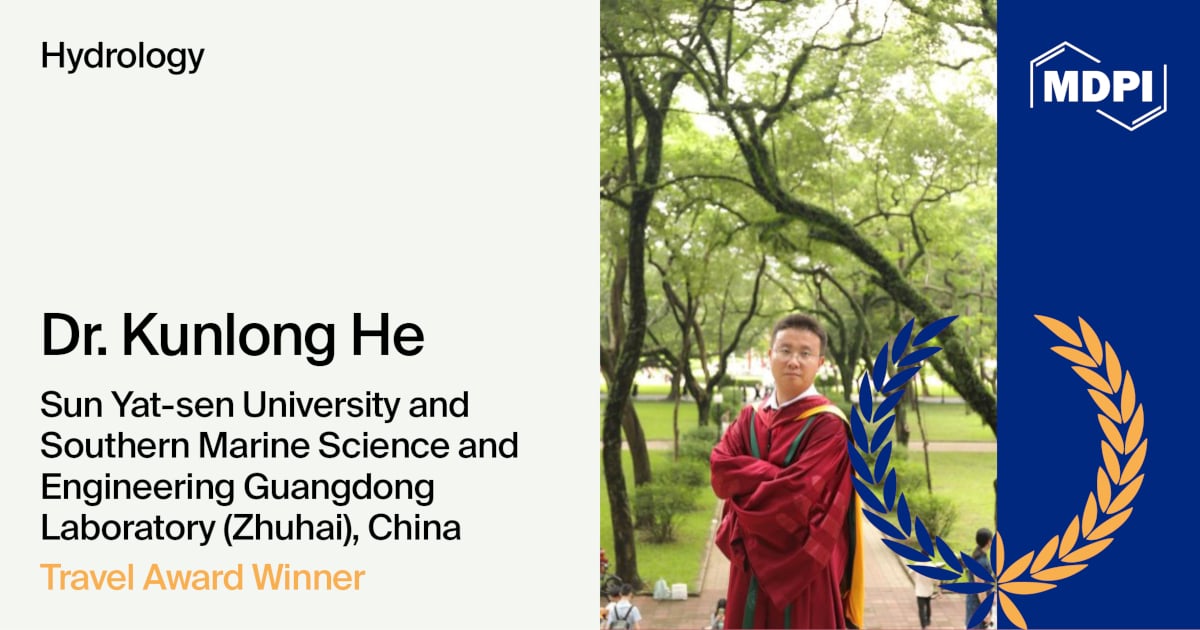
The Hydrology Travel Award was launched in 2019 and is presented annually to encourage junior scientists to present their latest research at academic conferences in the field of hydrology, helping them to grow their professional profile.
We wish to congratulate Dr. Konglong He on winning the Hydrology 2026 Travel Award!
Dr. Konglong He received his PhD from Sun Yat-sen University, China and is currently a postdoctoral researcher at the Hong Kong University of Science and Technology. His main research interests include extreme hydrometeorological events, precipitation remote sensing and reconstruction, artificial intelligence, and disaster risk.
His work has two main strands: First, he focuses on integrating multi-source data, such as satellite observations, reanalysis products, and ground-based measurements, and combining machine learning with physical process information to improve the monitoring, reconstruction, and uncertainty characterization of high-resolution precipitation, especially extreme rainfall. Second, he studies disaster processes triggered by extreme rainstorms, including flash floods, landslides, debris flows, and urban flooding, and the cascading and compound multi‑hazard chains that may arise among them. In recent years, he has more closely linked high-resolution hydro‑meteorological information with disaster processes, exposure, and risk assessment, providing more robust scientific support for extreme weather monitoring, early warning, and climate adaptation.
The following is an interview with Dr. Konglong He:
1. What is your current research topic and why did you choose this research field?
My research mainly focuses on extreme hydro-meteorological events, particularly high-resolution rainfall reconstruction, multi-source remote sensing data fusion, artificial intelligence, and rainstorm-triggered disaster chains and risk assessment.
Precipitation is one of the most important variables in the water cycle and at the same time one of the most spatially heterogeneous, especially short-duration extreme rainfall events, which often trigger flash floods, landslides, debris flows, and urban flooding. Through processes such as overland flow concentration, soil moisture change, slope instability, and sediment transport, these events can further develop into interconnected multi-hazard chains.
Therefore, my research not only looks at how precipitation itself can be monitored and reconstructed more accurately, but increasingly at how extreme precipitation propagates into disaster processes and risk evolution. Choosing this direction stems partly from my continued work during my Ph.D. on precipitation remote sensing and hydrological processes, and partly from my interest in coupled multi-hazard events, disaster chains, and their societal impacts under the background of extreme weather.
2. How did you learn about this award? What practical support do you think such awards provide to early career researchers?
I first learned about the Hydrology Travel Award while following international hydrology conferences and the academic activities of related journals. For early career researchers, participating in high-level international conferences often involves considerable costs, including registration fees, travel, and accommodation. Travel awards therefore offer very direct financial support.
However, I believe their significance goes beyond funding. Receiving a young scholar award from a journal is itself a recognition of one’s research work and academic potential, which can strengthen early career researchers’ confidence in engaging in international exchange. At the same time, such awards help researchers connect with new academic communities, obtain feedback from peers, and establish potential collaborations.
For these reasons, I am very grateful to Hydrology for providing opportunities that support young researchers in stepping onto international academic platforms.
3. In your view, what are the most direct benefits of attending international scientific conferences for early career researchers?
I believe the greatest value of international conferences lies in providing face-to-face academic interaction that cannot be fully replaced by papers or online communication. Early career researchers can, through oral presentations, poster sessions, and focused discussions, quickly learn about emerging questions, new data, and innovative methods that are currently attracting attention in their field, and can receive direct feedback from peers on their study design, methods, and results.
Sometimes, a discussion of just ten or fifteen minutes can help us identify issues we previously overlooked or even inspire new research ideas. In addition, international conferences are key venues for building long-term collaborative networks. For young researchers, proactively engaging with scientists from different countries and research backgrounds not only improves their ability to communicate scientific ideas, but also helps them understand how the same research problem may have different meanings across regions, disciplines, and application contexts.
4. What challenges have you encountered in your research? How did you overcome them?
One of the biggest challenges in research is that many ideas that appear promising may not deliver the expected results once implemented. For example, different precipitation products have different error structures, and machine learning models that perform well in one region may not transfer directly to other climates or terrains.
Over time, I have realized that research should not focus solely on model accuracy, but must pay more attention to data quality, uncertainty, and physical consistency. When facing such issues, I usually start with the simplest baseline models and use sensitivity analyses, ablation studies, and independent data validation to gradually diagnose the sources of problems.
My experience with international collaboration has also made me aware of the importance of discussing issues with researchers from different fields in a timely manner. Many difficulties are not solved by continually increasing model complexity, but by revisiting the scientific question itself.
5. What qualities do you think early career researchers need?
First, curiosity and independent thinking. The core of research is not simply following popular topics, but continuously posing questions that truly merit investigation and understanding why these questions matter.
Second, patience and resilience. Failures, revisions, and critical reviews are very common in research. Many achievements are the result of long periods of data processing, model tuning, and repeated validation.
Third, openness—being willing to accept different opinions, learn new methods, and collaborate with researchers from diverse disciplinary backgrounds. At the same time, I believe young researchers should remain rigorous, treating data, methods, and conclusions with due caution, and avoiding the temptation to overlook uncertainties in pursuit of “better results”.
In the long run, research that can continuously generate value is usually built on reliable, transparent, and reproducible scientific foundations.
6. Looking ahead, which research directions do you think will attract more attention from the academic community?
I believe the deep integration of artificial intelligence with Earth system science, hydrology, and meteorology will continue to be a major focus. In the future, however, emphasis may shift from purely pursuing predictive accuracy towards physical consistency, uncertainty quantification, interpretability, and cross-regional generalization.
At the same time, research on extreme precipitation will likely further expand from “meteorological event detection” to “disaster processes and risk chains”. A single extreme rainstorm does not necessarily correspond to a single type of hazard—it may simultaneously or sequentially trigger flash floods, landslides, debris flows, and urban flooding, and produce cascading impacts through transportation, infrastructure, and population exposure.
Therefore, an important direction will be how to use high-resolution observations, artificial intelligence, digital twins, and multi-source data fusion to characterize the full transmission pathway from extreme precipitation to hydrological response, geohazards, and ultimately societal risk. Research with real applied value should not only predict “where heavy rain will occur”, but also answer “what types of hazards may be triggered, how they will evolve, how severe the impacts might be, and how much lead time early warning systems will have”.
7. Do you have any suggestions on how Hydrology can further support early career researchers and the broader academic community?
I think Hydrology’s current initiatives—such as the Travel Award—to support young researchers’ participation in international conferences are very meaningful. If circumstances allow, the journal could further expand activities such as early career forums, early career researcher webinars, methodological training, and events facilitating interactions between young scholars and senior researchers. For example, the journal could organize online thematic discussions around rapidly evolving topics such as remote sensing hydrology, artificial intelligence, hydrological extremes, and climate risk, making it easier for young researchers from different countries and regions to participate. In addition, the journal could further encourage open data, open code, and reproducible research, and share best practices or exemplary case studies to help early career researchers develop more standardized research habits.
In my view, a journal is not only a platform for publishing research outputs but can also serve as an important bridge connecting different research communities, fostering the growth of young researchers, and promoting international collaboration.
Call for Hydrology 2027 Travel Award Applications:
We are pleased to announce that the Hydrology 2027 Travel Award is now open for applications. We invite eligible researchers to apply and seize this opportunity to present their research through an international platform.
For more information, please visit the following link: https://www.mdpi.com/journal/hydrology/awards/4389.
