
Skip to Content

Health Economics and Policy

Health Economics and Policy is an international, peer-reviewed, open access journal on health economics published quarterly online by MDPI.

Get Alerted

Add your email address to receive forthcoming issues of this journal.

All Articles (6)

Context: The French Diagnosis-Related Group (DRG) classification has become a complex system of 2629 groups. The challenge lies in determining the appropriate number of DRGs to balance classification precision with administrative feasibility. Objectives: This paper investigates a complementary and largely unexplored question: whether the observed distribution of hospital stays justifies the current level of DRG classification granularity in France. To address this question, we propose a novel approach to optimizing the DRG classification by identifying the minimum number of groups needed to capture the majority of hospital stays. To our knowledge, this is the first study to quantify hospital activity concentration across DRGs in France and examine whether low-use DRGs are systematically associated with patient and institutional characteristics. Research Design: We analyzed PMSI-MCO administrative databases (18.6 million stays, 2009–2022) to derive the cut-off defining the minimum number of DRGs. We estimate logistic regression models with fixed effects to identify determinants of low-use DRG assignment. Subjects: All hospital stays assigned to DRGs in French administrative databases (2629 DRGs, 3698 DRG-fees). Results: Fewer than 500 DRGs (19.4%) code 84.1% of hospital activity—a substantial reduction from 2629 DRGs. Rare DRGs disproportionately include very severe cases (p < 0.001) and are concentrated in university hospitals (p = 0.002). Conclusions: The DRG classification should be simplified. For rare, high-cost cases, T2A should be supplemented with fee-for-service reimbursement. This study provides the first evidence-based framework for DRG simplification in France.

Health Econ. Policy

14 August 2026
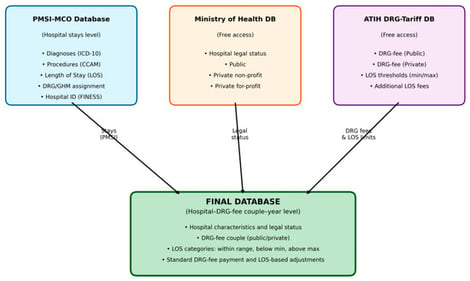
Data merging process leading to the final database.

Missing Health-Related Quality of Life (HRQoL) data in clinical studies risk propagating bias into health technology assessments (HTAs) and cost-utility analyses. Despite this, current National Institute for Health and Care Excellence (NICE) guidance offers no specific recommendations for handling missing HRQoL values. Using Monte Carlo simulations (1000 datasets), this study evaluated nine imputation methods, across the missing completely at random (MCAR), missing at random (MAR) and missing not at random (MNAR) assumptions at levels ranging from 5% to 50%. Performance was assessed using bias, variance, and coverage of the true HRQoL mean. While multiple imputation by chained equations (MICE)-based approaches performed best under MCAR and MAR, all methods showed bias under MNAR, with a delta-pattern mixture model performing the best (relative bias ≤2.1% at all missingness levels but coverage falls to 35.4% at 50% missingness). The choice of imputation method is key to preventing biased results from propagating into cost-effectiveness analysis, which in theory may lead to suboptimal reimbursement decisions and inefficient healthcare spending. To address the lack of explicit guidance from HTA bodies, we have developed a preliminary policy that could be used for HTA submissions: If the missingness pattern is not known and missingness ≤5%, it is suggested that most methods (except GLM) are acceptable (though care should be taken when using CCA and LOCF if MNAR is suspected). It is also suggested that MICE-based techniques are used as the base case for missingness >5%, and delta-PMM used as a sensitivity analysis when data are not MCAR. Further simulation studies would be required to strengthen the suggestions in this preliminary policy; however, the development of universal recommendations would lead to improved consistency and reliability of HTA globally.

Health Econ. Policy

13 August 2026

Refugees and asylum seekers in Germany face significant barriers to accessing routine dental care, leading to untreated conditions that escalate into costly emergency hospital admissions and increased public healthcare expenditures. This study evaluates the economic impact of an NGO-led dental care facility designed to address this critical gap in care for uninsured populations. Using a retrospective cost-effectiveness analysis, we compare three scenarios: (1) the NGO intervention, (2) the “status quo” reliance on emergency care, and (3) a dental clinic arm-based model. We test the hypothesis that NGO-led interventions reduce public healthcare costs by curbing preventable emergency admissions, thereby addressing systemic policy and market failures. Results demonstrate that the NGO facility is a cost-effective solution, generating a return of €0.60 for every euro invested, while the alternative scenarios yielded no financial returns. By providing equitable, preventive dental care, the NGO model reduced emergency admissions by addressing delayed treatment-seeking behaviors and structural access barriers. These findings confirm that NGO-led interventions can mitigate market failures by serving as a Pareto-improving solution, optimizing resource allocation and reducing long-term fiscal burdens. The study underscores the potential of NGOs to complement public health systems in achieving equitable and sustainable healthcare delivery. Policymakers should consider scaling such models to alleviate disparities in underserved populations while curbing avoidable costs linked to emergency care. This research contributes critical evidence for integrating NGO-led initiatives into healthcare strategies, particularly in contexts marked by fragmented access and systemic inefficiencies.

Health Econ. Policy

12 August 2026

Low generic drug prices in the US and Europe have benefited from offshoring production to low-cost overseas plants in countries with a strong manufacturing base, such as China and India. However, the ongoing quality control and reliability issues with the supply chain have engendered discussions on the merits of “reshoring”. This study examines the potential economic impact of reshoring generic drug production by estimating labor compensation cost and productivity in China-based, India-based, and US/EU-based generic firms. We estimate the magnitude of increase in cost of goods sold if drug production is “reshored” from China/India to the US/EU. We construct a sample of ninety generic drug manufacturers headquartered in China (43), India (32), and the US and Europe (15). All selected firms are publicly traded and have at least one production plant inspected by the US Food and Drug Administration between 2017 and 2019. Nearly 90% of generic drug firms in each region are vertically integrated and manufacture both active pharmaceutical ingredients and final drug formulations for generic drugs. The US/EU-based firms face significantly higher labor compensation costs and experience lower operating profit margins compared to China- and India-based firms. A Cobb-Douglas function is constructed to model production for generic drugs in each region. We employ a fixed effect regression model to obtain parameter estimates for the production function and use the estimated total factor productivity to compare the overall productivity across regions. We do not find evidence that US/EU-based generic drug firms have higher productivity. We project variable costs for generic drug production will rise by at least 35–40% if production is reshoring from China or India to the US/EU. Findings from our analyses highlight an urgent need for more in-depth economic analyses to assess the impact of reshoring on costs and ultimately prices for generic drugs in the US/EU market.

Health Econ. Policy

11 August 2026

Highly Accessed Articles

News & Conferences

Latest Issues

Open for Submission

Journal Sections

XFacebookLinkedIn
Health Econ. Policy - ISSN 3042-898X