

Skip to Content

Gynecologic Cancer

Gynecologic Cancer is an international, peer-reviewed, open access journal dedicated to publishing high-quality research that advances the understanding, prevention, diagnosis, and treatment of ovarian, cervical, fallopian tube, endometrial, vaginal, and vulvar cancers as well as HPV vaccine studies in cancer research, published quarterly online by MDPI.
  • Open Access— free for readers, with article processing charges (APC) paid by authors or their institutions.
  • Rapid Publication: first decisions in 18 days; acceptance to publication in 7 days (median values for MDPI journals in the first half of 2026).
  • Recognition of Reviewers: Reviewers whose reports are timely and of high quality receive an APC discount voucher for a future publication in an MDPI journal. Become a reviewer.

Get Alerted

Add your email address to receive forthcoming issues of this journal.

All Articles (2)

  • Review
  • Open Access

Ovarian Cancer Therapy Today and Tomorrow: Unmet Needs, Innovations, and Clinical Pathways

  • Jad C. Tannous,
  • Dilihumaer Maimaitiming and
  • Zohreh Amoozgar
  • + 2 authors

Despite advances with surgery, platinum-based chemotherapy, anti-angiogenics, and poly(ADP-ribose) polymerase (PARP) inhibition, the treatment of ovarian cancer remains challenging due to late presentation, molecular heterogeneity, rapid emergence of resistance, and a complex and dynamic tumor microenvironment (TME). In this perspective, we will discuss major challenges in ovarian cancer therapy, focusing on how the ovarian cancer TME, including both solid tumor lesions and malignant ascites, impacts therapeutic efficacy. We also discuss emerging therapies, both at the pre-clinical stage and in clinical trials.

Gynecol. Cancer

29 October 2026
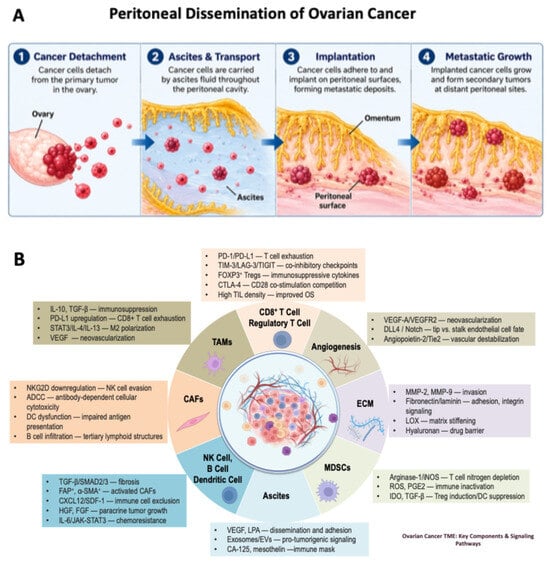
Overview of the ovarian tumor microenvironment. (A) Peritoneal dissemination of ovarian cancer. Tumor cells detach from the primary ovarian tumor (1), are transported across the peritoneal cavity by ascitic fluid (2), adhere to and implant on distant peritoneal surfaces such as the omentum (3), and proliferate to form secondary metastatic deposits (4). This transcoelomic route underlies the widespread peritoneal carcinomatosis characteristic of advanced epithelial ovarian cancer. (B) Key components and signaling pathways of the ovarian cancer TME. Schematic overview of the major cellular and molecular elements—CD8+ T cells/Tregs, TAMs, CAFs, NK/B/dendritic cells, MDSCs, ascites, ECM, and angiogenic vasculature—and their principal signaling pathways that collectively drive immune evasion, neovascularization, invasion, and chemoresistance in ovarian cancer.
  • Editorial
  • Open Access

Gynecologic Cancers—including ovarian, fallopian tube, endometrial, cervical, vulvar, as well as placental and gestational trophoblastic diseases—remain a major global health burden despite decades of scientific progress [...]

Gynecol. Cancer

20 July 2026

News & Conferences

Latest Issues

Open for Submission

Journal Sections

XFacebookLinkedIn
Gynecol. Cancer - ISSN 3043-0798