Skip to Content

Future Collections, Libraries, Archives, and Museums

Future Collections, Libraries, Archives, and Museums (FCLAM) is an international, peer-reviewed, open access journal that covers all aspects relevant to the theory, practice, and innovation of galleries, libraries, archives, and museums (GLAM) in the digital and future-oriented era, published quarterly online by MDPI.
  • Open Access— free for readers, with article processing charges (APC) paid by authors or their institutions.
  • Rapid Publication: first decisions in 18 days; acceptance to publication in 7 days (median values for MDPI journals in the first half of 2026).
  • Recognition of Reviewers: Reviewers whose reports are timely and of high quality receive an APC discount voucher for a future publication in an MDPI journal. Become a reviewer.

Get Alerted

Add your email address to receive forthcoming issues of this journal.

All Articles (4)

  • Article
  • Open Access

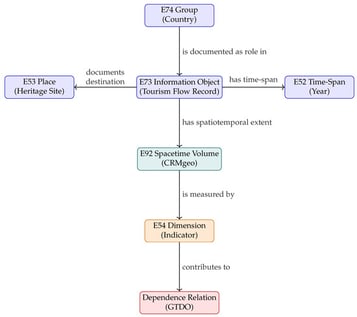
Tourism is both an economic activity and a cultural–political relation. When host economies rely heavily on visitors from specific origin countries, tourism can create measurable dependence while also carrying symbolic, cultural and potentially geopolitical effects. This paper presents the Geopolitical and Tourism Dependence Ontology (GTDO-CIDOC), a proof-of-concept, CIDOC conceptual reference model (CIDOC CRM)-compatible model built on CIDOC CRM and CRMgeo for representing tourism flows, indicators, dependence relations, asymmetry and evidence-linked influence hypotheses. Methodologically, the framework models aggregate tourism-flow records as information objects, represents indicators as CRM-compatible measurements and dimensions, computes a prototype Tourism Dependence Index (TDI) from normalised origin-market and host-exposure components, classifies dependence through explicit threshold rules, and tests the resulting graph through SHACL validation, SPARQL competency queries and a small Germany/Cyprus-to-Greece worked example. The model distinguishes individual tourism events from aggregate tourism-flow records and aligns tourism dependence with actors, information objects, places, time-spans and measurements already used in cultural heritage documentation. In this way, GTDO-CIDOC supports queryable, provenance-aware analysis of tourism dependence within cultural heritage knowledge graphs while treating geopolitical interpretation as a cautious, evidence-linked analytical claim rather than a direct causal conclusion.

CIDOC CRM and CRMgeo integration with GTDO concepts.
  • Systematic Review
  • Open Access

Generative artificial intelligence has begun to answer for the collection in the institution’s own voice, yet commentary has accumulated far faster than working systems have been documented, and no prior review identified by this search has consolidated and critically read the record of what has actually been deployed. Using a single open bibliographic index (OpenAlex)—chosen for reach and reproducibility, at the acknowledged cost of studies indexed only elsewhere—and a scoping protocol, this review narrows the literature to the systems genuinely placed in a working museum or gallery and observed in use, and maps them onto a function-based taxonomy. From a de-duplicated pool of more than eight thousand records, twenty-eight works describing twenty-seven distinct deployments are included. Three centers of gravity emerge: conversational guides that address the visitor, co-creative installations that make the act of generation the exhibit, and behind-the-scenes tools that read and catalog the collection. Against that map, the review weighs the evidence, confining every judgment of how well a system worked to the six studies that meet the review’s predefined evaluation-strength criteria. The result is a field whose map is clear while its proof is thin: the deployments can be named and sorted with confidence, but evidence that any delivers what it promises rests on a handful of cases, and the one production-scale system is also the only one tested at scale. Education, access, and audience understanding are almost absent from the record this search retrieved. The review closes with evidence-calibrated guidance for institutions weighing a deployment—a decision aid, a set of questions to put to a vendor, and stage-by-stage recommendations for selection, implementation, and evaluation, each marked with the strength of the evidence behind it—and an agenda redirecting the field toward the civic work it has set aside.

  • Article
  • Open Access

The availability of current and accessible knowledge in Library and Information Science (LIS) is essential for librarians’ continuing professional development within a rapidly evolving information environment. This study evaluates the capacity of Greek academic library collections to support librarians’ professional learning through a multidimensional assessment of 8291 LIS bibliographic records from 17 academic libraries, complemented by data from the HEAL-Link consortium and the Quality Assurance Unit of Academic Libraries (QAUAL). The analysis examines the size of LIS collections, the distribution of publication dates, access to Journal Citation Reports (JCR)-indexed LIS journals, e-book availability, and the thematic composition of collections based on subject headings. The findings indicate that existing collections are limited in both scope and currency, thereby constraining their ability to adequately support librarians’ professional information needs. Although electronic resources partially compensate for deficiencies in print collections, significant gaps remain in access to the current professional literature. The study recommends strengthening collaborative collection development through HEAL-Link and systematically integrating Open Access resources. By combining multiple collection evaluation indicators, it provides an evidence-based framework for assessing academic library collections that support librarians’ lifelong learning and continuing professional development.

  • Editorial
  • Open Access

Future Collections, Libraries, Archives, and Museums (FCLAM) is an international, peer-reviewed, open access journal dedicated to advancing theory, practice, and innovation within galleries, libraries, archives, and museums (GLAM) (Kwiecien et al [...]

News & Conferences

Latest Issues

Open for Submission

Journal Sections

XFacebookLinkedIn
Future Collect. Libr. Arch. Mus. - ISSN 3043-0550