
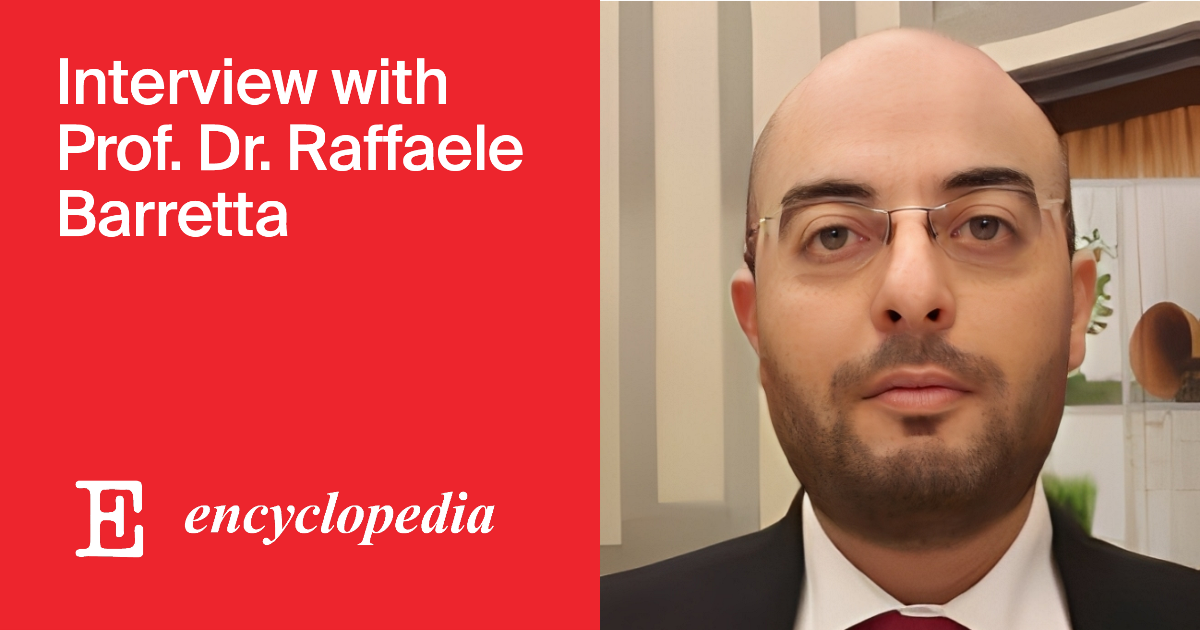
Encyclopedia | Interview with the Editor-in-Chief—Prof. Dr. Raffaele Barretta
We are pleased to share the following interview with Prof. Dr. Raffaele Barretta, founding Editor-in-Chief of Encyclopedia (ISSN: 2673-8392).
Name: Prof. Dr. Raffaele Barretta
Affiliation: Department of Structures for Engineering and Architecture (DiSt), University of Naples Federico II, Via Claudio, 21-80125 Naples, Italy
Interests: structural mechanics; nonlinear analysis; multiscale modeling; nonlocal mechanics; advanced materials; nanostructures; physics-informed neural networks
Prof. Barretta is currently Full Professor of solid and structural mechanics at the University of Naples Federico II. He received his master’s degree in civil engineering with full marks on October 28, 2003, from the University of Naples Federico II, with a thesis on polar models of beams and shells in large deformations (Tutor: Prof. Giovanni Romano). He subsequently earned his PhD in Structural Engineering from the same institution on January 19, 2007, presenting a dissertation on mixed variational methods in elasticity (Advisor: Prof. Giovanni Romano). In the 2006/2007 academic year, he began his teaching activity as a Lecturer in Solid and Structural Mechanics at the Accademia Aeronautica Militare di Pozzuoli (Naples). Following his PhD, he was awarded a two-year research grant (starting June 1, 2007) from the University of Naples Federico II, focusing on the nonlinear behavior of structures made from advanced materials. In 2008, he was a Research Scholar at Rice University (Houston, USA) within the Department of Civil and Environmental Engineering. In the academic years from 2009/2010 to 2012/2013, Prof. Barretta served as Lecturer in Solid and Structural Mechanics for both Structural and Mechanical Engineering programs at the University of Naples Federico II. He served as Assistant Professor of Solid and Structural Mechanics at DiSt from 2010 to 2015 and was subsequently promoted to Associate Professor.
He has coordinated and contributed to several competitive national research projects, serving as Local Coordinator for the PRIN 2017 project “Multiscale Innovative Materials and Structures (MIMS)”, Principal Investigator for the PRIN 2022 project “Nonlocal Mechanics of Innovative Soft Nanostructures (NoMISN)”, and Local Coordinator for the PRIN 2022 PNRR project “Nonlocal Modelling of Nano-Coatings (NanoCo)”. Since 2022, he has been Coordinator of the AIMETA Group on Multiscale and Nanostructure Mechanics and has served on the editorial boards of international journals such as Acta Mechanica, Archive of Applied Mechanics, Advances in Mechanical Engineering, Scientific Reports and Facta Universitatis, Series: Mechanical Engineering (FUME). He is Editor-in-Chief of Encyclopedia and Chemical Reports. His scientific contributions have been widely recognized. He was named among the Top Italian Scientists in Engineering (Single Year Career, 2017) and was included in the PLoS Biology database of the top 100,000 scientists worldwide, where he was also listed among the top 90 scholars of the University of Naples Federico II. In 2025, he was ranked among the leading scientists globally, placing #783 worldwide and #15 in Italy in his field.
The following is a short Q&A with Prof. Dr. Raffaele Barretta, who shared his vision for the journal with us:
1. What sparked your interest in Encyclopedia and motivated you to take the role of Editor-in-Chief?
My interest in Encyclopedia was sparked by my long involvement in editorial activities. In my career, I have been involved in the editorial boards of several journals in the field of mechanics and engineering, which has given me a comprehensive understanding of the opportunities and the challenges in the scientific community.
I accepted this role because Encyclopedia offers an alternative type of publication compared to standard journals. Indeed, it helps organize and clarify existing knowledge, making it accessible to a broad audience. In this sense, contributing to the journal means helping to improve the quality and clarity of scientific research.
2. Encyclopedia mainly publishes entry papers. In your opinion, what is the value of entries, and why should researchers consider this journal for their next manuscript?
Entries contribute significantly to the effective dissemination of scientific knowledge. In a context where knowledge is becoming increasingly specific, entries help organize and systematically catalog scientific knowledge.
They allow the main results to be presented in a structured manner, also collecting the outcomes obtained over a long period of time. Entries are useful in this regard for both experienced researchers and young scholars approaching a new discipline. They should therefore be usefully taken into account when writing new manuscripts.
3. What criteria do you consider most important when evaluating an entry paper?
The main criteria that I consider most important are the same as those for any scientific manuscript: rigor and clarity. Moreover, an entry paper should not be conceived as a simple collection of material, but rather as a concise and well-organized presentation of a specific topic.
The ability to highlight salient aspects is essential to the success of the contribution, which should be comprehensive and complete, but not overloaded with information.
4. Encyclopedia was recently accepted for coverage in Scopus, a significant milestone that reflects the journal’s growing influence. How has this achievement impacted the journal, and what is your vision for the journal moving forward?
Inclusion in Scopus represents a very important step for the journal. It increases its visibility, improves the perception of its quality, and makes it more attractive to both established and emerging researchers.
In my opinion, the next step is to further consolidate the quality, prestige, and consistency of Encyclopedia. This means attracting contributions from recognized experts and maintaining rigorous editorial standards.
5. Do you have a message you would like to share with the current board members of the journal Encyclopedia?
The editorial board has a decisive and incisive impact on the quality and solidity of the journal. The active and consistent involvement of the board members ensures the maintenance of high standards. The commitment of the editors is evident not only during the review process, but also in their ability to guide the direction of the journal.
Therefore, I would encourage board members to always promote valuable contributions, to be selective, and to prioritize quality over quantity.
6. What advice would you give to early career researchers?
Early career researchers should first focus on building a solid scientific foundation. This step represents a valuable investment that impacts the quality of their future scientific production.
It is also essential to learn to develop critical thinking skills and communicate clearly with the scientific community. I would also recommend investing in scientific production with commitment and seriousness, prioritizing the quality and consistency of the research path.