

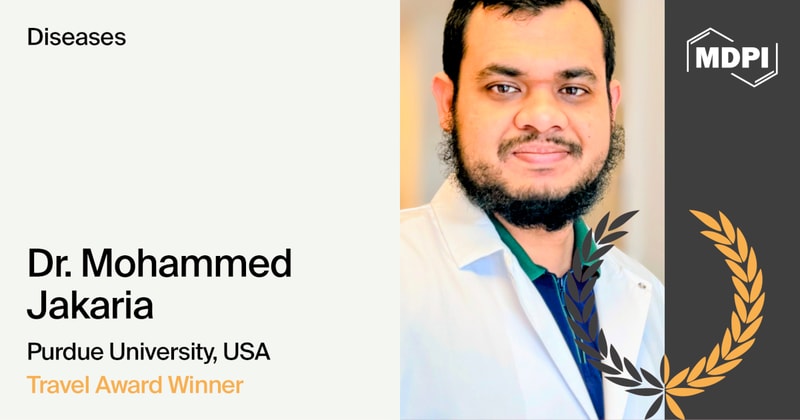
Interview with Dr. Mohammed Jakaria—Winner of the Diseases Travel Award
The Diseases Travel Award was launched in 2017 and is granted every year to encourage junior scientists to present their latest research at academic conferences in the field of human diseases and conditions, helping to grow their profile. The application process is open from May to December every year and the winners are announced by the end of February the following year.
Recently, we had the pleasure of speaking with Dr. Mohammed Jakaria, the 2026 winner of the Diseases Travel Award. In this interview, Dr. Jakaria shares insights and offers advice to young researchers beginning their scientific careers.
1. Congratulations on winning the Diseases Travel Award. Could you briefly introduce yourself to our readers and tell us a little bit about your fields of interest?
Thank you very much for this recognition. My name is Mohammed Jakaria, and I am currently a Postdoctoral Fellow in neurotoxicology at Purdue University in the United States. My research training has been interdisciplinary, spanning neuroscience, toxicology, and cell and molecular biology. I completed my PhD in neuroscience at the University of Melbourne in Australia, where I investigated the molecular mechanisms underlying neurodegenerative diseases, with a particular focus on Alzheimer’s disease.
My current research focuses on understanding how environmental exposures, particularly pesticides, contribute to neurotoxicity and neurodegenerative diseases, especially Parkinson’s disease. By integrating environmental toxicology with neuroscience, I investigate how these exposures disrupt critical cellular processes involved in neuronal health, including mitochondrial function, redox homeostasis, lipid metabolism, and regulated cell death. A major goal of my research is to understand how these cellular disturbances increase neuronal vulnerability and ultimately contribute to neurodegeneration. Through this work, I aim to identify potential therapeutic targets that could ultimately contribute to new strategies for preventing or treating neurodegenerative diseases such as Parkinson’s disease.
2. Can you share with us your feelings after winning the award? What motivated you to apply for the Travel Award in the first place?
I honestly could not believe my eyes when I saw the email informing me that I had won the Diseases Travel Award. It was a very rewarding moment. As an early career researcher, receiving this recognition was particularly meaningful because it felt like an acknowledgment of the hard work and dedication that I have invested in my research. It also renewed my motivation to continue pursuing research at the intersection of disease biology, neuroscience, and environmental toxicology.
I was motivated to apply because I had the opportunity to present my research at the 2026 Society of Toxicology (SOT) Annual Meeting in San Diego. I viewed the Travel Award not only as support for attending the meeting, but also as an opportunity to share my findings with an international scientific audience, receive valuable feedback, learn from researchers in related fields, and broaden my scientific perspective. The award allowed me to participate more fully in this important scientific meeting, exchange ideas, establish professional connections, and engage with the broader toxicology research community.
3. What advice would you offer to early career researchers who are considering applying for the Travel Award or attending their first international academic conference?
I would strongly encourage early-career researchers to apply for Travel Awards whenever they have the opportunity. These awards provide more than financial support for conference participation; they also offer valuable recognition that can strengthen an early-career researcher’s academic profile and support professional development. Although Travel Awards can be competitive and only a limited number of applicants may be selected, I would encourage researchers not to be discouraged by the competition. The application process itself is valuable because it helps you develop the ability to clearly communicate the significance, impact, and broader relevance of your research.
For researchers attending their first international conference, I would encourage them to make the most of the experience, whether or not they are presenting. Attend talks and poster sessions beyond your immediate area of expertise, ask questions, exchange ideas, and take the initiative to introduce yourself to other researchers. These interactions can broaden your scientific perspective and lead to valuable opportunities for collaboration and mentorship. Most importantly, approach the conference with curiosity and an open mind. You never know which conversation or presentation might inspire a new research question, open a new collaboration, or even shape the next stage of your career.
4. As an emerging researcher, what are your professional goals for the next five years? Which research directions or topics within your field do you expect to gain significant attention in the near future?
Over the next five years, my primary professional goal is to establish an independent faculty career and build a research program focused on understanding the molecular mechanisms underlying neurodegenerative diseases. My research will use environmental exposures as a unique lens to understand fundamental disease biology, while also investigating how these exposures contribute to the initiation and progression of neurodegenerative disease. I hope to develop a collaborative, interdisciplinary research program that integrates environmental toxicology, neuroscience, and disease biology to better understand disease mechanisms and identify opportunities for disease prevention and treatment.
While our understanding of Parkinson’s and Alzheimer’s diseases has advanced substantially, translating these insights into effective disease-modifying therapies remains a critical challenge. I anticipate that research focused on identifying therapeutic targets and developing mechanism-based interventions for neurodegenerative diseases will continue to gain significant attention. In particular, I believe that understanding how environmental exposures interact with genetic susceptibility, aging, mitochondrial dysfunction, metabolic stress, and cellular defense mechanisms will become an increasingly important area of research. An integrated understanding of these factors could reveal previously unrecognized disease mechanisms and create new opportunities for developing targeted therapeutic strategies.
5. How did you first become aware of Diseases? From your perspective, what role does the journal play in advancing open access publishing and supporting effective scholarly communication within your field?
I first became aware of Diseases through its publications and its broad scope of disease-related research. As I became more familiar with the journal, I was particularly interested in its coverage of different aspects of disease biology and its interdisciplinary approach. This aligns well with my own research, which lies at the intersection of neuroscience, environmental toxicology, and disease biology.
From my perspective, open access publishing plays an important role in making scientific knowledge readily accessible to researchers and the broader academic community. It facilitates the dissemination of research findings, encourages the exchange of ideas across disciplines, and can help accelerate scientific discovery.
I particularly appreciate Diseases as a journal that brings together research across different areas of disease biology. By making research openly accessible and facilitating cross-disciplinary knowledge exchange, the journal helps researchers build on existing findings, develop new ideas, and contribute to advances in biomedical research.
6. Do you have any suggestions for how our journal could further support young researchers and the academic community?
I believe Diseases is already making valuable contributions to supporting early career researchers, and I would encourage the journal to continue expanding opportunities for young scientists. Initiatives such as early career workshops, mentoring programs, and webinars on scientific writing and peer review could offer valuable professional development opportunities.
I would also suggest considering small research grants or seed-funding opportunities specifically for early career researchers. Even modest funding can help young investigators generate preliminary data, develop new research ideas, and establish a foundation for larger grant applications. Opportunities to participate in editorial activities, contribute to Special Issues, and engage with established researchers could further support their professional development and expand their scientific networks.
I greatly appreciate the support provided through initiatives such as the Travel Award, and I hope Diseases will continue to create opportunities that empower and support the next generation of researchers.
Call for Diseases 2027 Travel Award Applications:
We are pleased to announce that the Diseases 2027 Travel Award is now open for applications. We invite eligible researchers to apply for an opportunity to present their research through an international platform.
For more information, please visit the following link: https://www.mdpi.com/journal/diseases/awards/4149.