You are currently on the new version of our website. Access the old version .
  • Indexed in
    Scopus
  • 27 days
    Time to First Decision

Coasts

Coasts is an international, peer-reviewed, open access journal on coastal engineering, management, conservation, biology and ecology, published quarterly online by MDPI.

All Articles (139)

  • Systematic Review
  • Open Access

Unintended Victims: A Systematic Review of Global Marine Turtle By-Catch in Fisheries

  • Breno Carvalho da Silva,
  • Lucas Garcia Martins and
  • João Hemerson de Sousa
  • + 2 authors

Incidental capture (bycatch) is a major threat to all seven marine turtle species worldwide. This systematic review assessed (i) research trends over the past 20 years; (ii) relationships between fishery types, gear, and species caught; (iii) post-capture outcomes; and (iv) challenges in bycatch mitigation. A systematic search of Web of Science and Scopus up to April 2024 identified 236 studies, comprising 336,616 global bycatch records. Publications on turtle bycatch increased significantly (p < 0.001), peaking in 2020. Reported captures also rose (ρ = 0.45; p = 0.026), with Caretta caretta most frequently documented (74.8%). Methodology influenced outcomes: aerial monitoring and direct observation underestimated captures of Chelonia mydas, Lepidochelys kempii, and Eretmochelys imbricata compared with mixed methods; interviews only affected the latter. Regarding fishery interactions, Dermochelys coriacea was more susceptible to hook-and-line fishing (p = 0.0079), while C. mydas was more associated with small-scale fisheries (p = 0.0115). Most turtles were released after capture (60.6%), with no significant temporal variation in outcomes (p > 0.05). Despite growing monitoring, knowledge gaps remain in standardized reporting, regional and species coverage, and methodological integration. Addressing these issues is essential to guide effective, collaborative conservation strategies.

8 January 2026

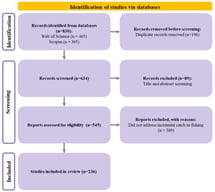
PRISMA 2020 flow diagram illustrating the study selection process.

The study focuses on the impact of climate change and spatial planning policies on coastal landscape dynamics. We examine the present and future coastal land use/land cover (LULC) change for southwestern Ghana under the coastal resilience (CR) scenario and coastal planning (CP) scenario. It employs an integrated approach of a review of literature and satellite imagery analysis to map coastal land use/land cover (LULC) change, from 2010 to 2020, to predict future landscape transitions under a coastal resilience approach and then contrast it with a scenario where development of the coast continues. The results show a continual decline in wetlands, from 1882.43 ha in 2010 to 1743.49 ha in 2020. Increased development would dominate the landscape under a scenario where coastal planning continues to expand, whereas cultivated, agricultural lands and vegetation are likely to increase under a coastal resilience scenario in 2035 and 2057. This study recommends that government and other stakeholders should consider coastal landscape restoration plans and programmes towards landscape sustainability for Sustainable Development Goals (SDG) 11 and 13.

22 December 2025

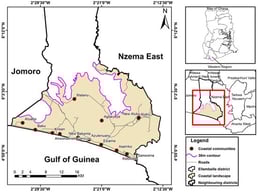
Map showing the southwestern coastal landscape in Ellembelle District of Ghana.

Impact of Environmental Weathering on the Chemical Composition of Spilled Oils in a Real Case in Brazil

  • Ana Beatriz A. de M. Salata,
  • Marília G. A. Pereira and
  • Isabelle F. S. de Lima
  • + 4 authors

Brazil suffered the largest oil spill disaster in its history, beginning on August 2019, affecting the Northeast coast. This study proposes a chemical investigation of oils from the 2019 spill in Brazil, which had naturally undergone different weathering processes in terrestrial and aquatic environments after an extended period of exposure. Three samples were collected at different times and under distinct environmental conditions, coded as spilled oil (SO), oil recovered from the aquatic environment (SA), and oil collected from the terrestrial environment (ST), the latter two having spent more time naturally exposed to aquatic and terrestrial environments. The analyses were performed by gas chromatography–mass spectrometry (GC-MS) and electrospray ionization coupled with Fourier transform ion cyclotron resonance mass spectrometry (ESI FT-ICR MS). The results of the GC-MS analysis indicated that, although the samples share a common geochemical origin, the SA and ST samples showed a decrease in the intensity of n-alkane distribution compared to the SO sample, mainly attributed to evaporation and biodegradation processes. FT-ICR MS analysis identified dozens of classes of ESI(+) and ESI(–) compounds, most of them rich in sulfur and oxygen, with the highest intensities and quantities of molecular formulas in the SA and ST samples. Diagnostic ratios for heteroatom classes concluded that the SA and ST samples had undergone a higher level of weathering, mainly associated with photooxidation and biodegradation processes. Thus, the combined use of GC-MS and FT-ICR MS proved to be a robust approach for the detailed characterization of spilled oils, contributing to a clearer understanding of the extent and type of weathering in samples from the 2019 Brazilian spill.

18 December 2025

Three spilled oils collected as: (A) oil reaching the beaches of Pernambuco state in September 2019; (B) the oil reappeared on the beaches in January 2021; and (C) spilled oil that remained on the ground for 1 year and 7 months collected in April 2021. Sample coordinates: SO: 8°18′56″  S; 34°56′51″ W; SA: 8°30′87.4″ S; 34°94′55.2″ W, and ST: 8°17′55.1″ S; 34°57′11.6″ W.

Community–Academic Collaboration for Sargassum Clean-Up and Coastal Monitoring in Xcalak, Southern Mexican Caribbean

  • Juan Carlos Alcérreca-Huerta,
  • Oscar F. Reyes-Mendoza and
  • Laura Carrillo
  • + 2 authors

Unprecedented quantities of pelagic sargassum since 2011 have demanded technical and management responses. Inappropriate measures might worsen environmental impacts, particularly in low-income regions and protected natural areas that also require low-cost, socio-ecologically integrated alternatives. This study aims to evaluate the effectiveness and local perception of sargassum clean-up treatments developed through a community–academic collaboration within a socio-ecological systems framework in the marine protected area Xcalak Reefs National Park (PNAX), at the southernmost Mexican Caribbean coast. In 2019 and 2021, clean-up efforts were implemented through the national PROREST program and a self-organized community group of 35–40 members supported by a multidisciplinary research advisory team. Monitoring in 2021 estimated sargassum removal at 4012 m2 over 50–75 work hours. Although average shoreline retreat was obtained (δmean = −0.22 m), final accretion of ~0.96 m alleviated community concerns about erosion linked to clean-up activities. The most effective and socially accepted clean-up treatment involved sargassum spreading, collection, drying, and revetment-type beach protection, reducing odors and harmful fauna. However, treatments aimed at shoreline stabilization were impractical, raising doubts about their long-term efficacy. These findings highlight the relevance of integrating ecological performance and social perception in sargassum management, especially where co-management with local communities in marine protected areas is needed.

3 December 2025

Location of the study area in the southernmost Mexican Caribbean, near the Mexico–Belize border (WGS-84/UTM16N coordinates). The limits of Xcalak Reefs National Park (PNAX), mangrove area navigation channels, and designated work areas for sargassum clean-up activities conducted during 2019 and 2021 are also shown.

News & Conferences

Issues

Open for Submission

Editor's Choice

Get Alerted

Add your email address to receive forthcoming issues of this journal.

XFacebookLinkedIn
Coasts - ISSN 2673-964X