
Assessing Flight Initiation Distance and Behavioural Tolerance of an Alien Invasive Species, the Sacred Ibis (Threskiornis aethiopicus), in Northern Adriatic Coasts (Italy): Implications for Management of Invasive Waterbirds

Abstract
1. Introduction
- (1)
- describe variation in FID across six habitat categories;
- (2)
- test the influence of social, environmental and observational predictors using a multivariate framework;
- (3)
- compare the local observed values with the few available from international studies. By clarifying the behavioural responses of this species to disturbance, our findings aim to support evidence-based management of this invasive species in human-dominated coastal ecosystems.
2. Materials and Methods
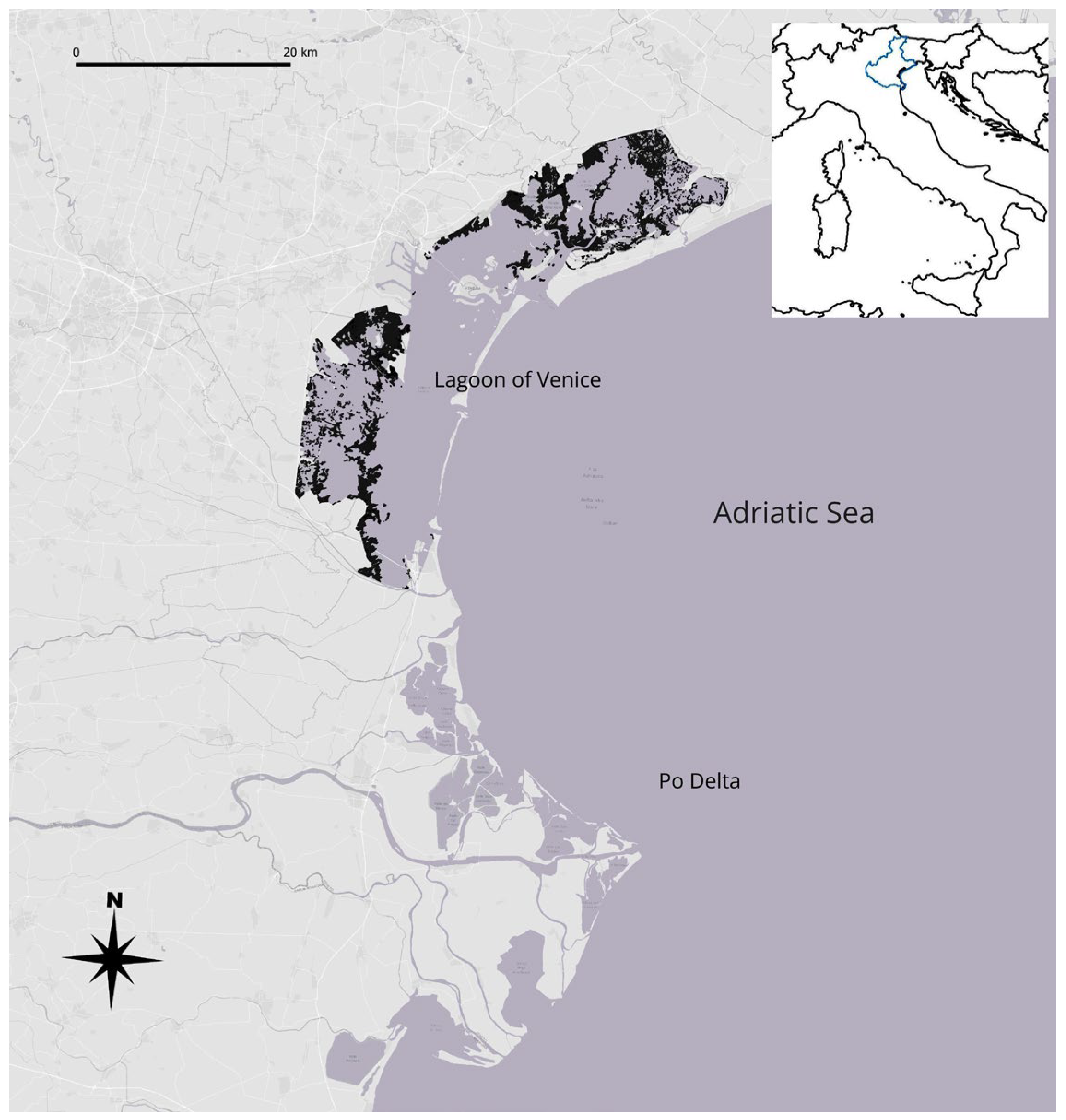
2.1. Study Area
2.2. Data Collection
- habitat category, grouped in six classes: natural saltmarshes and tidal flats, artificial saltmarsh (also called dredge islands [30]), brackish ponds (within fish farms), freshwater ponds/wetlands, farmland fields (mostly ploughed), and small vegetated islands;
- approach method: on foot or by boat;
- presumed breeding status: breeding (i.e., adult birds observed between April and July 2020–2025) or non-breeding (other months, or any month if before 2020, the date of the first confirmed nesting event in the study area);
- group size: number of individuals present within approximately a 30 m radius of the focal bird.
2.3. Statistical Analyses
- Descriptive statistics. Mean, variance, median, 25th–75th percentiles and range were computed for the full dataset. Habitat-specific summaries were then produced for the six habitat categories used in the study (Table 1).
- Comparisons among habitats. Because the dataset was right-skewed, heteroscedastic and unbalanced across habitat classes, we tested for differences using the Kruskal–Wallis H statistic (α = 0.05).
- Multivariate model of predictors of escape behaviour. To evaluate the joint influence of social, environmental and observational factors, we fitted a multiple linear regression model to log-transformed FID values. OLS (Ordinary Least Squares) regression—i.e., a linear model estimated by minimising the sum of squared residuals—was used to quantify the effects of predictors on log-transformed FID. Both FID and group size were transformed using log10 to approximate normality and stabilise variance, following best practices in behavioural and ecological regression modelling [37].
- 4.
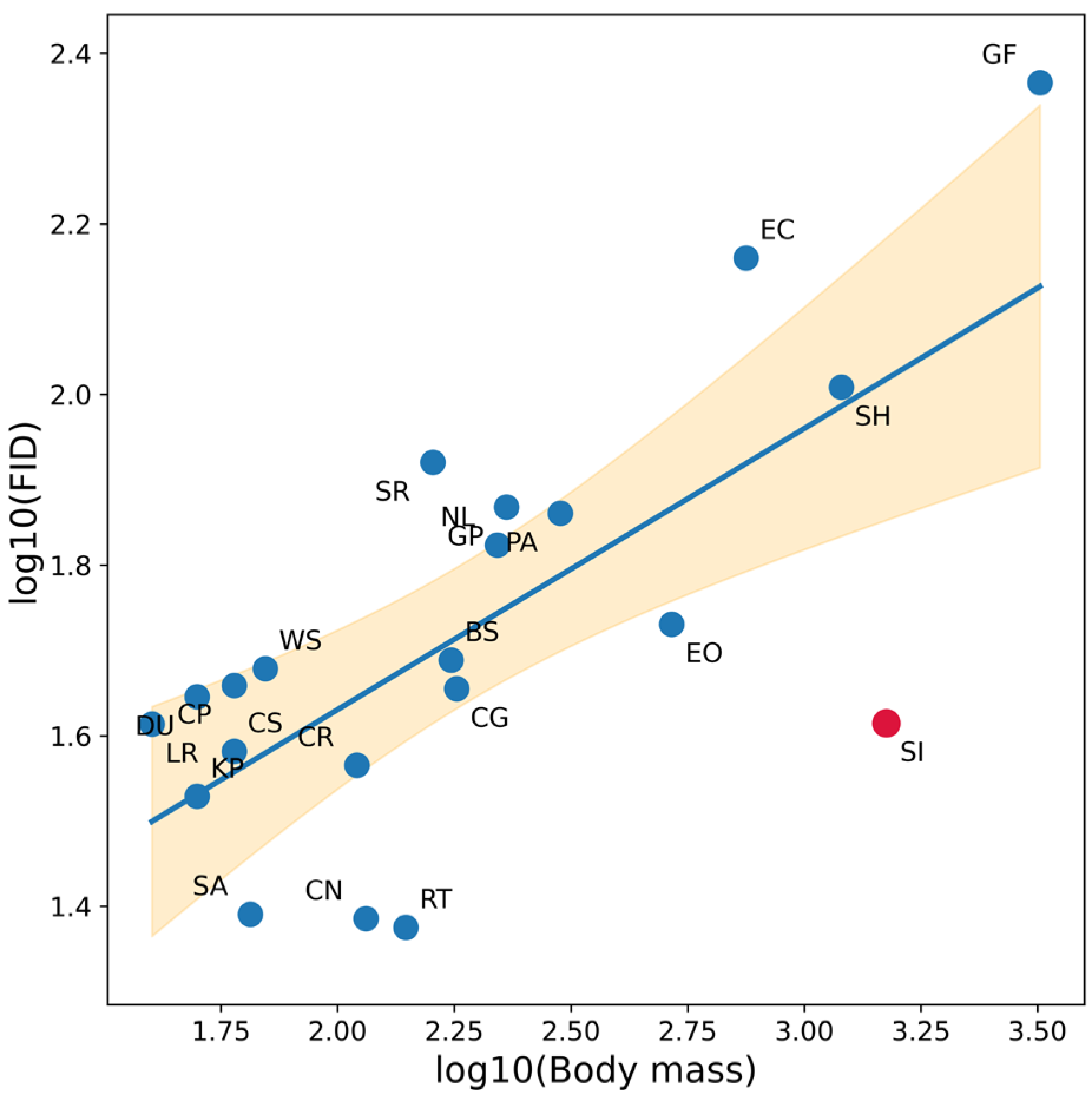
- Cross-species scaling (body mass vs. FID). To contextualise the behavioural responses of T. aethiopicus, FID measurements (boat and on foot combined) from 20 additional waterbird species (71 records on average, range 10–350) were extracted from the broader dataset held by the authors 1505 records). All measurements were collected by the same observer within the same regional and temporal context as the present study. Body mass values for each species were retrieved from the Swiss Ornithological Institute database (www.vogelwarte.ch, accessed on 26 November 2025). A log–log regression quantified scaling between body mass and FID, allowing the position of T. aethiopicus to be interpreted relative to community-level expectations.
3. Results
3.1. Descriptive Statistics of FID Across Habitats
3.2. Predictors of FID
3.3. FID–Body Mass Relationship and Comparative Positioning of T. aethiopicus
4. Discussion
4.1. Behavioural Tolerance and Habitat Use
4.2. Social and Environmental Drivers of Escape Behaviour
4.3. Comparisons with Other Studies
4.4. Management Implications
- 1.
- Buffer zones based on FID alone may have limited effectiveness
- 2.
- Behavioural tolerance may favour persistence under control efforts
- 3.
- Group size as an operationally relevant predictor
5. Conclusions
Supplementary Materials
Author Contributions
Funding
Data Availability Statement
Acknowledgments
Conflicts of Interest
References
- Bauer, H.G. African Sacred Ibis Threskiornis aethiopicus. In European Breeding Bird Atlas 2: Distribution, Abundance and Change; Keller, V., Herrando, S., Vorisek, P., Franch, M., Kipson, M., Milanesi, P., Martí, D., Anton, M., Klvanová, A., Kalyakin, M.V., et al., Eds.; European Bird Census Council & Lynx Edicions: Barcelona, Spain, 2020; pp. 252–253. [Google Scholar]
- Clergeau, P.; Yésou, P. Behavioural flexibility and numerous potential sources of introduction for the Sacred Ibis: Causes of concern in Western Europe? Biol. Invasions 2006, 8, 1381–1388. [Google Scholar] [CrossRef]
- Cucco, M.; Alessandria, G.; Bissacco, M.; Carpegna, F.; Fasola, M.; Gagliardi, A.; Gola, L.; Volponi, S.; Pellegrino, I. The spreading of the invasive Sacred Ibis in Italy. Sci. Rep. 2021, 11, 86. [Google Scholar] [CrossRef] [PubMed]
- Yésou, P.; Clergeau, P.; Bastian, S.; Reeber, S.; Maillard, J.F. The Sacred Ibis in Europe: Ecology and management. Br. Birds 2017, 110, 197–212. [Google Scholar]
- Clergeau, P.; Fourcy, D.; Reeber, S.; Yésou, P. New but Nice? Do Alien Sacred Ibises Threskiornis aethiopicus Stabilize Nesting Colonies of Native Spoonbills Platalea leucorodia at Grand-Lieu Lake, France? Oryx 2010, 44, 533–538. [Google Scholar] [CrossRef]
- Smits, R.R.; Van Horssen, P.; Van der Winden, J. A Risk Analysis of the Sacred ibis in The Netherlands Including Biology and Management Options of This Invasive Species; Bureau Waardenburg Rapp.: Culemborg, The Netherlands, 2010; nr. 10-005; 68p, Available online: https://www.buwa.nl/fileadmin/buwa_upload/Bureau_Waardenburg_rapporten/09-556_Risk_analysis_sacred_ibis.pdf (accessed on 1 February 2026).
- Herring, G.; Gawlik, D.E. Potential for successful population establishment of the nonindigenous Sacred Ibis in the Florida Everglades. Biol. Invasions 2008, 10, 969–976. [Google Scholar] [CrossRef]
- Marion, L. Is the Sacred Ibis a real threat to biodiversity? Long-term study of its diet in non-native areas compared to native areas. Comptes Rendus Biol. 2013, 336, 350–355. [Google Scholar] [CrossRef]
- Larroux, N.; Gagliardi, A.; Volponi, S.; Tenan, S.; Preatoni, D.; Martinoli, A. Sacred or unholy? Assessing the impact of Sacred Ibis (Threskiornis aethiopicus) on heronries in northern Italy. In Proceedings of the 14th European Vertebrate Management Conference, Ankaran, Slovenia, 12–16 May 2025; p. 87. [Google Scholar] [CrossRef]
- Martelli, L.; Fornasiero, D.; Martínez-Lanfranco, J.A.; Spada, A.; Scarton, F.; Scolamacchia, F.; Mulatti, P. Exploring the Role of Wild Bird Species in the Transmission of Avian Influenza to Poultry. Transbound. Emerg. Dis. 2025, 2025, 2288535. [Google Scholar] [CrossRef]
- Mariacher, A.; Di Nicola, M.R.; Senese, M.; Mariottini, F.; Maestrini, M.; Bellagamba, F.; Donnini, C.; Capecci, A.; Salomoni, A.; Varotto, M.; et al. Detection of avian influenza virus in the alien invasive African Sacred Ibis (Threskiornis aethiopicus) in Italy. Front. Vet. Sci. 2025, 12, 1661089. [Google Scholar] [CrossRef]
- Bao, X.Y.; Xin, J.J.; Ye, Y.X.; Hu, Y. Feedback on Escape Behavior of Birds Under Different Hunger Pressure. Ecol. Evol. 2025, 15, e70866. [Google Scholar] [CrossRef]
- Blumstein, D.T. Flight initiation distance in birds is dependent on intruder starting distance. J. Wildl. Manag. 2003, 67, 852–857. [Google Scholar] [CrossRef]
- Samia, D.S.M.; Blumstein, D.T. Birds Flush Early and Avoid the Rush: An Interspecific Study. PLoS ONE 2015, 10, e0119906. [Google Scholar] [CrossRef] [PubMed]
- Blumstein, D.T.; Anthony, L.L.; Harcourt, R.; Ross, G. Testing a key assumption of wildlife buffer zones: Is flight initiation distance a species-specific trait? Biol. Conserv. 2003, 110, 97–100. [Google Scholar] [CrossRef]
- Husby, M. Recommendations on how to use flight initiation distance data in birds. Biology 2025, 14, 329–335. [Google Scholar] [CrossRef] [PubMed]
- Laursen, K.; Kahlert, J.; Frikke, J. Factors affecting escape distances of staging waterbirds. Wildl. Biol. 2005, 11, 13–19. [Google Scholar] [CrossRef]
- Rodgers, J.A.; Schwikert, S.T. Buffer-zone distances to protect foraging and loafing waterbirds from disturbance by personal watercraft and outboard-powered boats. Conserv. Biol. 2022, 16, 216–224. [Google Scholar] [CrossRef]
- Weston, M.A.; McLeod, E.M.; Blumstein, D.T.; Guay, P.-J. A review of flight-initiation distances and their application to managing disturbance to Australian birds. Emu–Austral Ornithol. 2012, 112, 269–286. [Google Scholar] [CrossRef]
- Møller, A.P. Flight distance of urban birds, predation, and selection for urban life. Behav. Ecol. Sociobiol. 2008, 63, 63–75. [Google Scholar] [CrossRef]
- Coetzer, C.; Bouwman, H.; Cilliers, D. Waterbird flight initiation distances at Barberspan Bird Sanctuary, South Africa. Koedoe 2017, 59, a1419. [Google Scholar] [CrossRef]
- Weston, M.A.; Radkovic, A.; Kirao, L.; Guay, P.-J.; Van Dongen, W.F.D.; Malaki, P.; Blumstein, D.T.; Symonds, M.R.E. Differences in flight-initiation distances between African & Australian birds. Anim. Behav. 2021, 179, 235–245. [Google Scholar] [CrossRef]
- Scarton, F. Flight initiation distances in relation to pedestrian and boat disturbance in five species of waders breeding in a Mediterranean lagoon. Rev. d’Ècologie 2018, 73, 375–384. [Google Scholar] [CrossRef]
- Scarton, F. Disturbance of Non-Breeding Waders by Pedestrians and Boats in a Mediterranean Lagoon. Ardeola 2018, 65, 209–220. [Google Scholar] [CrossRef]
- Valle, R.G.; Scarton, F. Do Oystercatchers hate drones? A comparison of flight initiation distances of four wader species in response to drone intrusion. Wader Study 2024, 131, 214–218. [Google Scholar] [CrossRef]
- Volponi, S.; Giuntini, S.; Gagliardi, A.; Preatoni, D.G.; Tenan, S. Movement ecology of the Sacred Ibis (Threskiornis aethiopicus) outside of its natural range. NeoBiota 2025, 100, 305–320. [Google Scholar] [CrossRef]
- Scarton, F.; Luchetta, A.; Molin, E.; Sartori, A.; Valle, R.G. First confirmed breeding of an invasive alien species in the lagoon of Venice (Italy): The Sacred Ibis Threskiornis aethiopicus. Riv. Ital. Ornitol. Res. Ornithol. 2021, 91, 51–54. [Google Scholar] [CrossRef]
- Facca, C.; Ceoldo, S.; Pellegrino, N.; Sfriso, A. Natural recovery and planned intervention in coastal wetlands: Venice Lagoon (Northern Adriatic Sea, Italy) as a case study. Sci. World J. 2014, 2014, 968618. [Google Scholar] [CrossRef]
- Torresan, S.; Gallina, V.; Gualdi, S.; Bellafiore, D.; Umgiesser, G.; Carniel, S.; Sclavo, M.; Benetazzo, A.; Giubilato, E.; Critto, A. Assessment of climate change impacts in the North Adriatic coastal area. Part I: A multi-model chain for the definition of climate change hazard scenarios. Water 2019, 11, 1157. [Google Scholar] [CrossRef]
- Scarton, F.; Cecconi, G.; Cerasuolo, C.; Valle, R. The importance of dredge islands for breeding waterbirds. A three-year study in the Venice Lagoon (Italy). Ecol. Eng. 2013, 54, 39–48. [Google Scholar] [CrossRef]
- Blumstein, D.T. Flush early and avoid the rush: A general rule of antipredator behavior? Biol. Conserv. 2010, 143, 1837–1845. [Google Scholar] [CrossRef]
- Rodas-Trejo, J.; Ocampo-González, P. Assessment of ChatGPT’s potential as an innovative tool in searching for information on wild mammals. Ecol. Inform. 2024, 83, 102810. [Google Scholar] [CrossRef]
- Zhu, J.J.; Jiang, J.; Yang, M.; Ren, Z.J. ChatGPT and environmental research. Environ. Sci. Technol. 2023, 57, 17667–17670. [Google Scholar] [CrossRef]
- Cooper, N.; Clark, A.T.; Lecomte, N.; Qiao, H.; Ellison, A.M. Harnessing large language models for coding, teaching and inclusion to empower research in ecology and evolution. Methods Ecol. Evol. 2024, 15, 1757–1763. [Google Scholar] [CrossRef]
- Oliver, R.Y.; Chapman, M.; Emery, N.; Gillespie, L.; Gownaris, N.; Leiker, S.; Nisi, A.C.; Ayers, D.; Breckheimer, I.; Blondin, H.; et al. Opening a conversation on responsible environmental data science in the age of large language models. Environ. Data Sci. 2024, 3, e14. [Google Scholar] [CrossRef]
- Foroumandi, E.; Moradkhani, H.; Sanchez-Vila, X.; Singha, K.; Castelletti, A.; Destouni, G. ChatGPT in hydrology and Earth sciences: Opportunities, prospects, and concerns. Water Resour. Res. 2023, 59, e2023WR036288. [Google Scholar] [CrossRef]
- Zuur, A.F.; Ieno, E.N.; Elphick, C.S. A protocol for data exploration. Methods Ecol. Evol. 2009, 1, 3–14. [Google Scholar] [CrossRef]
- Roberts, G. Why individual vigilance declines as group size increases. Anim. Behav. 1996, 51, 1077–1086. [Google Scholar] [CrossRef]
- Shuai, L.Y.; Morelli, F.; Mikula, P.; Benedetti, Y.; Weston, M.A.; Ncube, E.; Tawanda Tarakini, G.; Díaz, M.; Gabor, M.; Jokimaki, J.; et al. A meta-analysis of the relationship between flock size and flight initiation distance in birds. Anim. Behav. 2024, 210, 1–9. [Google Scholar] [CrossRef]
- McLeod, E.M.; Guay, P.J.; Taysom, A.J.; Robinson, R.W.; Weston, M.A. Buses, cars, bicycles and walkers: The influence of the type of human transport on the flight responses of waterbirds. PLoS ONE 2013, 8, e82008. [Google Scholar] [CrossRef]
- Bernard, G.E.; van Dongen, W.F.; Guay, P.J.; Symonds, M.R.; Robinson, R.W.; Weston, M.A. Bicycles evoke longer flight-initiation distances and higher intensity escape behaviour of some birds in parks compared with pedestrians. Landsc. Urban Plan. 2018, 178, 276–280. [Google Scholar] [CrossRef]
- Glover, H.K.; Guay, P.J.; Weston, M.A. Up the creek with a paddle; avian flight distances from canoes versus walkers. Wetl. Ecol. Manag. 2015, 23, 775–778. [Google Scholar] [CrossRef]
- Genovesi, P.; Carboneras, C.; Vilà, M.; Walton, P. EU adopts innovative legislation on invasive species: A step towards a global response to biological invasions. Biol. Invasions 2015, 17, 1307–1311. [Google Scholar] [CrossRef]



| Habitat | n | Mean | SD | Median | Min | Max |
|---|---|---|---|---|---|---|
| (m) | ||||||
| Artificial saltmarshes | 17 | 35.7 | 14.5 | 35 | 14 | 62 |
| Brackish ponds | 5 | 29.8 | 10.1 | 27 | 17 | 42 |
| Farmlands | 31 | 45.4 | 24.8 | 40 | 12 | 120 |
| Freshwater ponds | 2 | 39.5 | 7.8 | 39.5 | 34 | 45 |
| Natural saltmarshes and tidal flats | 12 | 41.3 | 37.3 | 27.5 | 16 | 150 |
| Small islands | 5 | 45.2 | 17.6 | 45 | 18 | 65 |
| Predictor | Estimate (β) | SE | t | p-Value | 95% CI |
|---|---|---|---|---|---|
| Intercept | 1.51 | 0.09 | 16.86 | <0.001 | [1.33, 1.69] |
| log10(Group size) | 0.15 | 0.06 | 2.39 | 0.02 | [0.02, 0.28] |
| Habitat: Brackish_pond | −0.09 | 0.13 | −0.69 | 0.50 | [−0.34, 0.16] |
| Habitat: Farmland | 0.02 | 0.09 | 0.27 | 0.79 | [−0.15, 0.20] |
| Habitat: Fresh_water_pond | 0.09 | 0.17 | 0.54 | 0.59 | [−0.24, 0.42] |
| Habitat: Saltmarsh_tidalflat | −0.01 | 0.09 | −0.12 | 0.91 | [−0.19, 0.16] |
| Habitat: Small_island | 0.13 | 0.13 | 1.06 | 0.29 | [−0.11, 0.38] |
| Approach_method: Boat | −0.05 | 0.08 | −0.56 | 0.58 | [−0.21, 0.12] |
| Status: Breeding | −0.07 | 0.08 | −0.88 | 0.38 | [−0.222, 0.087] |
Disclaimer/Publisher’s Note: The statements, opinions and data contained in all publications are solely those of the individual author(s) and contributor(s) and not of MDPI and/or the editor(s). MDPI and/or the editor(s) disclaim responsibility for any injury to people or property resulting from any ideas, methods, instructions or products referred to in the content. |
© 2026 by the authors. Licensee MDPI, Basel, Switzerland. This article is an open access article distributed under the terms and conditions of the Creative Commons Attribution (CC BY) license.
Share and Cite
Scarton, F.; Valle, R.G. Assessing Flight Initiation Distance and Behavioural Tolerance of an Alien Invasive Species, the Sacred Ibis (Threskiornis aethiopicus), in Northern Adriatic Coasts (Italy): Implications for Management of Invasive Waterbirds. Coasts 2026, 6, 4. https://doi.org/10.3390/coasts6010004
Scarton F, Valle RG. Assessing Flight Initiation Distance and Behavioural Tolerance of an Alien Invasive Species, the Sacred Ibis (Threskiornis aethiopicus), in Northern Adriatic Coasts (Italy): Implications for Management of Invasive Waterbirds. Coasts. 2026; 6(1):4. https://doi.org/10.3390/coasts6010004
Chicago/Turabian StyleScarton, Francesco, and Roberto G. Valle. 2026. "Assessing Flight Initiation Distance and Behavioural Tolerance of an Alien Invasive Species, the Sacred Ibis (Threskiornis aethiopicus), in Northern Adriatic Coasts (Italy): Implications for Management of Invasive Waterbirds" Coasts 6, no. 1: 4. https://doi.org/10.3390/coasts6010004
APA StyleScarton, F., & Valle, R. G. (2026). Assessing Flight Initiation Distance and Behavioural Tolerance of an Alien Invasive Species, the Sacred Ibis (Threskiornis aethiopicus), in Northern Adriatic Coasts (Italy): Implications for Management of Invasive Waterbirds. Coasts, 6(1), 4. https://doi.org/10.3390/coasts6010004