Review

Degradation and Decomposition of Holopelagic Sargassum: A Review on Process Dynamics

by
Román Manuel Vásquez-Elizondo
1,*,
Adrian Fagundo-Mollineda
1,2,
Shrinivas Nandi
3 and
Daniel Robledo
1
1
Applied Phycology Laboratory, Marine Resource Department, Cinvestav, Mérida Unit, Mérida 97310, Mexico
2
Spanish Bank of Algae (BEA), Instituto de Oceanografía y Cambio Global (IOCAG), Universidad de Las Palmas de Gran Canaria, 35001 Las Palmas, Spain
3
Department of Biochemistry and Microbiology, Rutgers University, New Brunswick, NJ 08901, USA
*
Author to whom correspondence should be addressed.
Submission received: 31 October 2025 / Revised: 26 December 2025 / Accepted: 8 January 2026 / Published: 14 January 2026

Abstract

This review synthesizes the literature on the degradation and decomposition of holopelagic Sargassum, with a focus on process dynamics, including microbial contribution, process descriptions, and ecological impacts. Our objective is to consolidate a robust knowledge framework to inform and optimize management strategies in affected areas. Overall, we observed that the current literature relies primarily on isolated field ecological descriptions rather than a coherent, unified research line; mechanistic studies, including bacterial pathways and factors controlling degradation, remain scarce. At the fine scale, microbial community shifts during decomposition are strongly linked to the sequential utilization of distinct organic substrates, thereby favoring the proliferation of microorganisms capable of degrading complex organic molecules and of bacterial groups involved in sulfur respiration, methanogenesis, and nutrient recycling. In the case of sulfur respiration, groups such as Desulfobacterales and Desulfovibrionales may be responsible for the reported H2S emissions, which pose significant public health concerns. At a broad scale, degradation occurs both on beaches during emersion and in the water column during immersion, particularly during massive accumulations. The initial stages are characterized by the release of organic exudates and leachates. Experimental and observational studies confirm a strong early-stage release of H2S until the substrate is largely depleted. Depending on environmental conditions, a significant amount of biomass can be lost; however, this loss is highly variable, with notable consequences for contamination studies. Leachates may also contain low but ecologically significant amounts of arsenic, posing a potential contamination risk. Decomposition contributes to water-quality deterioration and oxygen depletion, with impacts at the individual, population, and ecosystem levels, yet many remain imprecisely attributed. Although evidence of nutrient enrichment in the water column is limited, studies indicate biological nutrient uptake. Achieving a comprehensive understanding of degradation and decomposition, including temporal and spatial dynamics, microbiome interactions, by means of directed research, is critical for effective coastal management, improved mitigation strategies, industrial valorization, and accurate modeling of biogeochemical cycles.

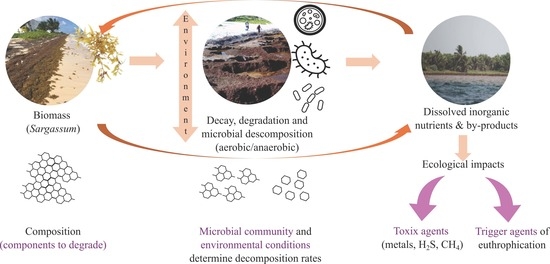
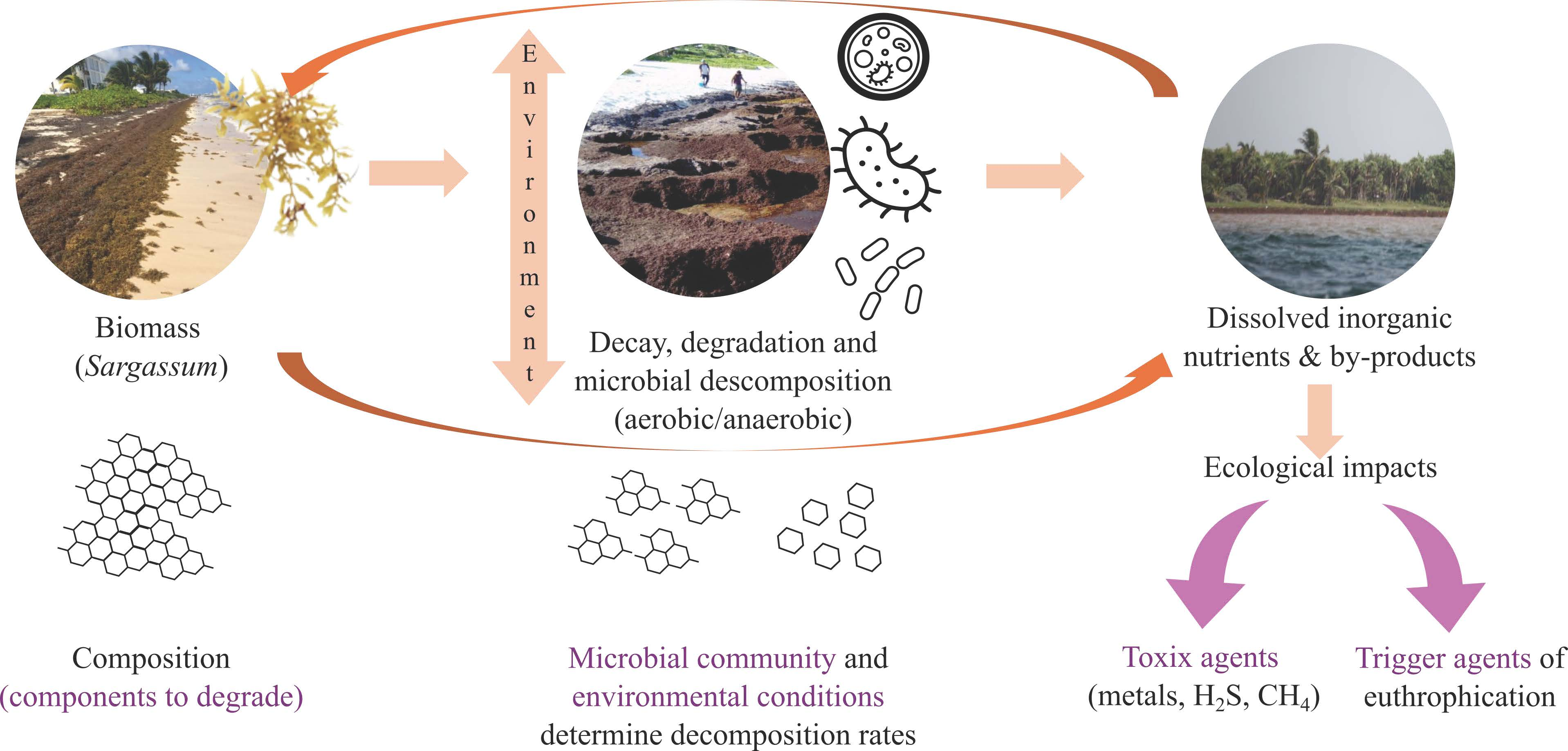
Graphical Abstract

1. Introduction

Since 2011, unprecedented massive strandings of holopelagic Sargassum have impacted the Caribbean and the tropical North Atlantic, establishing a new annual phenomenon with varying degrees of intensity and frequency. Initial assessments suggested an origin in the well-known Sargasso Sea, as synthesized in recent reviews [1,2]. Long-term monitoring, however, confirms this alga thrives in a new regime known as the Great Atlantic Sargassum Belt (GASB). These Sargassum events trigger a cascade of adverse effects at the local and regional level, severely disrupting economic and ecological functioning. As documented in existing literature reviews [1,2] these impacts also include significant consequences for public health when this biomass decomposes on the beaches.
Sargassum events in the tropical Atlantic have brought several socioeconomic impacts in Caribbean countries, as well as in Mexican, Brazilian, and African Atlantic coasts [1,2]. Driven by these massive blooms, the accumulated biomass in the Atlantic Basin reached 38 million tons of algae during the summer of 2025 (Satellite-based Sargassum Watch System [SaWS], University of South Florida). Historical data also indicate that the biomass and covered area of Sargassum in the Atlantic have increased over time, particularly during the summer months (with 10, 5, and 20 million tons reported during the events of 2015, 2017, and 2018, respectively) [2,3], indicating this phenomenon is becoming the new normal. The outstanding amount of biomass produced subsequently strands, degrades, and decomposes on beaches, imposing several ecological threats to the marine environment. In coastal zones, high remineralization rates typically occur in mangroves, salt marshes, and sediments; however, shorelines inundated by Sargassum should also be recognized as critical sites for remineralization.
Degrading and decomposing biomass alters the landscape of coastal communities, particularly when the capacity of the system to manage this biomass (natural or human removal) is exceeded due to the constant and massive arrival of seaweeds [1,4]. Therefore, although some of the impacts of Sargassum events begin during the initial biomass influx (e.g., light attenuation and oxygen limitation), most of the long-term impacts on ecosystems are derived from its decomposition, due to the release of various compounds, including nutrients and pollutants [5,6]. However, physical smothering of marine biota during Sargassum events, before degradation and decomposition dominate, can be considered a mid- to long-term impact on ecosystem functioning. Still, it is difficult to study independently, and it is often observed alongside degradation effects. Natural degradation and decomposition of Sargassum are complex processes due to the interactions between the different components involved, including the different integrity stages of the biomass (living, decaying, dead, detritus, etc.), microbial composition and activity, and environmental and spatial variation.
The scientific community has given special attention to the degradation and decomposition from an ecosystem perspective, whereas minimal studies have focused on understanding the process, which remains poorly understood in Sargassum; mechanistic studies focused on specific degradation enzymatic pathways and metabolic rates (and regulation) are still scarce in an ecological context, but have been addressed in the context of industrial valorization. For example, the composition of Sargassum leachates is quite variable, and its production depends on many factors, including origin, species and its chemical profile, environmental variation, and microbial composition [7,8,9,10]. The degradation of Sargassum biomass requires the breakdown of complex recalcitrant cell wall polysaccharides (CP), such as alginate (20–40% of DW), into smaller molecules [11]. This indicates that the biological degradation of Sargassum polysaccharides requires specific microbes that are often found in sediments, nearby water, or epiphytic on algal surfaces [11,12]. For example, isolated bacteria from these sources are known to degrade alginate, including members of the Proteobacteria and Bacteroidetes phyla. These include the genera Pseudomonas, Alteromonas, Pseudoalteromonas, Vibrio, Alterococcus, Microbulbifer, Agarivorans, Thalassomonas, and Saccharophagus from the Proteobacteria and Marinilabilia, Flavobacterium, Cellulophaga, Zobellia, Cytophaga, Persicobacter, and Microscilla from Bacteriodetes [11]. In this context, the study of the microbiome (associated with biomass or shallow coastal sediments) shapes the magnitude and variability of this process, along with environmental variables that modify its velocity. This knowledge is also critical to quantify and understand the timeline and magnitude of the impacts. Linking the microbiome to biotechnological processes, including efficient biorefinery and bioremediation approaches, as well as to the early detection of potential pathogenic vectors, is essential for biomass and coastal management [11,13,14]. In addition, abiotic factors such as light (UV, PAR), temperature, desiccation, wave action, etc., affect directly microbial activity; however, they also play an essential role inducing physical and biochemical priming mechanisms, accelerating microbial breakdown, through two main processes: (1) physical stress, compromising tissue integrity and increasing surface area for microbial activity, and (2) biochemical stress (UV, heat), which induces DOC release and small polysaccharide fragments. These effects may alter initial substrate availability, favor the presence of specific microbial groups, and shift microbial degradation pathways toward more easily digestible substrates. For example, depolymerization of complex carbohydrates has been experimentally achieved using UV (i.e., photodegradation [15,16]) and H2O2, which has profound implications for DOC exudate dynamics [17,18].
On a global scale, holopelagic Sargassum has been suggested as an active asset to mitigate climate change (CO2 capture, blue carbon); however, its real contribution remains unknown [1,19,20]. In other words, this capture is temporal. This is partly due to its relatively rapid turnover and lack of carbon sequestration in massive structures (i.e., seagrass roots [21,22]). Therefore, the real contribution to the global carbon cycle export is determined by the transport of different carbon sources to sediments and the deep ocean (as dissolved and particulate matter, DOM and POM) through decay, fragmentation, sinking, degradation, and decomposition [18,23]. This comprehension, as well as any other ecological impacts, requires a better understanding of degradation and decomposition at the fine and broad scales.
In this review, we synthesize the current literature on the degradation and decomposition of holopelagic Sargassum, with a focus on microbiome studies, process dynamics, and ecological impacts. Our objective is to consolidate a robust knowledge framework to inform and optimize management strategies in affected areas while gaining insights into this fascinating process.
To this end, we first analyze these processes together, emphasizing the dynamics of holopelagic Sargassum degradation and decomposition, as well as the role of the microbiome. Subsequently, we introduce a novel approach to characterize the degradation and decomposition scenarios based on their occurrence and the trends observed to date. Ultimately, we discuss the most prominent negative impacts of degradation and decomposition, as well as future directions for better understanding these processes at all scales.
To achieve this task, we searched scientific databases using the term holopelagic OR pelagic Sargassum in combination with the following key words “degradation/decomposition”; “decay”; “nutrients”; “impacts/effects”, “microbiome”, “microbial activity”; “contamination”; “hydrogen sulfide (H2S)”; “arsenic/(As)”. We selected only published papers from peer-reviewed scientific journals, and the search was conducted through the third quarter of 2024. Importantly, we excluded data that was unrelated to decomposition and degradation processes. Based on this literature review, we developed a novel descriptive framework that synthesizes current information on degradation and decomposition while characterizing their distinct environmental scenarios.

2. Degradation and Decomposition as Processes

In the ocean, the main source of inorganic nutrients is through remineralization by microbial activity (bacteria, archaea, and some protistan heterotrophs) through aerobic and anaerobic respiration [24]. From a planetary perspective, the decomposition of organic matter and its fate are of great relevance due to their links to biogeochemical cycles and primary production. Decomposition is particularly intense in the deep ocean and sediments where organic matter escapes the water column. Through advection, wind action, and upwelling, nutrients are brought back to surface waters, feeding up photosynthesis. Dissolved organic matter (DOM) is the carbon source used for decomposition, derived from decaying and dead organisms, mucous, organic exudates, fecal pellets, etc. Larger organic matter needs to break down and degrade, initially through lysis of cell membranes (releasing some DOM) and through enzymatic processes [11,25]. While degradation may refer to the deterioration or breakdown of organic matter resulting in some loss of original properties, decomposition refers to the biochemical breakdown of molecules into simpler inorganic components (i.e., remineralization). Organic matter decomposes under both aerobic and anaerobic conditions. Whereas environmental oxygen serves as the electron acceptor in aerobic degradation, alternative electron acceptors are utilized during anaerobic processes. Aerobic degradation consists of three main phases, including hydrolysis, oxidation, and mineralization. In contrast, the process under anaerobic conditions comprises hydrolysis, acidogenesis, acetogenesis, and methanogenesis, which are carried out by specialized microorganisms [5,12,24].

3. An Overview of Holopelagic Sargassum Degradation and Decomposition

A broad qualitative biochemical composition of holopelagic Sargassum is presented in Table 1, which includes recalcitrant compounds such as alginate, lignin-like, and cellulose. True lignin is absent in Sargassum, but the term lignin-like is often used, for practical reasons, to denote phlorotannins, a group of high-molecular-weight polyphenols that resemble lignin from land plants. In addition, the interannual, seasonal, and spatial variation in holopelagic Sargassum biochemical composition indicates substantial variation in degradation and decomposition kinetics. It is worth mentioning that literature does not provide a unique indicator of this, and measurements of H2S, methane, leachates, and microbial abundance are frequently used [26,27].
The chemical composition is essential to understand degradation kinetics, but the released material through degradation and decomposition has two significant outcomes. On the one hand, the available information suggests that pollutants can leach out from Sargassum. These include As, CH4, H2S, and NH4 (and other minor components such as Cu and B), either in the atmosphere, seawater, or groundwater, depending on where Sargassum is decomposing [5,6,28]. On the other hand, inorganic nutrients released (nitrogen, phosphorus, and carbon) may trigger eutrophication events, enhancing the dominance of opportunistic species [23,29] unbalancing the ecosystem functioning. In the tropical Caribbean, this is crucial given the oligotrophic conditions and the historical impacts of anthropogenic sources in this region. Hence, in combination with Sargassum events, a possible cascade of unknown effects will certainly affect the ecosystem services of the region [29].
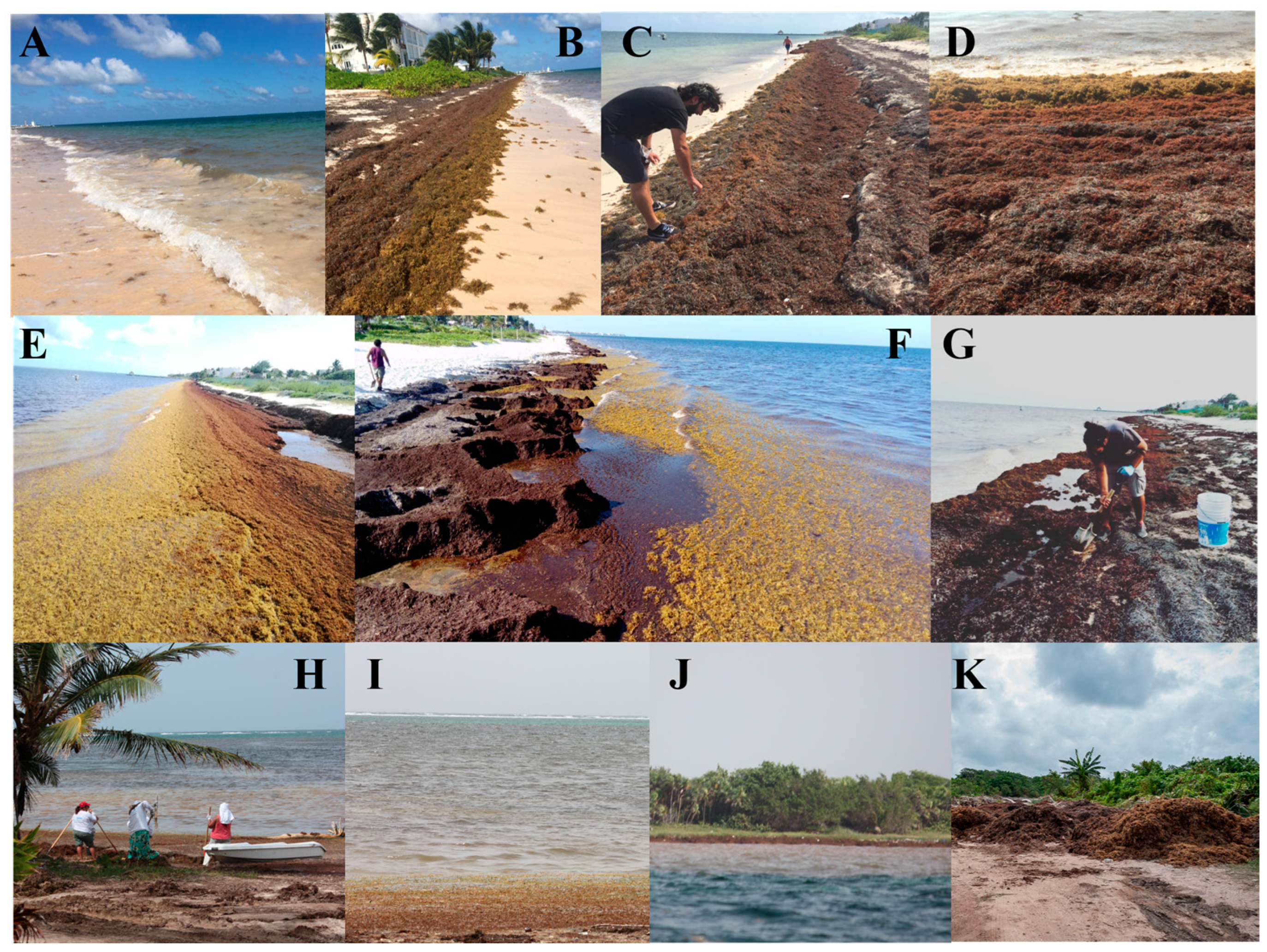
Regardless of Sargassum’s lifespan, when it strands and accumulates on the beach, it decomposes. Initially, however, premature and fast decay will be initiated by stressful conditions when biomass is exposed to air, during emersion. However, as accumulation increases, this standard scenario changes completely (Figure 1). Based on this, we propose, as an explanatory model, degradation into different scenarios; two isolated ones (during immersion and emersion), along with a third one, which combines both, when massive accumulations are at their peak (Figure 1). Nevertheless, degradation during immersion is mostly appreciable when significant accumulations occur. Although decay, degradation, and decomposition occur in the open ocean due to age, fragmentation, and sporadic stress events, these processes are diminished relative to massive degradation events.
The first scenario (degradation under emersion) corresponds to the initial stages of Sargassum events in the coastal zone, where biomass accumulates in areas lacking periodic cleaning or, when events slightly increase. This scenario is mainly composed of two consecutive phases: an initial, slow phase (Figure 1B) dependent on the rapid dehydration of the biomass, and a subsequent accelerated degradation phase (rapid phase) within the self-insulated larger biomass piles (Figure 1B–D). Slow phase decomposition also occurs in specially designed storage sites (disposal sites, local dumpsters, and illegal or clandestine dumpsters; Figure 1K). Continuous accumulations may drastically change environmental variables, accelerating degradation due to humidity inside (rapid phase, Figure 1B–D). One of the main concerns of decomposition during emersion, regardless of the magnitude of the event, is that, in the absence of proper treatment or strict regulation, contaminants generated through decomposition may infiltrate and contaminate groundwater [4,5]. The second scenario corresponds to degradation and decomposition during immersion. This degradation is the rule in benthic subtidal macroalgae [30]. However, in contrast to benthic algae, this may be indistinguishable in holopelagic Sargassum, because of lower stress in oceanic areas, and the fact that most fragmented or decaying biomass available will sink. However, light and temperature stress increase exudate release by two orders of magnitude [18]. High light and temperature levels are typically encountered in shallow coastal waters and will induce considerable stress through their interaction. Under such circumstances, stress will persist, leading to the decay and inevitable degradation of the biomass. Degradation and decomposition during immersion are more relevant in the third scenario, which combines both emersion and immersion degradation.
This third scenario (Figure 1E,F) results from the constant accumulation of seaweed over time on the shore, in which the same Sargassum acts as a barrier for the fresh biomass. The resulting scenario is a large two-sided degradation/decomposition picture. On the one hand, degradation and decomposition on the beach side become larger as the progressive accumulation enhances humidity and water retention within the pre-existing decomposing biomass. On the other hand, Sargassum in seawater experiences suboptimal conditions, enhancing decay and further decomposition. During the most intense periods, leachates and decomposition products are released into the ocean, the atmosphere, and groundwater simultaneously. This two-sided scenario becomes increasingly complex; a positive feedback loop occurs in which the products of emersed-biomass degradation reenter the sea, accelerating stress and decay on the newly fresh or already decaying Sargassum. Most of the negative ecological impacts are evident under this scenario. After the events stopped, the residual biomass continued to degrade, and some of the impacts remain (Figure 1G–J).
Table 1. Fresh holopelagic Sargassum biochemical constituents described in the literature. Sources: [8,10,31,32]. Abbreviations: SFA: saturated fatty acids; MUFA: monounsaturated fatty acids; PUFA: polyunsaturated fatty acids.
MonosaccharidesPolysaccharidesAmino AcidsLipids
Mannuronic acidCelluloseLeucineTriacyglycerides
Glucuronic acidAlginateThreonineTerpenoids (Fucoxanthin)
GuluronicFucoidanPhenylalanine
GalacturonicLignin-like *Isoleucine
Mannose ValineFree fatty acids, FFA (SFA, MUFA, PUFA)
Xylose HistidineLauric acid (SFA)
Glucose LysineMyristic acid (SFA)
Galactose ArgininePalmitic acid (SFA)
Rhamnose TryptophanStearic acid (SFA)
Arabinose MethionineArachidic acid (SFA)
Fucose Behenic acid (SFA)
Mannitol Lignoceric acid (SFA)
Fructose Myristoleic acid (MUFA)
Glucosamine Palmitoleic acid (MUFA)
Vaccenic acid (MUFA)
Oleic acid (MUFA)
Gondoic acid (MUFA)
Erucic acid (MUFA)
Nervonic acid (MUFA)
Linoleic acid (PUFA)
Alpha-linolenic acid (PUFA)
Dihomolinoleic acid (PUFA)
Eicosatrienoic acid (PUFA)
Dihomo-γ-linolenic acid (PUFA)
Arachidonic acid (PUFA)
Eicosapentaenoic acid (PUFA)
Docosahexaenoic acid (PUFA)
* Refers to phlorotannins.

4. The Role of Microbiome in Holopelagic Sargassum

Recent tools have significantly increased the way we investigate and understand complex microbial interactions and functions, yet the diversity of groups involved is enormous, and differences occur at different scales [33]. There is a notable lack of information on non-bacterial contributors to holopelagic Sargassum degradation. However, the degradative activities of other groups, such as fungi, yeast, and mollusks, have been previously examined. Most of these studies, however, focus on industrial or valorization processes ([34,35,36,37], which fall outside the scope of this review but warrant attention. Therefore, in this review, we will refer to the microbiome as only the prokaryotic (archaea and bacteria) community involved in the degradation of holopelagic Sargassum. Bacterial groups associated with seaweeds contribute to the decomposition of cell walls (biotransformation and nutrient recycling), mineralize algal organic exudates, supplying the algal host with carbon dioxide, minerals, vitamins, and growth factors, nitrogen (through fixation), and detoxifying compounds [33,38]. Other benefits include nutritional and growth-promoting effects, morphological and life-cycle shaping, and the secondary metabolite production [33,38,39,40]. In the study of microbial diversity, a functional approach is also common, where it is used to predict the dominant roles of microbial communities within a given sample (e.g., FAPROTAX). This information would provide insights into the complex metabolic interactions occurring during the degradation process [40,41]. For example, chemoheterotrophic or phototrophic, respiration of sulfur compounds, fermentation, nitrogen recycling (reduction, fixation, denitrification), methanogenesis, iron respiration, cellulolysis, and hydrocarbon degradation, among others, are functional groups described in seaweeds, including Sargassum. While tools such as FAPROTAX provide a powerful first relative functional screening, analysis of potential metabolic capacity, including metatranscriptomic or metaproteomic perspectives, is essential to confirm active in situ metabolic function.
The literature available on holopelagic Sargassum includes both types of studies, those related to the description of the microbiome in living samples and in degrading/decaying biomass (Table 2). In general, these studies have reported the presence of microbes related to the degradation and decomposition of complex organic molecules, sulfur respiration, methanogenesis, and nutrient recycling bacteria [40,41,42]. In addition, the microbiome suffers significant shifts (abundance, diversity, and composition) during stranding or during decomposition, including the microbiome associated with leachates [12,41,43].

4.1. Taxonomic and Functional Diversity

Available studies indicate that the most abundant phyla in holopelagic Sargassum are Proteobacteria (i.e., Ateromonadales, Rhodobacterales, Vibrionales, Pseudomonadales), Alphaproteobacteria, Bacteriodetes (Sphingobacteriales, Flavobacteriales), and Plancomycetes, whereas the most abundant orders are the Rhodobacterales, Vibrionales, Sphingobacteriales, and Flavobacteriales [40,41,42,43,44]. The abundance and presence of these groups vary across studies due to differences in experimental approaches, localities, and temporal scales.
Hervé et al. [40] reported that the most abundant functional groups in healthy holopelagic Sargassum samples correspond to taxa associated with chemoheterotrophy, fermentation, nitrate reduction, phototrophy, and sulfur compound respiration. In contrast, bacteria linked to intracellular parasites, predators or exoparasites, animal parasites or symbionts, as well as methanogenic, hydrocarbon-degrading, and dark sulfur-oxidizing bacteria were also present in low abundance [40,43]. With respect to this, members of the Rhodobacteraceae, particularly abundant in previous studies, are metabolically versatile bacteria capable of performing an extensive range of metabolic processes, from nitrogen fixation to oil degradation [44]. Similarly, members of Saprospiraceae and Sphingobacteriales (Bacteriodetes) are known to hydrolyze complex organic molecules from seaweeds and in sludge water. Likewise, a wide range of polysaccharides are used by members of Flavobacteriaceae (Polaribacter spp., Formosa spp., Dokdonia spp., Gramella spp., Cellulophaga spp., Lutibacter spp., Winogradskyella spp.), which are also present in holopelagic Sargassum [40,44]. The Vibrionaceae encompasses a well-known marine bacteria involved in diverse functions, from pathogens to nitrogen mineralization. Vibrio is also abundant in holopelagic samples, in the open ocean, and in coastal environments, and participates in nitrogen metabolism [13,42]. Species of Vibrio may also pose sanitary risks because many are pathogenic to animals and humans [13,41]. Bacteria related to the respiration of sulfur compounds present in holopelagic Sargassum include members of Desulfobacterales, Desulfovibrionales, Clostridiales, Desulfarculales, Desulfuromonadales, Syntrophobacterales, and Thermococcales, while sulfur-oxidizing bacteria include Sulfurovum and Sulfurimonas (Campylobacterales) [40].

4.2. Spatial and Temporal Shifts in Microbiome

Elucidating key patterns in microbial communities of holopelagic Sargassum is complex, not only because of scaling challenges but also because of the spatial dynamics (biomass transport) and the contribution of environmental conditions to community structure in the open ocean, as well as prior to and during strandings [12,13,40,43]. Consequently, spatial and temporal (decomposition) changes have been found in holopelagic Sargassum microbiome. For example, Theirlynck et al. [41] found differences in holopelagic Sargassum genotypes across the Great Atlantic Sargassum Belt (GASB) and several coastal stranding locations in the Caribbean Sea, Florida, and Mexico, as well as within genotypes. A large abundance of Pseudomonadaceae was found (40–60% of relative abundance), particularly high in S. natans VIII. Members of the Rhodobacteraceae (6–12%), Vibrionaceae (3–6%), Microtrichaceae (3–5%), Phormidesmiaceae (2–4%), and Nostocaceae (2–4%) were also found. At least 20 genera varied strongly between genotypes and were particularly present in S. fluitans III (15 genera). Differences between genotypes were attributed to differential morphology and composition of exudated DOC, yet this remains unsolved. Furthermore, the authors found a low abundance of Vibrio in the Atlantic Ocean locations (<1% relative abundance) but up to 40% in coastal sites, likely the result of changes in the resident microbiome and/or colonization by pre-existing Vibrio. According to the authors, the increase in Vibrio at coastal sites may be primarily attributed to an increase in endemic coastal Vibrio populations; fresh or decaying biomass likely serves as a physical vector and a nutrient-rich substrate for these bacteria, which are often associated with coastal pollution (e.g., sewage, runoff). An increase in the resident population or seed bank may be enhanced under suboptimal physiological conditions; it is probable that physiological stress may result in dysbiosis, increasing the relative abundance of a small but consistently pre-existing Vibrio community. However, previous reports have shown low Vibrio abundances [44], likely due to a lack of stress at the sites or to seasonal shifts in Vibrio populations.
Similarly, Michotey et al. [13] studied microbiomes associated with different Sargassum rafts in the Central Atlantic, Caribbean Islands, and the southern Sargasso Sea, emphasizing the presence of pathogenic Vibrio. In this analysis, four microbiome assemblages were identified based on the relative abundance of Rhodobacteraceae, Saprospiraceae, Hyphomodaceae, and the genera Vibrio and Alteromonas. Of the 12 Vibrio entities found, six potential pathogens were identified, corresponding to 80% of the total Vibrio abundance. Modelling abiotic parameters and growth revealed strong influences of nitrate and iron, wind speed, growth rate, zooplankton, raft size, and temperature on the bacterial abundances. A large abundance of Vibrio occurred under the highest nutrient concentration, whereas a high abundance of zooplankton reduced Vibrio abundance. High growth rates were also associated with the presence of Vibrio, in contrast to the findings of Theirlynck et al. [41]. This discrepancy was explained due to differences in the sampling sites.
Significant changes in the microbiome due to degradation/decomposition have also been reported. For example, in Guadeloupe and Martinique, a metabarcoding approach was used to distinguish the Sargassum microbiome from microbiomes at different tidal sites (accumulation sites), seawater, and stored biomass at inland sites [40]. Overall, the results showed that the prokaryotic community associated with Sargassum potentially contributes to organic matter decomposition, nitrogen cycling, and gas production (sulfate-reducing and methanogenic bacteria), yet distinct functional signatures were observed across compartments (sites). Differences were at the order or family level, yet 9% of the community was shared between compartments. In Sargassum tidal samples, the most diverse phyla were Proteobacteria (34.3% of relative abundance), Bacteroidetes (22.9%), and Planctomycetes (9%), whereas Cyanobacteria, Spirochaetes, and Firmicutes were present only in seawater samples. At the storage sites, the most abundant phyla were Bacteroidetes, Proteobacteria, Planctomycetes, Firmicutes, and Acidobacteria. Vibrionaceae were the most abundant group in Sargassum tidal samples (related to nitrogen recycling), followed by Flavobacteriaceae (Bacteroidetes), including the genera Polaribacter spp., Formosa spp., Dokdonia spp., Gramella spp., Cellulophaga spp., Lutibacter spp., Winogradskyella spp., Cryomorphaceae, Crocinitomicaceae, Cyclobacteriaceae, and Saprospiraceae from the Bacteroidetes. In contrast, the Flavobacteriaceae (Bacteroidetes) were the most abundant family in storage sites, a group known for its contribution to organic matter decay. Functional prediction revealed that the most abundant bacterial groups were chemoheterotrophic, nitrate-reducing, phototrophic, and sulfur-respiring. Bacterial groups potentially involved in methanogenesis were also abundant in storage sites. Also in minor proportions, bacteria related to the respiration of sulfur compounds (Desulfobacterales, Desulfovibrionales, Clostridiales, Desulfarculales, Desulfuromonadales, Syntrophobacterales, and Thermococcales), and sulfur-oxidizing bacteria were also present (Sulfurovum and Sulfurimonas). Although it is unclear whether these radical shifts in the stored biomass microbiome are due to Sargassum surface associated or seawater microbes, or to a non-native Sargassum microbiome (terrestrial contamination), the lack of information on the status of the experimental biomass complicates this differentiation.
Using an experimental approach, Mendonça et al. [43] found significant temporal differences in the microbiome of Sargassum phylloids (S. natans and S. fluitans) during a simulated stranding (biomass exposed to air for two days). At the beginning of the experiment, similar groups dominated between species: Rhodobacterales (23% of relative abundance), Microtrichales (17%), and Caldilineales (11%) for S. natans VIII, whereas Mitrotrichiales (43%), Rhodobacterales (10%), and Caulobacterales (7%) were found in S. fluitans. Dysbiosis occurred after 24 h, with increases in Alteromonadales (9 and 4% for S. fluitans III and S. natans VIII, respectively) and Vibrionales (85–92%). After 48 h, a significant reduction in Vibrionales occurred (S. fluitans, 68%; S. natans VIII, 65%), whereas Alteromonadales increased (S. fluitans, 22%; S. natans VIII, 10%). From a functional perspective, a shift from photoautotrophy (photosynthetic cyanobacteria and oxygenic photoautotrophy) to chemoheterotrophy and fermentation occurred after 24 h. Although not explored, conditions inside the Sargassum pile typically create a unique microenvironment. In this context, rapid drying of the above tissue and compaction due to humidity loss in their experimental set-up may create a rapidly reduced oxygen environment that induced the observed rapid shift. Similarly, Domínguez-Maldonado et al. [12] analyzed the changes in the microbiome of Sargassum leachates (S. fluitans and S. natans) for 150 days. At the beginning of the experiment, the most abundant phyla were Crenarchaeota (81% of relative abundance), Euryarcheaota (10%), Proteobacteria (5%), and Cyanobacteria (4%). Members of Crenarchaeota are thermophiles able to metabolize sulfur, whereas Euryarchaeota includes the halophilic Halobacteriaceae. After 30 days, Cyanobacteria dominated the leachate microbiome (59%), followed by Proteobacteria (33%), Actinobacteria (4%), and Crenarchaeota (3%), groups associated with degradation of the thalli. Cyanobacteria accounted for 81% of the relative abundance at day 90, followed by Proteobacteria (16%), Actinobacteria (2%), and Bacteroidetes (1%). After 150 days, the microbial community was still dominated by Cyanobacteria (71%) and Proteobacteria (16%), but Euryarchaeota (10%) slightly increased. Accordingly, three main changes in microbial communities were observed: stage 1 (0–30 days) bacteria (Thermofilum, Thermoproteus (Chrenarchea), Methanopyrus (Euryarchaeota), Hydrogenophilus (Proteobacteria) use sulfur polymers and produce toxic gases (H2S, H2, CH4). Stage 2 (30–90 days) genera such as Acidiphilum, Hydrogeniphillum [Proteobacteria], Thermofilum, Thermoproteus [Crenarchaea], Chroomonas [Cryptophyta], and Fischerella [Cyanobacteria] degrade organic compounds, producing ammonia and CO2. At the end, a significant contribution of Desulfobacter, producing CO2 and nitrogen-fixing cyanobacteria, Dolichospermum, among other important genera, was observed. The presence of Cyanobacteria in this study differs markedly from that of other studies. Therefore, compared to previous studies, this appears to be an outlier. However, microbes associated with leachate may vary substantially from the typical microbial biomass community. Additionally, some illumination was present during Domínguez et al.’s experiment, allowing cyanobacteria to grow under low-light conditions due to their photoadaptation/photoacclimation capacities [45,46]. Although this study is a key study for understanding Sargassum degradation, the conditions achieved in their experiments may not fully represent in situ degradation, creating a unique microenvironment. However, further experiments are needed to confirm the diversity observed and the shifts in leachate production. While this section is not intended to be an extensive review of the microbiome, we believe that it is critical to include this information. For further reading on this topic, a recent review is available [47].

5. Degradation and Decomposition of Biomass: From Emersion to Immersion

Stranded Sargassum biomass rapidly encounters suboptimal conditions, leading to its rapid decay and eventual death (Figure 1, Section 3). These suboptimal conditions, including high temperature and irradiance, promote the formation of distinct microenvironments that ultimately favor degradation. Increased respiration by bacteria and a lack of ventilation rapidly depletes oxygen, promoting the generation of toxic gases through anaerobic respiration, particularly H2S. These emissions were among the earliest indicators of degrading Sargassum on the beaches, and in some localities, H2S emissions are constantly monitored (Table 3 for details of this and other studies). This concern is due to the associated human health problems provoked after prolonged exposure to H2S [4,48,49,50,51,52]. For example, in Martinique and Guyana, where long-term monitoring is conducted, during 2016–2018, strong temporal variation in H2S (0–10 ppm) emissions in air, correlated with a significant presence of Sargassum in summer months, was reported. However, estimates indicate that H2S can reach 50 ppm within decomposition sites [52,53]. Recently, a study showed a positive correlation between H2S emissions and proximity to Sargassum accumulations at beach sites in the Mexican Caribbean during 2022 and 2023 [28]. Values between 2 ppm and occasionally 5 ppm above degrading piles decreased significantly (<2 ppm) at 10, 30, and 40 m from the piles. These values are considered non-risky for tourists and locals; however, values of 5 ppm with peaks of ~100 ppm were found inside the piles, high enough to induce health problems [52,53,54,55]. Therefore, public health authorities and sanitation agencies in affected countries should prioritize the development of monitoring protocols. Moreover, the corrosive effects of H2S on metals in the atmosphere have also been reported [56].
To date, no direct quantification of emission rates has been done in the field, which accounts for the stranded biomass. Laboratory experiments, however, have simulated decomposition under semi-controlled conditions, focusing on gas dynamics. These data indicate H2S emissions start after ~7 days, reaching a peak(s) (>100 ppm) between 12–14 days, followed by a decrease or intermittent peaks [57]. An initial peak in carbon monoxide (CO) emission occurred before H2S production (between days 2 and 5), either from biological origin or photodegradation. According to the authors, biological degradation includes aerobic degradation of chlorophyll and heme-containing compounds (e.g., cytochromes) and anaerobic degradation of organic matter in the absence of oxygen. In these experiments, neither CH4 nor NH3 were undetected, and O2 levels were below 20%. Variations in maximum release times and H2S concentrations across replications could be attributed to differences in temperature, light, the microbiome, and the amount of algae used. An emission rate of 192.3 g H2S h−1 m−2 (~15 Kg FW m−2) was estimated from Sargassum (mixed biomass). Although this is a significant contribution, caution is warranted, as the numbers appear relatively high compared to those from other natural sources of H2S [58]. Therefore, it is likely that the controlled optimal conditions of these determinations allow such dramatic, high-instantaneous peaks of emission that cannot be sustained in situ, not because of a lack of substrate but because of the considerable physical heterogeneity within strandings. Therefore, in situ validation is critically needed.
During the degradation of organic biomass, leachate refers to the organic-rich liquid generated by the biochemical disintegration of organic waste, commonly seen in local waste disposal facilities [59]. Since the initial stages of Sargassum degradation occur on land, experts have adopted this terminology; in the absence of a controlled environment, leachates represent a significant source of contaminants [5,6,59]. However, brown algae, including Sargassum species, release organic exudates during stress periods, as previously noted, which are mainly composed of phenolic aromatic compounds [9,26,60]. Hence, during extreme events (i.e., Scenario 3, Figure 1C,F,I–K) and in seawater, leachates and exudates may be indistinguishable, but both are related to negative impacts on marine organisms [23,61]. In general, leachates may contain soluble organic matter (aromatic hydrocarbons, alkanes and alkenes, organic acids, lipids, alcohols and phenols, aldehydes and ketones, amides, etc.), ammonia, phosphorus, heavy metals, total dissolved solids, and inorganic salts (Na, K, Cl, SO4, etc.), among other components [59,62]. Leachates also include different degrading bacteria [24,62]. During leachate generation, primary sources of proteins, carbohydrates, and fatty acids are assimilated, producing a liquid fraction containing soluble organic matter and biogas (a mixture of CH4, CO2, H2S, O2, and H2).
Little is known about the intermediary or end by-products and properties of compounds generated through leachates (and/or exudates) of Sargassum. For example, some characterizations have been made regarding the DOC composition of exudates, leachate properties, content, and dynamics. The DOC composition has been found to have fundamental metabolite classes, lipids, peptides, and various volatile carbohydrates, carboxyl-rich alicyclic compounds, oxygenation products of carotenoids and other OC2CH-units, classical aromatic compounds, and phlorotannins [5,6,18,26,27]. Although general degraded biomolecules are expected to be present in Sargassum leachates, including proteins, carbohydrates, and lipids, arsenic, boron, aluminium, and copper have also been found [1,5]. Other products of bacterial metabolism (CO2, NH3, NH4), fatty acids, various organic compounds, methane, proteases, Fe2+, pigments, H2S, fixed nitrogen, microcystins, and cyanotocins may occur [12].
Studies on leachate generation dynamics (indoor and outdoor simulations) have shown that the leachates are produced at a high rate during the initial stages of decomposing biomass (between 5 and 30 days), coinciding with the highest peak of H2S. The latter, however, is heavily affected by temperature (i.e., production is three times higher under 33 °C compared to 24 °C). Nevertheless, high temperatures also induce evaporation and a more rapid cease of leachate production [5]. These studies indicate a maximum leachate production rate of 25 mL d−1 between 30–60 days (indoor, 27 °C) and up to 80 mL d−1 within 5 days (outdoor, 34 °C). In addition, leachate pH and electrical conductivity increase with time. An estimation of 316–597 L of leachate per ton of fresh Sargassum has been reported, from which 5–10 g of total As and low but detectable concentrations of B, Al, and Cu have been identified in leachates [5,26]. In this context, seasonal dynamics in inorganic holopelagic Sargassum As content (As V) have been observed: lower values were recorded for S. natans I during the rainy season, whereas higher values were recorded during the dry-warm season [63]. These differences may be attributable to sample origin (i.e., travel history and enrichment locations), saturation of alginate-fucoidan binding sites, and leaching from tissues during rainy periods. This information has enormous implications for leachate content and toxicity in contamination studies, and its dynamics should be considered. A similar estimation of 0.302 ± 0.02 L kg−1 (150 days of experiment) was given by Domínguez-Maldonado et al. [12]. These studies reported a loss of biomass (dry basis) of ~16 and 38% after 180 d (indoor, 27 °C) and after 30 d (outdoor, ~34 °C), respectively, and a 50% loss (fresh weight) after 180 d (indoor, 28 °C). Such observations are consistent with decomposition half-lives of macroalgal detritus (~50% loss in less than 250 days) [5,12,25], confirming the complexity of cell wall polysaccharides. In this context, the relevance of the C:N:P ratios of biomass, a widely studied metric in holopelagic Sargassum [64,65], controls these decomposition rates at a certain point: nutrient-rich organic matter decomposes faster under low ratios (low carbon). For example, decomposition rate (% DW d−1) (log-log units) increases 1.19 or 0.93 times relative to nitrogen or phosphorus content in litter or detritus [25]. Although half-time models are an essential starting point, future studies must incorporate C:N:P stoichiometry and temperature effects, along with other variables, to improve our understanding of biomass loss and enable its integration into different models.
Temporal (year-to-year), species-specific, and biomass origin (stranded, fresh, before and after artificial barrier, and oceanic) differences in leachate production (ml leachate d−1) have been documented. In general, oceanic Sargassum generates more leachates (up to 60 mL d−1 kg−1 of fresh algae, and S. fluitans a maximum of ~46 mL kg−1). As in previous reports, temporal increases in leachate production were observed; however, uncontrolled conditions in outdoor experiments induced great variability in the trends.
It appears that leachate production depends on the quantity of recalcitrant lignin-like content. The lowest leachate production occurred in samples with high phenolic content (lignin-like) and likely lower structural carbohydrate content, which were collected from the beach and after the Sargassum barriers (450 m from the coast). An opposite trend was observed in oceanic samples (6–14 km from the coast) [25,26]. Clearer patterns were likely obscured by the lack of a unique control exposed to site-specific conditions, and differences, albeit significant, were slight. Furthermore, the reported temporal and spatial variations in biochemical composition are probably contributing to the temporal differences in leachate production observed in this study [8,9,10].

6. Massive Accumulations: Ecological Impacts on Marine and Coastal Ecosystems

Accumulated Sargassum on the beaches represents a physical barrier for the fresh, simultaneously arriving Sargassum. Under these conditions, stress dominates the physiological status of the algae, leading to decay and decomposition in seawater. Sources of stress include, but are not limited to, reduced water movement, increased temperature and respiration rates (oxygen depletion), photoinhibition, nutrient starvation (due to a massive initial uptake), and light limitation [23,66,67,68]. As a consequence, phenols accumulation in tissues and their release will occur [9,18]. A conservative estimate of 23–41 µg C g FW h−1 in autumn has been provided, but it can be as much as three times higher during summer, and up to ten times higher under extreme thermal stress (>26 °C + high irradiance, exudate experiments, biomass in excess) [18]. Stressed, decaying, and dead algae may rapidly lose structural integrity by fragmentation, loss of air vesicles, and phylloids, fragments which rapidly become POM (and/or DOM) in the water column and further accumulate in sediments, becoming an important sink of organic matter [23,29,69].
Reduction of oxygen levels (hypoxia) has been consistently documented in sites influenced by Sargassum degradation/decomposition (4–5 times lower than in uninfluenced sites, i.e., 1 mg O2 L−1). Oxygen depletion probably initiates as a large increase in Sargassum respiration under stress, and subsequently, due to bacterial activity [23,28,61,66,70]. Oxygen depletion by microbial activity is further supported by low redox potentials measured in the same zones, and due to an increase in DOC.
Leachate production and exudate release, along with oxygen levels, will deteriorate seawater quality in a multifactorial manner. The deterioration of water quality is most pronounced during the summer months, according to the seasonal cycle of holopelagic Sargassum, when the impacts on marine biota may be most severe. Still, water circulation may play a vital role in diluting the accumulated products towards the open ocean [28]. The impact of the massive release of exudate and leachates, though, has not been extensively studied; it may induce negative responses from physiological and growth effects to changes in the community structure (Table 4).
The accumulation of fresh Sargassum in the water column, including all its forms (i.e., decaying, degrading, fragments, DOC, and POM), influences light penetration. Significant increases in turbidity and light attenuation coefficient (Kd) have been reported [23,69,71]. Reduced light conditions at the short- to medium-term level have been associated with decreases in photosynthesis and changes in morphology [71,72]. Water quality is also affected by the resulting compounds from bacterial activity, such as inorganic nutrients. Except for one study, there is limited evidence of nutrient enrichment associated with Sargassum. This may be because of the complexity of distinguishing between bacterial and anthropogenic nutrient sources in coastal zones [73]. For example, one study showed an increase from 0.6 to 1.9 µmol of NH4 and from 0.2 to 1.2 µmol of PO4 from sites 100 m away from the shoreline compared to sites to ~20–30 m from the shoreline in affected sites in the Mexican Caribbean [69]. Although the low N:P ratios observed in this study may indicate anthropogenic nutrient sources, this is challenging to assess due to site-specific hydrodynamics and geomorphology, as well as the correct identification of the nutrient source. For example, in the Mexican Caribbean, an apparent deterioration due to anthropogenic factors is evident in northern sites compared to the south is evident [29,73,74]. Also, the geomorphology of the coast may influence accumulations [8]. Other studies, when comparing seawater nutrient levels and stable isotopes (including nitrogen, δ15N in macroalgal and T. testudinum tissues), have determined nitrogen incorporation from Sargassum remineralization [29,73,74,75]. Yet there is limited evidence of eutrophication events. Long-term nutrient monitoring studies have shown spatial patterns associated with Sargassum events (frequency and intensity) and with the presence or absence of submarine water discharge (SBD) [76], and these patterns are also linked to anthropogenic influences (e.g., increases in local population and the tourism industry) [29,74]. In a recent study, Camacho-Cruz et al. [73] combined in situ nutrient measurements with δ15N in tissues and estimated that sites in the vicinity of SBD may input 70 and 194 times more nitrogen and phosphorus, respectively, compared to the potential fluxes of Sargassum-derived nutrients. Hence, the influence of anthropogenically derived nutrients may be more significant, at least in the Mexican Yucatán Peninsula.
Changes in water chemistry, including pH, O2 depletion, as well as the presence of other toxic substances (H2S, As, CH4, etc.), may have been responsible for the reported mortality of different invertebrates (crustaceans, mollusks, polychaeta, echinoderm), fish, and small coral colonies [23,77]. One experimental study demonstrated significant reductions in the motility of Acropora palmata larvae, one of the primary reef builders in the Caribbean, following short-term exposure to leachate concentrations (100, 50, and 25% dilutions). Notably, severe oxygen depletion occurred under the 100% (undiluted) condition. This may have profound consequences for the recruitment and maintenance of new coral colonies, since the reproductive season coincides with peak events during summer [61]. Similarly, the continuous exposure to different pollutants may induce the formation of reactive oxygen species (ROS). This will cause an imbalance between antioxidant activity, resulting in oxidative stress, which deteriorates carbohydrates, lipids, and proteins. Elevated levels of biomarkers of oxidative stress (O2, GST activities, TBARS, and carbonylated proteins) were found to be present in red blood cells from green turtles inhabiting the coast of the Mexican Caribbean, coinciding with the first massive Sargassum event in the region [78]. However, the exact causes of this remain unknown.
The long-term effects of decomposing Sargassum have shown negative impacts on seagrass populations, including reductions in aerial cover, below-ground biomass, and the spatial extent of Thalassia testudinum meadows [4,29]. Changes in the abundance and diversity of benthic algae have also been observed before and after intense events (towards the increase in calcareous green algae and/or opportunistic algae), which can lead to substantial changes in the diet, trophic structure, and niche selection of sea urchins; however, there is no significant isotopic evidence of Sargassum in sea urchin tissues [23,70,79]. Changes in community structure may be driven by the ability of other species to outcompete resident species, newly available niches, or the efficient use of new nutrient sources, enhancing their growth or expansion. As noted previously, evidence of remineralized nitrogen taken by T. testudinum has been reported [29,74,75]. Whether this represents a negative impact remains to be seen; however, it does highlight the fact that Sargassum nitrogen sources are entering the system, and as it is, nitrogen sources may be available for other primary producers, including opportunistic forms.
Table 4. Summary of ecological impacts reported in the literature related to the degradation and decomposition of holopelagic Sargassum.
TopicMain ImpactsSources
Atmospheric contaminationIncrease in H2S concentration [28,50,53]
Seawater qualityDecreases in light penetration (increases in Kd and turbidity) [23,69,71]
Decreases in oxygen, pH, redox potential, increases in POM and DOM, and total solids[18,23,69,70,71,72]
Increases in NH4 and phosphates[69]
Physiological and GrowthDecreases in photosynthesis and growth of primary producers, and impairment of coral larvae motility [61,71,72]
Symptoms of oxidative stress in green turtles[78]
Ecosystem and long-term impactsChanges in the diversity of macroalgae communities toward opportunistic algae, loss of seagrass meadows[23,29,70,79]
Mass mortality of invertebrates (crustaceans, mollusks, echinoderms, and polychaetes) and fish *[77]
Changes in trophic structure, niche amplitude, and diet of different sea urchin species[70,79]
Risk of contamination of As, Cu, and Al (presence in leachates)[5,26]
Evidence of relative nutrient increases in seawater/estimations of anthropogenic vs. Sargassum-derived nutrients [23,29,69,73]
Evidence of Sargassum-derived nutrients incorporation in primary producer tissues (stable isotopes) [29,73,74,79]
* The mortality hypothesis indicates that hypoxia and water quality deterioration (presence of ammonia and H2S) are the main drivers of this. However, the authors did not determine the contribution of each factor.

7. Perspectives and Future Directions

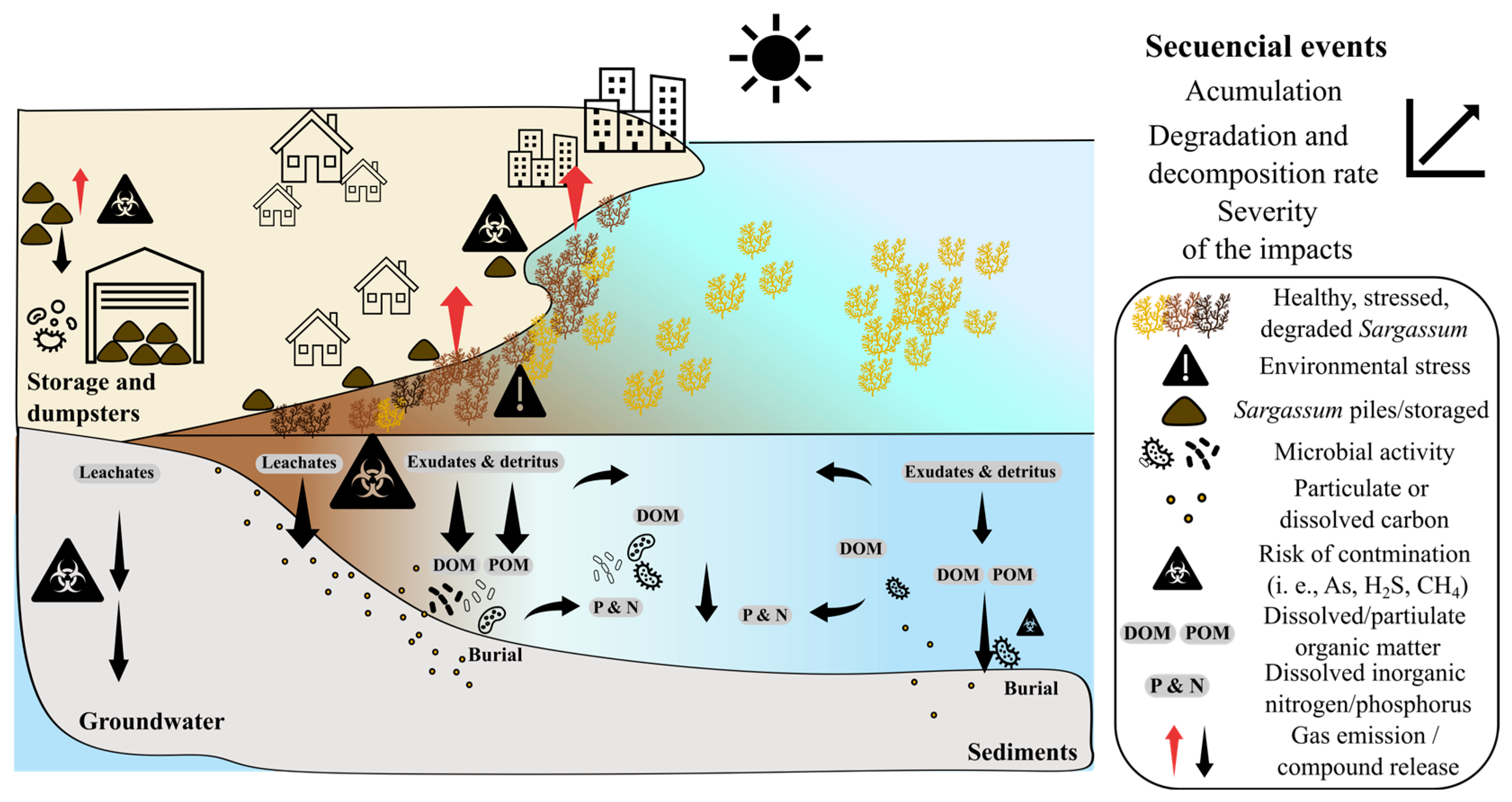
The degradation and decomposition of Sargassum in coastal zones (land, beaches, and seawater) are among the main concerns associated with Sargassum events. However, it is surprising that there is a lack of more concise studies aiming at understanding the process, including its regulation, velocity (i.e., degradation rates), variation within the environment, as well as the impacts (and their correct attribution) and their relevance at all scales (Table 4). Nevertheless, a significant effort has been made recently, particularly experimentally, allowing the scientific community to shape the direction (and needs) of future research on these topics. The generated information (descriptive molecular and experimental data of ecological significance) offers an important baseline for future studies while generating new working hypotheses. In this context, understanding the factors triggering, promoting, and controlling the degradation and decomposition of algal biomass is essential. Figure 2 shows a synthesized scheme of the degradation and decomposition of holopelagic Sargassum in nature.

7.1. Microbiome and Degradation and Decomposition

Understanding the role of the microbiome in the decomposition of holopelagic Sargassum is challenging due to the numerous factors involved. These include the constant heterogeneity observed within Sargassum biomass, either due to travel history and seasonal variation or within degradation and decomposition sites. Regardless of this, some important general tendencies have been identified. These include changes in the community structure due to decomposition (abundance and diversity), the constant presence of members of the Vibrionaceae (and its increased abundance in coastal areas), and spatial variation within degradation and decomposition sites.
It is urgently needed to better characterize microbial activity (i.e., regulation) according to environmental parameters at the fine and broad scales, in the laboratory and in the field. A significant effort has been made to identify the different taxonomic groups involved at different stages of decomposition, with a particular metabolism [12,43], yet we still lack the complete story due to the complexity of the process. Studies conducted to date lack rigorous control of variables and standarized controls, which are essential for maintaining homogeneity. Moreover, studies are difficult to compare due to different experimental designs (e.g., stranding vs. leachate microbial composition). Hence, the proposal of standard protocols and methodologies for degradation/decomposition experiments would improve this. Additionally, the time frames of the experiments are variable; if they are too long, essential shifts will be missing, and if they are too short, the final picture will be incomplete.
The study of microbiome imposes challenges and obstacles for the scientific community. Solving such challenges is crucial to describe specific patterns; otherwise, results may reflect unexplained sources of variation. For example, the nature of the sampling unit is critical to variability and reproducibility [33,38]. In holopelagic Sargassum studies, the analysis of the microbiome involves multiple sampling units, including phylloids, apical sections, biofilms obtained by sonication, exudates, etc. [12,41,43]. For example, seasonal variation influences individual structures within a single thalli, such as the phylloids, axis, and air vessels [41,80]. Accurate recognition of these different sources of variation within microbial communities will help to avoid discrepancies between studies. Yet, not as crucial as the ones depicted above, a minimal source of variation comes from different bioinformatic tools, yet differences are minimal when using the same datasets [41]. Therefore, although differences may exist, it is essential to standardize this, particularly to describe large-scale trends and facilitate comparison purposes. For example, temperature and bacterial inocula, as well as common microbial metabolic descriptors, should be fundamental. In addition, evaporation/humidity and oxygen should be standardized.
Moreover, age, physiological and nutritional status, seasonality, and the traveling component of the algal biomass influence its biochemical and elemental composition [8,9,81,82]. Such variables also influence susceptibility to microbial colonization even before decomposition begins, and, depending on the resulting “new” community, decomposition may change. This calls for more in situ descriptions that include key parameters of nutritional and seasonality components (and microbial composition) to predict the decomposition potential. Even when considerable effort has been made to understand many aspects of Sargassum biology, precise stress experiments are needed to accomplish the previous suggestions; stress initiates decay and degradation in accumulation conditions. Therefore, we believe future studies should include a link between living and deteriorating Sargassum. Thus, laboratory studies that track the fate of healthy, living material under stress and its subsequent degradation and microbiome are needed to complement in situ follow-up approaches, such as a Lagrangian-style study tracking a single mat. The introduction of alien microbial assemblages to coastal communities (i.e., pathogenic Vibrio members) should also be a focus of attention from a different perspective, due to the potential degradation of seagrass meadows and coral reefs [83], and potential changes in biodiversity due to the role of these two groups. However, as for seagrass meadows, no direct evidence of this is available. Also, the Sargassum DOC is released under stress [18], increasing substrate for pre-existing bacteria.

7.2. Degradation and Decomposition: Ecological Impacts and Monitoring

Based on this review, we have been able to identify research needs that must be focused on, more quantitative analyses describing decomposition patterns and decomposition rates to gain more predictive ability, in combination with assessments of landed biomass, such as the approximation done by Silva et al. [57] and Olguin-Maciel et al. [5]. We believe it is also important to select relevant, standard, and useful ecological indicators to quantify decomposition. The literature has shown several options for this, depending on the target question (e.g., biomass loss, nutrient release, CO2, O2, H2S, CH4). Selecting the appropriate option would help to have a better approximation and interpretation of the problem.
Along with microbiome analyses, a better understanding of degradation/decomposition as a process requires identifying and including essential variables promoting decay, which initiate degradation. These variables dictate the direction of degradation and decomposition. In this context, experimental studies that incorporate stressors (temperature, salinity, desiccation, light) while monitoring algal performance, decay, and degradation should be conducted. This is also relevant because the early stages of decomposition represent a critical window; during this phase, leachate production and H2S emissions peak, and the microbiome undergoes significant but poorly studied successional changes. In this way, we believe that better standardization of future designs will allow proper comparisons and critical insights into the complex stages of degradation and decomposition.
DOC and POM fluxes and pools (exudates and degrading biomass) should remain open research areas, particularly for carbon budget purposes. Still, many other open questions remain. For example, estimates indicate that holopelagic Sargassum may contribute significantly to the marine DOC pool (0.3–1.2 Tg C y−1, 8% of global input) in the North Atlantic and Gulf of México via the exudation of organic components [18]. This contribution may be higher, accounting for factors that influence its sink (and the generation of POM and DOM) in the open ocean and its production via premature decay. This information remains poorly understood, yet it is essential for improving our knowledge of lateral carbon transfer [84,85,86]. The latter should be done in combination with the fluxes of target nutrients (or compounds/ions released during degradation). Particularly important are the DIN and DIP derived from Sargassum decomposition as well as its pools (water column and sediments). In addition, quantification of the exported material (i.e., lateral transfer) needs to be addressed. It is likely that, because most of the material appears to be significantly reduced at the end of the Sargassum season, oceanographic dynamics export this material beyond the coastal zone and or into shallow and/or deep sediments, similar to other algae [21,22]. Therefore, these exports may mitigate the expected effects in the coastal area. Future research on these topics is warranted. This will help to assess potential eutrophication events and carbon and nutrient budgets. For example, significant shifts in DIN and DIP in the water column at several sites in the Mexican Caribbean occurred during 2014, tough events occurred during 2011 [29]. This information still cannot distinguish between nutrient origins, particularly in a highly impacted region. Nutrient enrichment experiments, as well as nutrient quotas for marine organisms, need to be considered for a better prediction of potential winners and losers through the increase in nutrients. At a broader scale, our understanding of biogeochemical cycles can also be improved by better interpreting the functioning of bacterial consortia within Sargassum (including sulfate-reducing and sulfur-oxidizing bacteria).
A better understanding of all ecological impacts of degradation at the individual, population, and ecosystem levels, along with their consequences for biodiversity previously described, is urgently needed, including temporal losses in biodiversity due to the progressive deterioration of water quality [6,12,23,61]. While long-term effects have so far been more challenging to assess, we should also focus on the correct attribution of effects, since they may or may not work in combination (i.e., As, O2 limitation, H2S). For example, the deleterious effects on coral larvae observed by Antonio-Martínez et al. [61] across different leachate concentrations are foremost, yet more precise attributions are needed. Another example is the presence of indicators of oxidative stress in green turtle blood cells, which was related to Sargassum events, yet no direct evidence regarding the mechanism(s) involved. As this interpretation may indicate the need for sophisticated laboratory and mesocosm approaches, simple experiments such as those described should be insightful if they include and measure essential variables that provide greater insight into the degradation environment. For example, the leachate dose is of limited utility if its chemical composition remains unknown.
The selection and long-term monitoring of relevant indicators of water quality is critical to address in strategic sites (long-term monitoring), which can be done in conjunction with satellite and drone analyses. Emphasis should be given to early indicators of degradation in the context of prevention. Long-term monitoring of the biodiversity, abundance, and cover of key ecosystem organisms (coral reefs, seagrasses, and algal functional groups) carried out continuously by various agencies, such as Healthy Reefs for Healthy People [87], and academic research groups [1,4,7,67,88,89,90] is essential for assessing appropriate baselines and temporal changes driven by Sargassum events.
In this context, the monitoring of dissolved nutrients can be of great utility to track the condition of waterbodies [29,73,75]. Although it is not an easy task, novel approaches involving groundwater fluxes have contributed to this understanding. The monitoring of potential sources of contamination should be conducted (e.g., H2S measurements in the atmosphere over the French Caribbean Islands), including arsenic and its transformations. This must be addressed from multiple perspectives, including biological processes, contamination risks, prevention, and bioremediation [5,6,27,63,91]. This will help fill gaps in how organisms respond to this biological contamination during all stages of Sargassum events.

8. Concluding Remarks

Sargassum events have provided a unique opportunity to study and understand a large-scale phenomenon. Yet many open research questions remain, and we must address them correctly. Understanding the degradation and decomposition of algal biomass requires a multidisciplinary approach. For example, the study of physiological stress over living Sargassum, the role of organic exudates on this decay, or in microbial activity (enhancing it due to the substrate DOC), the mobilization and accumulation of degradation by-products, contamination of groundwater, nutrient cycles, nutrient enrichments, are just a few examples of this. We believe that a more experimental approach under laboratory conditions, complemented by field descriptions or semi-controlled experimentation involving short- to mid-term exposure, is imperative. Along with other suggestions, this information will help improve the temporal precision of decomposition stages and the winners and losers within bacterial communities. The recognition of bacterial groups has valuable applications, from improving biotechnological processes, either for isolation, culture, and using them in different methods, or using them as substrates for other isolated microbes, which also improve different biorefinery approaches [14,92].
As in many other examples, such as ocean acidification or climate change [93], when attempting to understand any phenomenon, particular methodologies or protocols should be addressed through the involvement of multiple research groups, enhancing promising collaborations while multiplying efforts and avoiding duplication of information. All this knowledge is urgently needed for a comprehensive understanding of degradation and decomposition, including temporal and spatial dynamics and microbiome interactions, all of which are critical for effective coastal management, improved mitigation strategies, industrial valorization, and accurate modeling of biogeochemical cycles. We acknowledge that the Sargassum problem is a multidimensional challenge and must be addressed from multiple directions and perspectives.

Author Contributions

Conceptualization, R.M.V.-E., A.F.-M., S.N. and D.R.; investigation, R.M.V.-E.; resources, R.M.V.-E., A.F.-M., S.N. and D.R.; writing—original draft preparation, R.M.V.-E. and D.R.; writing—review and editing, R.M.V.-E., A.F.-M., S.N. and D.R.; visualization, R.M.V.-E. and D.R.; supervision, D.R.; project administration, R.M.V.-E., A.F.-M. and D.R.; funding acquisition, D.R. All authors have read and agreed to the published version of the manuscript.

Funding

This research review was funded by The Institut de Recherche pour le Développement (IRD) and the French Embassy in Mexico through the Fond Équipe France project (FEF-R Sargasses) “State of the Art Sargasso Events diagnosis”.

Data Availability Statement

No new data were created or analyzed in this study. Data sharing is not applicable to this article.

Acknowledgments

R.M.V.E., D.R. and S.N. would like to thank the Virtual Institute on Feedstocks of the Future (VIFF) under the Schmidt Sciences SaBRe project (Sargassum BioRefinery) for their collaborative insights during the development of this manuscript. We also thank all the FEF-R Sargasses team for the valuable comments during the development of this project.

Conflicts of Interest

The authors declare no conflicts of interest.

References

  1. Robledo, D.; Vázquez-Delfín, E.; Freile-Pelegrín, Y.; Vásquez-Elizondo, R.M.; Qui-Minet, Z.N.; Salazar-Garibay, A. Challenges and Opportunities in Relation to Sargassum Events Along the Caribbean Sea. Front. Mar. Sci. 2021, 8, 13. [Google Scholar] [CrossRef]
  2. Debue, M.; Guinaldo, T.; Jouanno, J.; Chami, M.; Barbier, S.; Berline, L.; Chevalier, C.; Daniel, P.; Daniel, W.; Descloitres, J.; et al. Understanding the Sargassum Phenomenon in the Tropical Atlantic Ocean: From Satellite Monitoring to Stranding Forecast. Mar. Pollut. Bull. 2025, 216, 117923. [Google Scholar] [CrossRef]
  3. Wang, M.; Hu, C.; Barnes, B.B.; Mitchum, G.; Lapointe, B.; Montoya, J.P. The Great Atlantic Sargassum Belt. Science 2019, 365, 83–87. [Google Scholar] [CrossRef]
  4. Chávez, V.; Uribe-Martínez, A.; Cuevas, E.; Rodríguez-Martínez, R.E.; van Tussenbroek, B.I.; Francisco, V.; Estévez, M.; Celis, L.B.; Monroy-Velázquez, L.V.; Leal-Bautista, R.; et al. Massive Influx of Pelagic Sargassum spp. on the Coasts of the Mexican Caribbean 2014–2020: Challenges and Opportunities. Water 2020, 12, 2908. [Google Scholar] [CrossRef]
  5. Olguín-Maciel, E.; Leal-Bautista, R.M.; Alzate-Gaviria, L.; Domínguez-Maldonado, J.; Tapia-Tussell, R. Environmental Impact of Sargassum spp. Landings: An Evaluation of Leachate Released from Natural Decomposition at Mexican Caribbean Coast. Environ. Sci. Pollut. Res. 2022, 29, 91071–91080. [Google Scholar] [CrossRef]
  6. Leal-Bautista, R.M.; Rodríguez-García, J.C.; Chablé-Villacis, R.; Acosta-González, G.; Bautista-García, J.E.; Tapia-Tussell, R.; Ortega-Camacho, D.; Olguín-Maciel, E.; González López, G. Assessment of Leachate Generated by Sargassum spp. in the Mexican Caribbean: Part 2, Mobility of Metals. Water 2024, 16, 2719. [Google Scholar] [CrossRef]
  7. Davis, D.; Simister, R.; Campbell, S.; Marston, M.; Bose, S.; McQueen-Mason, S.J.; Gomez, L.D.; Gallimore, W.A.; Tonon, T. Biomass Composition of the Golden Tide Pelagic Seaweeds Sargassum fluitans and S. natans (Morphotypes I and VIII) to Inform Valorisation Pathways. Sci. Total Environ. 2021, 762, 143134. [Google Scholar] [CrossRef]
  8. Vázquez-Delfín, E.; Freile-Pelegrín, Y.; Salazar-Garibay, A.; Serviere-Zaragoza, E.; Méndez-Rodríguez, L.C.; Robledo, D. Species Composition and Chemical Characterization of Sargassum Influx at Six Different Locations along the Mexican Caribbean Coast. Sci. Total Environ. 2021, 795, 148852. [Google Scholar] [CrossRef] [PubMed]
  9. Fagundo-Mollineda, A.; Robledo, D.; Vásquez-Elizondo, R.M.; Freile-Pelegrín, Y. Antioxidant Activities in Holopelagic Sargassum Species from the Mexican Caribbean: Temporal Changes and Intra-Thallus Variation. Algal Res. 2023, 76, 103289. [Google Scholar] [CrossRef]
  10. Freile-Pelegrín, Y.; Robledo, D.; Chávez-Quintal, C.; Vázquez-Delfín, E.; Pliego-Cortés, H.; Bourgougnon, N. Chemical Composition and Carbohydrate Characterization of Beach-Cast Marine Macrophytes from the Mexican Caribbean: Implications for Potential Bioethanol Production. Waste Biomass Valor. 2025, 16, 471–485. [Google Scholar] [CrossRef]
  11. Imran, M.; Poduval, P.B.; Ghadi, S.C. Bacterial Degradation of Algal Polysaccharides in Marine Ecosystem. In Marine Pollution and Microbial Remediation; Naik, M.M., Dubey, S.K., Eds.; Springer: Singapore, 2017; pp. 189–203. ISBN 978-981-10-1044-6. [Google Scholar]
  12. Domínguez-Maldonado, J.A.; Solís-Pereira, S.E.; Valle-Gough, R.E.; Álvarez, A.A.M.; Olguín-Maciel, E.; Alzate-Gaviria, L.; Tapia-Tussell, R. Microbial Communities Present in Sargassum spp. Leachates from the Mexican Caribbean Which Are Involved in Their Degradation in the Environment, a Tool to Tackle the Problem. Environ. Sci. Pollut. Res. 2024, 31, 19904–19916. [Google Scholar] [CrossRef]
  13. Michotey, V.; Blanfuné, A.; Chevalier, C.; Garel, M.; Diaz, F.; Berline, L.; Le Grand, L.; Armougom, F.; Guasco, S.; Ruitton, S.; et al. In Situ Observations and Modelling Revealed Environmental Factors Favoring Occurrence of Vibrio in Microbiome of the Pelagic Sargassum Responsible for Strandings. Sci. Total Environ. 2020, 748, 141216. [Google Scholar] [CrossRef]
  14. Azcorra-May, K.J.; Olguin-Maciel, E.; Domínguez-Maldonado, J.; Toledano-Thompson, T.; Leal-Bautista, R.M.; Alzate-Gaviria, L.; Tapia-Tussell, R. Sargassum Biorefineries: Potential Opportunities towards Shifting from Wastes to Products. Biomass Conv. Bioref. 2024, 14, 1837–1845. [Google Scholar] [CrossRef]
  15. Wada, S.; Omori, Y.; Kayamyo, Y.; Tashiro, Y.; Hama, T. Photoreactivity of Dissolved Organic Matter from Macroalgae. Reg. Stud. Mar. Sci. 2015, 2, 12–18. [Google Scholar] [CrossRef]
  16. Chen, X.; Zhang, R.; Li, Y.; Li, X.; You, L.; Kulikouskaya, V.; Hileuskaya, K. Degradation of Polysaccharides from Sargassum fusiforme Using UV/H2O2 and Its Effects on Structural Characteristics. Carbohydr. Polym. 2020, 230, 115647. [Google Scholar] [CrossRef] [PubMed]
  17. Powers, L.C.; Del Vecchio, R.; Blough, N.V.; McDonald, N.; Schmitt-Kopplin, P.; Gonsior, M. Optical Properties and Photochemical Transformation of the Dissolved Organic Matter Released by Sargassum. Front. Mar. Sci. 2020, 7, 588287. [Google Scholar] [CrossRef]
  18. Powers, L.C.; Hertkorn, N.; McDonald, N.; Schmitt-Kopplin, P.; Del Vecchio, R.; Blough, N.V.; Gonsior, M. Sargassum Sp. Act as a Large Regional Source of Marine Dissolved Organic Carbon and Polyphenols. Glob. Biogeochem. Cycles 2019, 33, 1423–1439. [Google Scholar] [CrossRef]
  19. Gouvêa, L.P.; Assis, J.; Gurgel, C.F.D.; Serrão, E.A.; Silveira, T.C.L.; Santos, R.; Duarte, C.M.; Peres, L.M.C.; Carvalho, V.F.; Batista, M.; et al. Golden Carbon of Sargassum Forests Revealed as an Opportunity for Climate Change Mitigation. Sci. Total Environ. 2020, 729, 138745. [Google Scholar] [CrossRef]
  20. Hu, C.; Wang, M.; Lapointe, B.E.; Brewton, R.A.; Hernandez, F.J. On the Atlantic Pelagic Sargassum’s Role in Carbon Fixation and Sequestration. Sci. Total Environ. 2021, 781, 146801. [Google Scholar] [CrossRef]
  21. Krause-Jensen, D.; Duarte, C.M. Substantial Role of Macroalgae in Marine Carbon Sequestration. Nat. Geosci. 2016, 9, 737–742. [Google Scholar] [CrossRef]
  22. Duarte, C.M. Reviews and Syntheses: Hidden Forests, the Role of Vegetated Coastal Habitats in the Ocean Carbon Budget. Biogeosciences 2017, 14, 301–310. [Google Scholar] [CrossRef]
  23. van Tussenbroek, B.I.; Hernández Arana, H.A.; Rodríguez-Martínez, R.E.; Espinoza-Avalos, J.; Canizales-Flores, H.M.; González-Godoy, C.E.; Barba-Santos, M.G.; Vega-Zepeda, A.; Collado-Vides, L. Severe Impacts of Brown Tides Caused by Sargassum spp. on near-Shore Caribbean Seagrass Communities. Mar. Pollut. Bull. 2017, 122, 272–281. [Google Scholar] [CrossRef]
  24. Libes, S.M. Introduction to Marine Biogeochemistry; Elsevier: Burlington, MA, USA, 2009. [Google Scholar]
  25. Enríquez, S.; Duarte, C.M.; Sand-Jensen, K. Patterns in Decomposition Rates among Photosynthetic Organisms: The Importance of Detritus C:N:P Content. Oecologia 1993, 94, 457–471. [Google Scholar] [CrossRef] [PubMed]
  26. Alzate-Gaviria, L.; Domínguez-Maldonado, J.; Chablé-Villacís, R.; Olguin-Maciel, E.; Leal-Bautista, R.M.; Canché-Escamilla, G.; Caballero-Vázquez, A.; Hernández-Zepeda, C.; Barredo-Pool, F.A.; Tapia-Tussell, R. Presence of Polyphenols Complex Aromatic “Lignin” in Sargassum spp. from Mexican Caribbean. J. Mar. Sci. Eng. 2020, 9, 6. [Google Scholar] [CrossRef]
  27. Leal-Bautista, R.M.; Rodríguez-García, J.C.; Acosta-González, G.; Chablé-Villacis, R.; Tapia-Tussell, R.; Bautista-García, J.E.; Olguìn-Maciel, E.; Alzate-Gaviria, L.; González-López, G. Assessment of Leachate Generated by Sargassum spp. in the Mexican Caribe: Part 1 Spatial Variations. Water 2024, 16, 1251. [Google Scholar] [CrossRef]
  28. Rodríguez-Martínez, R.E.; Gómez Reali, M.Á.; Torres-Conde, E.G.; Bates, M.N. Temporal and Spatial Variation in Hydrogen Sulfide (H2S) Emissions during Holopelagic Sargassum spp. Decomposition on Beaches. Environ. Res. 2024, 247, 118235. [Google Scholar] [CrossRef]
  29. Velázquez-Ochoa, R.; Enríquez, S. Environmental Degradation of the Mexican Caribbean Reef Lagoons. Mar. Pollut. Bull. 2023, 191, 114947. [Google Scholar] [CrossRef]
  30. Kennedy, J.R.; Blain, C.O. A Systematic Review of Marine Macroalgal Degradation: Toward a Better Understanding of Macroalgal Carbon Sequestration Potential. J. Phycol. 2025, 61, 399–432. [Google Scholar] [CrossRef] [PubMed]
  31. Adjahouinou, D.C.; Hinlin, C.; Kpogue Gangbazo, D.N.S.; Sohou, Z. First Assessment of the Proximate, Amino Acid and Mineral Composition of Sargassum from the Atlantic Ocean Coast in the Benin Republic for Fish Feeding Purposes. J. Appl. Biosci. 2025, 208, 22070. [Google Scholar] [CrossRef]
  32. Machado, C.B.; Maddix, G.-M.; Francis, P.; Thomas, S.-L.; Burton, J.-A.; Langer, S.; Larson, T.R.; Marsh, R.; Webber, M.; Tonon, T. Pelagic Sargassum Events in Jamaica: Provenance, Morphotype Abundance, and Influence of Sample Processing on Biochemical Composition of the Biomass. Sci. Total Environ. 2022, 817, 152761. [Google Scholar] [CrossRef]
  33. Hollants, J.; Leliaert, F.; De Clerck, O.; Willems, A. What We Can Learn from Sushi: A Review on Seaweed-Bacterial Associations. FEMS Microbiol. Ecol. 2013, 83, 1–16. [Google Scholar] [CrossRef] [PubMed]
  34. Schaumann, K.; Weide, G. Enzymatic Degradation of Alginate by Marine Fungi. Hydrobiologia 1990, 204, 589–596. [Google Scholar] [CrossRef]
  35. Zhu, B.; Yin, H. Alginate Lyase: Review of Major Sources and Classification, Properties, Structure-Function Analysis and Applications. Bioengineered 2015, 6, 125–131. [Google Scholar] [CrossRef]
  36. Wang, M.; Chen, L.; Zhang, Z.; Wang, X.; Qin, S.; Yan, P. Screening of Alginate Lyase-Excreting Microorganisms from the Surface of Brown Algae. AMB Expr. 2017, 7, 74. [Google Scholar] [CrossRef]
  37. Doval, R.L.; Timmermans, K.; De Vries, R.P. Marine Fungal Enzymes as Potential Degraders of the Diverse Seaweed Cell-Walls. Biotechnol. Adv. 2025, 83, 108653. [Google Scholar] [CrossRef]
  38. Egan, S.; Harder, T.; Burke, C.; Steinberg, P.; Kjelleberg, S.; Thomas, T. The Seaweed Holobiont: Understanding Seaweed–Bacteria Interactions. FEMS Microbiol. Rev. 2013, 37, 462–476. [Google Scholar] [CrossRef]
  39. Singh, R.P.; Reddy, C.R.K. Seaweed-Microbial Interactions: Key Functions of Seaweed-Associated Bacteria. FEMS Microbiol. Ecol. 2014, 88, 213–230. [Google Scholar] [CrossRef] [PubMed]
  40. Hervé, V.; Lambourdière, J.; René-Trouillefou, M.; Devault, D.A.; Lopez, P.J. Sargassum Differentially Shapes the Microbiota Composition and Diversity at Coastal Tide Sites and Inland Storage Sites on Caribbean Islands. Front. Microbiol. 2021, 12, 701155. [Google Scholar] [CrossRef] [PubMed]
  41. Theirlynck, T.; Mendonça, I.R.W.; Engelen, A.H.; Bolhuis, H.; Collado-Vides, L.; Van Tussenbroek, B.I.; García-Sánchez, M.; Zettler, E.; Muyzer, G.; Amaral-Zettler, L. Diversity of the Holopelagic Sargassum Microbiome from the Great Atlantic Sargassum Belt to Coastal Stranding Locations. Harmful Algae 2023, 122, 102369. [Google Scholar] [CrossRef]
  42. Léger-Pigout, M.; Navarro, E.; Ménard, F.; Ruitton, S.; Le Loc’h, F.; Guasco, S.; Munaron, J.-M.; Thibault, D.; Changeux, T.; Connan, S.; et al. Predominant Heterotrophic Diazotrophic Bacteria Are Involved in Sargassum Proliferation in the Great Atlantic Sargassum Belt. ISME J. 2024, 18, wrad026. [Google Scholar] [CrossRef]
  43. Mendonça, I.R.W.; Theirlynck, T.; Zettler, E.R.; Amaral-Zettler, L.A.; Oliveira, M.C. Microbiome Changes in a Stranding Simulation of the Holopelagic Macroalgae Sargassum natans and Sargassum fluitans. Ocean Coast. Res. 2024, 72, e24037. [Google Scholar] [CrossRef]
  44. Torralba, M.G.; Franks, J.S.; Gomez, A.; Yooseph, S.; Nelson, K.E.; Grimes, D.J. Effect of Macondo Prospect 252 Oil on Microbiota Associated with Pelagic Sargassum in the Northern Gulf of Mexico. Microb. Ecol. 2017, 73, 91–100. [Google Scholar] [CrossRef]
  45. Nowruzi, B.; Talebi, A.; Beiranvand, H.; Salehi, M. The Effect of LED Light Irradiation and Phosphate Concentrations on the Biological Activity of Fischerella sp. Discov. Appl. Sci. 2025, 7, 1055. [Google Scholar] [CrossRef]
  46. Chen, R.; Li, F.; Liu, J.; Zheng, H.; Shen, F.; Xue, Y.; Liu, C. The Combined Effects of Dolichospermum Flos-Aquae, Light, and Temperature on Microcystin Production by Microcystis Aeruginosa. Chin. J. Ocean Limnol. 2016, 34, 1173–1182. [Google Scholar] [CrossRef]
  47. Cox, D.D.; Stiffler, A.K.; Hervé, V.; Léger-Pigout, M.; Powers, L.C.; Lopez, P.J.; Sosa, O.A.; Parsons, R.J. Sailing Together: A Review of the Pelagic Sargassum Microbiome. Harmful Algae 2025, 148, 102904. [Google Scholar] [CrossRef]
  48. Franks, J.; Johnson, D.; Ko, D.; Sánchez-Rubio, G.; Hendon, J.; Lay, M. Unprecedented Influx of Pelagic Sargassum along Caribbean Island Coastlines during Summer 2011. In Proceedings of the 64th Gulf and Caribbean Fisheries Institute, Puerto Morelos, México, 5 November 2011; p. 3. [Google Scholar]
  49. Martínez Rodríguez, R.; van Tussenbroek, B. Afluencia masiva de sargazo pelágico a la costa del Caribe Mexicano. In Florecimientos Algales Nocivos en México; CICESE: Ensenada, Mexico, 2016. [Google Scholar]
  50. ANSES. Expositions Aux ’Emanations D’algues Sargasses En D’Ecomposition Aux Antilles et En Guyane; ANSES: Maisons-Alfort, France, 2017. [Google Scholar]
  51. Louime, C.; Fortune, J.; Gervais, G. Sargassum Invasion of Coastal Environments: A Growing Concern. Am. J. Environ. Sci. 2017, 13, 58–64. [Google Scholar] [CrossRef]
  52. Resiere, D.; Valentino, R.; Nevière, R.; Banydeen, R.; Gueye, P.; Florentin, J.; Cabié, A.; Lebrun, T.; Mégarbane, B.; Guerrier, G.; et al. Sargassum Seaweed on Caribbean Islands: An International Public Health Concern. Lancet 2018, 392, 2691. [Google Scholar] [CrossRef] [PubMed]
  53. Resiere, D.; Mehdaoui, H.; Florentin, J.; Gueye, P.; Lebrun, T.; Blateau, A.; Viguier, J.; Valentino, R.; Brouste, Y.; Kallel, H.; et al. Sargassum Seaweed Health Menace in the Caribbean: Clinical Characteristics of a Population Exposed to Hydrogen Sulfide during the 2018 Massive Stranding. Clin. Toxicol. 2021, 59, 215–223. [Google Scholar] [CrossRef]
  54. Merle, H.; Resière, D.; Mesnard, C.; Pierre, M.; Jean-Charles, A.; Béral, L.; Nevière, R. Case Report: Two Cases of Keratoconjunctivitis Tied to Sargassum Algae Emanations. Am. J. Trop. Med. Hyg. 2021, 104, 403–405. [Google Scholar] [CrossRef] [PubMed]
  55. De Lanlay, D.B.; Monthieux, A.; Banydeen, R.; Jean-Laurent, M.; Resiere, D.; Drame, M.; Neviere, R. Risk of Preeclampsia among Women Living in Coastal Areas Impacted by Sargassum Strandings on the French Caribbean Island of Martinique. Environ. Toxicol. Pharmacol. 2022, 94, 103894. [Google Scholar] [CrossRef]
  56. Ahmed, M.S.; Lebrini, M.; Lescop, B.; Pellé, J.; Rioual, S.; Amintas, O.; Boullanger, C.; Roos, C. Corrosion of Copper in a Tropical Marine Atmosphere Rich in H2S Resulting from the Decomposition of Sargassum Algae. Metals 2023, 13, 982. [Google Scholar] [CrossRef]
  57. Silva, T.M.; Waked, D.; Bastos, A.C.; Gomes, G.L.; Veras Closs, J.G.; Tonin, F.G.; Rossignolo, J.A.; Do Valle Marques, K.; Veras, M.M. A Custom, Low-Cost, Continuous Flow Chamber Built for Experimental Sargassum Seaweed Decomposition and Exposure of Small Rodents to Generated Gaseous Products. Heliyon 2023, 9, e18787. [Google Scholar] [CrossRef] [PubMed]
  58. Yu, Q.; Si, G.; Zong, T.; Mulder, J.; Duan, L. High Hydrogen Sulfide Emissions from Subtropical Forest Soils Based on Field Measurements in South China. Sci. Total Environ. 2019, 651, 1302–1309. [Google Scholar] [CrossRef] [PubMed]
  59. Mohammad, A.; Singh, D.N.; Podlasek, A.; Osinski, P.; Koda, E. Leachate Characteristics: Potential Indicators for Monitoring Various Phases of Municipal Solid Waste Decomposition in a Bioreactor Landfill. J. Environ. Manag. 2022, 309, 114683. [Google Scholar] [CrossRef]
  60. Abdala-Díaz, R.T.; Cabello-Pasini, A.; Pérez-Rodríguez, E.; Álvarez, R.M.C.; Figueroa, F.L. Daily and Seasonal Variations of Optimum Quantum Yield and Phenolic Compounds in Cystoseira Tamariscifolia (Phaeophyta). Mar. Biol. 2006, 148, 459–465. [Google Scholar] [CrossRef]
  61. Antonio-Martínez, F.; Henaut, Y.; Vega-Zepeda, A.; Cerón-Flores, A.I.; Raigoza-Figueras, R.; Cetz-Navarro, N.P.; Espinoza-Avalos, J. Leachate Effects of Pelagic Sargassum spp. on Larval Swimming Behavior of the Coral Acropora palmata. Sci. Rep. 2020, 10, 3910. [Google Scholar] [CrossRef]
  62. Youcai, Z. Chapter 1—Leachate Generation and Characteristics. In Pollution Control Technology for Leachate from Municipal Solid Waste; Youcai, Z., Ed.; Butterworth-Heinemann: Oxford, UK, 2018; pp. 1–30. ISBN 978-0-12-815813-5. [Google Scholar]
  63. Ortega-Flores, P.A.; Gobert, T.; Méndez-Rodríguez, L.C.; Serviere-Zaragoza, E.; Connan, S.; Robledo, D.; Freile-Pelegrín, Y.; Anda Montañez, J.A.D.; Waeles, M. Inorganic Arsenic in Holopelagic Sargassum spp. Stranded in the Mexican Caribbean: Seasonal Variations and Comparison with International Regulations and Guidelines. Aquat. Bot. 2023, 188, 103674. [Google Scholar] [CrossRef]
  64. Brooks, M.T.; Coles, V.J.; Hood, R.R.; Gower, J.F.R. Factors Controlling the Seasonal Distribution of Pelagic Sargassum. Mar. Ecol. Prog. Ser. 2018, 599, 1–18. [Google Scholar] [CrossRef]
  65. Lapointe, B.E.; Brewton, R.A.; Herren, L.W.; Wang, M.; Hu, C.; McGillicuddy, D.J.; Lindell, S.; Hernandez, F.J.; Morton, P.L. Nutrient Content and Stoichiometry of Pelagic Sargassum Reflects Increasing Nitrogen Availability in the Atlantic Basin. Nat. Commun. 2021, 12, 3060. [Google Scholar] [CrossRef]
  66. Lyons, D.A.; Arvanitidis, C.; Blight, A.J.; Chatzinikolaou, E.; Guy-Haim, T.; Kotta, J.; Orav-Kotta, H.; Queirós, A.M.; Rilov, G.; Somerfield, P.J.; et al. Macroalgal Blooms Alter Community Structure and Primary Productivity in Marine Ecosystems. Glob. Change Biol. 2014, 20, 2712–2724. [Google Scholar] [CrossRef]
  67. Sissini, M.N.; de Barros Barreto, M.B.B.; Széchy, M.T.M.; de Lucena, M.B.; Oliveira, M.C.; Gower, J.; Liu, G.; de Oliveira Bastos, E.; Milstein, D.; Gusmão, F.; et al. The Floating Sargassum (Phaeophyceae) of the South Atlantic Ocean—Likely Scenarios. Phycologia 2017, 56, 321–328. [Google Scholar] [CrossRef]
  68. Hatt, D.C.; Nauer, F.; Collado-Vides, L.; Campbell, J.E. Physiological Responses of Pelagic Sargassum (Phaeophyceae) to Thermal Stress Vary by Species and Morphotype. Appl. Phycol. 2025, 6, 1–19. [Google Scholar] [CrossRef]
  69. Rodríguez-Muñoz, R.; Muñiz-Castillo, A.I.; Euán-Avila, J.I.; Hernández-Núñez, H.; Valdés-Lozano, D.S.; Collí-Dulá, R.C.; Arias-González, J.E. Assessing Temporal Dynamics on Pelagic Sargassum Influx and Its Relationship with Water Quality Parameters in the Mexican Caribbean. Reg. Stud. Mar. Sci. 2021, 48, 102005. [Google Scholar] [CrossRef]
  70. Cabanillas-Terán, N.; Hernández-Arana, H.A.; Ruiz-Zárate, M.-Á.; Vega-Zepeda, A.; Sanchez-Gonzalez, A. Sargassum Blooms in the Caribbean Alter the Trophic Structure of the Sea Urchin Diadema antillarum. PeerJ 2019, 7, e7589. [Google Scholar] [CrossRef] [PubMed]
  71. Hendy, I.W.; Woolford, K.; Vincent-Piper, A.; Burt, O.; Schaefer, M.; Cragg, S.M.; Sanchez-Navarro, P.; Ragazzola, F. Climate-Driven Golden Tides Are Reshaping Coastal Communities in Quintana Roo, Mexico. Clim. Change Ecol. 2021, 2, 100033. [Google Scholar] [CrossRef]
  72. Álvarez-Rocha, M.; Ortegón-Aznar, I. Can the Sargassum sp. drift influence on cover and morphology of Syringodium filiforme (Cymodoceaceae) in the Mexican Caribbean? Hidrobiológica 2022, 32, 51–58. [Google Scholar] [CrossRef]
  73. Camacho-Cruz, K.; Rey-Villiers, N.; Ortiz-Hernández, M.C.; González-Jones, P.; Galán-Caamal, R.D.J.; Matus-Hernández, M.; Sánchez, A. Changes in the Enrichment of Dissolved Inorganic Nutrients in the Coastal Waters of the Mexican Caribbean, Influenced by Submarine Groundwater Discharges 2016–2019. Mar. Pollut. Bull. 2022, 185, 114308. [Google Scholar] [CrossRef]
  74. Sánchez, A.; Gonzalez-Jones, P.; Camacho-Cruz, K.A.; Anguas-Cabrera, D.; Ortiz-Hernández, M.C.; Rey-Villiers, N. Influence of Pelagic Sargassum Influxes on the δ15N in Thalassia testudinum of the Mexican Caribbean Coastal Ecosystem. Mar. Pollut. Bull. 2023, 192, 115091. [Google Scholar] [CrossRef] [PubMed]
  75. Pérez-Gómez, J.A.; García-Mendoza, E.; Olivos-Ortiz, A.; Paytan, A.; Rebolledo-Vieyra, M.; Delgado-Pech, B.; Almazán-Becerril, A. Indicators of Nutrient Enrichment in Coastal Ecosystems of the Northern Mexican Caribbean. Ecol. Indic. 2020, 118, 106756. [Google Scholar] [CrossRef]
  76. Null, K.A.; Knee, K.L.; Crook, E.D.; De Sieyes, N.R.; Rebolledo-Vieyra, M.; Hernández-Terrones, L.; Paytan, A. Composition and Fluxes of Submarine Groundwater along the Caribbean Coast of the Yucatan Peninsula. Cont. Shelf Res. 2014, 77, 38–50. [Google Scholar] [CrossRef]
  77. Rodríguez-Martínez, R.E.; Medina-Valmaseda, A.E.; Blanchon, P.; Monroy-Velázquez, L.V.; Almazán-Becerril, A.; Delgado-Pech, B.; Vásquez-Yeomans, L.; Francisco, V.; García-Rivas, M.C. Faunal Mortality Associated with Massive Beaching and Decomposition of Pelagic Sargassum. Mar. Pollut. Bull. 2019, 146, 201–205. [Google Scholar] [CrossRef]
  78. Labrada-Martagón, V.; Islas Madrid, N.L.; Yáñez-Estrada, L.; Muñoz-Tenería, F.A.; Solé, M.; Zenteno-Savín, T. Evidence of Oxidative Stress Responses of Green Turtles (Chelonia mydas) to Differential Habitat Conditions in the Mexican Caribbean. Sci. Total Environ. 2024, 946, 174151. [Google Scholar] [CrossRef]
  79. Pérez-Posada, I.; Cabanillas-Terán, N.; Rosas-Luis, R.; Hernández-Arana, H.A.; Sánchez-Gonzalez, A. Isotopic Niche Shift in the Sea Urchins Echinometra lucunter and E. viridis after Massive Arrivals of Sargassum in the Mexican Caribbean. Reg. Stud. Mar. Sci. 2023, 65, 103064. [Google Scholar] [CrossRef]
  80. Serebryakova, A.; Aires, T.; Viard, F.; Serrão, E.A.; Engelen, A.H. Summer Shifts of Bacterial Communities Associated with the Invasive Brown Seaweed Sargassum muticum Are Location and Tissue Dependent. PLoS ONE 2018, 13, e0206734. [Google Scholar] [CrossRef] [PubMed]
  81. Magaña-Gallegos, E.; Villegas-Muñoz, E.; Salas-Acosta, E.R.; Barba-Santos, M.G.; Silva, R.; Van Tussenbroek, B.I. The Effect of Temperature on the Growth of Holopelagic Sargassum Species. Phycology 2023, 3, 138–146. [Google Scholar] [CrossRef]
  82. Vásquez-Elizondo, R.M.; Vázquez-Delfín, E.; Robledo, D. Growth and Photosynthetic Physiology of Holopelagic Sargassum (Phaeophyceae) under Laboratory Conditions. Phycol. Res. 2024, 72, 92–102. [Google Scholar] [CrossRef]
  83. Munn, C.B. The Role of Vibrios in Diseases of Corals. Microbiol. Spectr. 2015, 3, 1–12. [Google Scholar] [CrossRef]
  84. Johnson, D.L.; Richardson, P.L. On the Wind-Induced Sinking of Sargassum. J. Exp. Mar. Biol. Ecol. 1977, 28, 255–267. [Google Scholar] [CrossRef]
  85. Watanabe, K.; Yoshida, G.; Hori, M.; Umezawa, Y.; Moki, H.; Kuwae, T. Macroalgal Metabolism and Lateral Carbon Flows Can Create Significant Carbon Sinks. Biogeosciences 2020, 17, 2425–2440. [Google Scholar] [CrossRef]
  86. Putman, N.F.; Hu, C. Sinking Sargassum. Geophys. Res. Lett. 2022, 49, e2022GL100189. [Google Scholar] [CrossRef]
  87. McField, M.; Soto, M.; Martinez, R.; Giró, A.; Guerrero, C.; Rueda, M.; Kramer, P.; Roth, L.; Muñiz, I. 2024 Mesoamerican Reef Report Card; Healthy Reefs for Healthy People: 2024. Available online: www.healthyreefs.org (accessed on 10 October 2025).
  88. Rodríguez-Martínez, R.E.; Ruíz-Rentería, F.; van Tussenbroek, B.; Barba-Santos, G.; Escalante-Mancera, E.; Jordan-Garza, G.; Jordan-Dahlgren, E. Environmental State and Tendencies of the Puerto Morelos CARICOMP Site, Mexico. Rev. Biol. Trop. 2010, 58, 23–43. [Google Scholar]
  89. Estrada-Saldívar, N.; Jordán-Dalhgren, E.; Rodríguez-Martínez, R.E.; Perry, C.; Alvarez-Filip, L. Functional Consequences of the Long-Term Decline of Reef-Building Corals in the Caribbean: Evidence of across-Reef Functional Convergence. R. Soc. Open Sci. 2019, 6, 190298. [Google Scholar] [CrossRef] [PubMed]
  90. González-Barrios, F.J.; Estrada-Saldívar, N.; Pérez-Cervantes, E.; Secaira-Fajardo, F.; Álvarez-Filip, L. Legacy Effects of Anthropogenic Disturbances Modulate Dynamics in the World’s Coral Reefs. Glob. Change Biol. 2023, 29, 3285–3303. [Google Scholar] [CrossRef] [PubMed]
  91. Ortega-Flores, P.A.; Serviere-Zaragoza, E.; De Anda-Montañez, J.A.; Freile-Pelegrín, Y.; Robledo, D.; Méndez-Rodríguez, L.C. Trace Elements in Pelagic Sargassum Species in the Mexican Caribbean: Identification of Key Variables Affecting Arsenic Accumulation in S. fluitans. Sci. Total Environ. 2022, 806, 150657. [Google Scholar] [CrossRef] [PubMed]
  92. Paredes-Camacho, R.M.; González-Morales, S.; González-Fuentes, J.A.; Rodríguez-Jasso, R.M.; Benavides-Mendoza, A.; Charles-Rodríguez, A.V.; Robledo-Olivo, A. Characterization of Sargassum spp. from the Mexican Caribbean and Its Valorization through Fermentation Process. Processes 2023, 11, 685. [Google Scholar] [CrossRef]
  93. Riebesell, U.; Fabry, V.J.; Hansson, L.; Gattuso, J.-P. Guide to Best Practices for Ocean Acidification Research and Data Reporting; Publications Office of the European Union: Luxembourg, 2011. [Google Scholar]
Figure 1. Landscape scenarios of holopelagic Sargassum degradation and decomposition on beaches. (A) Initial arrival of small algal fragments on clean beaches; this typically occurs at the beginning or end of the Sargassum season. Scenario 1 (BD): Degradation during emersion (exposure to air). In this scenario, accumulated material dries rapidly, slowing decomposition; however, as more biomass arrives, internal conditions change, promoting faster decay (note the different colors of the stranded biomass in (D)). Scenario 2 (E,F): decomposition during emersion. This process may initiate under high stress while biomass is still floating before it strands; however, it is most noticeable when accumulations peak and degradation is already occurring on the shore. Scenario 3 (E,F). Massive accumulations form a barrier for fresh algae. Stress and lack of water circulation trigger decomposition during immersion (underwater), while the emersion processes occur simultaneously. Consequently, released compounds in leachates may migrate into the ocean or groundwater, creating a complex scenario (F) where decomposing, stressed-decaying, and fresh algae coexist. Panels (GJ) show a post-accumulation scenario, where strandings are diminishing, but decomposing biomass and released products remain in the environment. Panel (J) shows a view from the open ocean toward the beach. In most cases, biomass is transported to clandestine (K) or permitted disposal sites, open-air sites, or special containers. Without proper management, biomass can leach and contaminate groundwater. See text for details. (AG) Puerto Morelos, Q. Roo, México, 2017–2018; (HJ) Xcalak, Q. Roo, México, 2018; (K) Ruta de los Cenotes, Q. Roo, México. All pictures were taken by the authors, except for (K) (source: https://piedepagina.mx/la-amenaza-de-lo-tiraderos-clandestinos-de-sargazo/ accessed on 1 October 2025).
Coasts 06 00003 g001
Figure 2. Schematic diagram of degradation and decomposition in holopelagic Sargassum in nature. As Sargassum travels to the coastline and accumulates, the effects and impacts of degradation and decomposition increase sequentially if accumulation events persist. Curved lateral arrows denote the biogeochemical cycling of nutrients (P & N), via microbial remineralization and the lateral transport of organic matter between coastal and oceanic zones. The residential and commercial buildings represent the socio-environmental receptors—local communities and the tourism industry—vulnerable to the impacts of Sargassum events. The inset graph (top right) illustrates the projected escalation in environmental severity, indicating that as Sargassum biomass accumulates, the rates of decomposition and subsequent ecosystem degradation increase over time. See main text for details.
Coasts 06 00003 g002
Table 2. Summary of literature regarding the microbiome in relation to the degradation and decomposition of holopelagic Sargassum. MB, mixed biomass; DE, descriptive; EX, experimental. In this study, we recognize S. fluitans and S. natans as distinct species; however, S. natans exhibits two forms, designated natans I and VIII. For practicality, the term morphotype is used to refer to any of the described species or forms, and mixed biomass or holopelagic Sargassum when no distinction between them is made.
Topic/ObjectiveMorphotypeRelevant FindingsSource
Effect of oil spill on bacterial communitiesMB No significant changes before and after the oil spill[44]
Diversity and description of pathogenic bacteria and modelingMBSignificant presence of pathogenic genera, abundance of Vibrio associated with high growth rates of Sargassum[13]
Description of Sargassum (tidal sites)—Seawater—Stored Sargassum microbiomesS. natans I, S. natans VIII, S. fluitansDifferences between compartments, a radical shift in stored biomass[40]
Microbial characterization from Sargassum leachates over timeMBShifts in the microbiome depending on time; the presence of distinct bacteria according to different metabolism [12]
Microbiome description according to a spatial gradient (focused on nitrogen recycling bacteria)MBImportant differences between diazotrophic, denitrifying, and nitrifying bacteria according to the Sargassum geographic origin[42]
Microbiome description during a stranding simulation (48 h)S. fluitans and S. natans VIII Shifts in the microbiome depending on time, bacteria with different metabolism[43]
Microbiome description according to a spatial gradient MBSpatial differences and, among morphotypes[41]
Table 3. Summary of literature regarding the degradation and decomposition of holopelagic Sargassum. MB, mixed biomass.
TopicLocalitySite CharacteristicsMorphRelevant FindingsSource
H2S monitoringMartinique & AntillesBeach, coastline MBSpatial and temporal changes[50]
Leachate propertiesMexican CaribbeanReef lagoonMBLow oxygen levels, pH, and low redox potential in leachates[23]
Exudate composition and ratesSargasso Sea & BermudaIndoor, outdoorMBHigh DOC rates (>phlorotannins)[18]
Leachate contentPuerto Morelos, MXLaboratoryMBPresence of Al and B [26]
H2S monitoringMartiniqueCoastline MBSpatial & Temporal changes[53]
Leachate production and contentPuerto Morelos, MXOceanicMBTemporal changes in leachate production, presence of metals in leachates, and C:N changes[5]
Decomposition gas dynamicsPernambuco, BZLaboratoryMBTemporal changes in H2S, CO, CO2[57]
Microbiome shifts during degradationCancún, MX (oceanic)OutdoorMBShifts in microbial communities in Sargassum leachates [12]
Microbiome shifts during strandingsNERR, Atlantic OceanOceanic S. fluitans and S. natans VIIIShifts in microbial communities in leachates[43]
Leachate production, propertiesPuerto Morelos, Cancún, MXBeach to oceanicMB, S. fluitans & S. natansTemporal dynamics in leachate production, site and species differences[27]
H2S monitoringPuerto Morelos, MXBeachMBTemporal and spatial dynamics[28]
Disclaimer/Publisher’s Note: The statements, opinions and data contained in all publications are solely those of the individual author(s) and contributor(s) and not of MDPI and/or the editor(s). MDPI and/or the editor(s) disclaim responsibility for any injury to people or property resulting from any ideas, methods, instructions or products referred to in the content.