

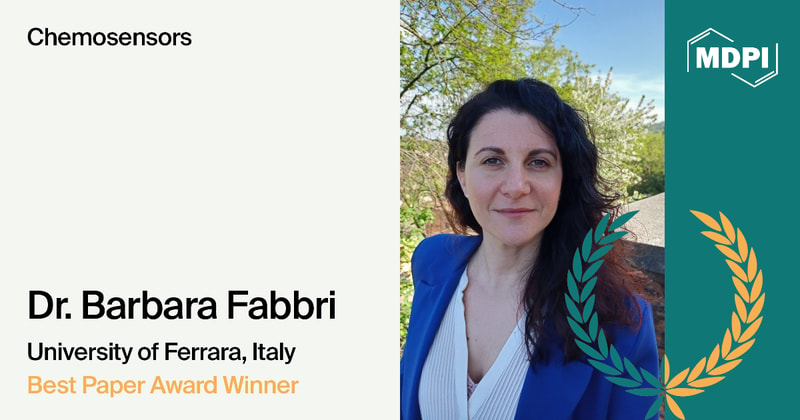
Interview with Dr. Barbara Fabbri—Winner of the Chemosensors Best Paper Award
Winning paper:
“SO2 Detection over a Wide Range of Concentrations: An Exploration on MOX-Based Gas Sensors”
by Arianna Rossi, Elena Spagnoli, Alan Visonà, Danial Ahmed, Marco Marzocchi, Vincenzo Guidi and Barbara Fabbri
Chemosensors 2024, 12(6), 111; https://doi.org/10.3390/chemosensors12060111
1. Congratulations on receiving the Best Paper Award. Could you please briefly introduce yourself to our readers and share your current research focus, including any recent developments in your work?
I am a physicist and, since I obtained my PhD in physics, have worked as researcher at the Department of Physics and Earth Science of Ferrara University in Italy since 2015. My research involves all key aspects regarding the study and implementation of chemoresistive gas sensors: from the synthesis and characterization of innovative sensing materials, to the investigation of their properties by advanced characterization techniques—mainly towards insight in the sensing mechanisms—and finally to the study of diverse applications for gas sensors, i.e., indoor/outdoor monitoring, precision farming, and medical diagnosis.
2. Could you briefly introduce the key research focus and main findings of your award-winning paper?
The experimentation performed in this work could guide future developments on modified MOX-based sensors and open new frontiers for olfactory systems dedicated to SO2 monitoring in a wide range of concentrations and real-world applications. Indeed, the tin dioxide-based sensor, functionalized with gold nanoparticles, demonstrated to be the most promising candidate for sulfur dioxide detection, owing to its high sensitivity (0.5–10 ppm), humidity-independent behavior (30 RH% onwards), and selectivity compared with different gases at an operating temperature of 400 °C.
3. Looking ahead, what impact do you hope your research will have on the field, and what do you consider to be the most significant innovation presented in your paper?
This comprehensive investigation facilitates a detailed performance comparison with other devices explored for SO2 sensing, supporting advancements in gas detection technology for enhanced workplace and environmental safety.
4. Could you share some of the major challenges in your research area, as well as any recent breakthroughs that you find particularly exciting?
The major shortcomings of metal oxide-based gas sensors are the short-term reproducibility of the response, the stability of conservative performance and the long-term signal drifts, which reduce the sensor life. Additionally, the activation of an effective sensing mechanism, based on gas–solid chemical reactions, represents a crucial hurdle for metal oxide-based gas sensors. Several attempts have been pursued to increase sensitivity by exploiting the broad palette of precursors and synthetic techniques that enable metal oxides’ compositional, crystallographic, and morphological properties to be tailored. Moreover, to date, the development of humidity-independent metal oxide sensors for atmospheric real-time gas measurements is extremely challenging. Finally, the low selectivity of standard metal oxide sensors, induced by kinetic competition in redox reactions between different gaseous species on the surface-active sites, is a crucial obstacle for the detection of the analyte in gas mixtures, especially when present at sub-ppm concentrations.
Along with the issues for commercialization of suitable metal oxide-based sensors, major challenges concern the more fundamental theoretical and experimental research needed to fill knowledge gaps, which persist on gas sensing mechanisms, especially in photo-activation mode.
In this perspective, the recent combination of different characterization techniques, such as operando analysis like Diffuse Reflectance FTIR spectroscopy coupled with dynamic chemisorption studies and/or analytical measurements, enables a multi-level approach toward a mechanistic study of multiscale phenomena, as the gas sensing mechanisms are complex.
5. In your view, how does open access publishing contribute to the dissemination of knowledge and the advancement of research in your area?
Open access is not merely a publishing model but an ethical commitment to ensuring that scientific progress is not constrained by the financial means of individuals or institutions. In fields such as physics or medicine, time is of the essence; it enables the instant sharing of critical findings, avoiding the months-long delays typical of traditional subscription models. This accelerates both technological innovation and the development of medical treatments.
Open access enhances the visibility of studies, boosting citation rates by up to 30% compared to paywalled content.
By removing financial barriers, it fosters smoother collaboration among universities, government bodies, and industry, thereby accelerating the practical application of discoveries. Finally, open access is often accompanied by the sharing of “Open Data”, making research more verifiable and robust.
6. Do you have any advice for young researchers who aspire to produce high-impact research results?
My main piece of advice is to balance ambition with rigor.
First, seek out the “right problem”: do not simply follow trends; instead, ask yourself what gap in knowledge is holding your field back.
Second, embrace collaboration. Paradigm-shifting results rarely emerge in isolation; they arise from dialogue across different disciplines.
Finally, remember that impact takes time. Do not sacrifice quality for the sake of publication speed. A single study that is profound, transparent, and well-communicated will have a far more lasting impact than ten superficial articles. Be prepared to fail often, for that is where the most interesting discoveries lie.