- Article

Lifetime Exposure to Digital Victimization and Depressive Symptoms in Adolescents in Chile: The Mediating Role of Self-Esteem
- Rodrigo Moya-Vergara,
- Diego Portilla-Saavedra and
- Ricardo Espinoza-Tapia
- + 3 authors
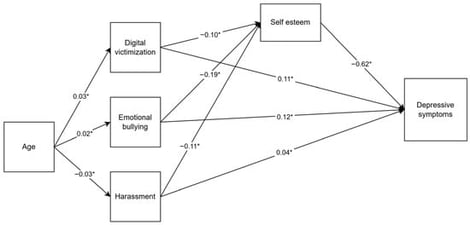
Digital victimization has been increasingly linked to adverse mental health outcomes during adolescence; however, less is known about its association with depressive symptoms when accounting for other forms of peer victimization and underlying psychological mechanisms. This study examined the relationship between lifetime digital victimization and depressive symptoms in a nationally representative sample of Chilean adolescents (N = 11,439) and tested the mediating role of self-esteem. Lifetime exposure to digital victimization, emotional bullying, and harassment were assessed using dichotomous indicators. Depressive symptoms were measured with the Birleson Depression Self-Rating Scale, and self-esteem with the Rosenberg Self-Esteem Scale. Overall, 27.2% of Chilean adolescents reported lifetime digital victimization. The proposed model showed an adequate fit to the data (CFI = 0.992; TLI = 0.942; RMSEA = 0.065; SRMR = 0.012). Lifetime exposure to digital victimization was directly associated with higher depressive symptoms and lower self-esteem, and self-esteem significantly mediated this association after controlling for age and in-person peer victimization. These findings highlight the importance of self-esteem as a key mechanism linking digital victimization and depressive symptoms in adolescents.
12 February 2026