
Universe 2026, 12(5), 151; https://doi.org/10.3390/universe12050151 - 21 May 2026
Abstract
►
Show Figures
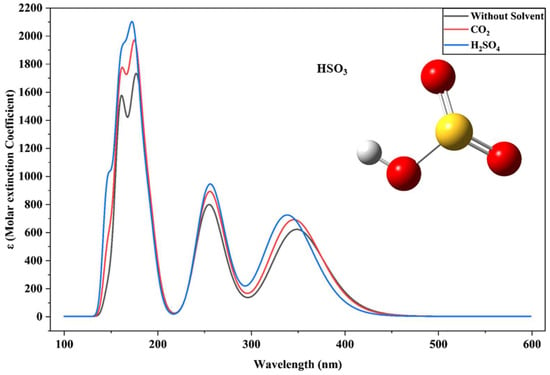
The identification of the chemical species responsible for the anomalous near-ultraviolet (UV) opacity in the Venusian cloud for “unknown absorber” remains a paramount challenge in planetary science. This study presents a comprehensive quantum chemical investigation into a broad suite of candidate molecules, including
[...] Read more.
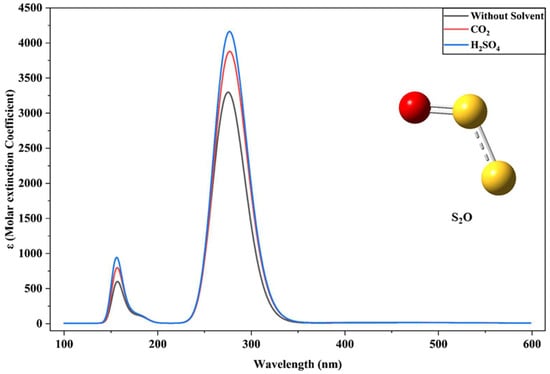
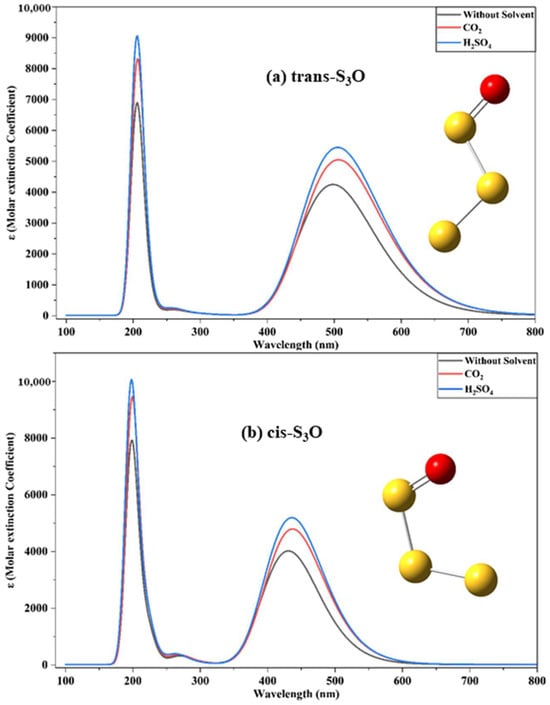
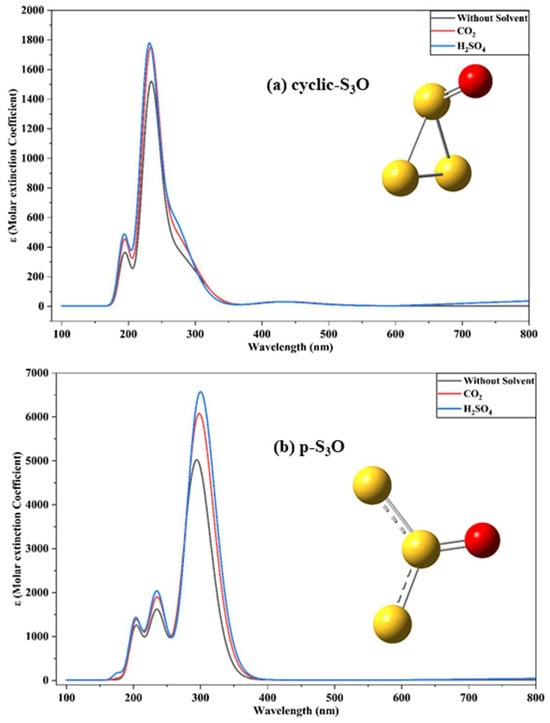
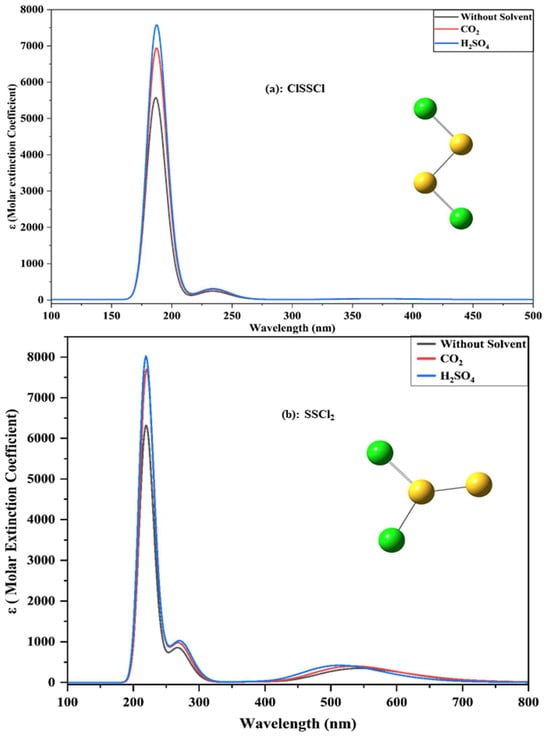
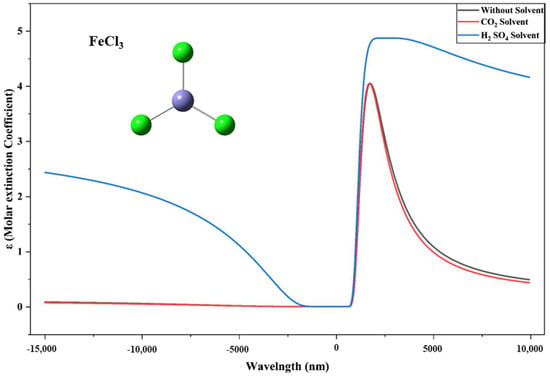
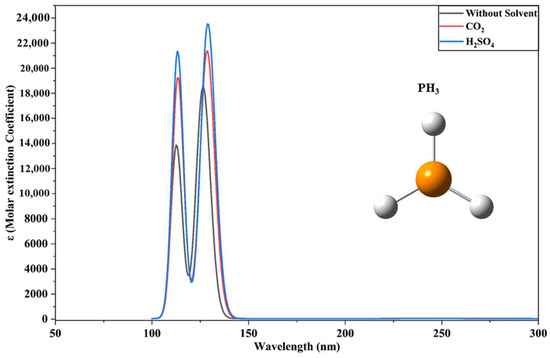
The identification of the chemical species responsible for the anomalous near-ultraviolet (UV) opacity in the Venusian cloud for “unknown absorber” remains a paramount challenge in planetary science. This study presents a comprehensive quantum chemical investigation into a broad suite of candidate molecules, including isomers of thiosulfeno (S2O2), the hydroxysulfonyl radical (HSO3), disulfur monoxide (S2O), disulfur dichloride (S2Cl2), iron(III) chloride (FeCl3), phosphine (PH3), and structural isomers of polysulfur oxides (S3O). Utilizing Time-Dependent Density Functional Theory (TD-DFT) at the CAM-B3LYP/def2-TZVPP level of theory, we systematically mapped electronic transitions across three distinct environmental phases: gas-phase (without solvent), supercritical CO2, and concentrated H2SO4 aerosols. To establish confidence in the predicted results, our TD-DFT approach was rigorously benchmarked against high-level theoretical methods (CCSD(T), EOM-CCSD, and MRCI+Q) from recent literature. All these electronic transitions were modeled via the Solvation Model based on Density (SMD). Our results demonstrate a profound topological and environmental dependence on spectral signatures. Among the candidates, trans-OSSO (t-OSSO) emerged as the most viable near-UV absorber candidate, exhibiting a highly allowed π → π* transition at 379.37 nm (f = 0.1140) in H2SO4, providing a near-perfect alignment with the observed 365 nm planetary albedo drop. Conversely, the polysulfur oxide cis-S3O was acknowledged as a primary visible-light chromophore, with an intense absorption at 436.31 nm (f = 0.1280) responsible for the characteristic yellow tint of the planet. Additionally, the photochemically maintained SSCl2 isomer was identified as a critical broadband near-UV absorber. Species such as S2O and planar S3O were found to function as critical mid-UV shields (270–300 nm). This work establishes a multi-chromophore model of the Venusian atmosphere, where a chemically stratified network of sulfur-oxygen chains and chlorine-sulfur reservoirs, tuned by the acidic aerosol matrix, collectively governs radiative balance and atmospheric super-rotation of the planet. Furthermore, to account for massive continuum tailing into the visible region (>400 nm), we employed a semi-classical Reflection Principle approach to model 1D vibronic broadening. This analysis revealed that while standard solvent effects induce minor solvatochromic shifts, ground-state structural fluxionality in the OSSO isomers drives intense, symmetry-allowed transitions deep into the visible spectrum, an effect absent in structurally constrained or rigid control species.
Full article
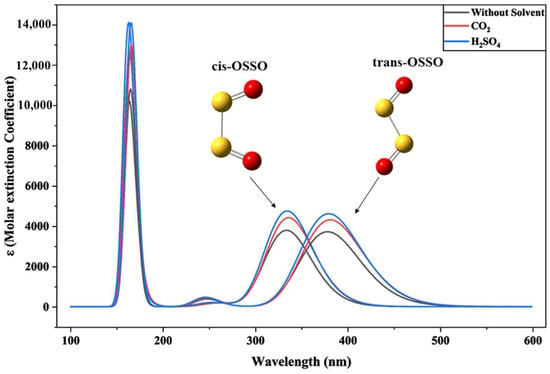
Figure 1