
Magnetized Matter in Neutron Star Dynamics: Challenges Ahead

Abstract
1. Introduction
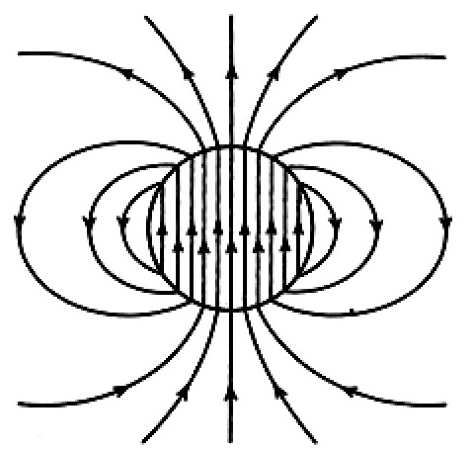
2. Standard Neutron Star Structure and the Simplest Expectations for the Magnetic Field
- (a)
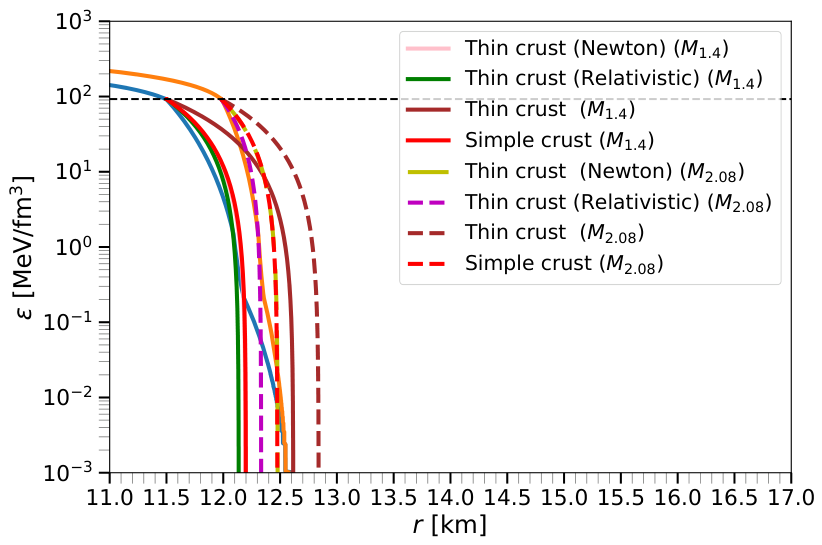
- Beneath a tiny atmospheric layer, an outer crust composed of nuclei + free electrons likely form a nuclear lattice from ∼103 g cm−3 to ∼4 × 10¹¹ g cm−3 (the so-called neutron drip density)
- (b)
- An inner crust composed of increasingly heavy nuclei in a lattice, and free neutrons escaping from them. The latter, due to the attractive channels, form a superfluid. The end of these layer happens at 1/2–1/3 of the nuclear saturation density, at around ≥1014 g cm−3. The interactive dynamics between these components give rise to a complex timing behavior of the pulsars, as we shall see later.
- (c)
- A core composed of homogeneous matter in which the nuclear structure has dissolved at the lower densities (up to 2–3 times the saturation value), and possibly exotic states at densities beyond that (including quark matter), up to the central value ∼1015 g cm−3. Sometimes, this division is labeled as “outer core” and “inner core” (see below).
3. Origin of the Magnetic Fields
4. Timing, Torques and External Magnetic Fields
5. The Crust State and Its Dynamical Behavior
6. The Core and Its Mysteries
7. Anisotropies in the Stellar Structure and Magnetic Fields
8. New Phenomena and How They Relate to the Internal Structure and Magnetic Fields
8.1. Glitches, Anti-Glitches and Permanent Changes of the Spin-Down
8.2. Sudden Magnetospheric Changes in PSR B1931+24, Magnetar Braking and Other Sources and Models
8.3. Confirmation of the Precession of Her X-1 and Other Sources
9. Challenges and Final Remarks
- Establishing a firm upper limit to the value of the central field, preferentially in a model-independent way, would be important to go ahead with the physics of the core. A simple calculation using the Virial theorem with the addition of magnetic energy indicates G, but values as high as G or more are employed many times in theoretical calculations. This is why an upper limit could be useful to discard extreme possibilities.
- Concerning the core, the quandary of magnetic field expulsion is an outstanding problem to be solved. The composition is still uncertain to a large degree, although a “minimal” stiffness is mandatory because of the empirical evidence in favor of high neutron star masses (with an upper limit yet not known). It may be stated that the magnetic field is not really important for the core structure, but this is only if a “normal” composition can be confirmed. If an exotic nature is the ultimate answer, it is likely that the upper limit of G stemming from a Virial relation with a magnetic term is enough to produce huge modifications, by quantizing quark single-particle levels [78,79], and even anisotropic stellar models would have to be considered [80,81].
- The winds should be seriously considered as a standard component of pulsars and magnetars [14,16,25,28,29,82]. This is coupled to the long-standing problem of the magnetosphere solutions (to which advances could be counted, see [83], and a lot of theoretical [84] and observational work should be dedicated). In particular, the “invisibility” of the winds in the majority of cases when they are suspected to be present but no PWN or any other obvious signal is detected should be clarified.
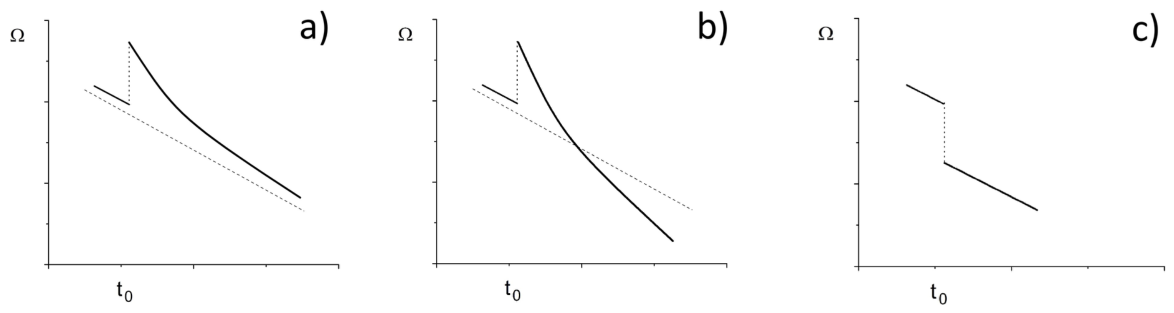
- Vortex creep models are now years old [85], but they seem insufficient to accommodate the full phenomenology of glitches, anti-glitches, spin-down events, etc., which suggests an interplay between the solid crust and the superfluid component mediated by plate tectonics [68,69,73,74,75,86], extending its predictive power to (some?) FRB sources [81]. It must be remembered that even the basics of this model, the pinning to the lattice, have been questioned over the years [87] and cannot be taken for granted. The precession issue is now compelling and closely related to the ultimate glitch models as well.
- The usefulness of anisotropic models should be established. It is not enough to label them as interesting formal problems, but rather to advance towards the observables that may be revealing anisotropic interiors. As noted above, numerical simulations of the type already available for isotropic models should be attempted and determine, for example, the topology of the field and its maximum value.
Funding
Data Availability Statement
Acknowledgments
Conflicts of Interest
References
- Hewish, A. Pulsars. Sci. Am. 1968, 219, 25–35. [Google Scholar] [CrossRef]
- Pacini, F. Rotating Neutron Stars, Pulsars and Supernova Remnants. Nature 1968, 219, 145–146. [Google Scholar] [CrossRef]
- Gold, T. Rotating Neutron Stars as the Origin of the Pulsating Radio Sources. Nature 1968, 219, 731–732. [Google Scholar] [CrossRef]
- Kramer, M.; Stairs, I.H.; Manchester, R.N.; Wex, N.; Deller, A.T.; Coles, W.A.; Ali, M.; Burgay, M.; Camilo, F.; Cognard, I.; et al. Strong-field gravity tests with the double pulsar. Phys. Rev. X 2021, 11, 041050. [Google Scholar] [CrossRef]
- Baade, W.; Zwicky, F. On super-novae. Proc. Natl. Acad. Sci. USA 1934, 20, 254–259. [Google Scholar] [CrossRef]
- Cameron, A.G. Neutron Star Models. Astrophys. J. 1959, 130, 884. [Google Scholar] [CrossRef]
- Nomoto, K. Evolution of 8–10 solar mass stars toward electron capture supernovae. I-Formation of electron-degenerate O+ NE+ MG cores. Astrophys. J. 1984, 277, 791–805. [Google Scholar] [CrossRef]
- Alcock, C.; Farhi, E.; Olinto, A.V. Strange Stars. Astrophys. J. 1986, 310, 261–271. [Google Scholar] [CrossRef]
- Benvenuto, O.G.; Horvath, J.E. On the structure of strange stars and bagged QCD parameters. MNRAS 1989, 241, 43–50. [Google Scholar] [CrossRef]
- Davies, L., Jr.; Goldhaber, A.S.; Nieto, M.M. Limit on the Photon Mass Deduced from Pioneer-10 Observations of Jupiter’s Magnetic Field. Phys. Rev. Lett. 1975, 35, 1402–1405. [Google Scholar] [CrossRef]
- Younes, G.; Lander, S.K.; Baring, M.G.; Enoto, T.; Kouveliotou, C.; Wadiasingh, Z.; Ho, W.C.G.; Harding, A.K.; Arzoumanian, Z.; Gendreau, K. Pulse Peak Migration during the Outburst Decay of the Magnetar SGR 1830-0645: Crustal Motion and Magnetospheric Untwisting. Astrophys. J. Lett. 2022, 924, L27–L30. [Google Scholar] [CrossRef]
- de Lima, R.C.R.; Pereira, J.P.; Coelho, J.G.; Nunes, R.C.; Stecchini, P.E.; Castro, M.; Gomes, P.; da Silva, R.R.; Rodrigues, C.V.; de Araujo, J.C.N.; et al. Evidence for 3XMM J185246.6+003317 as a massive magnetar with a low magnetic field. J. High Energy Astrophys. 2025, 42, 52–62. [Google Scholar] [CrossRef]
- Allen, M.P.; Horvath, J.E. Glitches, torque evolution and the dynamics of young pulsars. Mon. Not. R. Astron. Soc. 1997, 287, 615–621. [Google Scholar] [CrossRef]
- Tong, H.; Xu, R.-X.; Song, L.M.; Qiao, G.J. Wind braking of magnetars. Astrophys. J. 2013, 768, 144–154. [Google Scholar] [CrossRef]
- Coelho, J.G.; de Araujo, J.C.N.; Ladislau, S.M.; Nunes, R.C. Observational Constraints on the Pulsar Wind Model: The Cases of Crab and Vela. Astrophys. J. 2021, 920, 57–66. [Google Scholar] [CrossRef]
- Li, B.P.; Gao, Z.F.; Ma, W.Q.; Zhang, W.F.; Cheng, Q. Studies on the Spin and Magnetic Inclination Evolution of Magnetars Swift J1834.9-0846 under Wind Braking. Astrophys. J. 2026, 999, 262–279. [Google Scholar] [CrossRef]
- Staubert, R.; Trümper, J.; Kendziorra, E.; Klochkov, D.; Postnov, K.; Kretschmar, P.; Pottschmidt, K.; Haberl, F.; Rothschild, R.E.; Santangelo, A.; et al. Cyclotron lines in highly magnetized neutron stars. Astron. Astrophys. 2019, 622, A61–A82. [Google Scholar] [CrossRef]
- Cheong, P.C.-K.; Pitik, T.; Longo Micchi, L.F.; Radice, D. Gamma-Ray Bursts and Kilonovae from the Accretion-Induced Collapse of White Dwarfs. Astrophys. J. Lett. 2025, 999, 262–279. [Google Scholar] [CrossRef]
- Dehman, C.; Viganò, D.; Ascenzi, S.; Pons, J.A.; Rea, N. 3D evolution of neutron star magnetic fields from a realistic core-collapse turbulent topology. Mon. Not. R. Astron. Soc. 2023, 523, 5198–5206. [Google Scholar] [CrossRef]
- Bakir, E.; Eksi, K.Y. Evolution of proto-neutron stars to pulsars, magnetars and central compact objects. Mon. Not. R. Astron. Soc. 2026, 546, stag051. [Google Scholar] [CrossRef]
- Gourgouliatos, K.N.; Esposito, P. Strongly Magnetized Pulsars: Explosive Events and Evolution. In Astrophysics and Space Science Library; Springer International Publishing: Cham, Switzerland, 2018; Volume 457, pp. 57–93. [Google Scholar]
- Martin, J.; Rea, N.; Torres, D.F.; Papitto, A. Comparing supernova remnants around strongly magnetized and canonical pulsars. Mon. Not. R. Astron. Soc. 2014, 444, 2910–2924. [Google Scholar] [CrossRef]
- Igoshev, A.; Barrère, P.; Raynaud, R.; Guilet, J.; Wood, T.; Hollerbach, R. A connection between proto-neutron-star Tayler–Spruit dynamos and low-field magnetars. Nat. Astron. 2025, 9, 541–551. [Google Scholar] [CrossRef]
- Hansson, J.; Ponga, A. Pulsars: Cosmic Permanent “Neutromagnets”? Int. Sch. Res. Not. 2011, 2011, 378493. [Google Scholar] [CrossRef]
- Michel, F.C. Theory of Neutron Stars Magnetospheres; University of Chicago Press: Chicago, IL, USA, 1991. [Google Scholar]
- Pétri, J. Electrodynamics and Radiation from Rotating Neutron Star Magnetospheres. Universe 2020, 6, 15. [Google Scholar] [CrossRef]
- Horvath, J.E.; de Sá, L.M.; Rocha, L.S.; Chinen, G.Y.; Barão, L.G.; de Avellar, M.G. Evolution of long-period compact radio sources driven by winds. In Pulsar Astronomy with China’s Facilities; World Scientific: Singapore, 2024; pp. 1–51. [Google Scholar]
- Allen, M.P.; Horvath, J.E. Pulsar spin-down with both magnetic dipole and relativistic wind brakings. In Spin, Magnetism and Cooling of Young Neutron Stars; Kavli Institute for Theoretical Physics: Santa Barbara, CA, USA, 2000; unpublished; Available online: https://online.kitp.ucsb.edu//online/neustars_c00/p_allen/ (accessed on 10 May 2026).
- Michel, F.C. Magnetic Structure of Pulsar Winds. Astrophys. J. 1994, 431, 397–405. [Google Scholar] [CrossRef]
- Harding, A.K.; Contopulos, D.; Kazanas, D. Magnetar spin-down. Astrophys. J. Lett. 1999, 525, L125–L128. [Google Scholar] [CrossRef]
- Rea, N.; Hurley-Walker, N.; Caleb, M. Long period transients (LPTs): A comprehensive review. J. High Energy Astrophys. 2026, 52, 100566. [Google Scholar] [CrossRef]
- Baym, G.; Pethick, C.; Pines, D.; Ruderman, M. Spin Up in Neutron Stars: The Future of the Vela Pulsar. Nature 1969, 224, 872–874. [Google Scholar] [CrossRef]
- Antonopoulou, D.; Haskell, B.; Espinoza, C.M. Pulsar glitches: Observations and physical interpretation. Rep. Prog. Phys. 2022, 85, 126901. [Google Scholar] [CrossRef] [PubMed]
- Li, B.-A.; Magno, M. Curvature-slope correlation of nuclear symmetry energy and its imprints on the crust-core transition, radius, and tidal deformability of canonical neutron stars. Phys. Rev. C 2020, 102, 045807. [Google Scholar] [CrossRef]
- Köpp, F.; Horvath, J.E.; Vasconcellos, C.A.Z. The crusts of neutron stars revisited: Approximations within a polytropic equation of state approach. Eur. Phys. J. C 2026, 86, 244–252. [Google Scholar] [CrossRef]
- Mendes, M.; Fattoyev, F.J.; Cumming, A.; Gale, C. Fast Neutrino Cooling in the Accreting Neutron Star MXB 1659-29. Astrophys. J. 2022, 938, 119–130. [Google Scholar] [CrossRef]
- Chatziioannou, K.; Cromartie, H.T.; Gandolfi, S.; Tews, I.; Radice, D.; Steiner, A.W.; Watts, A.L. Neutron stars and the dense matter equation of state. Rev. Mod. Phys. 2025, 97, 045007. [Google Scholar] [CrossRef]
- Romani, R.W.; Beleznay, M.; Filippenko, A.V.; Brink, T.G.; Zheng, W. PSR J0952-0607: Tightening a Record-high Neutron Star Mass. Astrophys. J. 2026, 996, 101. [Google Scholar] [CrossRef]
- Ye, J.-T.; Wang, R.; Wang, S.-P.; Chen, L.W. High-density Symmetry Energy: A Key to the Solution of the Hyperon Puzzle. Astrophys. J. 2025, 985, 238. [Google Scholar] [CrossRef]
- Fujimoto, Y.; Kojo, T.; McLerran, L. Quarkyonic solution to the hyperon puzzle. In EPJ Web of Conferences; EDP Sciences: Les Ulis, France, 2025; Volume 316, p. 07007. [Google Scholar]
- Horvath, J.E.; de Souza, R. The stifness of the supranuclear equation of state (once again). Jour. Phys. Conf. Ser. 2017, 861, 012010. [Google Scholar] [CrossRef]
- Ruderman, M. Pulsars: Structure and Dynamics. Annu. Rev. Astron. Astrophys. 1974, 10, 427–476. [Google Scholar] [CrossRef]
- Lander, S.K.; Gourgouliatos, K.N.; Wadiasingh, Z.; Antonopoulou, D. Signatures of Magnetic Flux Expulsion from Neutron Star Cores. Astrophys. J. 2026, 997, L7–L14. [Google Scholar] [CrossRef]
- Elfritz, J.G.; Pons, J.A.; Rea, N.; Glampedakis, K.; Viganò, D. Simulated magnetic field expulsion in neutron star cores. Mon. Not. R. Astron. Soc. 2016, 456, 4461–4474. [Google Scholar] [CrossRef][Green Version]
- Köpp, F.; Horvath, J.E.; Hadjimichef, D.; Vasconcellos, C.A.Z. Quark/Hybrid Stars Within Perturbative QCD in View of the GW170817 Event. Astron. Nacht. 2025, 346, e20240136. [Google Scholar] [CrossRef]
- Sun, H.; Wen, D. Implications of supermassive neutron stars for the form of the equation of state of hybrid stars. Phys. Rev. C 2023, 108, 025801. [Google Scholar] [CrossRef]
- Farrell, D.; Weber, F.; Orsaria, M.G.; Ranea-Sandoval, I.F.; Canullán, M.; Negreiros, R.; Katayama, T.; Wagaman, I. Fast Pulsars, Neutron Stars, and Astrophysical Strange Quark Matter Objects. In Pulsar Astronomy with China’s Facilities; World Scientific: Singapore, 2024; pp. 504–530. [Google Scholar]
- Deb, D.; Mukhopadhyay, B.; Weber, F. Effects of Anisotropy on Strongly Magnetized Neutron and Strange Quark Stars in General Relativity. Astrophys. J. 2021, 922, 149. [Google Scholar] [CrossRef]
- Krsna, D.; Gleiser, M. Anisotropic Stars: Exact Solutions. Gen. Rel. Grav. 2002, 34, 1793–1808. [Google Scholar]
- Bowers, R.L.; Liang, E.P.T. Anisotropic Spheres in General Relativity. Astrophys. J. 1974, 188, 657–665. [Google Scholar] [CrossRef]
- Thirukkanesh, S.; Ragel, F.C. Exact anisotropic sphere with polytropic equation of state. Pramana 2012, 78, 387–400. [Google Scholar] [CrossRef]
- Malaver, M.; Iyer, R. Some new models of anisotropic relativistic stars in linear and quadratic regime. arXiv 2023, arXiv:2303.12161. [Google Scholar] [CrossRef]
- Horvath, J.E.; Moraes, P.H.R.S. Modeling a 2.5 M⊙ compact star with quark matter. Int. J. Mod. Phys. D 2021, 30, 2150016. [Google Scholar] [CrossRef]
- Quartuccio, J.T.; Moraes, P.H.R.S.; Arbañil, J.D.V. Deformed neutron stars. arXiv 2024, arXiv:2402.18550. [Google Scholar]
- Raposo, G.; Pani, P.; Bezares, M.; Palenzuela, C.; Cardoso, V. Anisotropic stars as ultracompact objects in General Relativity. Phys. Rev. D 2019, 99, 104072. [Google Scholar] [CrossRef]
- Becerra, L.M.; Becerra-Vergara, E.A.; Lora-Clavijo, F.D.; Rodríguez, J.F. On the Stability of Anisotropic Neutron Stars. arXiv 2025, arXiv:2512.19825. [Google Scholar] [CrossRef]
- Zhang, N.-B.; Li, B.-A. Impact of NICER’s Radius Measurement of PSR J0740+6620 on Nuclear Symmetry Energy at Suprasaturation Densities. Astrophys. J. 2021, 921, 111. [Google Scholar] [CrossRef]
- Blaschke, D.; Wojcik, A. Revisiting the Rhoades-Ruffini bound. arXiv 2026, arXiv:2604.03204. [Google Scholar] [CrossRef]
- Jahan Miri, M. Dynamical Coupling of the Core Superfluid in neutron Stars. Astrophys. J. Lett. 1998, 501, L185–L187. [Google Scholar] [CrossRef]
- Andersson, N.; Glampedakis, K.; Ho, W.C.G.; Espinoza, C.M. Pulsar Glitches: The Crust is not Enough. Phys. Rev. Lett. 2012, 109, 241103–241106. [Google Scholar] [CrossRef]
- Piekarewicz, J.; Fattoyev, F.J.; Horowitz, C.J. Pulsar Glitches: The Crust may be Enough. Phys. Rev. C 2014, 90, 015803. [Google Scholar] [CrossRef]
- Almirante, G.; Urban, M. Superfluid Density in Linear Response Theory: Pulsar Glitches from the Inner Crust of Neutron Stars. Phys. Rev. Lett. 2025, 135, 132701. [Google Scholar] [CrossRef]
- Lyne, A.G.; Smith, F.G.; Pritchard, R.S. Spin-up and recovery in the 1989 glitch of the Crab pulsar. Nature 1992, 359, 706–707. [Google Scholar] [CrossRef]
- Lyne, A.G.; Pritchard, R.S.; Smith, F.G. 23 years of Crab pulsar rotational history. Mon. Not. R. Astron. Soc. 1993, 265, 1003–1012. [Google Scholar] [CrossRef]
- Oliveira, H.O.; Magalhaes, N.S.; Marinho, R.M.; Carvalho, G.A.; Frajuca, C. Using pulsar’s braking indices to estimate changes in their moments of inertia with age-related considerations. J. Phys. Conf. Ser. 2019, 1291, 012012. [Google Scholar] [CrossRef]
- Link, B.; Epstein, R.I. Are We Seeing Magnetic Axis Reorientation in the Crab and Vela Pulsars? Astrophys. J. Lett. 1997, 478, L91–L94. [Google Scholar] [CrossRef]
- Gao, Z.-F.; Peng, F.-K.; Wang, N. The evolution of magnetic field and spin-down of young pulsars. Astron. Nacht. 2019, 340, 1023–1029. [Google Scholar] [CrossRef]
- Ruderman, M.; Zhu, T.; Cheng, K. Neutron Star Magnetic Field Evolution, Crust Movement, and Glitches. Astrophys. J. 1998, 492, 267–280. [Google Scholar] [CrossRef]
- Horvath, J.E. Braking index jumps in young pulsars. Mon. Not. R. Astron. Soc. 2019, 484, 1983–1987. [Google Scholar] [CrossRef]
- Barão, L.G.; Horvath, J.E. Spin-down Changes in PSR B0540-69 Induced by a Drift of the Magnetic Axis. Astrophys. J. 2026, 998, 319. [Google Scholar] [CrossRef]
- Kramer, M.; Lyne, A.G.; O’Brien, J.T.; Jordan, C.A.; Lorimer, D.R. A Periodically Active Pulsar Giving Insight into Magnetospheric Physics. Science 2006, 312, 549–551. [Google Scholar] [CrossRef]
- Heyl, J.; Doroshenko, V.; González-Caniulef, D.; Caiazzo, I.; Poutanen, J.; Mushtukov, A.; Tsygankov, S.S.; Kirmizibayrak, D.; Bachetti, M.; Pavlov, G.G.; et al. Complex rotational dynamics of the neutron star in Hercules X-1 revealed by X-ray polarization. Nat. Astron. 2024, 8, 1047–1053. [Google Scholar] [CrossRef]
- Link, B. Constraining Hadronic Superfluidity with Neutron Star Precession. Phys. Rev. Lett. 2003, 91, 101101. [Google Scholar] [CrossRef]
- Horvath, J.E. Pulsar Astrophysics: The Glitch Phenomenon. Int. J. Mod. Phys. D 2004, 13, 1327–1334. [Google Scholar] [CrossRef]
- Sedrakian, A. Type-I superconductivity and neutron star precession. Phys. Rev. D 2005, 71, 083003. [Google Scholar] [CrossRef]
- Desvignes, G.; Weltevrede, P.; Gao, Y.; Jones, D.I.; Kramer, M.; Caleb, M.; Karuppusamy, R.; Levin, L.; Liu, K.; Lyne, A.G.; et al. A freely precessing magnetar following an X-ray outburst. Nat. Astron. 2024, 8, 617–627. [Google Scholar] [CrossRef]
- Lyda, A.; MohanMurty, P. Exploring the internal structure of a neutron star and the associated magnetic fields aided by the mass-radius relationship. arXiv 2026, arXiv:2601.06380. [Google Scholar] [CrossRef]
- Paulucci, L.; Ferrer, E.J.; de la Incera, V.; Horvath, J.E. Equation of state for the magnetic-color-flavor-locked phase and its implications for compact star models. Phys. Rev. D 2011, 83, 043009. [Google Scholar] [CrossRef]
- González Felipe, R.; Manreza Paret, D.; Pérez Martí nez, A. Magnetized color flavor locked state and compact stars. Eur. Phys. J. A 2011, 47, 1. [Google Scholar] [CrossRef]
- Terrero, D.A.; Mederos, V.H.; Pérez, S.L.; Paret, D.M.; Martínez, A.P.; Angulo, G.Q. Modeling anisotropic magnetized compact objects. In The Fifteenth Marcel Grossmann Meeting: On Recent Developments in Theoretical and Experimental General Relativity, Astrophysics, and Relativistic Field Theories; World Scientific: Singapore, 2022; pp. 1835–1839. [Google Scholar]
- Manreza Paret, D.; Horvath, J.E.; Pérez Martí nez, A. Anisotropic stellar structure equations for magnetized strange stars. Res. Astron. Astrophys. 2015, 15, 975. [Google Scholar] [CrossRef]
- Michel, F.C. Winds from Pulsars. Rev. Mex. Astron. Astrofis. (Ser. Conf.) 2005, 23, 27–34. [Google Scholar]
- Li, J.; Spitkovsky, A.; Tchekhovskoy, A. Resistive Solutions for Pulsar Magnetospheres. Astrophys. J. 2012, 746, 60–72. [Google Scholar] [CrossRef]
- Kirk, J.G.; Lyubarsky, Y.; Pétri, J. The Theory of Pulsar Winds and Nebulae. In Neutron Stars and Pulsars; Springer: Berlin/Heidelberg, Germany, 2009; Volume 357, pp. 421–455. [Google Scholar]
- Pines, D.; Alpar, M.A. Superfluidity in neutron stars. Nature 1985, 316, 27–32. [Google Scholar] [CrossRef]
- Lander, S.K.; Andersson, N.; Antonopoulou, D.; Watts, A.L. Magnetically driven crustquakes in neutron stars. Mon. Not. R. Astron. Soc. 2015, 449, 2047–2058. [Google Scholar] [CrossRef]
- Jones, P.B. Rotation of the Neutron-Drip Superfluid in Pulsars: The Interaction and Pinning of Vortices. Astrophys. J. 2012, 373, 208–212. [Google Scholar] [CrossRef]
- Li, A.; Watts, A.L.; Zhang, G.; Guillot, S.; Xu, Y.; Santangelo, A.; Zane, S.; Feng, H.; Zhang, S.-N.; Ge, M.; et al. Dense matter in neutron stars with eXTP. Sci. China Phys. Mech. Astron. 2025, 68, 119503. [Google Scholar] [CrossRef]



| Name | (keV) | (G) |
|---|---|---|
| Her X-1 | 37 | 3.83 |
| Cen X-3 | 28 | 2.90 |
| Vela X-1 | 25 | 2.60 |
| GX 301-2 | 37 | 3.83 |
| A 0535+26 | 50 | 5.17 |
| Pulsar | |
|---|---|
| J1640-4631 | |
| Crab | |
| B1509-58 | |
| J1119-6127 | |
| Vela | |
| J1846-0258 | |
| B0540-69 | |
| J1734-3333 | |
| J0537-6910 | ∼ (?) |
Disclaimer/Publisher’s Note: The statements, opinions and data contained in all publications are solely those of the individual author(s) and contributor(s) and not of MDPI and/or the editor(s). MDPI and/or the editor(s) disclaim responsibility for any injury to people or property resulting from any ideas, methods, instructions or products referred to in the content. |
© 2026 by the author. Licensee MDPI, Basel, Switzerland. This article is an open access article distributed under the terms and conditions of the Creative Commons Attribution (CC BY) license.
Share and Cite
Horvath, J.E. Magnetized Matter in Neutron Star Dynamics: Challenges Ahead. Universe 2026, 12, 147. https://doi.org/10.3390/universe12050147
Horvath JE. Magnetized Matter in Neutron Star Dynamics: Challenges Ahead. Universe. 2026; 12(5):147. https://doi.org/10.3390/universe12050147
Chicago/Turabian StyleHorvath, J. E. 2026. "Magnetized Matter in Neutron Star Dynamics: Challenges Ahead" Universe 12, no. 5: 147. https://doi.org/10.3390/universe12050147
APA StyleHorvath, J. E. (2026). Magnetized Matter in Neutron Star Dynamics: Challenges Ahead. Universe, 12(5), 147. https://doi.org/10.3390/universe12050147