Skip Content
You are currently on the new version of our website. Access the old version .

Big Data and Cognitive Computing

Big Data and Cognitive Computing is an international, peer-reviewed, open access journal on big data and cognitive computing published monthly online by MDPI.

Quartile Ranking JCR - Q1 (Computer Science, Theory and Methods | Computer Science, Information Systems)

All Articles (1,143)

Large language models (LLMs) are now routine writing tools across various domains, intensifying questions about when text should be treated as human-authored, artificial intelligence (AI)-generated, or collaboratively produced. This rapid review aims to identify cue families reported in empirical studies as distinguishing AI from human-authored text and to assess how stable these cues are across genres/tasks, text lengths, and revision conditions. Following the Preferred Reporting Items for Systematic Reviews and Meta-Analysis (PRISMA) guidelines, we searched four online databases for peer-reviewed empirical articles (1 January 2022–1 January 2026). After deduplication and screening, 40 studies were included. Evidence converged on five cue families: surface, discourse/pragmatic, epistemic/content, predictability/probabilistic, and provenance. Surface cues dominated the literature and were the most consistently operationalized. Discourse/pragmatic cues followed, particularly in discipline-bound academic genres where stance and metadiscourse differentiated AI from human writing. Predictability/probabilistic cues were central in detector-focused studies, while epistemic/content cues emerged primarily in tasks where grounding and authenticity were salient. Provenance cues were concentrated in watermarking research. Across studies, cue stability was consistently conditional rather than universal. Specifically, surface and discourse cues often remained discriminative within constrained genres, but shifted with register and discipline; probabilistic cues were powerful yet fragile under paraphrasing, post-editing, and evasion; and provenance signals required robustness to editing, mixing, and span localization. Overall, the literature indicates that AI–human distinction emerges from layered and context-dependent cue profiles rather than from any single reliable marker. High-stakes decisions, therefore, require condition-aware interpretation, triangulation across multiple cue families, and human oversight rather than automated classification in isolation.

8 February 2026
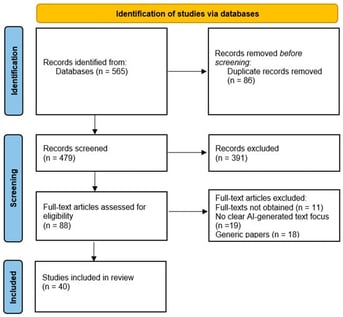
PRISMA flow diagram of article selection.

Active athletes represent a specific target for learning and development. Their schedules, including training sessions and competitions, leave little time for education. However, athletes still need skills beyond sports to ensure they are prepared for future employment. Our study approaches this issue by identifying appropriate settings for athletes’ learning and development. (1) Based on the background of current athletes’ education, it addresses the gap of not enough attention being paid to transferable practices from corporate attitudes to learning and development. (2) The study’s methodology primarily uses the case study concept because this conveys the video content we created for the athletes’ learning and development. This is combined with the method of content analysis of selected examples from corporate learning and development and the design thinking workshop, with the engagement of important stakeholder groups: athletes (2 participants), lecturers (2 participants), and representatives of sports organizations (1 participant). The other 9 workshop participants were master’s students in a managerial study programme because of their age similarities with the current athletes and the applicability of the courses they were studying to athletes’ education. (3) The designed process was created as a digital twin using haptic artefacts and the S2M technology (version 1.0) within the OMiLAB platform (version 1.6). Our results show that video content tailored to the athletes’ constraints is a viable solution that improves their career prospects. (4) The study’s practical implications are supported by the expert validation of the model provided by the inside of the large sports organizations’ management.

6 February 2026

Preparing the video “How to write your CV?” (Own elaboration).

Although multi-agent reinforcement learning (MARL) has achieved significant success in various domains, its deployment in real-world scenarios remains challenging, particularly in communication-constrained environments involving multi-task coupling. Existing methods suffer from two limitations: (1) the inability to effectively integrate and process incomplete state from disparate agents, and (2) a lack of robust mechanisms for handling complex multi-task coupling. To address these challenges, we propose the Coupled Communication-Task Decoupling (CCTD) framework. CCTD introduces two critical innovations: first, a distributed state compensation mechanism to process historical data, thereby reconstructing accurate global states from partial observations; second, a hierarchical architecture that systematically decomposes complex tasks into manageable subtasks while preserving their interdependencies. Thanks to its modular design, CCTD can integrate with existing MARL algorithms and allow for flexible combination of various subtasks. Extensive experiments demonstrate that CCTD outperforms baseline methods, achieving a 10% improvement in communication reception rate and superior performance across all subtasks in multi-task environments.

5 February 2026

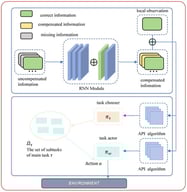
The overall process of CCTD is composed of an RNN-based state prediction module and the hierarchical MARL framework. Incomplete information from all agents is compensated through a state prediction mechanism and integrated with local observations. The task chooser (high-level controller) selects a subtask based on this information, and the corresponding action is generated by the lower-level subtask policy.

This paper proposes a novel method for transferable adversarial attacks from Image Quality Assessment (IQA) to Video Quality Assessment (VQA) models. Attacking modern VQA models is challenging due to their high complexity and the temporal nature of video content. Since IQA and VQA models share similar low- and mid-level feature representations, and IQA models are substantially cheaper and faster to run, we leverage them as surrogates to generate transferable adversarial perturbations. Our method, MaxT-I2VQA jointly Maximizes IQA scores and Targets IQA feature activations to improve transferability from IQA to VQA models. We first analyze the correlation between IQA and VQA internal features and use these insights to design a feature-targeting loss. We evaluate MaxT-I2VQA by transferring attacks from four state-of-the-art IQA models to four recent VQA models and compare against three competitive baselines. Compared to prior methods, MaxT-I2VQA increases the transferability of an attack success rate by 7.9% and reduces per-example attack runtime by 8 times. Our experiments confirm that IQA and VQA feature spaces are sufficiently aligned to enable effective cross-task transfer.

5 February 2026

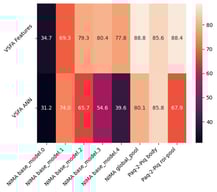
Layer-wise correlations between IQA and VQA features. For a set of videos, features were extracted from both IQA and VQA models. A linear mapping was learned on 10% of the frames; correlations reported are computed on the remaining 90%.

News & Conferences

Issues

Open for Submission

Editor's Choice

Reprints of Collections

Artificial Intelligence Applications in Financial Technology
Reprint

Artificial Intelligence Applications in Financial Technology

Editors: Albert Y.S. Lam, Yanhui Geng
Challenges and Perspectives of Social Networks within Social Computing
Reprint

Challenges and Perspectives of Social Networks within Social Computing

Editors: Maria Chiara Caschera, Patrizia Grifoni, Fernando Ferri

Get Alerted

Add your email address to receive forthcoming issues of this journal.

XFacebookLinkedIn
Big Data Cogn. Comput. - ISSN 2504-2289