
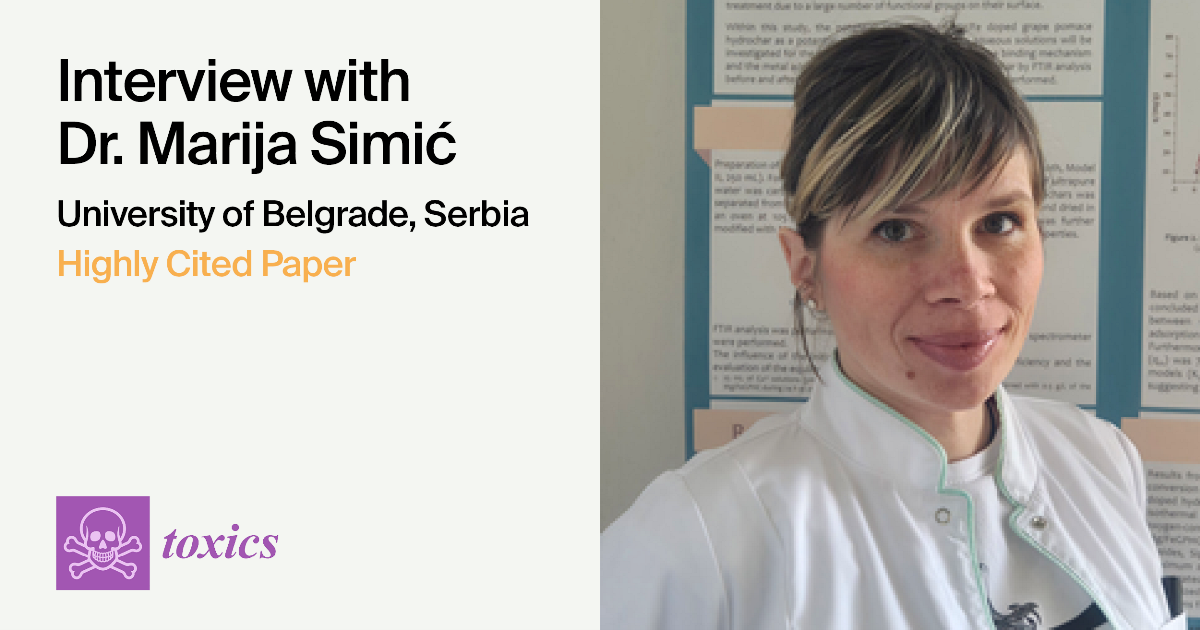
Toxics | Interview with One of the Authors—Dr. Marija Simić
We had the pleasure of speaking to Dr. Marija Simić, the first and corresponding author of a Highly Cited Paper in Toxics (ISSN 2305-6304). Here, she shares insights into her academic journey, research focus, and the motivation behind her recent work.
“Efficient Adsorption of Lead on Hydro-Pyrochar Synthesized by Two-Step Conversion of Corn Cob in Magnesium Chloride Medium”
by Marija Simić, Jelena Petrović, Marija Koprivica, Marija Ercegovic, Jelena Dimitrijević, Nikola S. Vuković and Núria Fiol
Toxics 2025, 13(6), 459; https://doi.org/10.3390/toxics13060459
Available online: https://www.mdpi.com/2305-6304/13/6/459
Dr. Marija Simić is a Research Associate at the Institute for Technology of Nuclear and Other Mineral Raw Materials, University of Belgrade, Serbia. Her research focuses on the valorization of agricultural and industrial biomass residues through thermochemical conversion processes, including hydrothermal carbonization and pyrolysis, with particular emphasis on the development of sustainable carbon-based adsorbents for environmental remediation. Her work integrates biomass processing, material characterization, adsorption science, and circular economy principles to address challenges related to water pollution and resource recovery. She is the author of numerous scientific publications in the fields of environmental engineering, waste valorization, and advanced functional materials.
The following is an interview with Dr. Marija Simić:
1. Could you briefly introduce the main research content of the published paper?
Our published paper investigates the preparation of a novel hydro-pyrochar adsorbent from corn cob biomass through a two-step thermochemical conversion process involving hydrothermal carbonization followed by pyrolysis in the presence of magnesium chloride. The objective was to develop an efficient, low-cost, and sustainable material for the removal of lead from contaminated water. The study demonstrated that combining hydrothermal treatment and pyrolysis significantly enhanced the physicochemical properties of the resulting material, leading to improved adsorption performance. The synthesized hydro-pyrochar exhibited a high affinity toward lead ions and achieved efficient removal under a wide range of operating conditions. These findings highlight the potential of agricultural residues as valuable feedstocks for producing advanced adsorbents that contribute to sustainable water treatment and waste valorization.
2. Could you tell us about yourself and your current research?
I am a researcher working in the fields of environmental engineering, biomass valorization, and sustainable material development. My research focuses on transforming agricultural and industrial waste streams into value-added functional materials through thermochemical conversion processes such as hydrothermal carbonization and pyrolysis. My current research is primarily directed toward the development of biochar- and hydrochar-based adsorbents for the removal of heavy metals, emerging contaminants, and other pollutants from water and soil. I am also interested in understanding the mechanisms governing contaminant adsorption and exploring the role of biomass-derived materials within circular economy and environmental sustainability frameworks.
3. How do you evaluate research trends in this field, and what advice would you give to early career researchers who are interested in this research area?
Research in this field is increasingly moving toward the development of multifunctional and highly efficient bio-based materials that can simultaneously address environmental pollution and waste management challenges. There is growing interest in optimizing thermochemical conversion processes, tailoring material properties for specific applications, and integrating biomass-derived adsorbents into real-world treatment systems. For early career researchers, I would recommend building a strong interdisciplinary foundation that combines materials science, environmental engineering, chemistry, and sustainability concepts. It is also important to focus not only on material synthesis but also on understanding the underlying mechanisms that govern performance. Collaboration across disciplines and maintaining awareness of emerging environmental challenges can help identify impactful research directions.
4. Why did you choose Toxics as a platform for publishing your work, and how was your experience? Would you consider publishing your future research in Toxics?
We chose Toxics because it is a well-recognized international journal that publishes high-quality research related to environmental contamination, toxic substances, and technologies for pollution mitigation. The scope of the journal aligns very well with our work on the removal of toxic heavy metals from aqueous systems. Our experience with the journal was very positive. The submission and peer-review processes were professional and efficient, and the reviewers provided valuable comments that helped improve the quality of the manuscript. We would certainly consider publishing future research in Toxics, particularly studies related to environmental remediation and sustainable technologies.
5. How does open access publishing benefit authors?
Open access publishing significantly increases the visibility and accessibility of scientific research. It allows researchers, practitioners, policymakers, and students worldwide to access scientific findings without subscription barriers. This is particularly important for environmental research, where rapid dissemination of knowledge can support the development of practical solutions to global challenges. From an author’s perspective, open access can enhance the impact of published work, promote international collaboration, and facilitate the broader application of research findings in both academia and industry.
6. Which research topics will be of interest to the research community in the coming years?
In the coming years, I believe there will be increasing interest in the development of sustainable carbon-based materials derived from biomass and waste resources for environmental applications. Research focused on the removal of emerging contaminants, resource recovery, carbon sequestration, and circular economy approaches is likely to gain significant attention. In particular, the design of engineered biochars and hydrochars with tailored surface properties, the integration of artificial intelligence and machine learning in material development, and the scaling-up of biomass-derived technologies for industrial applications represent promising research directions. The transition from laboratory-scale studies to practical implementation will be a key challenge and opportunity for the scientific community.