
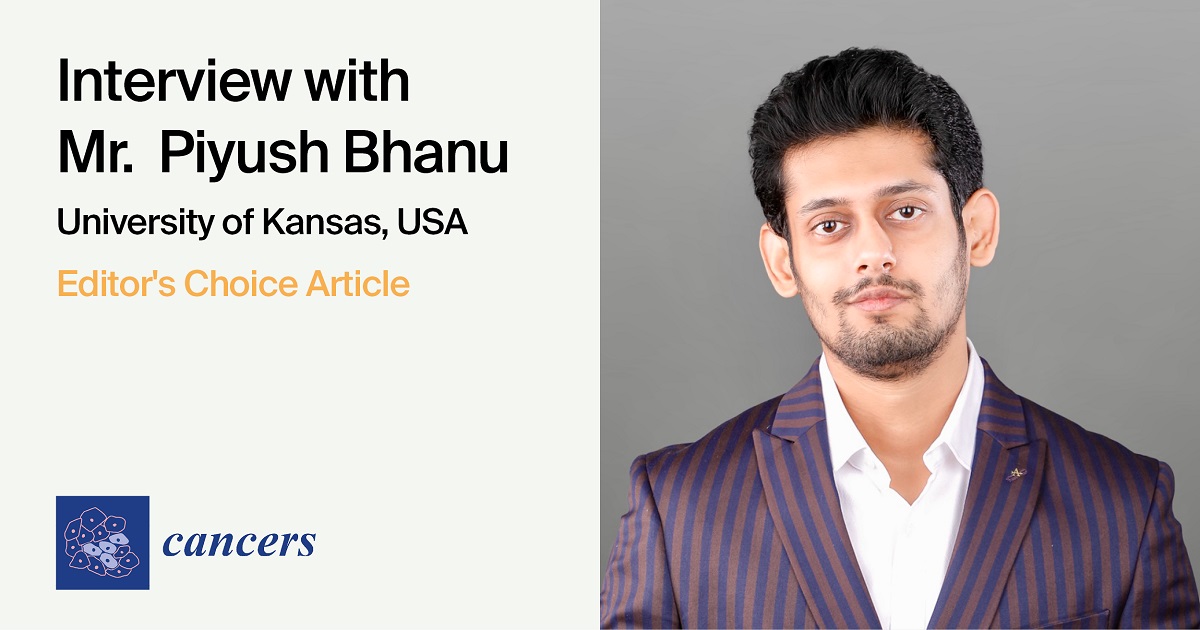
Cancers | Interview with the Author of Editor’s Choice Article—Mr. Piyush Bhanu
We had the pleasure of speaking with Mr. Piyush Bhanu, the first and corresponding author of the Editor’s Choice Article in Cancers (ISSN: 2072-6694). Here, he shares insights into his paper, research career, and personal interests.
“Bacterial Extracellular Vesicles in Oncology: Molecular Mechanisms and Future Clinical Applications”
by Piyush Bhanu, Andrew K. Godwin, Shahid Umar and Diane E. Mahoney
Cancers 2025, 17(11), 1774; https://doi.org/10.3390/cancers17111774
Available online: https://www.mdpi.com/2072-6694/17/11/1774
The following is an interview with Mr. Nicoletta Bianchi:
1. Could you briefly introduce yourself and describe your main research focus?
I'm Piyush Bhanu, a bioengineering PhD candidate at the University of Kansas Medical Center, co-advised by Dr. Andrew Godwin and Dr. Diana Mahoney. My dissertation focuses on bacterial extracellular vesicles (BEVs) as diagnostic biomarkers, with work spanning three directions: building a rigorous isolation and characterization platform using cultured Gram-positive and Gram-negative bacteria, validating BEV detection in sepsis patient plasma as a biological positive control, and applying the platform to ovarian cancer plasma to explore whether BEV-associated signatures carry disease-relevant information. The unifying thread is methodological rigor. BEVs are easy to claim and hard to prove, and I'm interested in the experimental standards that separate real biology from artifact.
2. In your own words, what are the key findings or main messages of your Editor's Choice Article?
The review makes three arguments. First, BEVs are not a curiosity at the edge of cancer biology; instead, they are a structured, biologically active carrier of bacterial molecular cargo that can reach distant sites, including tumors, through circulation. Second, the technical challenges of studying BEVs in human samples are real and under-discussed: host EVs outnumber bacterial EVs by orders of magnitude in plasma, and most isolation methods cannot cleanly separate the two. Third, despite these challenges, the field has reached a point where immunocapture-based enrichment, combined with multi-omics profiling, makes BEV interrogation in clinical samples genuinely tractable. The broader message is that bacterial contributions to cancer biology have historically been studied through nucleic acid signatures, and BEVs offer a complementary, functionally richer window, one that includes proteins, lipids, and metabolites packaged together in a way that reflects bacterial physiology rather than just presence.
3. What were the biggest challenges you encountered during this study, and how did you overcome them?
For the review itself, the hardest part was navigating a literature that uses inconsistent terminology and methodology. “BEVs”, “OMVs”, “membrane vesicles”, and “bacterial exosomes” are often used interchangeably, but they refer to vesicles with different biogenesis routes, cargo profiles, and isolation requirements. Synthesizing the oncology literature required reading carefully enough to know what each study actually isolated, which was often different from what the abstract claimed. The approach I took was to organize the review around biological questions rather than around methods or vesicle subtypes and to be explicit about the level of evidence supporting each claim. The harder challenge, and one I'm still working through in my dissertation, is translating that same rigor into wet-lab experiments, particularly around specific antibody selection for Gram-positive and negative BEV capture, where surface accessibility and organism-specific cell wall biology don't always cooperate with what commercial reagents claim to target.
4. How do you see this research evolving or influencing future studies in the field?
I think the next five years will be about standardization. The field has enough exciting findings; what it needs is the ability to compare them. That means agreed-upon isolation benchmarks, reference datasets for BEV cargo from well-characterized organisms, and clearer reporting standards for clinical BEV studies. I hope the work I'm doing contributes to that foundation, not because reference datasets are glamorous, but because without them, every new disease association remains isolated and difficult to interpret. In the longer term, I'm most interested in whether BEVs can move beyond being biomarkers toward being functionally interrogated in disease models: what do they actually deliver, to which host cells, and with what consequence. That's where the biology gets genuinely interesting, and where I think the translational payoff will ultimately come from.
5. What advice would you give to early-career researchers who aim to publish impactful work in oncology?
As an early-career researcher myself, I can suggest two things. First, write the review before you think you're ready. Forcing yourself to synthesize a literature you don't fully control teaches you the field in a way that reading papers one at a time cannot. You'll identify gaps, contradictions, and open questions that become your research program. Second, take methodological rigor more seriously than novelty. In fields like BEV research, where the technical floor is high and artifacts are easy to generate, the papers that hold up over time are the ones where the authors controlled for things their reviewers didn't even ask about. Impact follows from being right, and being right follows from being diligent.
6. Outside of research, what are some of your personal interests or hobbies? How do you like to recharge and find balance?
I don’t think of “balance” as a strict separation between work and life. For me, it’s more about maintaining intensity in my work while intentionally engaging in activities that expand how I think. Beyond research, I enjoy being outdoors and trying new activities, especially adventure sports. It helps me reset mentally and step away from structured thinking. I’m also deeply interested in human psychology and enjoy meeting new people and learning about their experiences and cultures. Reading is a big part of how I spend my time outside my core field. I primarily read non-fiction across diverse areas (such as economics, biographies, marketing, and history), and I’ve found that many of my better research ideas come from recognizing patterns in completely unrelated domains. That cross-disciplinary exposure has been very valuable for my work. I also strongly believe that meaningful scientific progress requires both deep expertise and the ability to think across disciplines. So even my interests outside research are, in a way, aligned with building that broader way of thinking.