


Highlights
Please indicate how your work links to systems science via your contributions to systems practice, theory, and/or methodology.
- This article develops a systems-informed process-flow model of U.S. federal civil litigation that identifies decision gates, forward and exit pathways, and rework pathways through which completed procedural work can be reopened.
- Drawing on the rework-cycle tradition in system dynamics, it introduces an original typology of expansive, filtering, balancing, and corrective procedural pathways.
What are the main findings and/or the implications of the main findings?
- The analysis suggests that discovery, amendment, reassessment, summary judgment, and appellate remand can reopen completed work, generate additional procedural rounds, and create path-dependent delay even when participants act within the rules.
- Reform aimed at delay may therefore need to address when and how procedural rework pathways are activated, not merely increasing judicial resources or improving case management, while preserving the fairness, accuracy, flexibility, and error-correction values those pathways serve.
Abstract
U.S. civil litigation is widely criticized for its costs, complexity, and delay, which are usually attributed to court congestion, limited judicial resources, inefficient case management, or strategic conduct by litigants. This article examines a complementary structural source of delay: the architecture of civil procedure. Taking a system dynamics perspective, in which the structure of a system shapes its behavior, we develop an exploratory, qualitative process-flow model of the federal civil litigation lifecycle, constructed from the Federal Rules of Civil Procedure, governing case law, and practitioner knowledge. Drawing on the rework-cycle tradition in project dynamics, the model identifies the principal pathways through which a case may advance, exit, or return to an earlier stage, and classifies them with an original typology of expansive, filtering, balancing, and corrective pathways. The analysis suggests that rules protecting accuracy, fairness, and error correction, including liberal amendment, broad discovery, partial summary judgment, and appellate remand, also create rework pathways through which procedural work and delay can accumulate and propagate. The article contributes a structural framework for analyzing delay as a property of interacting procedural pathways, derives hypotheses for empirical testing, and specifies the structure for formal simulation modeling in subsequent work.
1. Introduction
1.1. Bridging Systems Science and Legal Procedure
In the U.S. legal system, civil courts deal with disputes between private parties (individuals, businesses, or organizations) involving contracts, property, personal injury, family matters, or other legal obligations, where the goal is typically to resolve the conflict through remedies like monetary damages or court orders, rather than criminal punishment. The U.S. civil justice system is often recognized for its thoroughness and procedural fairness [1]. Yet it is equally criticized for its delays, high costs, and procedural complexity [2]. Civil cases can drag on for years, burdening the courts, parties, and society at large. At a time when efficiency, access to justice, and systemic reform are central concerns in civil justice scholarship and policy, understanding why delay persists has become critical.
This paper argues that delay is not simply the result of too few judges, too many litigants, inefficient case management, or strategic behavior by the parties. Those explanations matter, but they are incomplete. This article argues that the delay is also enabled by the architecture of U.S. civil procedure itself. The civil litigation process, as governed by the Federal Rules of Civil Procedure (FRCP) and local rules, contains feedback mechanisms, particularly around pleadings, discovery, and appeals, which allow for completed work to be reopened, revised, or redirected [3]. These feedback pathways, though procedurally justifiable on their own terms, interact in ways that make delay a recurrent outcome of the system’s structure. The model developed in this article distinguishes pathways that amplify procedural work from those that stabilize or reduce it.
This article answers the following research question: how does the procedural architecture of U.S. civil litigation generate delay through recursive pathways, rework loops, and backward-moving procedural effects, when individual procedural rules are designed for fairness, accuracy, and due process? The second related question is: which stages of the litigation process create the main structural opportunities for backward movement, delay propagation, and path-dependent escalation?
The U.S. civil procedure is not designed to maximize speed. It reflects a set of competing institutional objectives: fair notice, adversarial presentation, access to relevant information, accurate adjudication, opportunity for settlement, and hierarchical correction through appeal. The paper’s claim is the following: procedural rules adopted to serve these values create recursive pathways that can make delay a recurrent consequence of the system’s design architecture. In this sense, “delays by design” means the delay as an emergent effect of procedural choices that authorize rework, reconsideration, and correction. The system-level consequences include cumulative delays, bottlenecks, or reduced responsiveness.
In this article “design” refers to the institutional and procedural architecture of the system, including its rules, structures, and process configurations, rather than to any intentional creation or prolongation of delay.
To investigate this claim, we adopt a systems thinking approach to model civil litigation as a complex, interdependent process composed of procedural stages, decision gates, feedback pathways, and rework loops [4] (see Table 1). Systems analysis has been applied in fields such as healthcare, education, and intellectual property enforcement [5,6]. This article brings that perspective to civil litigation by translating procedural doctrine into systems terms. It does not treat litigation merely as a sequence of legal events, but as a dynamic process in which information generation, strategic adaptation, judicial decisions, settlement pressure, and appellate correction interact over time.
Table 1.
Systems concepts used in this article.
This paper uses a systems-informed process-flow model [7] that maps the litigation lifecycle as a procedural flow: it identifies the principal stages through which a civil case moves and highlights the points at which the process can loop backward, branch into settlement, or re-enter earlier phases after judicial correction. The model is therefore best understood as a recursive process diagram informed by systems thinking. Its purpose is not to quantify case duration or simulate litigation outcomes, but to expose the procedural architecture through which delay-producing recursion can occur (see Table 2).
Table 2.
Operational Definitions of System Components.
The model is intended primarily to describe federal civil litigation and complex civil cases in which pleadings, discovery, motion practice, settlement pressure, trial preparation, and appellate review interact over extended time horizons. It is less directly applicable to small claims proceedings, routine collection actions, uncontested matters, administrative adjudications, or specialized procedural regimes that use simplified rules, limited discovery, abbreviated timelines, or alternative case-management structures. The paper, therefore, does not claim that all civil cases exhibit the same degree of recursion or delay. Its claim is that, when the ordinary architecture of adversarial civil litigation is fully activated, it creates recurring opportunities for rework, backward movement, and delay propagation.
This article builds a bridge between legal process theory and systems modeling. Its central thesis is that U.S. civil litigation, viewed through a systems lens, operates as a recursive process system in which delay can emerge from the interaction of individually defensible procedural rules. We illustrate this point through an original process-flow model of U.S. civil litigation and use that model to identify design principles for reform aimed at reducing delays. Rather than asking only how courts can work faster or how litigants can behave better, the paper asks how the architecture of civil procedure might be modified to reduce unnecessary recursion while preserving the legal values that recursion serves.
1.2. Situating This Work: What Has Been Done and What’s New Here
While civil procedure has been rigorously analyzed from doctrinal, economic, and managerial perspectives, this paper focuses on a different level of analysis: the procedural architecture of litigation as a recursive process system. Existing accounts explain important parts of litigation delay, but they usually emphasize different mechanisms. Economic models, including Landes and Posner’s adjudication-as-private-good framework, focus on litigant incentives, settlement behavior, and case selection [8]. Judicial-administration literature evaluates docket management, case-flow efficiency, judicial capacity, and the use of alternative dispute resolution [9]. Legal realist and critical accounts examine strategic behavior, power imbalances, and the gap between formal procedural rules and litigation practice [10]. Each of these approaches is useful, but each tends to treat procedural architecture either as doctrine, as an institutional background condition, or as a managerial problem.
Courts, commentators, and reform bodies have also used litigation flowcharts and case-management diagrams to describe ordinary procedural sequence [11]. Those diagrams are useful pedagogically, but they usually represent litigation as a linear or branching progression from filing to disposition. They rarely foreground the rework pathways through which a case can return to earlier procedural stages, expand the scope of dispute, or generate delay through recursive interactions among pleadings, discovery, motion practice, settlement, trial, and appeal.
This paper, therefore, does not claim novelty simply for applying systems thinking to law or for describing litigation as dynamic. Prior scholarship has already analyzed legal systems dynamically, including work on litigation, uncertainty, and legal change [11,12]. The distinct contribution here is narrower: this paper uses a systems-informed process-flow model to examine the internal procedural architecture of individual civil cases.
This paper offers two principal contributions: (1) it develops a systems-informed process-flow model of the U.S. civil litigation lifecycle that explicitly represents recursive and rework pathways; and (2) it develops a pathway typology distinguishing expansive, filtering, balancing, and corrective procedural pathways and uses that typology to explain how delay propagates through litigation. In sum, this paper argues that an important and understudied source of delay lies in the structure of the process itself: a system of rules that authorizes information generation, correction, reconsideration, and appellate review in ways that can reopen, prolong, or redirect the path to resolution.
The systems contribution is not the observation that litigation sometimes moves backward. Conventional procedural analysis already recognizes amendment, additional discovery, and remand. The systems contribution lies in distinguishing different structural functions of those pathways and showing how they interact: some pathways simply redirect the process; some require rework; some form closed recursive structures capable of repeated activation; some filter or terminate work; and some counteract expansion by moving cases toward closure. This makes it possible to analyze litigation delay as an architectural property of interacting procedural pathways rather than as the sum of isolated procedural events.
This article takes a structural approach grounded in the central principle of system dynamics: the structure of a system, its stages, flows, feedback, and delays, shapes its behavior over time [13,14]. In the system dynamics modeling process, articulating the problem and mapping the structure of the system come before formal model specification, calibration, and simulation, and a quantitative model is only as sound as the structural account on which it rests [14]. The present article provides that structural account for U.S. federal civil litigation. In the tradition of the project-dynamics literature on the rework cycle [15,16,17], it documents the procedural architecture of civil litigation, identifies the pathways through which completed procedural work can be reopened, and classifies them by their effect on the work remaining in a case. This structural analysis is a contribution in its own right: it shows where delay can originate in the design of procedure, it gives legal scholars and reformers a framework for locating structural leverage points, and it specifies the structure that any causal-loop, stock-and-flow, or simulation model of litigation would need to represent. Quantitative estimation of these pathways’ effects on case duration lies beyond the scope of this article.
2. Background
This section reviews four bodies of scholarship on litigation delay: doctrinal, economic, judicial-administration, and systems-oriented. For each, we note what it explains, what it leaves unresolved, and how the present model addresses the gap. Together, these perspectives provide a basis for explaining how formal requirements and interactions can generate the phenomena examined in this study.
2.1. U.S. Civil Procedure
This section briefly defines the procedural concepts used throughout the paper. The goal is not to provide a full account of U.S. civil litigation, but to supply enough vocabulary for readers to understand the process-flow model and the later analysis of rework pathways. In U.S. federal practice, civil litigation is governed primarily by the Federal Rules of Civil Procedure (FRCP), supplemented by local rules and individual judicial practices. These rules establish both a nominal forward sequence—from filing to resolution—and the conditions under which a case may branch, narrow, settle, or return to an earlier procedural stage [18].
A civil case begins when a dispute is translated into a formal legal claim and filed in court. The plaintiff initiates the action by filing a complaint, which alleges facts and states the legal theories that would entitle the plaintiff to relief if proven. The defendant typically responds by filing an answer, which admits or denies allegations and asserts defenses. This initial exchange is known as the pleadings stage. Pleadings define the dispute by identifying the parties, claims, defenses, factual allegations, and legal theories that structure the case at its outset.
Pleadings are not always fixed. For example, federal Rule of Civil Procedure 15(a)(2) provides that courts should freely grant leave to amend when justice so requires. In Foman v. Davis, the Supreme Court emphasized this liberal amendment policy while identifying considerations such as undue delay, bad faith, repeated failure to cure deficiencies, undue prejudice, and futility that may justify denying leave to amend [19]. In systems terms, amendment rules create a procedural pathway through which the case’s initial boundaries may be revised as the litigation develops. Because U.S. civil procedure generally favors resolving disputes on the merits, parties may sometimes amend their pleadings when new information, corrected theories, or changed circumstances emerge.
Early in the case, courts may also consider motions to dismiss. A motion to dismiss tests whether the complaint, assuming the truth of its factual allegations, states a legally sufficient claim. [See, e.g., Fed. R. Civ. P. 12(b)(6)] Dismissal can end all or part of a case before discovery begins. But dismissal is not always final; courts may permit amendment when defects are viewed as curable. This makes early motion practice both a screening mechanism and, in some cases, a source of limited procedural rework.
If the case survives the pleading stage, it typically enters discovery. [See, e.g., Fed. R. Civ. P. 26–37; 45] Discovery is the formal process through which parties obtain information from each other and from third parties, including documents, electronically stored information, written interrogatories, deposition testimony, subpoenas, as well as expert reports, and expert depositions, which are part of expert discovery a sub-category of discovery. [See, e.g., Fed. R. Civ. P. 26(a)(2), 26(b)(4), 26(e)(2)] Discovery is designed to reduce informational asymmetry and allow parties to evaluate claims and defenses on a more complete factual record. For purposes of this paper, discovery is important because it is the litigation system’s principal information-generation stage. Information developed during discovery may affect later motions, settlement positions, trial preparation, and, in some cases, the pleadings themselves.
As litigation proceeds, parties also reassess the case in response to new information, judicial rulings, expert analyses, litigation costs, and changing risk estimates. This reassessment is not always a formal procedural step, but it is a recurring feature of litigation practice. It links information development to later procedural choices, including settlement, further discovery, amendment, dispositive motions, and trial strategy.
A major decision point that usually occurs after discovery is summary judgment. [See, e.g., Fed. R. Civ. P. 56] It allows a court to resolve some or all claims without trial when the developed record shows that there is no genuine dispute of material fact and that one party is entitled to judgment as a matter of law. Summary judgment may end the case, narrow the issues, or clarify what remains for trial. In systems terms, it operates as a decision gate: a point at which the case may exit, continue, or proceed along a narrowed path.
If the case is not resolved through dismissal, settlement, or summary judgment, it proceeds toward pretrial preparation and trial. [See, e.g., Fed. R. Civ. P. 16] Pretrial procedures include evidentiary motions, witness lists, exhibit lists, proposed jury instructions, and other steps that shape how the dispute will be presented. A trial is a formal adjudicative event in which a judge or jury evaluates evidence and reaches a decision. Judgment is the court’s formal resolution of the case or of particular claims.
After judgment, a party may appeal. Here the Federal Rules of Appellate Procedure apply (28 U.S.C. § 1291; Fed. R. App. P. 3–4). An appeal asks a higher court to review aspects of the lower court’s decision, usually for legal error rather than for a complete re-evaluation of the facts. Appeals serve important functions of error correction, consistency, and institutional legitimacy. For this paper, the key appellate concept is remand. A remand occurs when an appellate court sends a case back to the trial court for further proceedings. Depending on the appellate ruling, remand may require additional motions, further factual development, a new trial, or reconsideration of issues previously thought resolved.
Civil litigation terminates when the dispute exits the system through settlement, dismissal, final judgment, or completion of appellate and remand proceedings. The concepts introduced here—pleadings, amendment, motions to dismiss, discovery, reassessment, summary judgment, settlement, trial, judgment, appeal, and remand—are the building blocks of the process-flow model. With this vocabulary in place, the later sections analyze how rule-defined opportunities for information development, correction, and reconsideration can generate rework, path dependence, and delay within the litigation process.
2.2. Delay in Legal Systems
Civil litigation has long been criticized for its procedural complexity and its vulnerability to strategic behavior [1]. A substantial body of scholarship has examined litigation delay from doctrinal, economic, judicial-administration, and empirical perspectives [8,9,10]. Each of these studies explains part of the problem. Doctrinal scholarship examines the rules that structure litigation; economic analysis explains parties’ incentives and settlement behavior; judicial administration scholarship studies docket management and institutional capacity; and empirical work measures case duration, discovery costs, and disposition patterns. This paper builds on those accounts but asks a different question: how do the procedural stages of civil litigation interact over time to create recursive pathways that can generate delay as an endogenous feature of the process itself?
2.3. Legal Doctrine and Procedural Design
Much of civil procedure scholarship focuses on how courts interpret and apply procedural rules. More specifically, it refers to the rules that govern how a lawsuit moves through the court system: how a case begins, how parties exchange information, how courts decide whether claims may proceed, how trials are prepared, and how judgments are reviewed on appeal. These rules are not merely technical instructions. They shape the path a case can take.
Subrin’s [20] account of the Federal Rules of Civil Procedure is important for this paper because it shows how modern U.S. litigation became organized around information development rather than simply formal pleading. Before the modern Federal Rules, civil litigation placed greater weight on the initial written statements of the parties’ claims and defenses. The Federal Rules helped create a more flexible system. Parties could amend their pleadings more easily, obtain broad discovery from one another, and use motions to test or narrow issues as the case developed. In practical terms, this made litigation less like a straight line from complaint to trial and more like an iterative process in which the case can change as new information is uncovered.
Bone [21] and Burbank [22] are also important because they show that procedural rules cannot be understood one rule at a time. A pleading rule, a discovery rule, or an amendment rule may look reasonable in isolation. But litigation is not experienced in isolation. The rules operate together. A flexible amendment rule matters differently in a system with broad discovery than it would in a system with limited discovery. A generous discovery regime matters differently when parties can later revise claims, add defenses, seek summary judgment, or appeal legal errors. Bone and Burbank, therefore, help frame procedure as more than doctrine: it is an institutional design that shapes how litigation unfolds over time.
That design has obvious benefits. A legal system that allows amendment can correct early mistakes. A system with broad discovery can uncover facts that one side does not already know. A system with appeals can correct legal errors by trial courts. These features reflect important values: fairness, accuracy, party participation, and confidence that outcomes are based on a developed record rather than incomplete information.
But the same features also have system-level consequences. In systems terms, a “rework loop” occurs when a process must return to an earlier step because new information, correction, or review changes what came before. Civil litigation contains several such loops. Discovery may reveal facts that lead a party to amend its claims. An amended claim may require more discovery. A summary judgment ruling may narrow some issues but force parties to reassess others. An appellate court may send a case back to the trial court, requiring additional proceedings after years of litigation.
The point is not that amendment, discovery, motion practice, or appeals are bad. Each serves a legitimate procedural function. The point is that when combined, these rules can create a process in which correcting or improving the case also extends it. The system gains accuracy and flexibility, but often at the cost of time and expense. This is the central design tradeoff examined in this paper: procedures meant to make litigation fairer and more accurate can also make litigation more recursive, costly, and slow.
This design may also have unequal effects. Parties with greater resources may be better able to withstand repeated discovery, expert work, motion practice, and appeals, consistent with Galanter’s account of the structural advantages of well-resourced, repeat litigants [23]. The point is not that U.S. litigation is simply “pay to win.” Rather, the model implies that repeated rounds of legal work may burden lower-resource litigants more heavily than parties able to absorb the costs of prolonged litigation, an implication that requires empirical investigation.
2.4. Economic Analysis of Litigation
Economic models of civil procedure typically evaluate litigation as a strategic interaction. In Landes and Posner’s framework (1979) [8], adjudication is treated partly as a “private good,” meaning that parties decide whether to litigate by comparing the expected private benefits of litigation with its expected costs. From this perspective, litigation happens because the parties choose it, and delay happens because the parties use time strategically—not because the legal system is designed to slow things down.
Shavell (1982) [24] extends this approach by analyzing how expected litigation costs, settlement incentives, trial risk, and rules for allocating legal fees affect whether parties sue, settle, or proceed to trial.
Later economic work has also introduced more explicitly dynamic accounts of legal systems. Dari-Mattiacci, Deffains, and Lovat’s “The Dynamics of the Legal System,” for example, models the relationship among litigation, legal uncertainty, and the production of legal rules over time. That work is important because it shows that law-and-economics scholarship has already treated legal systems as dynamic rather than static. This paper, therefore, does not claim novelty merely for introducing time, change, or dynamics into the study of litigation.
The contribution here is different. Dari-Mattiacci, Deffains, and Lovat [12] model legal-system dynamics at a relatively aggregate level, focusing on litigation demand, uncertainty, and lawmaking output. Litigation, in that model, is largely an input into the evolution of the legal system. This paper focuses instead on the internal architecture of civil litigation itself. It asks how fixed procedural rules create repeated opportunities for cases to reopen, expand, or move backward within individual lawsuits. In other words, their work studies dynamics at the level of the legal system as a whole; this paper studies dynamics at the level of the litigation process.
This literature is useful because it explains why parties may use delay strategically. For example, a party with stronger finances may benefit from making litigation more expensive, while a party facing uncertainty may settle to avoid the risk and cost of trial. But economic models often treat the court process as the background setting in which parties make choices. This paper focuses on that background setting itself. It asks how the structure of civil procedure creates the opportunities that parties later respond to: discovery requests, amendment of pleadings, motion practice, settlement pressure, appeal, and remand.
Economics helps explain why parties act the way they do within the litigation system. This paper asks how the litigation system creates the paths available to them. The two approaches are complementary. Strategic behavior matters, but strategy operates through procedural architecture. A party cannot exploit delay unless the system provides procedural tools that can be used, extended, repeated, or appealed.
Related institutional and comparative economic work also examines how legal systems shape behavior over time, including scholarship on judicial councils, comparative legal efficiency, and the coevolution of legal institutions and social norms [25,26,27]. This literature is a useful background, but the present paper focuses more narrowly on the internal process structure of U.S. civil litigation.
2.5. Judicial Administration and Reform
Judicial administration scholarship studies how courts manage cases and court systems. This literature asks practical questions: How many judges are needed? How should courts schedule cases? How much should judges supervise discovery before trial? When should courts encourage settlement or mediation? And how can courts reduce delay without sacrificing fairness?
Resnik’s work, Managerial Judges [28], is especially important because it describes a major change in the judge’s role. In the older model, judges were often imagined mainly as neutral decision-makers who resolved disputes when parties brought motions or proceeded to trial. In modern civil litigation, judges often do much more. They set schedules, manage discovery, hold case conferences, encourage settlement, and narrow issues before trial. Resnik’s point is not simply that judges decide cases, but that judges increasingly manage the process by which cases move through the court.
Geyh’s work, Judicial Independence, Judicial Accountability, and the Role of Constitutional Norms in Congressional Regulation of the Courts [29], addresses the same general problem from a broader institutional angle. His scholarship on judicial independence and accountability examines how courts can be regulated, supervised, and improved while preserving the independence judges need to decide cases fairly. That matters for this paper because delayed reform is not only a question of better rules. It also depends on the institutional capacity and governance of the courts themselves.
The Civil Justice Reform Act (CJRA) of 1990 [30], for example, encouraged individualized case management and early intervention. In plain terms, the CJRA reflected the idea that courts should not passively wait for cases to move forward on their own. Courts should identify delays early, manage cases actively, and use procedures designed to reduce costs and time. However, evaluations of such reforms have yielded mixed results. Heise [31] notes that even well-managed courts often struggle to shorten case durations.
This paper builds on that lesson but shifts the focus. Court management matters. Better scheduling, earlier judicial involvement, proportional discovery, and settlement conferences can reduce delay in particular cases. But these tools mainly manage how cases move through the existing process. They do not necessarily change the process itself. If discovery can still generate new issues, if new issues can still lead to amended pleadings, if summary judgment can still reshape the case, and if an appeal can still send the case back to the trial court, then delay may persist even in a well-managed court.
2.6. Systems-Based Approaches in Institutional Contexts
Systems thinking provides a way to study institutions as connected processes rather than as isolated rules, decisions, or events. For readers outside the systems field, the basic idea is straightforward: a system is a set of parts that interact over time. A “feedback loop” exists when the output of one part of the system affects what happens later in the same system. A “delay” is the time between an action and its consequences. A “rework loop” occurs when a process must return to an earlier step because new information, correction, or review changes what came before. These concepts are useful for studying civil litigation because lawsuits often do not move in a straight line from filing to judgment.
This characterization draws on the rework cycle, a standard structure in system dynamics models of project management [14,17]. The rework cycle was first formalized in support of a shipbuilding claim [16], so its origins lie in litigation over project delay, and it was later developed in studies of large engineering and software projects [15,32,33,34]. A closely related study on disruption and delay examines how changes introduced during a project generate additional work and extend schedules [35,36]. These studies share a common mechanism: as a process unfolds, it generates information that reveals further work to be done, including revision of work previously treated as complete, so that schedules can grow even when each activity is locally rational. Civil litigation exhibits the same mechanism in procedural form. Discovery, amendment, reassessment, and appellate remand can reactivate earlier stages and require completed work to be revisited. The present model applies this rework perspective to procedural architecture.
Systems methods have already been applied in legal and legally adjacent settings. Stephens, Graham, and Lyneis [37] examine the use of system dynamics modeling in legal disputes, particularly when experts use models to explain or quantify damages. Their work is important because it shows that system dynamics is not foreign to legal settings; it has already been used in litigation-related contexts. Howick similarly studies whether system dynamics can be used to analyze disruption and delay in complex projects for litigation [35]. That article is especially relevant here because it connects system dynamics, delay, and litigation, although its focus is project-delay claims rather than the internal architecture of civil procedure.
Other systems-based work examines legal and policy institutions more broadly. Olaya’s study of model-based lawmaking and the Colombian criminal justice system shows how modeling tools can help analyze legal reform in a complex institutional setting [38]. Madachy’s work on system dynamics structures for lawmaking processes likewise treats lawmaking as a process that can be modeled through recurring structures [39]. Sabounchi and coauthors use a system dynamics approach to evaluate the impact of Connecticut’s Good Samaritan Law, showing how legal interventions can have effects that unfold over time rather than immediately [40]. Hovmand’s work on domestic-violence prosecution caseloads similarly applies system dynamics reasoning to prosecutorial workload and institutional response [41].
A related group of scholarship uses systems language to study information environments. Yu’s work on intellectual property and the information ecosystem is useful because it frames legal rules as part of a broader information system rather than as isolated commands [42]. Although intellectual property differs from civil procedure, the methodological move is similar: legal rules are understood as part of an interacting environment that shapes behavior and outcomes over time.
Pavlov and coauthors’ institutional modeling work is also directly relevant [43,44]. The work on radicalization dynamics and higher-education systems shows how individual decisions can combine into larger patterns that no single actor necessarily intends. For this paper, the important lesson is that institutional outcomes can emerge from structure. Judges may seek fairness, lawyers may act within the rules, and parties may make rational choices. Yet the interaction of those choices within a recursive procedure can still produce delay.
This paper builds on that systems literature to develop a systems-informed process-flow model to identify where U.S. civil litigation permits cases to move backward, reopen earlier issues, or generate additional rounds of work. This model identifies how the structure of the legal system can contribute to delay.
Following common usage in systems science, we treat a complex system as one composed of multiple interdependent elements whose interactions, through feedback and delays, produce system-level behavior that cannot be inferred from the elements considered in isolation [14]. Civil litigation exhibits several such properties, and the model represents them as follows: multiple interacting agents (parties, counsel, and courts, whose decisions determine which transitions in Figure 1 are activated); interdependence among procedural stages (the forward and return pathways linking nodes); feedback and recursion (the rework pathways in Table 3); adaptation (Case Reassessment, Node E); state dependence (Section 3); delays (the time required to complete and repeat procedural work, Section 5.7); and emergence (delay as a system-level outcome of individually defensible rules, Section 5.9). Nonlinearity and heterogeneity across cases are not represented in the present qualitative model and are left to formal modeling.
Figure 1.
Systems-informed process-flow model of U.S. civil litigation. Procedural stages are shown as rectangles. Solid arrows show ordinary procedural progression or exit pathways. Dashed arrows show recursive pathways through which discovery, reassessment, or appellate review may return a case to earlier stages. Principal rework pathways are given in Table 3.
Table 3.
Principal Procedural Pathways in U.S. Civil Litigation.
3. Method: A Systems Approach to Modeling Civil Litigation
Modeling civil litigation requires a methodological frame that captures both the formal sequence of procedural steps and the structural features that allow the process to loop, expand, and generate additional procedural work. Traditional civil procedure scholarship often analyzes rules doctrinally. This means that legal scholars study what a rule says, how courts have interpreted it, why it developed, and how it should apply in future cases. Court administration research usually asks a different set of questions: how many cases courts handle, how quickly cases move, how judges manage dockets, and which reforms reduce costs or delays. A systems approach used in this article complements the other two strands of literature by focusing specifically on how procedural steps interact with one another.
Systems thinking offers a way to examine litigation as a dynamic process. In that context, “dynamic” means that the process changes as it unfolds. This qualitative and explanatory model identifies recurring procedural pathways through which litigation may move forward, branch, exit, or return to earlier stages. What happens at one stage affects what becomes possible at later stages. In litigation, new evidence may change the claims; a judicial ruling may narrow or expand the case; a settlement conference may alter party incentives; and an appeal may send the case backward. The purpose of this section is to explain why a systems-informed process model is useful for studying those interactions.
Because the unit of analysis is the individual civil case, particularly the federal civil litigation process, the model is useful for analyzing federal and complex civil litigation.
Systems thinking examines how components of an institutional structure interact over time, often in ways that produce outcomes not predictable from the components themselves. Civil litigation is well-suited to this type of analysis. What appears superficially as a sequential process (filing, discovery, trial, appeal) is in practice a set of interacting procedural stages in which later developments may alter earlier assumptions, redirect the case, or require additional rounds of work. New information discovered mid-stream reshapes the legal framing; strategic decisions by litigants alter the procedural path; judicial rulings open or foreclose future options; appellate decisions send cases backward for reconsideration. These interactions can generate familiar system behaviors: repeated rounds of work, delay, sensitivity to early choices, and different outcomes in cases that looked similar at the start.
Three systems concepts are particularly central. First, a feedback loop exists when something produced at one stage affects what happens later in the same process. In litigation, feedback-like effects appear in cycles of amended pleadings [19] triggered by new evidence, in strategic reassessments following partial summary judgment rulings, and in appellate remands that reopen earlier stages. While the frequency and scope of appellate remands vary by circuit, case type, and standard of review, remands occur regularly enough—particularly in complex litigation—to influence litigant strategy and judicial resource allocation [45].
Second, delay refers to the time between an action and its practical consequence. Some delays are built into the rules, such as briefing schedules or appeal deadlines. Others arise because parties need time to gather documents, take depositions, prepare expert reports, or respond to new rulings. These delays can accumulate across stages, producing long case timelines even when no single actor is behaving inefficiently.
Third, path dependence means that early choices can shape the later direction of the case. We use the term in a limited sense, closer to state dependence: the pathways available to a case depend on earlier procedural events. A pleading decision, discovery ruling, expert disclosure, or early judicial interpretation may affect what evidence is developed, what motions are filed, whether settlement becomes likely, and what issues remain for trial or appeal. Together, these concepts characterize litigation as an interacting process whose behavior depends on the relationships among its parts over time.
The model distinguishes feedback from procedural backward movement, recursion, and rework. A backward procedural movement occurs whenever a later procedural event returns a case to an earlier stage. Recursion occurs when the procedural architecture permits an earlier stage to be revisited, potentially through repeated iterations. Rework occurs when such a return requires previously completed procedural work to be revised, supplemented, or repeated. A feedback loop is narrower: it requires a closed causal structure in which the output of a downstream stage changes an earlier system state, and that changed state subsequently influences the downstream process from which the change originated. Accordingly, not every backward-moving arrow in the model constitutes a feedback loop. Some represent re-entry or rework pathways without completing a feedback structure. This distinction allows the model to separate simple procedural reversal from recursive mechanisms capable of producing repeated rounds of work.
Civil litigation is a strong candidate for systems modeling because it openly embeds recursion into its governing rules. Recursion means that a process can return to an earlier stage rather than only move forward. Parties may amend pleadings, reopen discovery under certain circumstances, challenge admissibility of evidence late in the case, or pursue appeals that send matters backward into earlier phases. Each stage is conditioned by the outcomes of prior stages, and litigants adjust their strategies dynamically in response to new evidence, judicial behavior, and shifting risk assessments. Delays can also propagate across a case. A discovery delay can affect motion deadlines; a motion ruling can affect trial preparation; an appeal can undo years of prior work. When courts manage many cases at once, scheduling limits and resource constraints can further compound these effects.
Because the goal of this study is to expose the structural roots of delay a qualitative systems-informed process-flow model provides an appropriate methodological instrument. The modeling method identifies the principal procedural stages, maps the relationships connecting those stages, and distinguishes ordinary forward movement, exit pathways, and pathways that return a case to earlier procedural states. Section 4 presents the resulting model. Section 5 then uses that model to analyze the delay dynamics associated with its principal recursive pathways.
The construction of the model draws on the Federal Rules of Civil Procedure [8], governing case law, and practitioner knowledge, and is informed by empirical research on case duration and appellate outcomes [31,45]. These sources provide the basis for identifying the model’s major stages and pathways. Because empirical conditions vary across courts, case types, and jurisdictions, the model focuses on the general structure of the process: the points at which litigation can move forward, exit through settlement, or return to earlier stages.
No interviews or systematic expert elicitation were conducted. Practitioner knowledge and the litigation experience of one author who is a practicing attorney was used to structure stages and pathways and to check the model against practice, not to support causal claims. Validation is therefore structural: each stage and transition was checked against the governing rules and case law (Section 2.1), corresponding to the structure-verification test in system dynamics [14,46]. Behavioral validation against observed case durations would require a simulation model.
Accordingly, this study uses a qualitative process-flow model. A numerical model would require estimates for many variables: average discovery length, amendment frequency, motion practice, settlement timing, remand rates, judicial capacity, case complexity, and party resources. Those variables differ widely across courts and case types. A qualitative process-flow model is more appropriate for this paper’s narrower goal: identifying the procedural architecture that enables recursive delay.
The modeling process proceeds by identifying the fundamental stages that constitute the litigation system’s forward motion, mapping the procedural pathways that link those stages, and isolating the recursive and rework pathways that move the system back into earlier procedural states.
Once those pathways are identified, the analysis asks how delay can spread through the process and where procedural reform might reduce unnecessary rework without sacrificing fairness or accuracy.
Finally, the paper uses the model to develop theoretical expectations about litigation delay. Because discovery, summary judgment, and appeals each contain opportunities for recursion, the paper expects these stages to be especially important sources of delay. Because forward movement can be interrupted by backward movement, litigation may stall, repeat, or branch rather than proceed steadily to closure. Because early decisions influence which later options remain available, similar cases may follow different paths. And because managerial reforms may improve case handling without altering the underlying pathways, delays may persist even in actively managed courts.
These expectations are dynamic hypotheses [14] to be tested through formal modeling and future empirical investigation. The model’s analytical scope is structural: it identifies where recursion may occur and how delay may propagate, while leaving the average quantitative contribution of each pathway to future empirical work. Recursion may also serve valuable procedural functions. Some rework is necessary to protect fairness, accuracy, and error correction. The methodological claim is that a process-flow model can identify where civil procedure authorizes rework and can help explain why delay may arise even when the underlying rules are individually defensible.
This methodological approach reframes litigation as a dynamic process whose long-term performance is shaped by its architecture. The flow diagram serves as both an analytical tool and a conceptual bridge. It helps legal scholars see civil procedure as an interacting process rather than a set of isolated rules, and it helps systems scholars understand how litigation rules create decision points, rework loops, and delay pathways. This methodology sets the foundation for the model presented in Section 4 and the system-level analysis developed in Section 5.
4. Conceptual Model Presentation and Interpretation
The model is an exploratory conceptual framework intended to generate analytical propositions rather than establish empirically validated causal conclusions.
4.1. U.S. Civil Litigation as a Recursive Process
Figure 1 presents a systems-informed process-flow model of U.S. civil litigation. The model abstracts from variation by court, claim type, judge, litigant behavior, and jurisdiction to identify the major stages through which many civil cases move and highlights the pathways through which the process may branch, loop back, or exit before trial. Solid arrows represent ordinary forward movement or exit pathways. Dashed arrows represent recursive or rework pathways through which a case may return to an earlier procedural stage. The diagram is a process-flow model that uses systems concepts to show how litigation can become recursive.
The model is simplified and depicts the principal procedural pathways relevant to the analysis; it does not attempt to represent every procedurally permissible connection or case-specific variation. Settlement at Node O, for example, can occur at any point in the litigation and for any reason, including factors entirely unrelated to the case itself. Representing this with solid lines from every other stage to Node O would add visual complexity without meaningfully improving the analysis.
The basic forward sequence represented in the model begins with a civil dispute, moves through formal pleadings, proceeds into discovery, may be tested by motions, may settle, may go to trial, and may be reviewed on appeal. Alongside that forward sequence, the model contains branching, exit, and return pathways connecting later procedural stages with earlier ones.
The present study does not attempt a comprehensive identification or formal analysis of all feedback mechanisms operating within civil litigation. Such an analysis would require a more detailed causal model capable of specifying feedback structure, polarity, activation conditions, and interaction among loops, developed iteratively with legal practitioners [47]. The present article identifies the procedural architecture and principal rework pathways that provide a foundation for subsequent formal systems modeling and empirical analysis.
4.2. Intake, Pre-Lawsuit Negotiation, and Filing
The model begins with Initial Review at Node A. This is the intake and evaluation stage. A potential plaintiff, lawyer, or institution evaluates the dispute, considers possible claims, estimates costs and risks, and decides whether the dispute is worth pursuing. At this point, the dispute has not yet entered the formal court system.
The next step is Pre-Lawsuit Negotiation. Some disputes settle before any lawsuit is filed. In Figure 1, those disputes move to Pre-lawsuit Settlement at Node P and then to Final Resolution and Case Closure at Node M. This pathway represents resolution before formal filing and provides the model’s earliest exit from the litigation process.
If the dispute does not settle before filing, it moves to File Lawsuit at Node B. Filing activates the formal legal process. At that point, the dispute becomes a court case subject to procedural rules, judicial scheduling, motion practice, discovery obligations, and possible appellate review.
4.3. Pleadings and Initial Motions
After filing, the case moves to Pleadings and Filing of Initial Motions at Node C.
In systems terms, pleadings set the case’s initial boundaries. They identify the parties, claims, defenses, factual allegations, and legal theories that will structure the rest of the litigation. The model also permits those boundaries to change through pathways returning to Node C when later developments lead to amended claims or defenses.
Node C is also an early decision point. If a motion to dismiss is granted, the case may end or narrow before discovery begins. If the motion is denied or granted only in part, the case usually proceeds to Node F. If the amendment is allowed, the case may return to revised pleadings before moving forward again. Node C therefore represents both the initial definition of the dispute and an early screening point in the modeled process.
4.4. Discovery as the Information-Generation Stage
If the case survives the pleading stage, it proceeds to Discovery at Node F. For systems purposes, discovery is the main information-generation stage. It produces the facts, documents, testimony, and expert opinions that shape later motions, settlement discussions, trial preparation, and appeals.
Figure 1 represents the principal connections from Node F to subsequent decision points and to earlier procedural stages. The dashed pathway from discovery back toward pleadings represents a return from Node F to Node C, while the connection to Case Reassessment at Node E represents another route by which information generated during discovery may redirect the case.
4.5. Case Reassessment and Strategic Adjustment
Case Reassessment at Node E represents the repeated process by which lawyers and parties reconsider the case as new information becomes available. Reassessment can happen after discovery (Node F), after a motion ruling (in Node D), after an expert report, after a settlement conference, or after an appellate decision (Node L). The parties may revise their settlement positions, change litigation strategy, seek to amend pleadings, adjust damages theories, or prepare different trial themes. Node E functions as an adaptive reassessment point connecting information and rulings generated elsewhere in the process with later procedural choices. As discussed above, the model omits some connections for clarity and simplification. Node E is also conceptually different from the other nodes in Figure 1: most nodes represent identifiable procedural stages, events, or decision points recognized within the litigation process, whereas Case Reassessment represents the continuing cognitive and strategic process by which parties and counsel evaluate the case. Reassessment may therefore occur at virtually any point in the litigation and may be triggered by new evidence, judicial rulings, costs, settlement developments, changes in risk, or other information. The connections shown to Node E are representative rather than exhaustive.
4.6. Summary Judgment as a Decision Gate
After substantial discovery, many cases reach Motions for Summary Judgment at Node D. Node D operates as a major decision gate in the model. In Figure 1, summary judgment can send the case in several directions. If granted, it may lead to Verdict/Judgment at Node K. If denied or granted only in part, the case may proceed to Pre-Trial Procedures at Node G. The ruling may also trigger Case Reassessment at Node E because the parties must reconsider what remains of the case after the court’s decision. The model therefore represents Node D as a branching point capable of directing the case toward judgment, continued pre-trial proceedings, or reassessment.
4.7. ADR, Settlement, and Exit from the System
The diagram also includes Alternative Dispute Resolution (ADR) at Node H and Settlement at Node O.
Within Figure 1, ADR and settlement form an exit pathway from the formal litigation sequence. The model principally depicts movement from discovery or pre-trial procedures to ADR at Node H, then to Settlement at Node O, and finally to Final Resolution and Case Closure at Node M. Section 5 analyzes the role of this pathway as a balancing mechanism and its relationship to delay.
4.8. Pre-Trial Procedures, Trial Preparation, and Trial
If the case does not resolve through dismissal, summary judgment, ADR, or settlement, it moves toward trial. Figure 1 separates this path into Pre-Trial Procedures at Node G, Trial Preparation at Node I, and Trial at Node J.
Pre-trial procedures include additional motions, evidentiary disputes, proposed jury instructions, witness lists, exhibit lists, and efforts to narrow the issues for trial. Trial preparation includes preparing witnesses, organizing exhibits, developing opening and closing statements, preparing examinations, and shaping the story that will be presented to the judge or jury.
A trial is a formal adjudication event. It is where the factfinder—usually a judge or jury—hears evidence and decides disputed factual issues. In the model, Node J leads to Verdict/Judgment at Node K, while alternative exit pathways remain available before trial.
4.9. Judgment, Appeal, Remand, and Final Closure
After summary judgment or trial, the case may reach Verdict/Judgment at Node K. A judgment is the court’s formal resolution of the case or of particular claims.
Judgment may be followed by appellate review. Figure 1 shows this through the Appeals/Remand Process at Node L. An appeal asks a higher court to review the lower court’s decision for legal error. The appellate court may affirm the judgment, reverse it, modify it, or remand the case.
In the diagram, dashed appeal pathways show how appellate review can return the case to earlier stages, including pleadings, discovery, or trial.
These dashed pathways constitute the model’s most explicit form of re-entry into earlier procedural stages. The process ends at Final Resolution and Case Closure at Node M. Closure can occur through pre-lawsuit settlement, dismissal, settlement after filing, final judgment, or completion of appellate and remand proceedings. In systems terms, closure is the point at which the dispute exits active processing.
5. Discussion
The proposed model extends conventional process mapping by representing not only sequential activities but also feedback, recursion, interdependencies, endogenous dynamics, and delays. A systems perspective therefore explains how interactions among processes generate cumulative and emergent effects that cannot be captured through a linear process representation alone.
5.1. Rework Pathways and Delay Dynamics
Section 4 described the major stages of civil litigation shown in Figure 1. This section explains what the model reveals about delay. The model identifies authorized procedural rework as an endogenous source of litigation delay alongside court congestion, resource constraints, and strategic behavior. Endogenous here means that the source of delay lies within the modeled system, in the rules governing transitions, rather than in external conditions such as caseload. Later events in a lawsuit can change what must be done earlier or require earlier work to be repeated. Discovery can change the pleadings. Motion practice can change the shape of the case. Settlement pressure can redirect the case away from trial. Appeal can send the case back to the trial court. These pathways are normal parts of civil litigation, but they also explain how delay can arise from the structure of the process itself.
Pathways in Table 3 have different effects on delays. Some are expansive pathways: discovery-to-pleadings and discovery-to-reassessment can enlarge or redirect the case by introducing new facts, theories, defenses, or strategic choices. Some are filtering pathways: summary judgment can remove claims, narrow issues, or terminate the case before trial, even though partial rulings may also require further reassessment. Some are balancing pathways: ADR and settlement counteract continued procedural expansion by moving the case toward closure. Others are corrective pathways: appeal and remand preserve legal accuracy and institutional legitimacy, but may return the case to earlier stages after substantial work has already occurred. This classification matters because some pathways expand the case, some narrow it, some push it toward exit, and some correct errors by reopening prior proceedings. The system-level effect depends on how these pathways interact over the life of a case. Delay emerges from the interaction among these functions, and therefore cannot be attributed to a single procedural device in isolation.
This original typology classifies pathways by their effect on the procedural work remaining in a case.
In terms of their effects on procedural work, expansive pathways can support reinforcing rework structures, while filtering and settlement pathways tend to reduce the work remaining. Corrective pathways, such as appellate remand, may require additional rework but do not necessarily constitute reinforcing feedback loops.
5.2. Discovery and Pleadings: When New Information Reopens the Case
The C → F → C pathway illustrates how information generated downstream can reactivate an earlier procedural stage. This structure has an obvious benefit. It allows the case to develop on a fuller factual record and enables the parties and court to reassess the initial framing of the dispute as evidence develops. A plaintiff may learn facts that were unavailable before discovery. A defendant may uncover evidence that supports a new defense. Expert analysis may clarify causation or damages. These developments can make the litigation more accurate.
But the same structure can also create delay. When discovery changes what the parties know, the pleadings may no longer match the facts. A party may seek to add a claim, drop a claim, revise a defense, or change the theory of the case. If the court allows amendment, the case may return to an earlier stage. The amended pleading may require a new response, new motion practice, and additional discovery.
In systems terms, this is a rework loop: work completed at one stage must be revisited because later information changed the assumptions on which that work was based. The system therefore couples information generation with the possibility of reopening the legal framework that defined the scope of that information generation in the first place. This is one of the clearest ways in which civil litigation becomes recursive.
The resulting design tradeoff is that amendment can be necessary to reach a fair result while the rule permitting amendment, combined with broad discovery, creates a structure in which factual development can generate additional legal work. Accuracy improves, but time and cost may increase.
5.3. Discovery and Reassessment: Litigation Strategy Changes as the Case Develops
The F → E pathway captures a strategic adaptation to information generated during litigation. As discovery proceeds, parties continuously reassess the case. They update their views about liability, damages, credibility, settlement value, and trial risk.
For lawyers, this is familiar. A deposition may make a witness look stronger or weaker than expected. A document production may reveal a damaging email or expose a gap in proof. An expert report may change the settlement value of the case. A discovery dispute may signal how aggressively the other side intends to litigate. Each event can change the parties’ strategy.
Reassessment matters because it links information to procedural action. New information affects what the parties do next. They may seek an amendment, file motions, change their settlement posture, request additional discovery, retain new experts, or prepare different trial themes. This means discovery changes the behavior of the participants.
This pathway helps explain why litigation can be hard to predict. Two cases may begin with similar claims but diverge sharply after discovery. One may settle quickly after key facts become clear. Another may expand because discovery uncovers new issues. A third may become more expensive because expert analysis opens new disputes. The process is path-dependent: early choices and information can shape the case’s later direction. The significance of Node E is therefore analytical rather than merely descriptive: it captures the mechanism through which information feeds back into procedural choice.
5.4. Summary Judgment: A Filter That Can Also Reshape the Case
The F → D pathway introduces a decision gate with two competing system effects. A full grant of summary judgment can terminate the case without trial and thereby reduce future procedural work, while a partial disposition can redirect the remaining case into a different configuration.
Many summary judgment motions are granted only in part or denied in part. When that happens, the resulting ruling changes the procedural state of the case. The court’s ruling may eliminate some claims, preserve others, clarify legal standards, or identify factual disputes that must be tried. The parties then have to reassess what remains.
That reassessment can generate additional work. Parties may revise trial strategy, adjust damages theories, prepare new motions, supplement expert analysis, or seek limited additional discovery. Even when summary judgment narrows a case, it may also change the case enough to require further preparation.
This is why summary judgment is best understood as a decision gate. A decision gate is a point in a process where the case may end, narrow, or continue along a different path. Summary judgment often reduces the need for trial, while partial resolution or reframing can generate mid-case rework. The case moves forward, potentially along a newly defined path.
5.5. Settlement and ADR: The System’s Main Exit Pathway
The F/G → H → O → M pathway provides the model’s principal balancing mechanism after filing by directing cases away from continued procedural processing and toward closure.
From a system perspective, settlement is a balancing mechanism. A balancing mechanism pushes against expansion. As litigation becomes more expensive, uncertain, and time-consuming, parties often have stronger incentives to settle. Discovery may clarify the facts. Motion practice may clarify the legal risks. Trial preparation may make costs more immediate. These forces can push the parties toward a negotiated resolution.
Settlement’s effect on delay depends heavily on when the exit pathway is activated. On one hand, settlement reduces the number of cases that go to trial and prevents further litigation costs. On the other hand, settlement often occurs only after the parties have already spent substantial time and money. In many cases, the information needed to settle becomes available only after discovery, motion practice, or expert analysis. The system may therefore require significant procedural work before the parties can accurately value the case.
This means settlement is both a solution to delay and a product of the same process that creates delay. It helps the system avoid trial, but it often does so after the case has already passed through expensive stages of litigation.
5.6. Appeal and Remand: Error Correction as Backward Movement
The appeal/remand pathway is the most explicit form of backward movement in the model. After judgment, a party may ask a higher court to review the trial court’s decision. Appellate review serves important legal purposes. It promotes consistency, corrects legal error, and helps ensure that trial courts apply the law properly.
But appeal can also extend litigation. If the appellate court affirms, the case may move toward final closure. If it reverses or remands, the case may return to the trial court. A remand may require a new trial, renewed motion practice, reconsideration of evidence, additional expert work, or further proceedings on a narrower issue.
From a systems perspective, remand is a re-entry point. The case has already moved through judgment, but it can be sent back into the process. This is how the system corrects errors. But it can require parties and courts to repeat work that once appeared complete.
This is another design tradeoff. Appellate review improves legal accuracy and legitimacy. It ensures that the trial-level process remains subject to higher-level correction. But the same correction mechanism can create long case timelines, especially in complex litigation where remand may reactivate discovery, pre-trial motions, or trial preparation.
Remand is therefore the clearest example of legally authorized backward movement. It shows the central tension in the paper’s thesis: a procedure designed to improve correctness and legitimacy can also reinsert a dispute into earlier stages of the process.
5.7. Delay Cascades and Path Dependence
The pathways described above interact. That interaction produces two important effects: delay cascades and path dependence.
A delay cascade occurs when a delay at one stage affects later stages. A discovery extension may push back summary judgment. A delayed summary judgment ruling may push back trial preparation. A postponed trial may affect the timing of settlement. An appeal may delay final enforcement. Each individual delay may be understandable, but together they can extend the case far beyond the original schedule. The systems significance is that delay at one node becomes an input into the timing of dependent downstream nodes, allowing a local disruption to propagate through the litigation lifecycle.
Path dependence means that early choices can shape later outcomes. The way a complaint is drafted may affect the scope of discovery. The scope of discovery may affect the strength of summary judgment. A summary judgment ruling may affect settlement value. A trial ruling may affect the issues on appeal. Once a case moves down one path, switching paths may become more difficult and expensive.
These dynamics help explain why similar cases may develop differently. Two cases may begin with similar facts and claims, but one may settle early, another may expand through discovery, and another may return after appeal. The difference may reflect both merits and which procedural pathways became active and when.
Delay accumulation is the time added by each activation of a rework pathway. Propagation is its transmission to dependent downstream stages. Amplification occurs when downstream delay exceeds the original. For example, late discovery that supports a new claim leads to amendment and reopened discovery (accumulation), postpones summary judgment (propagation), and can cost a trial date that takes months to replace (amplification).
5.8. Procedural Leverage Points and the Design of Rework
The pathways identified in Figure 1 also reveal potential places where changes to system structure can alter broader system behavior. The most important such leverage points here may lie in the rules governing transitions between procedural stages: when amendment is permitted, when additional discovery may follow, when reassessment generates renewed procedural activity, and how far a case may move backward after remand.
These pathways also show how delay can accumulate. Each activation of a rework pathway adds procedural work and elapsed time to the case. Repeated activation can therefore produce cumulative delay, while delays generated at one stage can propagate into later stages. Recursion describes the return to an earlier procedural state; accumulation describes the additional time and work generated through that return; and propagation describes how those effects extend downstream.
This suggests that procedural reform should focus on speeding up individual stages as well as the connections between them. Reducing unnecessary rework may therefore depend on when recursive pathways become available, what conditions activate them, and how much previously completed work must be repeated. These are leverage points in Meadows’ sense [48], acting on the rules governing transitions rather than on parameters such as judicial staffing. Changing them can weaken values such as merits-based adjudication or error correction and can have unintended effects.
5.9. What the Rework-Pathway Analysis Adds
The rework-pathway analysis adds a structural explanation of delay to the ordinary procedural sequence. A basic litigation flowchart shows the order in which events can occur; the present model also identifies where outputs from later stages can alter earlier stages, where cases can branch or exit, and where completed procedural work can be reopened. The relevant systems property is therefore the architecture of the connections among stages, not simply the duration of each stage considered separately.
This distinction matters for civil justice reform. Measures directed at judicial capacity, scheduling, case management, and strategic behavior may reduce important sources of delay. The model identifies an additional design question: how frequently procedural pathways permit re-entry into completed stages, under what conditions that re-entry occurs, and how much additional work an activated pathway generates. Reform directed at structural delay therefore requires attention to the architecture of rework as well as the speed with which courts and parties perform individual procedural tasks.
The central lesson is that delay can emerge from ordinary legal values. Discovery serves truth-seeking. Amendment serves fairness. Summary judgment serves efficiency. Settlement serves party autonomy. Appeal serves error correction. Each feature is defensible. But together, they create a process that can reopen, expand, and repeat.
The resulting reform problem therefore is how to preserve those values while reducing unnecessary rework. From a systems perspective, the relevant design variables include when a return pathway becomes available, what conditions activate it, how far backward it permits the case to move, and how much previously completed work must be repeated.
That question leads directly to the conclusion. A systems perspective provides a clearer diagnosis: some delay is produced by the architecture of the process itself. Serious reform must therefore examine how courts manage cases, together with how procedural pathways are built, when they are activated, and how much rework they permit.
In that sense, the model complements doctrinal, economic, and managerial explanations of delay by adding procedural architecture as a distinct level of analysis. Delay can arise from actor behavior, resource constraints, management practices, and the design of the procedural pathways through which those actors and institutions operate.
This distinction between pathway types demonstrates what the systems perspective adds to a conventional procedural flowchart. A conventional map identifies where a case can proceed next. The present model instead examines the functional relationships among procedural stages: whether a pathway expands or narrows future work, returns information to an earlier stage, requires rework, closes a causal cycle, or directs the case toward exit. The relevant systems property therefore lies not simply in backward movement but in the interaction among these structures over successive procedural rounds. Closed rework loops can create repeated iterations of procedural work, while filtering and exit pathways can constrain or terminate those iterations. The model thus shifts the unit of analysis from individual procedural rules to the architecture created by their interaction.
6. Conclusions
This paper has argued that delay in U.S. civil litigation is not only the product of crowded dockets, scarce judicial resources, inefficient management, or strategic behavior by lawyers and parties. Those factors matter. But they do not fully explain why delay persists even when judges manage cases actively, and parties act within the rules. A systems-informed view suggests that some delay arises from the structure of the litigation process itself. The process-flow model developed in this paper identifies multiple pathways for rework in civil litigation. These pathways are part of a system designed to protect fairness, accuracy, party participation, and error correction.
The central design tradeoff is therefore not simply speed versus inefficiency. It is speed and cost on one side, and procedural accuracy, flexibility, and legitimacy on the other. U.S. civil procedure allows cases to change as more information becomes available. It allows courts to correct errors. It allows parties to test claims before trial. These are important legal values. But each value can also create additional procedural work. The result is a system in which delay can emerge from ordinary and legitimate use of the process.
This exploratory model has limits: it addresses U.S. federal civil litigation; it is qualitative; it does not estimate the frequency or effect of any pathway; it represents behavior only through activated transitions; it depicts the principal rather than all permissible pathways; and it has been verified structurally but not against observed case trajectories. The model reflects the U.S. federal system, where the authors’ legal expertise lies. Several of its pathways, such as amendment, appeal, and settlement, exist in most civil justice systems, and we expect the basic framework to apply more broadly; assessing its applicability to other legal systems is best undertaken by scholars of those systems.
This article reframes the civil justice reform problem. Reform should not ask only whether courts need more judges, whether lawyers behave strategically, or whether judges should manage cases more aggressively. Those questions remain important, but they are incomplete. A systems perspective asks a different question: where does the process authorize cases to reopen, expand, or move backward, and can those pathways be redesigned without sacrificing the values they serve?
Possible reform questions follow from the model. Should amendment become more constrained after certain discovery milestones? Should discovery be staged more tightly around claims that have survived early motion practice? Should summary judgment rulings more clearly define what remains for trial? Should remand orders be structured to reduce unnecessary reopening of issues not affected by the appeal? Should settlement mechanisms be introduced earlier, before the parties have already incurred the full cost of discovery? This paper does not fully resolve those questions. It identifies them as design questions that become visible once litigation is understood as a recursive process.
The broader contribution is methodological. Civil litigation is usually described as a sequence of legal stages: pleading, discovery, motions, trial, appeal, and judgment. That description is accurate but incomplete. The systems-informed process model suggests that the more important feature may be how those stages interact. Litigation delay is not merely the sum of time spent at each stage. It can also arise from movement among stages: discovery back to pleadings, motions back to strategy, judgment back to trial-court proceedings, and settlement pressure throughout the process.
This article documents the structure of the civil litigation process, laying the groundwork for future quantitative and computational research, including simulation-based estimates of delay and comparative modeling across case types. By translating civil litigation into systems terms, this paper does not claim that delay has a single cause or an easy solution. It offers a more precise and holistic way to see the problem. U.S. civil litigation is slow not only because courts are busy or parties are strategic, but also because the process itself authorizes repeated correction, expansion, reassessment, and review. The model developed in this article provides a foundation for future work testing the effects of procedural changes and the tradeoffs among delay, cost, and values such as fairness and accuracy.
Author Contributions
Conceptualization, P.P., O.V.P. and E.K.; methodology, P.P., O.V.P. and E.K.; formal analysis, P.P.; writing (original draft preparation), P.P.; writing (review and editing), P.P., O.V.P. and E.K.; visualization, O.V.P. All authors have read and agreed to the published version of the manuscript.
Funding
This research received no external funding.
Institutional Review Board Statement
Not applicable.
Informed Consent Statement
Not applicable.
Data Availability Statement
No new data were created or analyzed in this study. Data sharing is not applicable to this article.
Acknowledgments
During the preparation of this manuscript, the authors used ChatGPT (OpenAI, GPT-5.6 Sol.) and Claude (Anthropic, Opus 5.5) for language refinement, organization, and assistance in revising manuscript text. The authors reviewed and edited all outputs and take full responsibility for the content of this publication. All ideas, analyses, and conclusions are solely those of the authors. AI was not used to generate data, determine results, or independently formulate the study’s conclusions.
Conflicts of Interest
The authors declare no conflicts of interest.
References
- Burke, K.; Leben, S. Procedural fairness: A key ingredient in public satisfaction. Court Rev. 2007, 44, 4–25. [Google Scholar]
- Avraham, R.; Hubbard, W.H.J. Civil procedure as the regulation of externalities: Toward a new theory of civil litigation. Univ. Chic. Law Rev. 2022, 89, 1–64. [Google Scholar]
- Subrin, S.N. How equity conquered common law: The Federal Rules of Civil Procedure in historical perspective. Univ. Pa. Law Rev. 1987, 135, 909–1002. [Google Scholar] [CrossRef] [Scilit]
- Saeed, K. Slicing a complex problem for system dynamics modeling. Syst. Dyn. Rev. 1992, 8, 251–261. [Google Scholar] [CrossRef] [Scilit]
- Selvik, J.T.; Abrahamsen, E.B.; Moen, V. Conceptualization and application of a healthcare systems thinking model for an educational system. Stud. High. Educ. 2022, 47, 1872–1889. [Google Scholar] [CrossRef] [Scilit]
- Merges, R.P. After the trolls: Patent litigation as ex post market-making. Akron Law Rev. 2021, 54, 555–594. [Google Scholar]
- Pavlov, O.V. Dynamic analysis of an institutional conflict: Copyright owners against online file sharing. J. Econ. Issues 2005, 39, 633–663. [Google Scholar] [CrossRef] [Scilit]
- Landes, W.M.; Posner, R.A. Adjudication as a private good. J. Leg. Stud. 1979, 8, 235–284. [Google Scholar] [CrossRef] [Scilit]
- Resnik, J. Procedure as contract. Notre Dame Law Rev. 2005, 80, 593–668. [Google Scholar]
- Levit, N. Procedural justice and structural incentives in litigation: The Defense Playbook. Ohio State Law J. 2026, 87, 1–53. [Google Scholar]
- McLachlan, S.; Webley, L.C. Visualisation of law and legal process: An opportunity missed. Inf. Vis. 2021, 20, 192–204. [Google Scholar] [CrossRef] [Scilit]
- Dari-Mattiacci, G.; Deffains, B.; Lovat, B. The dynamics of the legal system. J. Econ. Behav. Organ. 2011, 79, 95–107. [Google Scholar] [CrossRef] [Scilit]
- Forrester, J.W. Industrial Dynamics; MIT Press: Cambridge, MA, USA, 1961. [Google Scholar]
- Sterman, J.D. Business Dynamics: Systems Thinking and Modeling for a Complex World; Irwin/McGraw-Hill: Boston, MA, USA, 2000. [Google Scholar]
- Abdel-Hamid, T.K.; Madnick, S.E. Software Project Dynamics: An Integrated Approach; Prentice Hall: Englewood Cliffs, NJ, USA, 1991. [Google Scholar]
- Cooper, K.G. Naval ship production: A claim settled and a framework built. Interfaces 1980, 10, 20–36. [Google Scholar] [CrossRef] [Scilit]
- Ford, D.N.; Sterman, J.D. Dynamic modeling of product development processes. Syst. Dyn. Rev. 1998, 14, 31–68. [Google Scholar] [CrossRef] [Scilit]
- Committee on the Judiciary, U.S. House of Representatives. Federal Rules of Civil Procedure, December 1, 2025; U.S. Government Publishing Office: Washington, DC, USA, 2026. Available online: https://www.uscourts.gov/sites/default/files/document/federal-rules-of-civil-procedure.pdf (accessed on 17 August 2026).
- Foman v. Davis, Executrix, 371 U.S. 178 (1962). Available online: https://www.govinfo.gov/app/details/USREPORTS-371/USREPORTS-371-178 (accessed on 17 August 2026).
- Subrin, S.N. Fishing expeditions allowed: The historical background of the 1938 Federal Discovery Rules. B. C. Law Rev. 1998, 39, 691–745. [Google Scholar]
- Bone, R.G. Civil Procedure: The Economics of Civil Procedure; Foundation Press: New York, NY, USA, 2003. [Google Scholar]
- Burbank, S.B. Judicial accountability to the past, present, and future: Precedent, politics and power. U. Ark. Little Rock Law Rev. 2005, 28, 19–62. [Google Scholar]
- Galanter, M. Why the “haves” come out ahead: Speculations on the limits of legal change. Law Soc. Rev. 1974, 9, 95–160. [Google Scholar] [CrossRef] [Scilit]
- Shavell, S. The social versus the private incentive to bring suit in a costly legal system. J. Leg. Stud. 1982, 11, 333–339. [Google Scholar] [CrossRef] [Scilit]
- Garoupa, N.; Ginsburg, T. The comparative law and economics of judicial councils. Berkeley J. Int. Law 2009, 27, 53–83. [Google Scholar]
- Garoupa, N.; Gómez-Ligüerre, C. The syndrome of the efficiency of the common law. B. U. Int. Law J. 2011, 29, 287–335. [Google Scholar]
- Güth, W.; Ockenfels, A. The coevolution of morality and legal institutions: An indirect evolutionary approach. J. Inst. Econ. 2005, 1, 155–174. [Google Scholar] [CrossRef] [Scilit]
- Resnik, J. Managerial judges. Harv. Law Rev. 1982, 96, 374–448. [Google Scholar] [CrossRef] [Scilit]
- Geyh, C.G. Judicial independence, judicial accountability, and the role of constitutional norms in congressional regulation of the courts. Ind. Law J. 2003, 78, 153–221. [Google Scholar]
- Civil Justice Reform Act of 1990, Pub. L. No. 101-650, tit. I, 104 Stat. 5089 (1990) (Codified as Amended at 28 U.S.C. §§ 471–482). Available online: https://www.govinfo.gov/content/pkg/STATUTE-104/pdf/STATUTE-104-Pg5089.pdf (accessed on 17 August 2026).
- Heise, M. Justice delayed?: An empirical analysis of civil case disposition time. Case W. Reserve Law Rev. 2000, 50, 813–850. [Google Scholar]
- Cooper, K.G. The rework cycle: Why projects are mismanaged. PM Netw. 1993, 7, 5–7. [Google Scholar]
- Cooper, K.G.; Mullen, T.W. Swords and plowshares: The rework cycles of defense and commercial software development projects. Am. Program. 1993, 6, 41–51. [Google Scholar]
- Abdel-Hamid, T.K.; Madnick, S.E. The dynamics of software project scheduling. Commun. ACM 1983, 26, 340–346. [Google Scholar] [CrossRef] [Scilit]
- Howick, S.M. Using system dynamics to analyse disruption and delay in complex projects for litigation: Can the modelling purposes be met? J. Oper. Res. Soc. 2003, 54, 222–229. [Google Scholar] [CrossRef] [Scilit]
- Eden, C.; Williams, T.; Ackermann, F.; Howick, S. The role of feedback dynamics in disruption and delay on the nature of disruption and delay (D&D) in major projects. J. Oper. Res. Soc. 2000, 51, 291–300. [Google Scholar] [CrossRef] [Scilit]
- Stephens, C.A.; Graham, A.K.; Lyneis, J.M. System dynamics modeling in the legal arena: Meeting the challenges of expert witness admissibility. Syst. Dyn. Rev. 2005, 21, 95–122. [Google Scholar] [CrossRef] [Scilit]
- Olaya, C. Model-based lawmaking and the curious case of the Colombian criminal justice system. Kybernetes 2010, 39, 1678–1700. [Google Scholar] [CrossRef] [Scilit]
- Madachy, R. System dynamics structures for modeling lawmaking processes. Sci. Laws J. 2017, 3, 12–22. [Google Scholar]
- Sabounchi, N.S.; Heckmann, R.; D’Onofrio, G.; Walker, J.; Heimer, R. Assessing the impact of the Good Samaritan Law in the state of Connecticut: A system dynamics approach. Health Res. Policy Syst. 2022, 20, 5. [Google Scholar] [CrossRef] [Scilit]
- Hovmand, P.S. Managing a prosecutor’s domestic violence caseload. In Proceedings of the 22nd International Conference of the System Dynamics Society, Oxford, UK, 25–29 July 2004. [Google Scholar]
- Yu, P.K. Intellectual property and the information ecosystem. Mich. State Law Rev. 2005, 2005, 1–20. [Google Scholar] [CrossRef] [Scilit]
- Clancy, T.; Addison, B.; Pavlov, O.; Saeed, K. Contingencies of violent radicalization: The terror contagion simulation. Systems 2021, 9, 90. [Google Scholar] [CrossRef] [Scilit]
- Pavlov, O.V.; Katsamakas, E. Will colleges survive the storm of declining enrollments? A computational model. PLoS ONE 2020, 15, e0236872. [Google Scholar] [CrossRef] [Scilit]
- Administrative Office of the U.S. Courts. U.S. Courts of Appeals—Decisions in Cases Terminated on the Merits, by Nature of Proceeding—During the 12-Month Period Ending June 30, 2026, Table B-5. Statistical Tables for the Federal Judiciary. Available online: https://www.uscourts.gov/data-news/data-tables/2026/06/30/statistical-tables-federal-judiciary/b-5 (accessed on 17 August 2026).
- Barlas, Y. Formal aspects of model validity and validation in system dynamics. Syst. Dyn. Rev. 1996, 12, 183–210. [Google Scholar] [CrossRef]
- Vennix, J.A.M. Group Model Building: Facilitating Team Learning Using System Dynamics; Wiley: Chichester, UK, 1996. [Google Scholar]
- Meadows, D. Leverage Points: Places to Intervene in a System; The Sustainability Institute: Hartland, VT, USA, 1999. [Google Scholar]
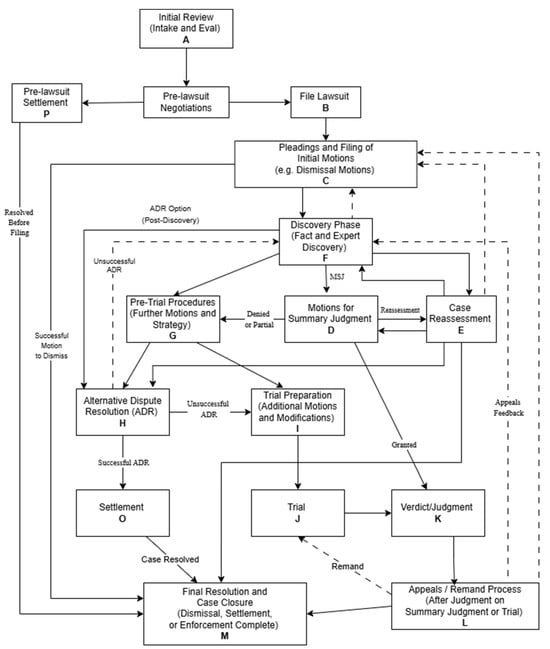
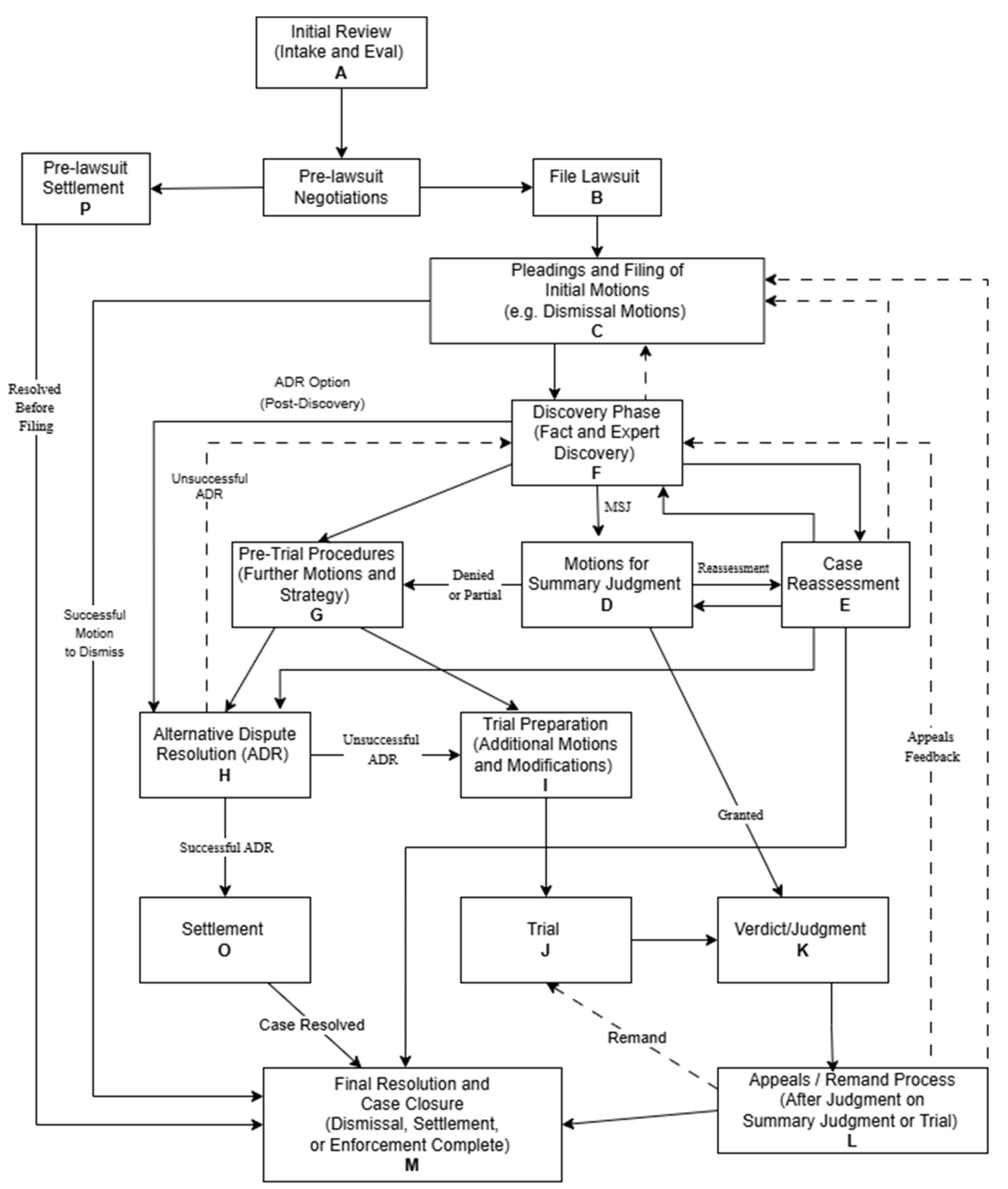

Disclaimer/Publisher’s Note: The statements, opinions and data contained in all publications are solely those of the individual author(s) and contributor(s) and not of MDPI and/or the editor(s). MDPI and/or the editor(s) disclaim responsibility for any injury to people or property resulting from any ideas, methods, instructions or products referred to in the content. |
© 2026 by the authors. Licensee MDPI, Basel, Switzerland. This article is an open access article distributed under the terms and conditions of the Creative Commons Attribution (CC BY) license.