


Abstract
It is well-known that the acceptability judgments at the core of current syntactic theories are continuous. However, an open question is to what extent gradience has to be situated in the grammar itself, or can be derived from extra-grammatical factors (e.g., processing limitations). This paper explores these issues through a model of gradience rooted in the connection between categorical grammars and processing mechanisms, building on a computational framework that links structure-building operations to memory usage. As a proof-of-concept, I leverage structure-sensitive measures of processing effort to evaluate whether categorical representations can derive patterns of gradience, recast as pairwise contrasts, reported in the experimental literature. I show that this approach allows us to derive acceptability differences between items deemed equally well-formed by the underlying categorical grammar. I then discuss the value of this framework for theory evaluation, and for future work on linking hypotheses that fruitfully integrate probabilistic and processing-based insights into the relation between grammaticality and continuous acceptability.
1. Introduction
Acceptability judgments, the baseline measure many linguists use to evaluate the adequacy of syntactic theories, fall on a wide, non-binary spectrum. While gradient grammaticality is not per se at odds with generative approaches to syntax (Chomsky, 1956, 1965, a.o.), a long-standing working assumption in this literature is that syntactic knowledge is, at its core, categorical, and that gradience in acceptability judgments comes from extra-grammatical factors (Sprouse, 2007, a.o.). However, the rise of experimental and computational methods has renewed the question of whether gradience should be integrated into grammatical theories directly (Crocker & Keller, 2005; Francis, 2022; Keller, 2000; Lau et al., 2014, 2015, 2017; Sorace & Keller, 2005).
As the relation between grammaticality and acceptability is not transparent, constructing a well-specified theory of how gradient acceptability arises from grammatical knowledge is clearly valuable. From an empirical perspective, however, categorical approaches seem to fall short when compared to gradient grammatical models rooted in quantitative, probabilistic frameworks. There is an abundance of well-known proposals about the way syntactic structure and cognitive resources can be integrated to derive connections between acceptability and processing difficulty (e.g., Gibson, 2000; Lewis & Vasishth, 2005; McElree et al., 2003; Rambow & Joshi, 1994; Rizzi, 1990; Wanner & Maratsos, 1978; Yngve, 1960, a.o.). However, few models based on current grammatical formalisms have been implemented in precise computational frameworks (cf. Boston, 2010; De Santo, 2020a; Villata & Tabor, 2022).
In order to have a complete theory of how acceptability judgments relate to categorical grammars, what seems to be necessary is a formal model of the syntactic structures licensed by said grammars, and a theory of how such structures interact with extra-grammatical factors to derive differences in acceptability. This would make it possible to test how assumptions about fine-grained syntactic details lead to quantifiable predictions for the gradient acceptability of individual sentences (Sprouse et al., 2018; Stabler, 2013).
In this paper, I show how a computational model based on Minimalist grammars (MGs; Stabler, 2013) is effective in addressing these issues. Importantly, recent work has demonstrated that this model can correctly derive offline and online processing difficulty for a vast set of constructions cross-linguistically, based on complexity metrics that connect memory usage to how the parser navigates fine-grained syntactic details (De Santo, 2020b, 2025; Gerth, 2015; Graf et al., 2017). The ability of MGs to encode rich syntactic analyses makes the parser especially sensitive to fine-grained grammatical information, and thus able to generate quantitative predictions that naturally lend themselves to evaluating gradience. In this context, it is not my goal to claim that MGs are the “correct” formalism to encode grammatical knowledge, nor that they have any a priori advantage in terms of capturing gradient effects compared to other formalisms (e.g., CCG, TAG, HPSG, LFG; I return to this discussion in Section 6). The crucial claim of this paper is that questions about the nature of grammatical representations and their relation to behavioral data can be informed by computational models that integrate symbolic grammars explicitly. Thus, I adopt MGs as the formal grammar at the core of the model as an example of how such an approach would work, given that they can accommodate most representational assumptions of modern Minimalism, and their independent success in a well-specified, algorithmically transparent model of offline processing effects.
Concretely, I model the acceptability judgments for types of syntactic island effects in English, using as a baseline the judgments reported in Sprouse et al. (2012a). Importantly, my main aim is not to settle the debate of whether gradience should be found in the grammar itself, or in the interaction between grammar and external factors (if such a debate could ever be settled). What I offer is a formalized, testable model as a proof-of-concept of the latter hypothesis, in the hope of providing ground for a more principled investigation of categorical grammaticality and continuous acceptability. Importantly, here I do not propose a new model specifically designed to capture gradience. Instead, I show how an approach that proved insightful in studying the broader connection between grammar and processing difficulty can also directly derive gradient differences between equally grammatical structures.
2. Grammaticality, Acceptability, and Theories of Grammar
Historically, acceptability judgments have played a central role in generative syntax, by providing evidence for the kind of phenomena used to motivate a sound theory of grammatical knowledge. Interestingly, while the reliance on acceptability judgments could be interpreted as identifying being grammatical with being acceptable, generative syntacticians have traditionally used grammaticality to refer to the theoretical knowledge of possible structures in the language. However, acceptability judgments as collected by linguists are a performance phenomenon, and grammaticality is only one of the many possible factors (e.g., semantic plausibility, processing difficulty, etc.) driving them. Thus, judgments about the acceptability of a sentence are clearly only an indirect measure of the grammatical distinctions made by the underlying syntactic knowledge.
Since a user’s grammar is not directly accessible to observation or measurement, a widespread view in linguistics is that acceptability judgments are a reasonable proxy to investigate grammatical knowledge. Because of this non-transparent relation between acceptability and grammaticality, though, we need to be careful in how we use human judgments to make inferences about the theoretical properties of the grammar.1 That is, since our aim is to build a theory of an unobservable cognitive object (the grammar) but we can only rely on indirect measures of it (observable behavior), we must also build explicit linking hypotheses between the two constructs. However, building and evaluating such hypotheses is non-trivial, since they are often tied to a number of (related, but separate) theoretical questions (Bever & Townsend, 2001; Ferreira, 2005; Phillips, 2004; Sprouse & Almeida, 2013).
In this sense, a fundamental question about the nature of our theories of grammar arises by observing the granularity of acceptability judgments. In particular, modern versions of the Minimalist program presuppose that grammatical knowledge is, at its core, categorical. Under this view, a user’s grammar establishes a binary distinction between the set of well-formed structures and ill-formed (ungrammatical) ones. However, it is a well-known fact that humans do not produce binary acceptability judgments, but instead classify sentences over a continuous spectrum of acceptability.
An adequate linguistic theory will have to recognize degrees of grammaticalness [...] there is little doubt that speakers can fairly consistently order new utterances, never previously heard, with respect to their degree of belongingness to the language.(Chomsky, 1975, pp. 131–132)
This apparent discrepancy between presupposed categorical grammaticality and gradient acceptability has led to a variety of theories trying to account for it. Here, I want to focus on two main views of how a grammar can account for continuous acceptability, which have been dominating the discussion in the past years. For succinctness, I will focus on sketching the core ideas at two extremes of a spectrum of proposals. For a deeper, nuanced discussion of these proposals, the reader is referred to (Francis, 2022) and references therein.
From one side, we could assume that syntactic competence is categorical and generates all and only the grammatical structures of a given language. On top of that, there are processing mechanisms of varied nature (e.g., probabilistic prediction, cost of reanalysis, memory load, task effects, etc.) that give rise to gradience when measuring grammaticality through acceptability (Bader & Häussler, 2010; Chomsky, 1975; Schütze, 2011, 2016).
On the other hand, we could assume that syntactic knowledge does not establish a binary membership condition over a grammar—thus selecting well-formed structures exclusively. Instead, it generates a probability distribution over all possible—well-formed and ill-formed—structures (Crocker & Keller, 2005; Lau et al., 2017; Sorace & Keller, 2005; Villata & Tabor, 2022). For instance, Lau et al. (2014, 2015, 2017) argue that the distribution of acceptability across a wide selection of sentences can be predicted by using a variety of probabilistic language models. While probabilistic approaches to grammatical knowledge have been explored even within the generative literature (Keller, 2000; Sorace & Keller, 2005), Lau et al.’s take is particularly interesting as it relies on theories of grammar that deviate substantially from modern generative syntax, in the sense that they attempt to explain grammaticality just based on the surface (i.e., word-level) probability of a sentence (see Sprouse et al., 2018, for a critical review of these results).
Importantly, there is no a priori reason to prefer one approach over the other. In fact, an idealized version of either of these theories would hypothetically be able to account for the same set of acceptability data.
Both views have strengths and weaknesses. The probabilistic approach can model certain aspects of linguistic behavior—disambiguation, perception, etc.—quite easily, but it does not naturally account for intuitions of grammaticality. By contrast, binary categorical models can easily express the distinction between grammatical and ungrammatical sentences, but they construe all sentences in each class as having the same status with respect to well-formedness. They do not, in themselves, allow for distinctions among more or less likely words or constructions, nor do they express different degrees of naturalness.(Lau et al., 2017, p. 3)
Going back to the issue of the relation between observable and unobservable cognitive objects in theory building, what this means is that the continuous nature of acceptability data does not necessarily imply an underlying gradient grammar (Lau et al., 2017; Sprouse, 2007, 2023). That is, the behavioral data is compatible with a number of stances about the nature of the underlying cognitive object, that crucially vary on the theoretical assumptions made about the process(es) that connect the two. Thus, informative scientific inquiry into the relation between grammaticality and acceptability has to focus on evaluating the plausibility and explanatory power of complex linking hypotheses beyond simple behavioral adequacy. In this sense, proponents of a continuous approach to grammar have argued that assuming a non-categorical grammar to account for continuous data is more parsimonious, since this type of grammar does not need to stipulate additional mechanisms to reconcile grammaticality with the nature of the observed data. Even this observation is not necessarily true, however, especially if we accept (in the way that seems commonly assumed by researchers on both sides of the debate) that a number of different factors do contribute to acceptability (e.g., processing resources, cognitive effects tied to the judgment task itself, etc.) independently of whether the grammaticality space provided by the grammar itself is continuous or not. In other words, it is conceptually possible to define an approach that derives gradience from processing effects over a categorical grammar relying only on mechanisms that are independently motivated by other sentence processing phenomena.
Computational models can significantly contribute to the discussion (Guest & Martin, 2021). Importantly, formalized models can clarify what kind of assumptions different theories need to make in terms of properties of the grammatical representations and their relation to the mechanisms underlying language acquisition and processing. Thus, well-specified, quantitative implementations of these theoretical frameworks would allow us to understand exactly in which ways they actually differ, both theoretically and empirically.
So far, though, probabilistic approaches have more explicitly embraced the empirical side of this challenge, in that they have been implemented in quantitative models that could be directly tested over human data. On the contrary, there is a lack of models that take generative syntactic assumptions about the nature of the grammar seriously, while also defining a precise performance system that can lead to quantitative predictions (Francis, 2022; Lau et al., 2017; Sprouse et al., 2018).
By contrast, classical formal grammars cannot, on their own, explain these judgment patterns. In principle, they might be able to do so if they are supplemented with a theory of processing. To date, no such combined account has been formulated that can accommodate the data of acceptability judgments to the extent that our best-performing language models can.(Lau et al., 2017, p. 7)
What is needed to significantly advance this debate then is a model showing how/whether the right notion of gradience—fitting human acceptability judgments—can be obtained from a specific categorical grammar.
[...] there is no single, coherent categorical grammar that is sufficiently formalized to perform the kind of quantitative evaluation that [Lau et al.] prefer. [...] direct comparisons between theories are difficult if one (or both) of those theories are insufficiently comprehensive (and formal) to make quantitative predictions.(Sprouse et al., 2018, p. 595)
This paper begins building a foundation to address this gap. The model we leverage here relates sentence acceptability to sentence structure by specifying: (1) a formalized theory of syntax in the form of MGs; (2) a parser as a model of how the structural representation of a sentence is built from its linear form; (3) a linking theory between structural complexity and acceptability in the form of metrics measuring memory usage, which has been previously shown to capture online and offline sentence processing effects. Thus, this model is an ideal candidate to test whether a performance system sensitive to fine-grained syntactic analyses can derive gradient judgments without the need for ad hoc mechanisms. As a first step in addressing this complex question, I investigate whether using measures of processing effort that have been independently proposed to account for different sentence processing results can also derive gradient differences in grammaticality, as summarized by pairwise comparisons between sentences that should be equally grammatical from a categorical perspective.
3. Minimalist Parsing
As mentioned, this paper builds on past research leveraging computational formalisms for the study of human sentence processing (Demberg & Keller, 2008; Gerth, 2015; Graf et al., 2017; Hale, 2001; Joshi, 1990; Kobele et al., 2013; Rambow & Joshi, 1994, a.o.). While different in their technical details and cognitive commitments, the processing models in these works share a tripartite structure consisting of the following:
- A formalized theory of syntax with extensive empirical coverage;
- A sound and complete parser for the grammatical formalism;
- A linking theory between grammar and parser in the form of a complexity metric deriving processing difficulty, which allows for precise psycholinguistic predictions.
Articulating the assumptions behind the psycholinguistic model rigorously allows this kind of approach to connect grammatical information to performance evidence, while (partially) avoiding the risk of empirical indeterminacy intrinsic to every computational cognitive model (Berwick & Weinberg, 1983; Kaplan, 1995).
Specifically, this section summarizes a recent research enterprise (Gerth, 2015; Graf et al., 2015, 2017; Kobele et al., 2013) that explores these issues by combining a top-down parser (Stabler, 2013) with complexity metrics measuring memory usage, as modulated by the rich structural hypotheses of recent versions of the Minimalist program (Chomsky, 1995; Stabler, 1996). This is the model we will use to explore gradient effects in this paper. To walk the reader through an understanding of the approach, I will first discuss the intuitions behind the choice of grammatical representations. Then, I present the details of the parsing model and the way the tree traversal strategy affects complexity metrics and memory load. In doing so, I review a series of results showing the empirical success of the approach in terms of coverage for a variety of sentence processing phenomena in the psycholinguistic literature.
3.1. Minimalist Grammars
Minimalist grammars (MGs; Stabler, 1996, 2011) are a highly lexicalized, mildly context-sensitive formalism incorporating the structurally rich analyses of Minimalist syntax. Much work has been conducted in the past on the formal properties of MGs, showing how they can easily accommodate most of the tools of modern generative syntax—for instance, sideways movement (Graf, 2012, a.o.), copy movement (Kobele, 2006), ATB extraction (Kobele, 2008), extraposition (Hunter & Frank, 2014), and Late Merge (Graf, 2014; Kobele & Michaelis, 2011), among others. As MGs allow for Minimalist analyses to be formalized more or less faithfully, they are particularly suitable for determining to what extent fine-grained syntactic assumptions can affect processing predictions (for a different perspective on MGs and Minimalism, see Frank & Hunter, 2021). The technical details of the formalism are unnecessary given the focus of this paper. I thus introduce MGs in a mostly informal way, as my main goal is to provide the reader with an intuitive understanding of their core data structure: derivation trees. The reader is referred to Stabler (2011) or Graf (2013, Chapters 1 and 2; a.o.) for a more formal introduction.
In MGs, a grammar is a set of lexical items (LIs) consisting of a phonetic form and a finite, non-empty string of features. We distinguish two types of features, each with either positive or negative polarity: Merge features (which I write here in upper caps, with the exception of little v), and Move features (in lower caps). LIs are assembled via two feature checking operations: Merge and Move. Intuitively, Merge encodes subcategorization, while Move encodes long-distance movement dependencies.
Informally, Merge combines two LIs if their respective first unchecked features are Merge features of opposite polarity. Move removes a phrase (whose head’s first unchecked feature is a negative Move feature) from an already assembled tree and displaces it to a different position (as indicated by a matching positive Move feature; Stabler, 2011). Importantly, in standard versions of MGs, a mover always targets the closest possible landing site, making Move a fully deterministic operation: it is always possible to infer which particular subtree is to be displaced to which position, exclusively from the feature specifications of the LIs. Thus, Move can be represented as a unary branching operation, as there is no need to explicitly specify its arguments (Graf et al., 2017).
MGs succinctly encode the sequence of Merge and Move operations required to build the phrase structure tree for a specific sentence into derivation trees (Harkema, 2001; Michaelis, 1998). For instance, Figure 1 compares these two kinds of trees for the sentence Who do the Gems love?. In the derivation tree, all leaf nodes are labeled by LIs, while unary and binary branching nodes are labeled as Move or Merge, respectively. Crucially, the main difference between the phrase structure tree and the derivation tree is that in the latter, moving phrases remain in their base position, and their landing site can be fully reconstructed via the feature calculus. Thus, the final word order of a sentence is not directly reflected in the order of the leaf nodes in a derivation tree.
Figure 1.
Phrase structure tree (left), and MG derivation tree (right), for Who do the Gems love?
As mentioned, derivation trees are the core data structure in MG research. As a record of how a given phrase structure tree is assembled, they contain all the information encoded in the latter. This approach to MGs as generators of derivation trees has numerous technical advantages (Graf, 2013; Hunter, 2011; Kobele, 2006; Kobele et al., 2007). For us, though, the main insights come from the perspective that this view provides on parsing: if the structures produced by an MG parser are derivation trees rather than phrase structure trees, MG parsing turns out to be closely related to parsing of context-free grammars (CFGs). Essentially, MG derivation trees form a regular tree language (Michaelis, 1998; Salvati, 2011, a.o.), and thus—modulo a more complex mapping from trees to strings to resolve the mismatch between movers’ base and final/pronounced position—can be regarded as a simple variant of CFGs (Kobele, 2009; Thatcher, 1967), which have been studied extensively in the computational parsing literature. This is the core insight behind Stabler’s top-down parser.
Before we proceed, a notational clarification. As we will see in the next section, the feature component of the LIs does not play a crucial role for our aims. Thus, in what follows, I will use a simplified version of derivation trees—in which internal nodes are labeled as in a standard phrase structure tree, features are omitted, and movement elements are linked to their target site with dashed arrows (Figure 2). Moreover, for the sake of clarity, unpronounced LIs are indicated by their category (e.g., C, T, v).
Figure 2.
Simplified MG derivation trees for Who do the Gems love?
3.2. Top-Down MG Parsing
Stabler (2013)’s parser for MGs is a variant of a standard depth-first, top-down parser for CFGs: it takes as input a sentence represented as a string of words, hypothesizes the structure top-down, verifies that the words in the structure match the input string, and outputs a tree encoding of the sentence structure. Basically, the parser scans the nodes from top to bottom and from left to right; but since the surface order of lexical items in the derivation tree is not the phrase structure tree’s surface order, simple left-to-right scanning of the leaf nodes yields the wrong word order. Thus, while scanning the nodes, the MG parser must also keep tracking the derivational operations that affect the linear word order. Without delving too much into technical details, this string-driven parsing procedure can be outlined slightly more clearly as follows (Kobele et al., 2013):
- Hypothesize the top of the structure and add nodes downward (toward words) and left-to-right;
- If Move is predicted, it triggers the search for mover ⇒ build the shortest path towards predicted mover;
- Once the mover has been found, continue from the point where it was predicted.
An example of this procedure for the sentence Who do the Gems love? is given in Figure 3, which illustrates how the parser’s predictions are matched to the input string. Importantly, note that lexical nodes in each tree are conjectures that need to be confirmed against the input. For ease of exposition, the input is enriched with empty lexical heads (C, T, v), and a bullet • is used to indicate which lexical item the parser is waiting to integrate into the structure next.2
Figure 3.
Illustrative example of the actions of a string-driven recursive descent parser for Who do the Gems love?. For each tree, an underlined leaf node is a node that has been both conjectured and confirmed.
In the example in Figure 3, the parser needs to confirm leaf nodes according to the linear order of items in the input string Who do the Gems T v love. Such order then influences which nodes in the tree structure are expanded next. Specifically, since the first word in the input is who, the parser does not expand on any left-branching node (e.g., the DP containing the Gems) until who is found. When that happens, who can be scanned: the prediction of the parser is matched to the actual input received. Because of this, while do is postulated at step 3, it can only be scanned at step 10. Similarly, T can only be scanned after who, do, and the whole DP the Gems have been scanned. A summary of the parser’s actions for this example can be found in Table 1.
Table 1.
Summary of the actions of a string-driven recursive descent parser for Who do the Gems love?, as exemplified in Figure 3.
Essential to this procedure is the role of memory: if a node in the tree is hypothesized at step i, but cannot be worked on (scanned) until step j, it must be stored for steps in a priority queue. Moreover, an important advantage of a top-down parser is that the input string is read as a stream, and thus we do not require a separate memory buffer to keep hold of it while the structure is being built.
To make the traversal strategy easy to follow, I adopt Kobele et al. (2013)’s notation, in which each node in the tree is annotated with an index (superscript) and an outdex (subscript). Intuitively, the annotation indicates for each node in the tree when it is first conjectured by the parser (index) and placed in the memory queue, and at what point it is considered completed and flushed from memory (outdex). Figure 4 shows this strategy, presenting an annotated, simplified version of the derivation tree in Figure 1. The reader is invited to verify how such annotations match the parsing steps in Table 1 exactly, and thus allow us to fully reconstruct the tree-traversal strategy illustrated in Figure 3.
Figure 4.
MG derivation tree for Who do the Gems love?, annotated according to a top-down string-driven tree traversal. Boxed nodes are those kept in the stack memory for more than 2 (trivial) steps, following (Graf & Marcinek, 2014).
Importantly, the annotation strategy also clearly highlights in what respect the string-driven nature of Stabler’s parser distinguishes it from the tree-traversal strategy of a standard recursive-descent parser. Consider Figure 5, illustrating how a standard recursive descent parser would operate over an MG derivation tree for the sentence Who do the Gems love?. As discussed before, Move alters the precedence relations between leaf nodes in the derivation tree. But, unlike in a phrase-structure tree, this is not reflected by the order of the leaf nodes in the tree itself. In particular, the standard recursive-descent parser tries to scan the leaf nodes in this derivation in the following order: do T the Gems v love who. Thus, the parser would first try to reach do and scan it. However, since that leaf node does not match the first word in the input (who), scanning it would be impossible, and the parse would be aborted. The problem with the CFG recursive descent parser is in the assumption that the left-to-right order in trees reflects the left-to-right order in the derived string.
Figure 5.
Standard recursive-descent tree-traversal for Who do the Gems love? (compare to the string-driven strategy in Figure 4).
Stabler’s insight is that the order in which leaf nodes need to be scanned can be inferred from the feature calculus, thus modifying the straightforward depth-first strategy of the recursive descent (see Figure 4). Intuitively, the string-driven recursive descent parser chooses a right branch instead of a left one whenever the right branch contains a mover, and in the input this mover appears to the left of all the material in the left branch (Graf et al., 2017).
In sum, Stabler’s top-down algorithm seems to capture some core properties of human language processing strategies: it works incrementally, and it is predictive—it makes hypotheses about how to build the upcoming syntactic structure that then need to be confirmed based on the input (Demberg & Keller, 2009; Marslen-Wilson & Tyler, 1980; Phillips, 2003; Tanenhaus et al., 1995, a.o.).
As in other aspects of cognition, prediction also plays a crucial role in language processing. In the MG model, this is reflected by the fact that the predictive abilities of the top-down approach guide how the parser recruits memory resources. Finally, note that Stabler’s original formulation assumes the parser to be equipped with a search beam that discards the most unlikely predictions. This beam makes it possible for the parser to handle ambiguity in selecting possible next steps (e.g., by probabilistic mechanisms or another form of rule-selecting heuristic). However, work using the MG parser to model processing has ignored the beam component of the model, assuming that the parser is equipped with a perfect oracle, which always makes the right choices when constructing a tree (De Santo, 2019; Graf et al., 2017; Kobele et al., 2013). While disambiguation is known to play an important role in human sentence processing (Chambers et al., 2004; Ellis, 2002; Hale, 2006; Levy, 2013; Traxler & Pickering, 1996; Wagers & Phillips, 2009), this approach considers a deterministic parsing strategy, where ambiguity and reanalysis are not explicitly considered. The choice to factorize the sentence processing system and to assume a deterministic oracle to zoom in on the role of structure building is generally common in the computational psycholinguistic literature (Boston, 2012; Brennan & Hale, 2019; Brennan et al., 2016; Demberg & Keller, 2008; Demberg et al., 2013; Stanojević et al., 2023, a.o.). Given the complex relation between online parsing and offline results and the ongoing debates about how the human parser navigates the search for a correct structural analysis, it is intriguing that models that abstract away from the choice of the correct parse can nonetheless capture online and offline data (cf. Dillon et al., 2019; Hale et al., 2018; Huang et al., 2024; Ozaki et al., 2024). This simplified MG model has also been argued to be informative in the study of structural ambiguity (De Santo, 2025; De Santo & Lee, 2022; Lee, 2018).
Similarly, human performance during sentence comprehension and production is demonstrably affected by a variety of factors, including lexical biases (MacDonald et al., 1994) and world knowledge (Chambers et al., 2004; Kentner, 2019), which the MG model purposely ignores. These idealizations are clearly implausible from a psycholinguistic point of view, and the model could in principle consider these additional factors. However, these choices are made with a precise purpose in mind: to focus on the specific contribution of the syntactic structure building to processing difficulty.
3.3. Measuring Memory Usage
In order to allow for psycholinguistic predictions, the behavior of the parser must be related to processing difficulty via a linking theory, which here takes the form of complexity metrics. Specifically, the MG model relies on complexity metrics that predict processing difficulty based on how the geometry of the trees built by the parser affects memory usage.
Based on previous work on MG parsing (Gerth, 2015; Graf & Marcinek, 2014; Kobele et al., 2013), Graf et al. (2017) distinguish three cognitive notions of memory usage: (a) how long a node is kept in memory (tenure); (b) how many nodes must be kept in memory (payload); (c) how much information is stored in a node (size). Extending the work of Joshi (1990) and Rambow and Joshi (1994), Kobele et al. (2013) assume that one memory unit is allocated per item on the parser’s stack, where the stack holds predictions yet to be verified (nodes predicted by the grammar but not scanned yet).3 Then, tenure reflects “the amount of time that an item is retained in memory”.
Tenure for each node n in the tree can be easily computed via the node annotation schema of Kobele et al.: a node’s tenure is equal to the difference between its index and its outdex.4 Then, the payload of a derivation tree is computed as the number of nodes with a tenure strictly greater than 2.
Defining size in an informal way is slightly trickier, as its original conception was based on how information about movers is stored by Stabler’s top-down parser (for a technical discussion, see Graf et al., 2015). Intuitively, size encodes how many nodes in a derivation consume more memory because a certain phrase m moves across them. When the top-down parser conjectures a Move node (e.g., CP in Figure 4), it is also conjecturing that it will contain a phrase undergoing movement (thus, a negative movement feature wh−). To keep track of the movement dependency to be resolved, the parser will carry a wh+ feature when conjecturing new structure, until a node carrying wh− is found. Size, then, provides a way to compute how many additional features the parser has to carry around, increasing memory consumption. Procedurally, the size of the parse item corresponding to each node n can be simply computed by exploiting our simplified representation of derivation trees: it corresponds to the number of nodes below n that have a movement arrow pointing to somewhere above n. In practice, size encodes the additional cost of long movement dependencies over short ones.
The majority of previous work on this model has been interested in exploring the role grammatical information has in driving off-line processing results. What we are missing then is a way for these notions of cost to be applied to a given derivation as measures of overall processing difficulty. In order to do so, these definitions of memory usage have been used to define a vast set of complexity metrics measuring processing difficulty over a full derivation tree. This will also be the essential step that will allow us to connect estimated processing difficulty to degraded acceptability.
3.3.1. Complexity Metrics
Kobele et al. (2013) associate tenure with quantitative values by defining three base complexity metrics:
MaxT and AvgT5 measure the maximum and average amount of time any node stays in memory during processing, respectively. In turn, SumT measures the overall amount of memory usage for all nodes whose tenure is not trivial (i.e., >2). It thus captures total memory usage over the course of a parse. Through a series of modeling simulations, Kobele et al. (2013) show that tenure-based metrics (MaxT in particular) can account for the well-established contrasts between center-embedding and right-embedding constructions in English (Bach et al., 1986; Cowper, 1976; Gibson & Thomas, 1999; Miller & Chomsky, 1963), as well as for differences in the processing of nested and crossing dependencies in Dutch and German (Gibson, 2000). Building on these results, Graf and Marcinek (2014) discuss how MaxT also correctly accounts for a set of solidly documented processing asymmetries for relative clause (RC) constructions (Frauenfelder et al., 1980; Gibson, 1998, 2000; Gibson & Wu, 2013; Goodluck & Tavakolian, 1982; Gordon et al., 2001; King & Kutas, 1995; O’Grady, 2011; Reali & Christiansen, 2007; Schriefers et al., 1995, a.o.):
- SC/RC < RC/SCA sentential complement containing a relative clause is easier to process than a relative clause containing a sentential complement.
- SRC < ORCA relative clause containing a subject gap (SRC) is easier to parse than a relative clause containing an object gap (ORC).
However, Graf and Marcinek (2014) point out that, if they also consider the processing contrasts in Kobele et al. (2013), tenure-based metrics find it difficult to account for all of these phenomena at the same time (cf. Gerth, 2015).
Extending Graf and Marcinek (2014)’s analysis of relative clause constructions cross-linguistically, Graf et al. (2015) also argue for the insufficiency of MaxT as a single, reliable metric. Additionally, Graf et al. (2017) point out that, given the MG parser’s sensitivity to fine-grained structural details, a comprehensive evaluation of the model should also modulate processing phenomena over different syntactic analyses cross-linguistically. Based on this observation, Graf et al. (2015) and Graf et al. (2017) then introduce several new metrics, inspired by those defined for tenure. Relevant to this paper, they introduce the equivalent of SumT for size, which measures the overall cost of maintaining long-distance filler-gap dependencies (O’Grady, 2011). Let N be the set of all nodes of derivation tree t that are the root of a subtree undergoing movement. For each , is the index of n and is the index of the highest Move node that n’s subtree is moved to. Then SumS is defined as . The full set of base metrics introduced by Graf et al. (2017) is summarized in Table 2.
Table 2.
Summary of the base metrics defined in Graf et al. (2017). We refer to n as any node in a derivation tree t. For size-based metrics, N refers to the set of all nodes that are the root of a subtree undergoing movement, while is the index of the highest Move node that the subtree related to the node n is moved to.
3.3.2. Contrasting Derivations: An Example
As an illustrative example of how these complexity metrics are used to derive offline processing predictions, consider (1) and (2).
| (1) | Who __ loves the Gems? | Wh Subject |
| (2) | Who do the Gems love __ ? | Wh Object |
In (1), there is a dependency between Who at the beginning of the sentence and the subject position of loves. In (2), this dependency is instead established with the object position. The corresponding derivation trees, annotated by the MG parser with index and outdex values at each node, are shown in Figure 6. To keep the parsing steps straightforward to follow while staying in line with standard Minimalist structural assumptions, let us again assume that phonologically empty functional heads are already present in the input string, as follows:
| (3) | Who C T v loves the Gems? | Wh Subject |
| (4) | Who do the Gems T v love? | Wh Object |
Consider now the node C in the left tree in Figure 6. This node is introduced in the memory stack at step 3, as soon as the parser predicts that should be expanded in a subtree. However, C cannot be scanned until who is found and scanned (at steps 6 and 7). Thus, tenure for C is computed as .
Figure 6.
Annotated derivation trees for (left) Who loves the Gems? and (right) Who do the Gems love?
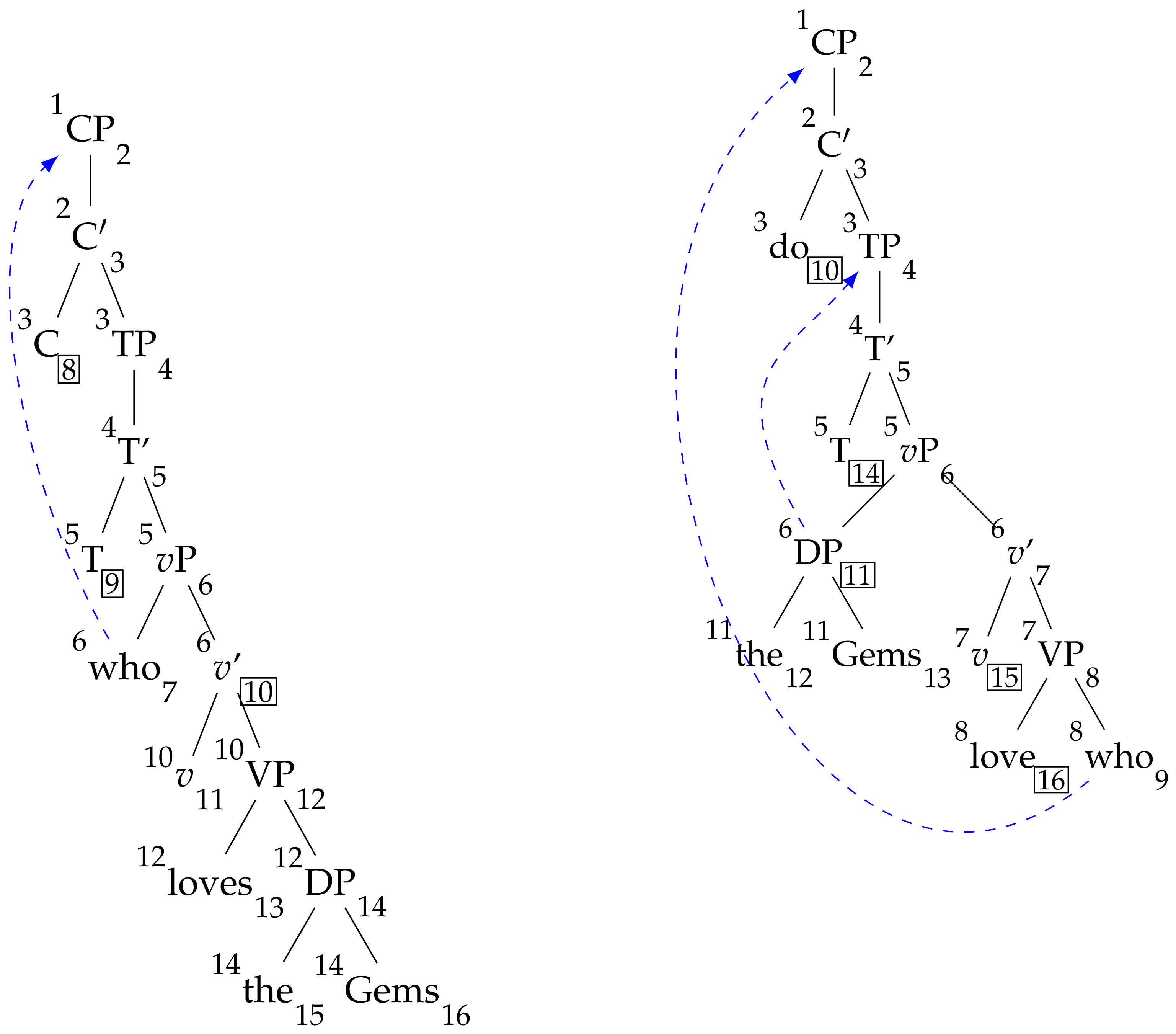
Consider now the same node in the adjacent tree (do). As before, do is introduced at step 3, but it has to wait until the first word in the input (who) is scanned. This time, however, who originates from a lower position and can only be scanned at step 9. Then, tenure for does is . Note also how movement out of the subject or object position affects the overall traversal strategy. In the first tree, once is expanded, the left branch is immediately explored, and the parser goes back to expanding the right branch of the prediction only after C and T have also been scanned and flushed out of the memory queue. In the other tree instead, the left branch is ignored, and the right branch is expanded so that the parser can explore the quickest path to who.
A summary of the non-trivial (i.e., >2) tenure values for the two trees is shown in Table 3. As can be seen from this table, the maximum tenure for the Subject derivation in Figure 6 (left) is 5, registered at the node C. Tenure of the Object derivation is instead highest at v, where it reaches 8 (). Thus, if we use MaxT to compare the processing difficulty of the two derivations, the model predicts that Wh Subject is easier to process than Wh Object. While this is essentially a mock example, it seems that the model captures the general psycholinguistic intuition that resolving long movement dependencies is costly.
Table 3.
Summary of non-trivial tenure values for the derivations in Figure 6. For each derivation, nodes with MaxT values are bolded and highlighted in red.
3.3.3. The Final Piece: Ranked Metrics
Lastly, Graf et al. (2015) introduce the idea of ranked metrics of the type . These are similar to constraint ranking in Optimality Theory (Prince & Smolensky, 2008): a lower-ranked metric matters only if all higher-ranked metrics have failed to pick out a unique winner. For instance, take the ranked metric ⟨MaxT, SumS⟩. If two constructions result in a tie over MaxT, then their SumS values will decide which of the two is the winner.
Graf et al. (2017) show that, when complexity metrics are allowed to be ranked in such a way, the total number of possible metrics quickly reaches an astronomical size (up to 1600 distinct metrics).6 Given such an explosion in the metric space, it would be reasonable to wonder whether such quantitative measures are helping, or if instead are just once again highlighting the empirical difficulties connected to formulating a valid, psychologically plausible linking theory. However, surveying the variety of previously modeled phenomena, Graf et al. (2017) suggest that the number of metrics truly needed to account for human processing contrasts can be reduced to a small number of core metrics. This hypothesis seems supported by recent work on several different constructions cross-linguistically, which shows that a ranked combination of ⟨MaxT, SumS⟩ can be strikingly successful in capturing the correct difficulty predictions for several off-line processing phenomena cross-linguistically (Del Valle & De Santo, 2023; De Santo, 2019; De Santo & Lee, 2022; De Santo & Shafiei, 2019; Fiorini et al., 2023; Lee, 2018; L. Liu, 2018; Zhang, 2017).
Looking at the relation between structural complexity and processing effects through the lens of an MG parsing model has thus proven empirically successful and theoretically insightful. In what follows, I will explore whether this model can derive gradient contrasts between constructions predicted to be equivalently well-formed by a categorical grammar, specifically through the ⟨MaxT, SumS⟩.
4. Modeling Gradient Acceptability in Syntactic Islands
The value of a computational modeling approach in addressing theoretical questions is crucially dependent on choosing an appropriate evaluation set. When it comes to the MG model discussed in the paper, this problem can be reframed as the issue of selecting an appropriate set of contrasts, which are going to be maximally informative when compared through the MG complexity metrics. In the case of acceptability judgments, the variety of alternative comparisons forces us to explicitly commit to the nature and relevance of the constructions we are going to evaluate (Francis, 2022; Lau et al., 2017; Sprouse et al., 2018).
In fact, several datasets are available in the literature, created specifically for the study of gradience in acceptability judgments. For instance, we could look at acceptability contrasts present in the datasets used by Lau et al. (2014, 2015, 2017). These datasets collect a range of acceptability scores over sentences from different domains and languages, obtained by drawing items from corpora, automatically inducing grammatical violations, and then crowd-sourcing users’ acceptability judgements. Alternatively, we could look at more linguistically controlled contrasts, as exemplified in the datasets collected by Sprouse et al. (2013, 2018) or Sprouse and Almeida (2012). All of these contain a vast selection of judgments over sentences with syntactic violations of various sorts, and vary widely in terms of structural configurations.
However, as discussed in previous papers, the MG metrics’ sensitivity to minor differences in syntactic structure makes the MG parser’s predictions most interpretable when used to compare the relative complexity of minimally different sentences. Careful comparisons across sentences as similar as possible in their underlying syntactic structure seem also desirable, if we want to understand the source of gradient variation in acceptability judgments. For these reasons, this paper focuses on modeling the data on the acceptability of syntactic islands collected by Sprouse et al. (2012a) (henceforth SWP), as a proof of concept for the viability of the parser as a model of gradient acceptability.
4.1. Gradience in English Island Effects
Syntactic islands are well-known in linguistics (Chomsky, 1965; Ross, 1968) as a set of phenomena in which the acceptability of a sentence is degraded, in relation to the interaction of a long-distance dependency and its syntactic context. Consider the following sentences:
| (5) | a. Whati do you think that John left ti at the office? |
| b. Whati do you laugh if John leaves ti at the office? |
In (5)a, there is a long-distance dependency between what in the sentence-initial position and its lower position as the complement of the verb left. In (5)b, this same dependency cannot be established, as what is inside an adjunct clause (headed by if). Thus, (5)b is considered ill-formed by native speakers of standard American English. Since establishing long-distance dependencies from inside an adjunct leads to ungrammaticality, adjunct clauses are a classic example of island structures.
To investigate the origin of these effects, SWP conducted an extensive study of the acceptability of island constructions by collecting formal acceptability judgments for four island types using a magnitude estimation task.7 In particular, the stimuli in SWP’s design were based on a factorial definition of island effects, and explicitly identified two structural factors that might affect acceptability: 1) the length of a long-distance dependency; 2) the presence of a so-called “island construction” (Kluender & Kutas, 1993). Consider how the sentences in (6) expand on the contrast in (5):
| (6) | a. Whoi ti thinks that John left his briefcase at the office? | Matrix | Non Isl. |
| b. Whati do you think that John left ti at the office? | Emb. | Non Isl. | |
| c. Whoi ti laughs if John leaves his briefcase at the office? | Matrix | Isl. | |
| d. Whati do you laugh if John leaves ti at the office? | Emb. | Isl. |
In (6), the extraction site of the wh-element can either be in the matrix clause (Matrix) or in the embedded one (Emb.). This contrast is meant to isolate the effect of dependency length (short vs. long) on acceptability. Sentences are then modulated along a second dimension: Island or emph Non-Island. Consider the Island sentences in (6)c and (6)d. Importantly, the Island label does not imply an island violation (i.e., ungrammaticality). Instead, I am following Sprouse et al. (who in turn follow Kluender & Kutas, 1993), and refer in these contrasts to the presence of an island structure: a clause that could in principle be an island (e.g., an adjunct clause, as in (6)a,b vs. (6)c,d). According to Kluender and Kutas (1993), there is a processing cost associated with the operations necessary to build these structures. Decomposing sentences across this second dimension is then meant to isolate the effect of processing intrinsically costly island constructions.
Crucially, the careful dimensional decomposition of the test sentences (a factorial design) results in minimally different pairwise comparisons, ideal for the MG parser’s modeling approach. Moreover, while a categorical grammar would predict a binary split in sentence acceptability (violates an island/does not violate an island), the continuous scale of the acceptability estimation task in SWP revealed a spectrum of gradient judgments. Thus, the contrasts in this study are optimal for our purposes.
In what follows, I test whether the gradient of acceptability shown in SWP’s data is predicted by a parser grounded in a rich categorical grammar. Before proceeding with the modeling analysis, though, it seems to be important to make an additional note about my aim. In particular, given that the data I am going to test the parser on is a collection of acceptability judgments for sentences containing islands, it seems important to clarify how this modeling approach fits into an ongoing debate about the nature of island effects.
4.2. Another Debate: The Nature of Island Effects
There is an ongoing debate in the literature about the nature of island effects —with some accounts rooting them in grammatical constraints, while others argue that such effects can be reduced to a conspiracy of processing (or other) factors. Consider again the examples in (6)d, which we said is predicted to be unacceptable, since there is a long-distance dependency established from a position within an adjunct clause. Note that this is not an explanation as to why that should be the case. Instead, it is an attempt to capture a widely observed generalization: there are specific types of structures that “block” the formation of long-distance dependencies, which have been historically labeled islands.
Island phenomena are well attested cross-linguistically, even though there is significant variability in terms of the kind of structures that give rise to these effects (Alexopoulou & Keller, 2003; Andersson et al., 1982; Georgopoulos, 1985; Rizzi, 1980; Saah & Goodluck, 1995, a.o.).
Following Ross (1968), mainstream generative syntax has used these phenomena to posit the existence of island constraints: grammaticalized restrictions on the formation of long-distance dependencies. These constraints have played a fundamental role in the development of syntactic theories that assume domain-specific biases in acquisition (Chomsky, 1986, 1993; Chomsky et al., 1973, a.o.). Despite their long history, though, island constraints have lacked stable analyses, in part due to the heterogeneity of these effects and of the acceptability judgments used to motivate different island constraints—often ripe with possible counter-examples (Hofmeister & Sag, 2010; Szabolcsi et al., 2006). Moreover, while many cases of unacceptability involving long-distance dependency formation are collected under the umbrella term of islands, it is unclear whether a uniform account of these effects is possible or even desirable (cf. Chaves, 2021a; Sabel, 2002).8
These facts have led researchers to formulate a different kind of theories that attempt to explain island effects not in terms of grammatical constraints, but as side-effects of limitations on the human sentence processing system (Alexopoulou & Keller, 2007; Deane, 1991; Hofmeister & Sag, 2010; Kluender, 1992, 1993; Kluender & Kutas, 1993). That is to say, in (6)d there is nothing specifically wrong with the formation of a long-distance dependency from inside the adjunct clause. Instead, the unacceptability of the sentence would be due to the processing requirements for that specific construction (e.g., increased memory load).
The factorial design in SWP was meant to explicitly address this debate. Specifically, it targeted the idea that the unacceptability of sentences that give rise to island effects could in fact be reduced to the presence of factors that increase processing effort (thus lowering acceptability) independently of specific grammatical constraints. What their experiments showed is that sentences like (6)d give rise to a so-called super-additivity effect—a non-linear increase in unacceptability, which they argued could not be explained just as the sum of independent processing factors. While SWP take these results as clear evidence against processing-based accounts of islands, the debate on the source of these effects is still open (cf. Hofmeister et al., 2012a, 2012b; Sprouse et al., 2016, 2012b).
Importantly, it looks like the MG model could be construed as a processing-based approach to the unacceptability of island phenomena. However, in this paper, I am not attempting to reduce island effects to processing demands and, at least at this stage, it is not my purpose to directly engage with this debate. For the same reasons, I do not investigate the super-additivity found in SWP’s paper. Relatedly, I do not claim that the acceptability of island violations is purely syntactic in nature, as it has been shown to be sensitive to a variety of factors (e.g., semantics and pragmatics; Abeillé et al., 2020; Cartner et al., 2026; Chaves, 2021a, 2022; Cuneo & Goldberg, 2022; Kohrt et al., 2018; Kush et al., 2018; Momma & Dillon, 2023; Szabolcsi et al., 2006; Truswell, 2011), a.o.). Crucially, in this paper, I am “just” interested in exploring the idea that (at least part of) the gradient component of these acceptability judgments arises due to processing factors. The use of sentences involving island effects is exclusively due to the optimal baseline offered by SWP’s data.
Finally, discussing gradience in the context of island effects could be the source of one additional point of confusion. In the theoretical syntax literature, there is a well-known distinction between strong (e.g., Complex NPs) and weak (e.g., whether clauses) islands (Phillips, 2013a, 2013b; Ross, 1968, a.o.). Famously, while strong islands never permit extraction, weak islands permit extraction of specific types of elements (Szabolcsi & Lohndal, 2017; Truswell, 2007). For instance, both strong and weak islands disallow extraction of adjuncts, but weak islands are supposed to allow extraction of arguments, under certain conditions. Thus, it looks like islands could be gradient, in the sense that there is variation in how severe these effects are depending on the type of extraction domain, and of the element being extracted (Abeillé et al., 2020; Chaves, 2022, a.o.). In this sense, it is possible that processing factors could be contributing to such variation (Keller, 2000; Kluender, 1992, 1998), and that a computational model such as the one presented here could help in addressing the origin of such effects (Boston, 2010; De Santo, 2020a; Villata & Tabor, 2022). These issues are clearly tied to questions about the nature of island constructions. As mentioned repeatedly above, though, here, I am only interested in addressing the issue of gradience as non-binarity in the degree of acceptability of purportedly grammatical sentences, and not in modeling the (un)grammaticality of island violations per se.
Pursuing a deeper understanding of the nature of island effects—and the trade-off between syntactic constraints and memory limitations—is a worthwhile future endeavor, but the relation between categorical grammars and gradient acceptability is a fundamental issue on its own, and it is the focus of the rest of this paper. Thus, in what follows I exclusively discuss how the MG parser can model the gradience in acceptability for the case studies reported in Sprouse et al. (2012a). I will return to the question of whether this model could give us any insights into the question of separating processing and grammatical contributions to island phenomena in Section 6.
5. Modeling Results
As a reminder, the core linking hypothesis explicitly connects processing difficulty to acceptability by assuming that higher memory cost (as captured by memory-usage metrics) implies lower acceptability. Staying true to the goal of deriving gradience from an independently verified model of processing effort, I focus here on the predictions made by a ranked version of ⟨MaxT, SumS⟩ in comparing effort for contrasting sentences.
With all preliminaries in place, this section evaluates the MG parser’s performance on the acceptability contrasts for English Islands effects in SWP. SWP focused on English wh-movement dependencies to explore four types of island constructions: Subject, Adjunct, Complex NP, and Whether islands. Table 4 overviews how the predictions of the MG model fares with respect to SWP’s experimental results, summarized in qualitative pair-wise contrasts by condition (see Table 4).9 Remember also that the complexity metrics adopted here are only sensitive to the geometry of a derivation tree, and to how the linearized string affects the tree-traversal strategy of the parser. Since in the SWP dataset all sentence items are controlled for structure, each lexically different item within a condition will have the exact same derivation (and thus be functionally identical for the model). Thus, the results below are presented with respect to one lexicalized example set, since those scores generalize to every item in the stimulus set for that same condition. These scores are then contrasted with pairwise differences extracted from aggregated behavioral data. We assume that there is a difference between two conditions if that difference was statistically significant in the original paper, which used a model that included item-level differences as random effects.
Table 4.
Summary of results (as pairwise comparisons) from Sprouse et al. (2012a), and corresponding parser’s predictions (x > y: x more acceptable than y). For each comparison, a check-mark means that model’s predictions and human data coincide.
5.1. Subject Island: Case 1
First, I model Subject islands as in SWP’s Experiment 1, comparing sentence types across conditions: Subject/Object extraction and Island/Non-Island. Note again that here Island does not imply a violation, but refers to the presence of an island structure (Kluender & Kutas, 1993).
| (7) | a. Whati do you think the speech interrupted ti? | Obj/Non Island |
| b. Whati do you think ti interrupted the show? | Subj/Non Island | |
| c. Whati do you think the speech about global warming interrupted the show about ti? | Obj/Island | |
| d. Whati do you think the speech about ti interrupted the show about global warming? | Subj/Island |
Annotated MG derivation trees for these sentences are shown in Figure 7 (Object/Subject with No Island) and Figure 8 (with Island).10 The parser’s predictions (via MaxT) overall match the experimental results (see Table 4).11
Figure 7.
Annotated derivation trees for (left) (7)a (object, non-island) and (right) (7)b (subject, non-island).
Figure 8.
Annotated derivation trees for the test sentences in (left) (7)c (object, island) and (right) (7)d (subject, island).
The factorial design of the original study helps us understand the model’s predictions. The contrast between (7)b and (7)a, (7)d is correctly captured by MaxT. This is due to the wh-element spanning a longer, more complex structure comprising the whole embedded DP subject in the Island cases. Compare (7)a and (7)b, both with the highest tenure on do (14 and 11, respectively—Table 5). In (7)a, do is conjectured after what has been scanned from the input, but it cannot be flushed out of memory until what is confirmed in its base position as the embedded complement. In (7)b, do only has to wait in memory until the embedded subject position is reached.
Table 5.
Summary of MaxT (value/node) and SumS by test sentence for Subject island in case 1 and 2 (T2 marks the embedded T head.)
Consider now (7)c. Here, the highest tenure is on the embedded T head, which has to wait for the wh-element in object position, and then for the whole complex DP in subject position, before it can finally be flushed out of the queue. The longer wh-dependency in the object case explains once again why (7)b is preferred over (7)c, and the additional complexity of the DP subject is crucial in driving the (7)a > (7)c contrast.
Finally, there is one case in which the parser’s predictions and experimental data disagree: the contrast between subject and object extraction in the island condition ((7)c vs. (7)d). The parser predicts that (7)c should be more acceptable than (7)d (Subj/Island > Obj/Island). This is not surprising, as the memory metrics pick up on the additional length of the extraction in the object case, and thus obviously predict the preference for a subject gap. However, SWP show Obj/Island > Subj/Island—which is expected from a theoretical perspective since (7)d is the ungrammatical condition (i.e., there is an extraction out of an island).
I will come back to the significance of this mismatch in Section 6. For now, recall that here I am not trying to account for the ungrammaticality of island violations. Instead, I am trying to show that the gradient can arise correctly from a processing system fine-tuned to the details of a categorical grammar. Crucially for this claim then, the parser correctly predicts the gradient of acceptability for those conditions that, according to the grammar, should all be equivalently well-formed (i.e., those containing no “forbidden” extraction).
5.2. Subject Island: Case 2
The previous section suggests that, when a grammatical violation coincides with processing factors (e.g., structural length of a dependency), parser and human judgments should match on all contrasts. Luckily, SWP offers us the chance to test such a prediction, with a second set of subject island sentences. SWP’s Experiment 2 compares a short dependency and long dependency (Matrix vs. Embedded extraction in the original paper), again in an Island and Non-Island condition.
| (8) | a. Whoi ti thinks the speech interrupted the primetime TV show? | Matrix | Non Isl. |
| b. Whati do you think ti interrupted the primetime TV show? | Emb. | Non Isl. | |
| c. Whoi i thinks the speech about global warming interrupted the primetime TV show? | Matrix | Isl. | |
| d. Whati do you think the speech about ti interrupted the primetime TV show? | Emb. | Isl. |
As expected, parser’s preferences and experimental data fully match in this case, as the ungrammatical condition ((8)d) is also the one in which the movement dependency is the longest. Here, however, deriving the correct preferences requires the ranking of ⟨MaxT,SumS⟩, instead of just MaxT alone (note also that SumS by itself would not suffice, as it would not predict (8)a > (8)c, see Table 5). Such a ranking also preserves the results in the previous section, which fully relied on MaxT. Interestingly, note how MaxT values for (8)b (Emb. | Non Isl.) and (8)c (Matrix | Isl.) tie here, as the additional structural complexity of (8)c does not interact with the main movement dependency (who raising from Spec,TP to Spec,CP). Moreover, the Matrix | Non Isl. ((8)a) and Matrix | Isl. ((8)c) conditions have very similar structures (with an extraction out of the main subject). Nonetheless, the memory metrics are able to capture subtle differences in the way the parser goes through the two sentences (arguably encoding the “island construction” cost of Kluender & Kutas, 1993).
5.3. Adjunct and Complex NP Islands
So far, we have been successful in replicating SWP’s acceptability judgments via the MG parser. However, we might wonder whether this success is due to something peculiar in the way the Subject island test cases interact with the MG parsing strategy. Thus, I tested the MG parser on Adjunct and Complex NP islands12, again using as a baseline the results in SWP’s Experiment 1. The test sentences for the adjunct case were as follows:
| (9) | a. Whoi ti thinks that John left his briefcase at the office? | Matrix | Non Isl. |
| b. Whati do you think that John left ti at the office? | Emb. | Non Isl. | |
| c. Whoi ti laughs if John leaves his briefcase at the office? | Matrix | Isl. | |
| d. Whati do you laugh if John leaves ti at the office? | Emb. | Isl. |
As for Subject islands in case 2, ⟨MaxT,SumS⟩ correctly predicts the pattern of acceptability reported by SWP, matching the empirical results across all conditions (see Table 6). Similar results are obtained for the Complex NP island, with test sentences as follows:
| (10) | a. Whoi ti claimed that John bought a car? | Matrix | Non Isl. |
| b. Whati did you claim that John bought ti? | Emb. | Non Isl. | |
| c. Whoi ti made the claim that John bought a car? | Matrix | Isl. | |
| d. Whati did you make the claim that John bought ti? | Emb. | Isl. |
Once more, the parser matches the acceptability preferences reported in SPW correctly in all conditions (Table 6). Particularly interesting is the absence of a contrast between (9)a and (9)c. This is again due to the absence of a real interaction between the additional structural complexity of the island and the main movement dependency. The fact that it results in a tie stresses how movement dependencies and structural complexity conspire with the top-down strategy of the MG parser in non-trivial ways to drive memory cost.
Table 6.
Adjunct Island and Complex NP Island: MaxT (value/node) and SumS values by test sentence.
5.4. Whether Island
Finally, we consider the case of Whether Islands. This construction is of particular note since it highlights how the structural sensitivity of the parser makes the choice of syntactic analysis a crucial parameter/degree of freedom for the model. Consider the stimuli from SWP:
| (11) | a. Whoi ti thinks that John bought a car? | Matrix | Non Isl. |
| b. Whati do you think that John bought ti? | Emb. | Non Isl. | |
| c. Whoi ti wonders whether John bought a car? | Matrix | Isl. | |
| d. Whati do you wonder whether John bought ti? | Emb. | Isl. |
In (11)d, what originates from within the clause headed by whether, thus leading to a whether-island violation and reported ungrammaticality. Compare it now to the minimally different long-distance dependency in (11)b. If we assume that whether is a complementizer, then there is no difference in structure between (11)b and (11)d (and similarly, between (11)a and (11)c), at least at the level of the geometry of the derivation tree. That is, the “structural” manipulation between the Island and Non-Island condition does not really exist. Therefore, even without running any simulation, we know that the MG model would not be able to capture any processing difference across this factor (though it might, of course, still capture differences across the other condition).
However, there have been convincing arguments that in this type of clauses whether is in fact not a complementizer, but it is instead the wh-counterpart to either (den Dikken, 2006; Han & Romero, 2004; Larson, 1985; Wu, 2022a, 2022b, a.o.). That is, whether would not be like that or if and occupy a C position, but it would instead originate from within the embedded clause and raise up to Spec, CP. Arguments for this line of analysis rely on the syntactic behavior of whether resembling that of other wh-words (e.g., in its ability to pied-pipe), as well as on cross-linguistic comparisons with constructions in Polish and Bengali (Wu, 2022a, 2022b). Additionally, independent support for this view can be found in recent experimental results providing evidence for the presence of a null complementizer in whether clauses (Momma et al., 2025).
Therefore, the modeling simulations for the Whether Island cases will be conducted on derivations following the type of structural analysis suggested in Wu (2022a). Under this approach, the parser’s preferences and experimental data fully match (see Table 7).
Table 7.
Whether Island: MaxT (value/node) and SumS values by test sentence (T2 marks the embedded T head).
As summarized in Table 7, MaxT alone successfully predicts all contrasts. Crucially, the fact that SumS would make the wrong prediction for this contrast ends up not mattering for the final results since MaxT is ranked higher. Although the analysis adopted here adds additional structure to the “Island” conditions, the model nicely captures the fact that the Matrix | Non Isl. case is more acceptable than the Emb. | Non Isl. case. It is worth noting that the fact that these results rely on a specific analysis of the construction is a feature of the approach, not a bug. The model is by design not agnostic with respect to the syntactic representation of interest. Importantly, though, the analytical choices are not made to serve the MG model, but they are grounded in independently motivated theoretical arguments from the syntactic literature.
6. Discussion
This paper aims to contribute to the ongoing debate about whether the source of gradience in human acceptability judgments must be situated in the grammar itself, by providing an explicitly specified implementation of a theory of gradience arising from independently motivated extra-grammatical factors. Specifically, I argued that a parser for Minimalist grammars coupled with metrics measuring memory usage can serve as a good, non-probabilistic formal model to explore how gradient acceptability could be directly derived from categorical grammars.
Building on the recent success of the MG model in capturing sentence processing contrasts, I argue here that computational models can build bridges between syntactic theory and psycholinguistic insights that work in both directions, by showing how they can help bring experimental data to address questions about the nature of grammatical representations. As a proof-of-concept, I showed how this approach can correctly capture the gradient effects reported for the acceptability of Island constructions in English (Sprouse et al., 2012a), when interpreted as pairwise contrasts between conditions. While this is certainly only a preliminary case study, this paper provides one of the first explicitly formalized models of how processing factors and fine-grained, minimalist-like grammatical information can conspire to modulate gradient acceptability. Moreover, some existing MG parsing work provides additional evidence for the ability of this model to explain gradient acceptability patterns, even though such results were not framed in these terms in the original contributions. For instance, De Santo (2021) shows how MaxT is able to correctly capture a number of asymmetries in word order preferences in Italian (see also L. Liu, 2018, 2022). The success of the parser on these baselines is thus encouraging, and opens new opportunities to compare different cognitive hypotheses about grammatical and extra-grammatical constraints on sentence acceptability (Boston, 2012).
The core goal of this paper was to show that independently motivated metrics of processing effort are able to predict acceptability differences between items that are equivalently grammatical for an underlying categorical grammar, and that these differences are qualitatively in the direction of what is measured in human acceptability data. As discussed, in our evaluation gradient acceptability was interpreted in terms of pairwise comparisons between sentence types. While reinterpreting judgments as qualitative pairwise comparisons is relatively common both in the experimental and computational modeling literature (Bader & Häussler, 2010; Boston, 2010; Sprouse et al., 2018), doing so might ignore some of the complexity of the original behavioral data. As mentioned before, I intentionally refrained from attempting to model the magnitude of the pairwise differences, or more broadly, to make claims about the absolute (instead of relative) acceptability of each sentence type. In this sense, the model may be under- or overestimating the scale of the differences between some of the conditions, even while predicting the correct pairwise ranking. It is thus possible that, while the model is capturing the relevant differences between conditions correctly, it might not be predicting the global structure of the behavioral data. While fundamental to the broader goal of investigating how different factors contribute to sentence acceptability, as measured in behavioral experiments, fully modeling the structure of the gradient space in an interpretable way would require an explicit link between processing complexity metrics and scale judgments. This is, in a sense, a separate linking hypothesis from the one targeted in this proposal, which is still absent from computational modeling work on human data more broadly (Boston, 2012; Demberg et al., 2013; Hale, 2016; Huang et al., 2024; Lau et al., 2014), and deserves particular attention in future work. In fact, computational sentence processing research has recently started to tentatively explore the ability of a model not to simply fit behavioral data, but also to capture finer-grained distinctions in the magnitude of an effect (Huang et al., 2024; Ozaki et al., 2024). Importantly, the proposal in this paper is not meant to be interpreted as a maximally comprehensive model of acceptability. Instead, what we are offering is a minimal linking hypothesis between acceptability judgments and sentence processing, in line with work linking acceptability to probability (Bader & Häussler, 2010; Keller, 2000; Lau et al., 2017). In this respect, it is intriguing that a relatively simple processing model (only sensitive to the geometry of a syntactic derivation) is able to capture the correct minimal gradient separation between sentences in terms of their relative order.
Additionally, given that the target judgments modeled here are obviously part of a restricted set, future studies will benefit from wider comparisons among minimally different variants of acceptable and unacceptable sentences (Sprouse et al., 2013, 2016). As mentioned, the nature of the model makes comparisons beyond pairs of minimal sentences hard to interpret. However, in future it might also be possible to define normalization measures for memory metrics computed over sentences with widely different underlying structures. In this respect, De Santo (2025) has successfully used Tenure to model online reading data for individual sentences without the need for qualitative pairwise comparisons. This approach could be expanded to modeling gradience over varied datasets and to take additional steps towards an informative approach to modeling magnitude differences, by also exploiting recent advances in broad-coverage parsers for MGs (Torr et al., 2019) together with Bayesian modeling techniques (Huang et al., 2024). Additionally, as with the MG parsing work focused on offline sentence processing, testing the predictions of this model on cross-linguistic contrasts for as many diverse languages as possible is a fundamental next validation step.
The approach proposed here should not be taken to be arguing against other sources of gradience (e.g., soft-constraints, frequency-based effects, etc. See Francis, 2022, for a recent, in-depth review). The (relatively humble) aim of this paper was to take a first step towards exploring how far one can get with a theory of gradience that only relies on syntactic information driving processing effort. However, the end goal of this research enterprise should be to compare (and potentially integrate) different sources (and theories of) gradience. In this sense, in the future, it will be important to also explore the relation between the complexity metrics adopted here and alternative views into the nature of human sentence processing mechanisms. For instance, it would be interesting to see whether SPW’s results can be derived from different cognitive hypotheses; for instance, by implementing in the MG model the variety of constraints explored by Boston (2012) for a dependency parser. Moreover, in this paper, I employ a deterministic parser to exclusively focus on the relation between structural complexity and memory usage. However, it is known that structural and lexical frequency influence processing and acceptability (although in complex and possibly still opaque ways Bader & Häussler, 2010; Bybee & Eddington, 2006; Chaves & Dery, 2019; Christensen & Nyvad, 2024; Featherston, 2019; Francis, 2022; Kempen & Harbusch, 2008, a.o.). Thus, informative insights would come from implementing information-theoretical complexity metrics over the MG parser (Hale, 2016), explore the predictions of expectation-based approaches (cf. De Santo, 2025; Gerth, 2015), and incorporate non-deterministic oracles to implement different hypotheses about how the parser navigates structural uncertainty (e.g., parallel vs. serial processing; Dillon et al., 2019; Hale et al., 2018; Ozaki et al., 2024, a.o.). Encouragingly, MGs as a formalism are compatible both with probabilistic approaches to grammar (Hunter & Dyer, 2013) and with distributional models of meaning (Paulson et al., 2026).
Relatedly, in Section 5, I presented results relying on one “example” sentence per condition. This might be a source of confusion, since the human data used for evaluation are extracted from aggregated estimates over multiple, lexically diverse item sets. As discussed in Section 3, however, note that while MGs are a lexicalized formalism, the parsing model adopted here is only sensitive to the geometry of the syntactic derivations. That is, lexically diverse sentences corresponding to the same condition across item sets will have the exact same derivation (and thus the exact same score for the MG metrics). The lexicalization of that condition does not matter for the model, which makes scores extracted from one “example” applicable across the entire stimulus set. Importantly, this is also why it is appropriate for us to consider the by-condition means reported by Sprouse et al. (2012b) to derive the pairwise differences used in evaluation, since the significance of those differences was estimated over the human data taking into account item-level random effects. Nevertheless, capturing lexical variability is going to be fundamental to comprehensive cognitive models of acceptability. In line with this future goal, recent work in sentence processing has shown that Tenure values are able to fit human reading time data beyond common estimates of lexical frequency (De Santo, 2025), and MGs are directly compatible with models incorporating lexical information (Paulson et al., 2026). This type of factorization approach to processing effects is relatively common in the computational modeling literature, and in the future, it will allow us to fully explore the complex relation between structural complexity and lexical frequency (Christensen & Nyvad, 2024), as well as the (hypothetical) relative contribution of other additional factors.
Zooming in on the specific case study explored in this paper, in Section 4, I avoided discussing the nature of island effects, as I did not mean for the MG model to directly address the debate of whether island violations are reducible to processing factors, or are instead tied to core grammatical constraints. Importantly, while this approach might superficially be construed as a reductionist theory, it is not: for instance, the MG parser by itself is not able to explain the difference between sentences that are simply hard to process and sentences considered unacceptable/ungrammatical. Thus, the model is theoretically neutral with respect to grammatical or reductionist frameworks, as well as theoretically compatible with other, non-syntactic sources of Island ungrammaticality (Chaves & Dery, 2019).
Consider the first case of Subject islands we analyzed in Section 5. The parser produced the right predictions for all test sentences except when, in the presence of an island construction, the longest movement dependency and the island violation did not coincide ((7)c and (7)d). What this “failure” is suggesting is that the lower acceptability of the Island-violating condition is not easily explained by the same processing mechanisms that explain reduced acceptability across the other conditions.13 However, this mismatch is actually expected if we embrace non-processing accounts of these constructions (e.g., grammatical accounts, broadly defined). For instance, under a syntactic approach to island constraints, (7)d should be preferable from a processing perspective (as it involves shorter dependencies), but its acceptability is lowered by the fact that it violates a grammatical constraint, while (7)c does not. Following a similar line of reasoning, these results are also fully compatible with work arguing for a discourse-based account of subject islands, according to which minimizing information-structural mismatches would ameliorate the unacceptability of the “island-violating” condition (c.f. Cartner et al., 2026; Y. Liu et al., 2022; Momma & Dillon, 2023; Winckel et al., 2025, for contrasting view on this issue specifically). In other words, the model suggests that if the source of unacceptability for the Island-violating conditions is taken away (e.g., by manipulating the information-structural properties of the sentence), their relative acceptability should improve, in some cases to a level above the acceptability of some of the other conditions. In fact, this approach also predicts that if we were to find varieties of English that do not exhibit Subject Islands at all, speakers of those varieties should behave in a factorial design precisely as derived by the model for the Subject Island Case 1 simulations. While we have to be careful in over-interpreting results based on a single data point, this contrast suggests that the MG model could help us investigate those aspects of acceptability that are fundamentally tied to grammatical (syntactic, semantic, discourse-based, etc.) constraints.
To clarify, this paper’s aim is not to offer a comprehensive proposal of how processing effort and non-processing factors conspire to derive acceptability. This work, however, does argue that computational models that implement linking hypotheses with explicit commitments to properties of the grammar, the parser, and what aspects of their interactions affect processing could in the future help us fully explore the question of how grammatical constraints and processing mechanisms jointly give rise to the full pattern of gradience measured in humans. In this sense, symbolic grammar formalisms allow us to directly investigate how syntactic constraints might interact with parsing strategies. For instance, MGs can be refined to incorporate a number of locality constraints, like the Specifier Island Constraint (Stabler, 1996) and the Adjunct Island Constraint (Gärtner & Michaelis, 2007), and recent computational work suggests that it should be possible to incorporate such constraints into an MG parser directly as a restriction on the complexity of the parse space (Graf & De Santo, 2019).14 Moreover, MGs are flexible enough to be compatible both with hard constraints that would “crash” a derivation, or with cumulative/gradient views of constraint violation (as, for instance, in a Gradient Harmonic Grammar sense; Indurkhya, 2015; Legendre et al., 1990; G. Müller et al., 2022, a.o.). For instance, recall that here we explicitly avoided discussing “ungrammaticality”, to the degree that it was assumed that even derivations containing island “violations” could be fully parsed. The evaluation of the island cases highlighted how being able to derive the additional effort assigned to the “Island” condition with respect to the other conditions could not really tell us anything about whether that item should be “ungrammatical” or simply hard to parse. However, we could, in principle, imagine building a more comprehensive model of acceptability in which the parser assigns a particular penalty score to a sentence if its derivation “crashes” (i.e., is not licensed by the grammar). The formal flexibility of the system is thus encouraging, but fully exploring these connections is outside of the scope of the current paper. What this discussion is meant to highlight then is not that developing a fully sketched out model of how the two systems would interact is trivial, but that the framework proposed here is compatible (both theoretically and practically) with a number of different views of what a grammatical constraint even is.
Essentially, one central claim of this proposal is that the advantage of having a computational model which provides a testable link between syntactic theory and behavioral data is that it allows us to integrate structural hypotheses in existing psycholinguistic theories in a way that leads to precise quantitative predictions. In this respect, there is a piece of this paper’s linking hypothesis worth further discussion: the choice of syntactic representation. As mentioned multiple times, the model adopted here fundamentally relies on Minimalist grammars as its grammar formalism, and thus its core representational commitment. It is thus worth wondering how essential this commitment is to the claims of the paper. In a sense, the fact that we are relying on MG derivation trees is crucial: this choice makes the model sensitive to fine-grained aspects of grammatical structure that end up driving all the successful predictions. However, the claim here is not that MGs are the one, true formalism for deriving gradience. There are, in fact, a number of alternative, highly expressive grammar formalisms (known to have complex relations to each other) that capture theoretically desirable properties of syntactic representations to different degrees (Borsley et al., 2024; Findlay, 2023; Hunter & Frank, 2021; S. Müller, 2018, 2026; Schiffer & Maletti, 2021, a.o.). Some of these formalisms have also been extremely fruitful in investigating the role of grammar in sentence comprehension. For instance, recent computational modeling work has shown that a CCG parser (Steedman, 2001) can successfully model a variety of neuro- and psycholinguistic results (Ozaki et al., 2024; Stanojević et al., 2023, a.o.). Similar work has been conducted, for instance, for TAG (Demberg & Keller, 2008; Demberg et al., 2013). Notably, these results are for online sentence processing profiles, and rely on metrics like Node Count, which do not explicitly connect structure to memory recruitment during a full parse (Stanojević et al., 2023). On the other end, there have been numerous arguments that formalisms implementing different usage-based perspectives are naturally suited to capture sentence processing data (Chaves, 2021b; Konieczny & Strube, 1995; Sag & Wasow, 2015; Schachter, 1985; Steedman, 1985; Wasow, 2024, a.o.). While the arguments in this line of work are thought-provoking, and computational parsers for a number of these formalisms do exist, as far as I am aware, there does not seem to be any work yet using these parsers to explicitly model the exact psycholinguistic patterns found in human psycholinguistic experiments.
Notably, the claim of this paper is not that MGs have any a priori advantage for the study of gradience over any of the other formalisms mentioned above. Instead, this paper argues that symbolic computational models can help us investigate different approaches to gradience by being explicit across three crucial components: a fully formalized theory of grammatical structures, an algorithm detailing how such structures are built over time, and a transparent theory of how structure-building operations affect cognitive load/effort. In this sense, the model adopted here commits (with a number of idealizations/simplifications) to all three components, and all three are fundamental in the conclusions we reach: it is not just that we are using MGs, but that we are taking seriously how the MG derivation tree is navigated by a specific tree traversal strategy to modulate specific notions of memory usage. Crucially, an open challenge to extra-grammatical approaches to gradience has been to keep the explanation simple (Francis, 2022; Lau et al., 2017). In the model proposed here, gradience is derived from mechanisms that have been independently used to account for unrelated processing contrasts. Therefore, as long as one believes that some sentence processing effects do not depend (just) on probabilistic factors but arise from cognitive effort of another kind (e.g., memory burden), the MG parser addresses the “no ad hoc mechanisms” challenge. Additionally, MGs allow us to explore the processing effects of building grammatical representations that (at least geometrically) follow the structural analyses suggested in recent generative syntax, a line of syntactic inquiry sometimes perceived to be at odds with psycholinguistic data. Beyond further validation of the MG model itself, future work grounded in these results should extend the investigation to comparing computational models of processing centered in alternative grammar formalisms. This would be a particularly fruitful line of inquiry which could lead to numerous insights into what aspects of grammatical representations influence grammaticality and processing effects (Berwick & Weinberg, 1982; Bresnan, 1982; Kajikawa et al., 2024; Kaplan, 1995). A first practical step in this direction would be to enrich explicit parsers for these formalisms with complexity measures for offline effects, so as to make explicit commitments about how grammatical information is used to build a structural representation, and what aspect of that process should be effortful. In this respect, it is notable that nothing in the definition of Tenure ties it to the specific geometry of MG trees, and it could be directly adapted to other formalisms. Additionally, some grammar formalisms (e.g., MGs and CCG) are directly compatible with different approaches to gradient grammars, either in the form of probabilistic grammars (Hockenmaier & Steedman, 2002; Hunter & Dyer, 2013, a.o.) or as embedded in self-organized models of sentence processing (Gerth & beim Graben, 2009; Smith et al., 2021; Villata & Tabor, 2022, a.o.). Thus, grounding explorations of extra-grammatical theories of gradience in models adopting such formalisms (as performed here with MGs) allows us to set the ground for direct, comparative (or integrative) computational work exploring the fine-grained trade-offs between these views.
Relatedly, in line with recent work using the MG parser as a model of processing difficulty, Section 5 focused on the predictions made by MaxT and SumS. Clearly, one could easily conceive of metrics that take different syntactic information into account (for example, by counting the number of bounding nodes or phases). However, Tenure and Size arguably rely on the simplest possible connection between memory, structure, and parsing behavior—as they exclusively refer to the geometry of a derivation tree, without additional assumptions about the nature of its nodes. In this sense, while this model is certainly not the first to formalize memory cost as associated with the length of movement dependencies, the previous discussion highlighted how size-centered metrics do not simply depend on the length of movement steps. Instead, they pick up on the non-trivial changes in the behavior of the parser, based on how long-distance dependencies interact with local structural configurations. Thus, they cannot trivially be identified with other length-based measures (cf. Gibson, 1998; Rambow & Joshi, 1994, a.o.).
In conclusion, it is worth remarking that a computational model is not a theory on its own—and it should not be confused with one. However, transparent computational models can help (or even drive) theory building, by forcing us to commit to explicit formulations of our theoretical assumptions (Guest & Martin, 2021; van Rooij & Baggio, 2021). Computational modeling is thus a powerful tool in exploring the intricacies of human cognition. The work presented here builds on the exciting fact that the past decades brought us extraordinary refinements of our linguistic theories, a deeper understanding of the formal properties of syntactic representations and general psycholinguistic mechanisms, and great advances in computational and experimental methodologies. While much work remains to be performed, the research presented in this paper embraces Bresnan (1978)’s suggestions for a multidisciplinary path towards the cognitive study of language, by arguing that the puzzle of gradience is best answered by taking different frameworks seriously, and exploring their predictions to the full extent.
Supplementary Materials
The following supporting information (Supplementary LaTex files for all the syntactic derivations modeled in the paper) can be downloaded at: https://www.mdpi.com/article/10.3390/languages11110235/s1.
Funding
This research received no external funding.
Institutional Review Board Statement
Not applicable.
Informed Consent Statement
Not applicable.
Data Availability Statement
A copy of scripts, comparisons, and MG derivation files necessary to replicate all the simulations in this paper is available at https://github.com/aniellodesanto/MGgradience (accessed on 26 August 2026).
Acknowledgments
I thank the editors and the anonymous reviewers for their insightful feedback. I also thank Thomas Graf, Jon Sprouse, and audiences at SCiL 2020 and CUNY/HSP 2020 for their valuable feedback and helpful discussions on previous versions of this work.
Conflicts of Interest
The author declares no conflicts of interest.
Notes
| 1 | There is an additional ongoing debate in the literature about the reliability of the acceptability judgments used in theoretical syntax (Edelman & Christiansen, 2003; Gibson & Fedorenko, 2010; Gibson et al., 2013; Linzen & Oseki, 2018). However, this debate is usually concerned with informal data-collection methods focused on the judgment of a single individual. Instead, the data modeled in this paper were collected during a carefully controlled psycholinguistic experiment. Thus, this debate is at best tangential to the claims of this paper, independently of the validity of the argument in favor of or against informal elicitation techniques (Phillips, 2009; Phillips & Lasnik, 2003; Sprouse & Almeida, 2017; Sprouse et al., 2013). |
| 2 | Aside from making the presentation of the examples/case studies easier to follow for the reader, recent work on broad coverage MG parsing has shown how to handle the potential presence of phonologically null elements even in practice, for example via complex supertags in which null heads are “anchored” to overt lexical items (Torr, 2018; Torr et al., 2019). Note that MGs do not require the use of null heads, but they allow it (cf. De Marneffe & Nivre, 2019; Kaplan & Bresnan, 1995; S. Müller, 2013; Pollard & Sag, 1994; Steedman, 2001). In the rest of this paper, empty lexical elements are often used to be faithful to representational/analytical assumptions in the Minimalist literature. This should not be taken, by itself, as a strong claim pro or against the theoretical and/or psychological plausibility of these elements (see Branigan & Pickering, 2017; Culicover & Jackendoff, 2006; Goldberg & Suttle, 2010; Momma et al., 2025; S. Müller, 1999, a.o.), but as a claim that to model the effect of syntactic structure on processing/usage/cognition one has to commit to representational decisions. |
| 3 | Following Kobele et al. (2013), I sometimes refer to items being kept in a memory stack. Note, though, that in the actual implementation of the parser the data structure is really a priority queue; cf. (Kobele et al., 2013, Section 4.1). |
| 4 | Note that Gerth (2015) computes tenure in a slightly different way. For her, a node’s index is not the moment it was first predicted, but when the features of an item on the stack are processed, and scan would be applicable. For instance, if a word is in the first position and can be matched against the input immediately, such a word will have a tenure value of 0. Here I follow Graf and Marcinek (2014) and compute tenure consistently with Kobele et al. (2013)’s definition. But note that this difference is not significant in practice, and it is essentially equivalent to ignoring nodes with tenure ≤2. |
| 5 | Consistently with Graf and Marcinek (2014), I use Box to distinguish payload as a complexity metric over derivation trees from payload as general concept of memory usage. |
| 6 | The reader is referred to Graf et al. (2017) and De Santo (2020b) for a detailed discussion of the whole metric space. |
| 7 | Specifically, the task was a standard seven-point scale acceptability-judgment task, with 1 representing the least acceptable option, and and 1 representing the most acceptable one (Sprouse et al., 2012a). See Marty et al. (2019) and Sprouse and Almeida (2017, a.o) for a discussion of how the choice of task affects the sensitivity/reliability of acceptability judgment experiments. |
| 8 | See however Shafiei and Graf (2020) and Graf and De Santo (2019) for recent computational takes attempting to unify these phenomena at a more fundamental level. |
| 9 | Modeling simulations were performed with the scripts made available by Graf et al. (2017) at https://github.com/CompLab-StonyBrook/mgproc (accessed on 28 August 2026). |
| 10 | This paper provides annotated derivations just for the Subject island case, as an illustrative example. Derivations for all other island types were drawn according to standard/textbook minimalist analyses of the test sentences (e.g., Adger, 2003), unless noted otherwise. MG tree source files needed to rerun the simulations for the contrasts in the paper are available in the Supplementary Materials. |
| 11 | When a wh-element is displaced from an embedded position, I avoid intermediate landing sites due to successive cyclicity. As intermediate movement steps do not affect the traversal strategy, this choice does not significantly change the results (cf. Zhang, 2017). |
| 12 | Technically, “Complex NP” is traditionally used to refer both to an extraction of out the clausal complement of a noun, and out of a relative clause (Boeckx, 2012, a.o.). Here, however, I use this term to refer exclusively to the former case, consistently with SWP’s notation. |
| 13 | In this work, the implementation of memory-based metrics is mostly compatible with a storage-based account. It is possible that other approaches to processing difficulty might account for these data, but see Boston (2010) for similar conclusions about Strong Islands using retrieval-based metrics. |
| 14 | Similarly, in Section 3.1 it was also mentioned how standard versions of MGs constrain the feature calculus so that a mover always targets the closest possible landing site (Shortest Movement Constraint; SMC). This description of the SMC was somewhat informal, with the goal of conveying the intuition behind the deterministic aspect of Move. More technically, the SMC as originally stated disallows for two identical licensee features to both be active at the same time in the derivation (i.e., they are the current unchecked feature of two distinct syntactic expressions/objects; Stabler, 1996, 2011). Intuitively, this would, for instance, block derivations where both the subject and the object undergo wh-movement to the C head. A potential source of confusion is that this is not the exact constraint as the identically named one from the syntactic literature, and it is directly tied to the need for Move to be a deterministic operation. However, it also turns out to be connected to issues of locality (Gärtner & Michaelis, 2007, 2010; Graf, 2013; Salvati, 2011) more relevant to the practicing syntactician. The reader might be thinking of the numerous cases reported in the literature where multiple lexical items are considered potential movers. Indeed, it is relatively straightforward to adjust the definition of the SMC to accommodate these cases without affecting the desired mathematical properties of the formalism (getting it closer to the informal sketch of it given in this paper). A satisfying discussion of this requirement would, however, require delving into a full formal characterization of MGs, beyond the scope of this paper. The interested reader is referred to (Graf, 2013, Sections 1.1.4, 2.2.3 and 2.2.4, and references therein) for an in-depth discussion of this topic. |
References
- Abeillé, A., Hemforth, B., Winckel, E., & Gibson, E. (2020). Extraction from subjects: Differences in acceptability depend on the discourse function of the construction. Cognition, 204, 104293. [Google Scholar] [CrossRef] [Scilit]
- Adger, D. (2003). Core syntax: A minimalist approach (Vol. 33). Oxford University Press. [Google Scholar]
- Alexopoulou, T., & Keller, F. (2003). Linguistic complexity, locality and resumption. In Proceedings of WCCFL (Vol. 22). Cascadilla Press. [Google Scholar]
- Alexopoulou, T., & Keller, F. (2007). Locality, cyclicity, and resumption: At the interface between the grammar and the human sentence processor. Language, 83, 110–160. [Google Scholar] [CrossRef] [Scilit]
- Andersson, L.-G., Engdahl, E., & Ejerhed, E. (1982). Readings on unbounded dependencies in Scandinavian languages. Universitetet i Umeå. [Google Scholar]
- Bach, E., Brown, C., & Marslen-Wilson, W. (1986). Crossed and nested dependencies in German and Dutch: A psycholinguistic study. Language and Cognitive Processes, 1(4), 249–262. [Google Scholar] [CrossRef] [Scilit]
- Bader, M., & Häussler, J. (2010). Toward a model of grammaticality judgments. Journal of Linguistics, 46(2), 273–330. [Google Scholar] [CrossRef] [Scilit]
- Berwick, R. C., & Weinberg, A. S. (1982). Parsing efficiency, computational complexity, and the evaluation of grammatical theories. Linguistic Inquiry, 13, 165–291. [Google Scholar]
- Berwick, R. C., & Weinberg, A. S. (1983). The role of grammar in models of language use. Cognition, 13, 1–61. [Google Scholar] [CrossRef] [Scilit]
- Bever, T. G., & Townsend, D. J. (2001). Some sentences on our consciousness of sentences. In Language, brain, and cognitive development: Essays in honor of Jacques Mehler (pp. 143–155). MIT Press. [Google Scholar]
- Boeckx, C. (2012). Syntactic islands. Cambridge University Press. [Google Scholar]
- Borsley, R. D., Müller, S., Abeillé, A., & Koenig, J. (2024). HPSG and minimalism. In Head-driven phrase structure grammar: The handbook (2nd revised ed., pp. 1333–1411). (Empirically Oriented Theoretical Morphology and Syntax 9). Language Science Press. [Google Scholar]
- Boston, M. F. (2010). The role of memory in superiority violation gradience. In Proceedings of the 2010 workshop on cognitive modeling and computational linguistics (pp. 36–44). Association for Computational Linguistics. [Google Scholar]
- Boston, M. F. (2012). A computational model of cognitive constraints in syntactic locality [Unpublished doctoral dissertation, Cornell University]. [Google Scholar]
- Branigan, H. P., & Pickering, M. J. (2017). Structural priming and the representation of language. Behavioral and Brain Sciences, 40, e313. [Google Scholar] [CrossRef] [Scilit]
- Brennan, J. R., & Hale, J. T. (2019). Hierarchical structure guides rapid linguistic predictions during naturalistic listening. PLoS ONE, 14(1), e0207741. [Google Scholar] [CrossRef] [Scilit]
- Brennan, J. R., Stabler, E. P., Van Wagenen, S. E., Luh, W.-M., & Hale, J. T. (2016). Abstract linguistic structure correlates with temporal activity during naturalistic comprehension. Brain and Language, 157, 81–94. [Google Scholar] [CrossRef] [Scilit]
- Bresnan, J. (1978). A realistic transformational grammar. In Linguistic theory and psychological reality (pp. 1–59). MIT Press. [Google Scholar]
- Bresnan, J. (1982). The mental representation of grammatical relations. MIT Press. [Google Scholar]
- Bybee, J., & Eddington, D. (2006). A usage-based approach to Spanish verbs of ‘Becoming’. Language, 82(2), 323–355. [Google Scholar] [CrossRef] [Scilit]
- Cartner, M., Kogan, M., Webster, N., Wagers, M., & Sichel, I. (2026). Subject islands do not reduce to construction-specific discourse function. Cognition, 271, 106467. [Google Scholar] [CrossRef] [Scilit]
- Chambers, C. G., Tanenhaus, M. K., & Magnuson, J. S. (2004). Actions and affordances in syntactic ambiguity resolution. Journal of Experimental Psychology: Learning, Memory, and Cognition, 30(3), 687. [Google Scholar] [CrossRef] [Scilit]
- Chaves, R. P. (2021a). Island phenomena and related matters. In S. Müller, A. Abeillé, R. D. Borsley, & J.-P. Koenig (Eds.), Head-driven phrase structure grammar: The handbook (p. 713). Language Science Press. [Google Scholar]
- Chaves, R. P. (2021b). Unbounded dependency constructions: Theoretical and experimental perspectives. Oxford University Press. [Google Scholar]
- Chaves, R. P. (2022). Sources of discreteness and gradience in island effects. Languages, 7(4), 245. [Google Scholar] [CrossRef] [Scilit]
- Chaves, R. P., & Dery, J. E. (2019). Frequency effects in Subject Islands. Journal of Linguistics, 55(3), 475–521. [Google Scholar] [CrossRef] [Scilit]
- Chomsky, N. (1956). Three models for the description of language. IRE Transactions on Information Theory, 2, 113–124. [Google Scholar] [CrossRef] [Scilit]
- Chomsky, N. (1965). Aspects of the theory of syntax (Vol. 11). MIT Press. [Google Scholar]
- Chomsky, N. (1975). The logical structure of linguistic theory. University of Chicago Press. [Google Scholar]
- Chomsky, N. (1986). Barriers. MIT Press. [Google Scholar]
- Chomsky, N. (1993). Lectures on government and binding: The pisa lectures (No. 9). Walter de Gruyter. [Google Scholar]
- Chomsky, N. (1995). The Minimalist Program. MIT Press. [Google Scholar]
- Chomsky, N., Anderson, S., & Kiparsky, P. (1973). A Festschrift for Morris Halle. Holt, Rinehart and Winston. [Google Scholar]
- Christensen, K. R., & Nyvad, A. M. (2024). Complexity, frequency, and acceptability. Glossa: A Journal of General Linguistics, 9(1), 1–48. [Google Scholar] [CrossRef] [Scilit]
- Cowper, E. A. (1976). Constraints on sentence complexity: A model for syntactic processing [Unpublished doctoral dissertation, Brown University Providence]. [Google Scholar]
- Crocker, M. W., & Keller, F. (2005). Probabilistic grammars as models of gradience in language processing. In Gradience in grammar: Generative perspectives. Oxford University Press. [Google Scholar]
- Culicover, P. W., & Jackendoff, R. (2006). The simpler syntax hypothesis. Trends in Cognitive Sciences, 10(9), 413–418. [Google Scholar] [CrossRef] [Scilit]
- Cuneo, N., & Goldberg, A. (2022). Islands effects without extraction: The discourse functions of constructions predicts island status. In Proceedings of the annual meeting of the cognitive science society (Vol. 44). Lawrence Erlbaum Associates. [Google Scholar]
- Deane, P. (1991). Limits to attention: A cognitive theory of island phenomena. Cognitive Linguistics (Includes Cognitive Linguistic Bibliography), 2(1), 1–64. [Google Scholar] [CrossRef] [Scilit]
- Del Valle, D., & De Santo, A. (2023). Processing french rcs with postverbal subjects in a minimalist parser. Society for Computation in Linguistics, 6(1), 411–412. [Google Scholar]
- De Marneffe, M.-C., & Nivre, J. (2019). Dependency grammar. Annual Review of Linguistics, 5(1), 197–218. [Google Scholar] [CrossRef] [Scilit]
- Demberg, V., & Keller, F. (2008). Data from eye-tracking corpora as evidence for theories of syntactic processing complexity. Cognition, 109(2), 193–210. [Google Scholar] [CrossRef] [Scilit]
- Demberg, V., & Keller, F. (2009). A computational model of prediction in human parsing: Unifying locality and surprisal effects. In Proceedings of the annual meeting of the cognitive science society (Vol. 31). Cognitive Science Society. [Google Scholar]
- Demberg, V., Keller, F., & Koller, A. (2013). Incremental, predictive parsing with psycholinguistically motivated tree-adjoining grammar. Computational Linguistics, 39(4), 1025–1066. [Google Scholar] [CrossRef] [Scilit]
- den Dikken, M. (2006). Either-float and the syntax of co-or-dination. Natural Language & Linguistic Theory, 24(3), 689–749. [Google Scholar] [CrossRef] [Scilit]
- De Santo, A. (2019). Testing a minimalist grammar parser on Italian relative clause asymmetries. In Proceedings of the ACL workshop on cognitive modeling and computational linguistics (CMCL) 2019. Association for Computational Linguistics. [Google Scholar]
- De Santo, A. (2020a). MG parsing as a model of gradient acceptability in syntactic islands. In Proceedings of the society for computation in linguistics 2020 (pp. 59–69). Association for Computational Linguistics. [Google Scholar]
- De Santo, A. (2020b). Structure and memory: A computational model of storage, gradience, and priming. State University of New York at Stony Brook. [Google Scholar]
- De Santo, A. (2021). Italian postverbal subjects from a minimalist parsing perspective. Lingue E Linguaggio, 20(2), 199–227. [Google Scholar]
- De Santo, A. (2025). Capturing online SRC/ORC effort with memory measures from a minimalist parser. In Proceedings of the workshop on cognitive modeling and computational linguistics (pp. 24–35). Association for Computational Linguistics. [Google Scholar]
- De Santo, A., & Lee, S. Y. (2022). Evaluating structural economy claims in relative clause attachment. In Proceedings of the society for computation in linguistics 2022 (pp. 65–75). Association for Computational Linguistics. [Google Scholar]
- De Santo, A., & Shafiei, N. (2019). On the structure of relative clauses in Persian: Evidence from computational modeling and processing effects. In Talk at the 2nd north american conference in iranian linguistics (NACIL2). John Benjamins Publishing Company. [Google Scholar]
- Dillon, B., Andrews, C., Rotello, C. M., & Wagers, M. (2019). A new argument for co-active parses during language comprehension. Journal of Experimental Psychology: Learning, Memory, and Cognition, 45(7), 1271. [Google Scholar] [CrossRef] [Scilit]
- Edelman, S., & Christiansen, M. H. (2003). How seriously should we take Minimalist syntax? Trends in Cognitive Sciences, 7(2), 60–61. [Google Scholar] [CrossRef] [Scilit]
- Ellis, N. C. (2002). Frequency effects in language processing: A review with implications for theories of implicit and explicit language acquisition. Studies in Second Language Acquisition, 24(2), 143–188. [Google Scholar]
- Featherston, S. (2019). The decathlon model. In Current approaches to syntax—A comparative handbook (pp. 155–186). De Gruyter Mouton. [Google Scholar]
- Ferreira, F. (2005). Psycholinguistics, formal grammars, and cognitive science. Linguistic Review, 22(2–4), 365. [Google Scholar] [CrossRef] [Scilit]
- Findlay, J. Y. (2023). LFG and tree-adjoining grammar. In Handbook of lexical functional grammar (pp. 2069–2125). Language Science Press. [Google Scholar]
- Fiorini, M., Chang, J., & De Santo, A. (2023). An mg parsing view into the processing of subject and object relative clauses in basque. In Proceedings of the society for computation in linguistics 2023 (pp. 145–154). Association for Computational Linguistics. [Google Scholar]
- Francis, E. (2022). Gradient acceptability and linguistic theory (Vol. 11). Oxford University Press. [Google Scholar]
- Frank, R., & Hunter, T. (2021). Variation in mild context-sensitivity: Derivational state and structural monotonicity. Evolutionary Linguistic Theory, 3(2), 181–214. [Google Scholar]
- Frauenfelder, U. H., Segui, J., & Mehler, J. (1980). Monitoring around the relative clause. Journal of Verbal Learning and Verbal Behavior, 19(3), 328–337. [Google Scholar] [CrossRef] [Scilit]
- Gärtner, H.-M., & Michaelis, J. (2007). Some remarks on locality conditions and minimalist grammars. Interfaces+ Recursion= Language, 89, 161–195. [Google Scholar] [CrossRef] [Scilit]
- Gärtner, H.-M., & Michaelis, J. (2010). Multiple-Wh-Interrogatives. Language and Logos: Studies in Theoretical and Computational Linguistics, 72, 339. [Google Scholar] [CrossRef] [Scilit]
- Georgopoulos, C. (1985). Variables in Palauan syntax. Natural Language & Linguistic Theory, 3(1), 59–94. [Google Scholar] [CrossRef] [Scilit]
- Gerth, S. (2015). Memory limitations in sentence comprehension: A structural-based complexity metric of processing difficulty (Vol. 6). Universitätsverlag Potsdam. [Google Scholar]
- Gerth, S., & beim Graben, P. (2009). Unifying syntactic theory and sentence processing difficulty through a connectionist minimalist parser. Cognitive Neurodynamics, 3(4), 297–316. [Google Scholar] [CrossRef] [Scilit]
- Gibson, E. (1998). Linguistic complexity: Locality of syntactic dependencies. Cognition, 68(1), 1–76. [Google Scholar] [CrossRef] [Scilit]
- Gibson, E. (2000). The dependency locality theory: A distance-based theory of linguistic complexity. In 2000, image, language, brain: Papers from the first mind articulation project symposium (pp. 95–126). MIT Press. [Google Scholar]
- Gibson, E., & Fedorenko, E. (2010). Weak quantitative standards in linguistics research. Trends in Cognitive Sciences, 14(6), 233–234. [Google Scholar] [CrossRef] [Scilit]
- Gibson, E., Piantadosi, S. T., & Fedorenko, E. (2013). Quantitative methods in syntax/semantics research: A response to Sprouse and Almeida (2013). Language and Cognitive Processes, 28(3), 229–240. [Google Scholar] [CrossRef] [Scilit]
- Gibson, E., & Thomas, J. (1999). Memory limitations and structural forgetting: The perception of complex ungrammatical sentences as grammatical. Language and Cognitive Processes, 14(3), 225–248. [Google Scholar] [CrossRef] [Scilit]
- Gibson, E., & Wu, H.-H. I. (2013). Processing Chinese relative clauses in context. Language and Cognitive Processes, 28(1–2), 125–155. [Google Scholar] [CrossRef] [Scilit]
- Goldberg, A., & Suttle, L. (2010). Construction grammar. Wiley Interdisciplinary Reviews: Cognitive Science, 1(4), 468–477. [Google Scholar]
- Goodluck, H., & Tavakolian, S. (1982). Competence and processing in children’s grammar of relative clauses. Cognition, 11(1), 1–27. [Google Scholar] [CrossRef] [Scilit]
- Gordon, P. C., Hendrick, R., & Johnson, M. (2001). Memory interference during language processing. Journal of Experimental Psychology: Learning, Memory, and Cognition, 27(6), 1411. [Google Scholar] [CrossRef] [Scilit]
- Graf, T. (2012). Movement-generalized minimalist grammars. In International conference on logical aspects of computational linguistics (pp. 58–73). Springer. [Google Scholar]
- Graf, T. (2013). Local and transderivational constraints in syntax and semantics [Unpublished doctoral dissertation, University of California Los Angeles]. [Google Scholar]
- Graf, T. (2014). Late merge as lowering movement in Minimalist grammars. In International conference on logical aspects of computational linguistics (pp. 107–121). Springer. [Google Scholar]
- Graf, T., & De Santo, A. (2019). Sensing tree automata as a model of syntactic dependencies. In Proceedings of the 16th meeting on the mathematics of language (pp. 12–26). Association for Computational Linguistics. [Google Scholar]
- Graf, T., Fodor, B., Monette, J., Rachiele, G., Warren, A., & Zhang, C. (2015). A refined notion of memory usage for Minimalist parsing. In Proceedings of the 14th meeting on the mathematics of language (mol 2015) (pp. 1–14). Association for Computational Linguistics. Available online: http://www.aclweb.org/anthology/W15-2301 (accessed on 28 August 2026).
- Graf, T., & Marcinek, B. (2014). Evaluating evaluation metrics for Minimalist parsing. In Proceedings of the 2014 ACL workshop on cognitive modeling and computational linguistics (pp. 28–36). Association for Computational Linguistics. [Google Scholar]
- Graf, T., Monette, J., & Zhang, C. (2017). Relative clauses as a benchmark for Minimalist parsing. Journal of Language Modelling, 5, 57–106. [Google Scholar] [CrossRef] [Scilit]
- Guest, O., & Martin, A. E. (2021). How computational modeling can force theory building in psychological science. Perspectives on Psychological Science, 16(4), 789–802. [Google Scholar] [CrossRef] [Scilit]
- Hale, J. (2001). A probabilistic earley parser as a psycholinguistic model. In Proceedings of the second meeting of the north american chapter of the association for computational linguistics. Association for Computational Linguistics. [Google Scholar]
- Hale, J. (2006). Uncertainty about the rest of the sentence. Cognitive Science, 30(4), 643–672. [Google Scholar] [CrossRef] [Scilit]
- Hale, J. (2016). Information-theoretical complexity metrics. Language and Linguistics Compass, 10(9), 397–412. [Google Scholar] [CrossRef] [Scilit]
- Hale, J., Dyer, C., Kuncoro, A., & Brennan, J. (2018). Finding syntax in human encephalography with beam search. In Proceedings of the 56th annual meeting of the association for computational linguistics (volume 1: Long papers) (pp. 2727–2736). Association for Computational Linguistics. [Google Scholar]
- Han, C.-h., & Romero, M. (2004). The syntax of whether/Q... or questions: Ellipsis combined with movement. Natural Language & Linguistic Theory, 22(3), 527–564. [Google Scholar] [CrossRef] [Scilit]
- Harkema, H. (2001). A characterization of minimalist languages. In International conference on logical aspects of computational linguistics (pp. 193–211). Springer. [Google Scholar]
- Hockenmaier, J., & Steedman, M. (2002). Generative models for statistical parsing with Combinatory Categorial Grammar. In Proceedings of the 40th annual meeting of the association for computational linguistics (pp. 335–342). Association for Computational Linguistics. [Google Scholar]
- Hofmeister, P., Casasanto, L. S., & Sag, I. A. (2012a). How do individual cognitive differences relate to acceptability judgments? A reply to Sprouse, Wagers, and Phillips. Language, 390–400. [Google Scholar] [CrossRef] [Scilit]
- Hofmeister, P., Casasanto, L. S., & Sag, I. A. (2012b). Misapplying working-memory tests: A reductio ad absurdum. Language, 88(2), 408–409. [Google Scholar] [CrossRef] [Scilit]
- Hofmeister, P., & Sag, I. A. (2010). Cognitive constraints and island effects. Language, 86(2), 366–415. [Google Scholar] [CrossRef] [Scilit]
- Huang, K.-J., Arehalli, S., Kugemoto, M., Muxica, C., Prasad, G., Dillon, B., & Linzen, T. (2024). Large-scale benchmark yields no evidence that language model surprisal explains syntactic disambiguation difficulty. Journal of Memory and Language, 137, 104510. [Google Scholar] [CrossRef] [Scilit]
- Hunter, T. (2011). Insertion Minimalist Grammars: Eliminating redundancies between merge and move. In Conference on mathematics of language (pp. 90–107). Association for Computational Linguistics. [Google Scholar]
- Hunter, T., & Dyer, C. (2013). Distributions on minimalist grammar derivations. In Proceedings of the 13th meeting on the mathematics of language (MOL 13) (pp. 1–11). Association for Computational Linguistics. [Google Scholar]
- Hunter, T., & Frank, R. (2014). Eliminating rightward movement: Extraposition as flexible linearization of adjuncts. Linguistic Inquiry, 45(2), 227–267. [Google Scholar] [CrossRef] [Scilit]
- Hunter, T., & Frank, R. (2021). Comparing methods of tree-construction across mildly context-sensitive formalisms. In Proceedings of the society for computation in linguistics 2021 (pp. 355–358). Association for Computational Linguistics. [Google Scholar]
- Indurkhya, S. (2015). Acquiring minimalist grammars via constraint satisfaction [Unpublished doctoral dissertation, Massachusetts Institute of Technology]. [Google Scholar]
- Joshi, A. K. (1990). Processing crossed and nested dependencies: An automation perspective on the psycholinguistic results. Language and Cognitive Processes, 5(1), 1–27. [Google Scholar] [CrossRef] [Scilit]
- Kajikawa, K., Yoshida, R., & Oseki, Y. (2024). Dissociating syntactic operations via composition count. In Proceedings of the annual meeting of the cognitive science society (Vol. 46). Lawrence Erlbaum Associates. [Google Scholar]
- Kaplan, R. M. (1995). Three seductions of computational psycholinguistics. In Formal issues in lexical-functional grammar (p. 47). CSLI Publications. [Google Scholar]
- Kaplan, R. M., & Bresnan, J. (1995). Formal system for grammatical. In Formal issues in lexical-functional grammar (Vol. 47, p. 29). CSLI Publications. [Google Scholar]
- Keller, F. (2000). Gradience in grammar: Experimental and computational aspects of degrees of grammaticality [Unpublished doctoral dissertation, The University of Edinburgh]. [Google Scholar]
- Kempen, G., & Harbusch, K. (2008). The relationship between grammaticality ratings and corpus frequencies: A case study into word. Linguistic Evidence: Empirical, Theoretical and Computational Perspectives, 85, 329. [Google Scholar]
- Kentner, G. (2019). Rhythmic parsing. The Linguistic Review, 34(1), 123–155. [Google Scholar] [CrossRef] [Scilit]
- King, J. W., & Kutas, M. (1995). Who did what and when? Using word-and clause-level ERPs to monitor working memory usage in reading. Journal of Cognitive Neuroscience, 7(3), 376–395. [Google Scholar] [CrossRef] [Scilit]
- Kluender, R. (1992). Deriving island constraints from principles of predication. In Island constraints: Theory, acquisition and processing (pp. 223–258). Springer. [Google Scholar]
- Kluender, R. (1993). Cognitive constraints on variables in syntax [Unpublished doctoral dissertation, University of California at San Diego]. [Google Scholar]
- Kluender, R. (1998). On the distinction between strong and weak islands: A processing perspective. In The limits of syntax (pp. 241–279). Brill. [Google Scholar]
- Kluender, R., & Kutas, M. (1993). Subjacency as a processing phenomenon. Language and Cognitive Processes, 8(4), 573–633. [Google Scholar] [CrossRef] [Scilit]
- Kobele, G. M. (2006). Generating copies: An investigation into structural identity in language and grammar [Unpublished doctoral dissertation, University of California, Los Angeles]. [Google Scholar]
- Kobele, G. M. (2008). Across-the-board extraction in Minimalist Grammars. In Proceedings of the ninth international workshop on tree adjoining grammar and related frameworks (TAG+ 9) (pp. 113–120). Association for Computational Linguistics. [Google Scholar]
- Kobele, G. M. (2009). Without remnant movement, MGs are context-free. In The mathematics of language (pp. 160–173). Springer. [Google Scholar]
- Kobele, G. M., Gerth, S., & Hale, J. (2013). Memory resource allocation in top-down minimalist parsing. In Formal grammar (pp. 32–51). Springer. [Google Scholar]
- Kobele, G. M., & Michaelis, J. (2011). Disentangling notions of specifier impenetrability: Late adjunction, islands, and expressive power. In Conference on mathematics of language (pp. 126–142). Association for Computational Linguistics. [Google Scholar]
- Kobele, G. M., Retoré, C., & Salvati, S. (2007). An automata-theoretic approach to minimalism. In Model theoretic syntax at 10 (pp. 3–82). Trinity College Dublin. [Google Scholar]
- Kohrt, A., Sorensen, T., & Chacón, D. A. (2018). The real-time status of semantic exceptions to the adjunct island constraint. In Proceedings of wecol 2018: Western conference on linguistics. California State University. [Google Scholar]
- Konieczny, L., & Strube, G. (1995). SOUL: A cognitive parser. In Proceedings of the annual meeting of the cognitive science society, vol. 17. Psychory Press. [Google Scholar]
- Kush, D., Lohndal, T., & Sprouse, J. (2018). Investigating variation in island effects. Natural Language & Linguistic Theory, 36(3), 743–779. [Google Scholar] [CrossRef] [Scilit]
- Larson, R. K. (1985). On the syntax of disjunction scope. Natural Language & Linguistic Theory, 3(2), 217–264. [Google Scholar] [CrossRef] [Scilit]
- Lau, J. H., Clark, A., & Lappin, S. (2014). Measuring gradience in speakers’ grammaticality judgements. In Proceedings of the annual meeting of the cognitive science society (Vol. 36). UC Merced. [Google Scholar]
- Lau, J. H., Clark, A., & Lappin, S. (2015). Unsupervised prediction of acceptability judgements. In Proceedings of the 53rd annual meeting of the association for computational linguistics and the 7th international joint conference on natural language processing (Vol. 1, pp. 1618–1628). Association for Computational Linguistics. [Google Scholar]
- Lau, J. H., Clark, A., & Lappin, S. (2017). Grammaticality, acceptability, and probability: A probabilistic view of linguistic knowledge. Cognitive Science, 41(5), 1202–1241. [Google Scholar] [CrossRef] [Scilit]
- Lee, S. Y. (2018). A Minimalist Parsing Account of Attachment Ambiguity in English and Korean. Journal of Cognitive Science, 19(3), 291–329. [Google Scholar] [CrossRef] [Scilit]
- Legendre, G., Miyata, Y., & Smolensky, P. (1990). Harmonic Grammar–A Formal Multi-Level Connectionist Theory of Linguistic Well-Formedness: Theoretical Foundations. In Proceedings of the twelfth annual conference of the cognitive science society (pp. 884–891). Lawrence Erlbaum Associates. [Google Scholar]
- Levy, R. (2013). Memory and surprisal in human sentence comprehension. In Sentence processing (pp. 90–126). Psychology Press. [Google Scholar]
- Lewis, R. L., & Vasishth, S. (2005). An activation-based model of sentence processing as skilled memory retrieval. Cognitive Science, 29(3), 375–419. [Google Scholar] [CrossRef] [Scilit]
- Linzen, T., & Oseki, Y. (2018). The reliability of acceptability judgments across languages. Glossa: A Journal of General Linguistics, 3(1), 100. [Google Scholar] [CrossRef] [Scilit]
- Liu, L. (2018). Minimalist parsing of heavy NP shift. In Proceedings of Paclic 32 the 32nd Pacific Asia conference on language, information and computation. The Hong Kong Polytechnic University. [Google Scholar]
- Liu, L. (2022). Phrasal weight effect on word order. State University of New York at Stony Brook. [Google Scholar]
- Liu, Y., Winckel, E., Abeillé, A., Hemforth, B., & Gibson, E. (2022). Structural, functional, and processing perspectives on linguistic island effects. Annual Review of Linguistics, 8, 495–525. [Google Scholar] [CrossRef] [Scilit]
- MacDonald, M. C., Pearlmutter, N. J., & Seidenberg, M. S. (1994). The lexical nature of syntactic ambiguity resolution. Psychological Review, 101(4), 676. [Google Scholar] [CrossRef] [Scilit]
- Marslen-Wilson, W., & Tyler, L. K. (1980). The temporal structure of spoken language understanding. Cognition, 8(1), 1–71. [Google Scholar] [CrossRef] [Scilit]
- Marty, P., Chemla, E., & Sprouse, J. (2019). The effect of three basic task features on the sensitivity of acceptability judgment tasks. Available online: https://ling.auf.net/lingbuzz/004588 (accessed on 28 August 2026).
- McElree, B., Foraker, S., & Dyer, L. (2003). Memory structures that subserve sentence comprehension. Journal of Memory and Language, 48(1), 67–91. [Google Scholar] [CrossRef] [Scilit]
- Michaelis, J. (1998). Derivational minimalism is mildly context–sensitive. In International conference on logical aspects of computational linguistics (pp. 179–198). Springer. [Google Scholar]
- Miller, G. A., & Chomsky, N. (1963). Finitary Models of Language Users. In R. Luce, R. Bush, & E. Galanter (Eds.), Handbook of mathematical psychology (Vol. 2). John Wiley. [Google Scholar]
- Momma, S., & Dillon, B. (2023). Discourse factors do not explain islands. Preprint. Available online: https://ssrn.com/abstract=4635713 (accessed on 28 August 2026).
- Momma, S., Richards, N., & Ferreira, V. S. (2025). Speakers encode silent structures: Evidence from complementizer priming in English. Journal of Memory and Language, 145, 104671. [Google Scholar] [CrossRef] [Scilit]
- Müller, G., Englisch, J., & Opitz, A. (2022). Extraction from NP, frequency, and minimalist gradient harmonic grammar. Linguistics, 60(5), 1619–1662. [Google Scholar] [CrossRef] [Scilit]
- Müller, S. (1999). An HPSG-analysis for free relative clauses in German. Grammars, 2(1), 53–105. [Google Scholar] [CrossRef] [Scilit]
- Müller, S. (2013). Unifying everything: Some remarks on simpler syntax, construction grammar, minimalism, and HPSG. Language, 89(4), 920–950. [Google Scholar] [CrossRef] [Scilit]
- Müller, S. (2018). Evaluating theories: Counting nodes and the question of constituency. Language under Discussion, 5(1), 52–67. [Google Scholar] [CrossRef] [Scilit]
- Müller, S. (2026). Dependency or Phrase Structure Grammars. Preprint. Available online: https://hpsg.hu-berlin.de/~stefan/Pub/dg-vs-psg.pdf (accessed on 28 August 2026).
- O’Grady, W. (2011). Relative Clauses. Processing and Acquisition. In E. Kidd (Ed.), Processing, typology, and function (pp. 13–38). John Benjamins. [Google Scholar]
- Ozaki, S., De Santo, A., Linzen, T., & Dillon, B. (2024). CCG parsing effort and surprisal jointly predict RT but underpredict gardenpath effects. Society for Computation in Linguistics, 7, 362–364. [Google Scholar]
- Paulson, J., De Santo, A., & Rawski, J. (2026). A Feature-Driven Tensor Semantics for Minimalist Grammars. In Proceedings of the society for computation in linguistics 2026 (pp. 219–229). Association for Computational Linguistics. [Google Scholar]
- Phillips, C. (2003). Parsing: Psycholinguistic aspects. In International encyclopedia of linguistics (2nd ed.). Oxford University Press. [Google Scholar]
- Phillips, C. (2004). Linguistics and linking problems. In Developmental language disorders: From phenotypes to etiologies (pp. 241–287). Lawrence Erlbaum Associates. [Google Scholar]
- Phillips, C. (2009). Should we impeach armchair linguists? Japanese/Korean Linguistics, 17, 49–64. [Google Scholar]
- Phillips, C. (2013a). On the nature of island constraints I: Language processing and reductionist accounts. In Experimental syntax and island effects (pp. 64–108). Cambridge University Press. [Google Scholar]
- Phillips, C. (2013b). On the nature of island constraints II: Language learning and innateness. In Experimental syntax and island effects (pp. 132–157). Cambridge University Press. [Google Scholar]
- Phillips, C., & Lasnik, H. (2003). Linguistics and empirical evidence. Reply to Edelman and Christiansen. Trends in Cognitive Sciences, 7(2), 61–62. [Google Scholar]
- Pollard, C., & Sag, I. A. (1994). Head-driven phrase structure grammar. University of Chicago Press. [Google Scholar]
- Prince, A., & Smolensky, P. (2008). Optimality theory: Constraint interaction in generative grammar. John Wiley & Sons. [Google Scholar]
- Rambow, O., & Joshi, A. K. (1994). A Processing Model for Free Word Order Languages. In Perspectives on sentence processing. Lawrence Erlbaum Associates, Inc. [Google Scholar]
- Reali, F., & Christiansen, M. H. (2007). Word chunk frequencies affect the processing of pronominal object-relative clauses. The Quarterly Journal of Experimental Psychology, 60(2), 161–170. [Google Scholar] [CrossRef] [Scilit]
- Rizzi, L. (1980). Violations of the Wh island constraint in Italian and the subjacency condition. Journal of Italian Linguistics Amsterdam, 5(1), 157–191. [Google Scholar]
- Rizzi, L. (1990). Relativized minimality. The MIT Press. [Google Scholar]
- Ross, J. R. (1968). Constraints on variables in syntax [Ph.D. dissertation, MIT]. Available online: https://babel.ucsc.edu/~hank/ross67.pdf (accessed on 28 August 2026).
- Saah, K. K., & Goodluck, H. (1995). Island effects in parsing and grammar: Evidence from Akan. The Linguistic Review, 12(4), 381–410. [Google Scholar] [CrossRef] [Scilit]
- Sabel, J. (2002). A minimalist analysis of syntactic islands. Linguistic Review, 19(3), 271–315. [Google Scholar] [CrossRef] [Scilit]
- Sag, I. A., & Wasow, T. (2015). Flexible processing and the design of grammar. Journal of Psycholinguistic Research, 44(1), 47–63. [Google Scholar] [CrossRef] [Scilit]
- Salvati, S. (2011). Minimalist grammars in the light of logic. In Logic and grammar (pp. 81–117). Springer. [Google Scholar]
- Schachter, P. (1985). Lexical functional grammar as a model of linguistic competence. Linguistics and Philosophy, 8(4), 449–503. [Google Scholar] [CrossRef] [Scilit]
- Schiffer, L. K., & Maletti, A. (2021). Strong Equivalence of TAG and CCG. Transactions of the Association for Computational Linguistics, 9, 707–720. [Google Scholar] [CrossRef] [Scilit]
- Schriefers, H., Friederici, A. D., & Kuhn, K. (1995). The processing of locally ambiguous relative clauses in German. Journal of Memory and Language, 34(4), 499. [Google Scholar] [CrossRef] [Scilit]
- Schütze, C. T. (2011). Linguistic evidence and grammatical theory. Wiley Interdisciplinary Reviews: Cognitive Science, 2(2), 206–221. [Google Scholar] [CrossRef] [Scilit]
- Schütze, C. T. (2016). The empirical base of linguistics: Grammaticality judgments and linguistic methodology. Language Science Press. [Google Scholar]
- Shafiei, N., & Graf, T. (2020). The subregular complexity of syntactic islands. Proceedings of the Society for Computation in Linguistics, 3(1), 272–281. [Google Scholar]
- Smith, G., Franck, J., & Tabor, W. (2021). Encoding interference effects support self-organized sentence processing. Cognitive Psychology, 124, 101356. [Google Scholar] [CrossRef] [Scilit]
- Sorace, A., & Keller, F. (2005). Gradience in linguistic data. Lingua, 115(11), 1497–1524. [Google Scholar] [CrossRef] [Scilit]
- Sprouse, J. (2007). Continuous acceptability, categorical grammaticality, and experimental syntax. Biolinguistics, 1, 123–134. [Google Scholar] [CrossRef] [Scilit]
- Sprouse, J. (2023). Acceptability judgments. In The oxford handbook of experimental syntax. Oxford University Press. [Google Scholar]
- Sprouse, J., & Almeida, D. (2012). Assessing the reliability of textbook data in syntax: Adger’s Core Syntax. Journal of Linguistics, 48(3), 609–652. [Google Scholar] [CrossRef] [Scilit]
- Sprouse, J., & Almeida, D. (2013). The role of experimental syntax in an integrated cognitive science of language. In The Cambridge handbook of biolinguistics. Cambridge University Press. [Google Scholar]
- Sprouse, J., & Almeida, D. (2017). Design sensitivity and statistical power in acceptability judgment experiments. Glossa, 2(1), 1. [Google Scholar] [CrossRef] [Scilit]
- Sprouse, J., Caponigro, I., Greco, C., & Cecchetto, C. (2016). Experimental syntax and the variation of island effects in English and Italian. Natural Language & Linguistic Theory, 34(1), 307–344. [Google Scholar] [CrossRef] [Scilit]
- Sprouse, J., Schütze, C. T., & Almeida, D. (2013). A comparison of informal and formal acceptability judgments using a random sample from Linguistic Inquiry 2001–2010. Lingua, 134, 219–248. [Google Scholar] [CrossRef] [Scilit]
- Sprouse, J., Wagers, M., & Phillips, C. (2012a). A test of the relation between working-memory capacity and syntactic island effects. Language, 88(1), 82–123. [Google Scholar] [CrossRef] [Scilit]
- Sprouse, J., Wagers, M., & Phillips, C. (2012b). Working-memory capacity and island effects: A reminder of the issues and the facts. Language, 88(2), 401–407. [Google Scholar] [CrossRef] [Scilit]
- Sprouse, J., Yankama, B., Indurkhya, S., Fong, S., & Berwick, R. C. (2018). Colorless green ideas do sleep furiously: Gradient acceptability and the nature of the grammar. The Linguistic Review, 35(3), 575–599. [Google Scholar] [CrossRef] [Scilit]
- Stabler, E. P. (1996). Derivational minimalism. In International conference on logical aspects of computational linguistics (pp. 68–95). Springer. [Google Scholar]
- Stabler, E. P. (2011). Computational perspectives on Minimalism. In The oxford handbook of linguistic minimalism. Oxford University Press. [Google Scholar]
- Stabler, E. P. (2013). Two models of minimalist, incremental syntactic analysis. Topics in Cognitive Science, 5(3), 611–633. [Google Scholar] [CrossRef] [Scilit]
- Stanojević, M., Brennan, J. R., Dunagan, D., Steedman, M., & Hale, J. T. (2023). Modeling structure-building in the brain with CCG parsing and large language models. Cognitive Science, 47(7), e13312. [Google Scholar] [CrossRef] [Scilit]
- Steedman, M. (1985). LFG and psychological explanation. Linguistics and Philosophy, 8(3), 359–385. [Google Scholar] [CrossRef] [Scilit]
- Steedman, M. (2001). The syntactic process. MIT Press. [Google Scholar]
- Szabolcsi, A., Everaert, M., & Riemsdijk, H. v. (2006). The Blackwell companion to syntax (H. van Riemsdijk, & M. Everaert, Eds.; Vol. 1, pp. 479–531). Wiley-Blackwell. [Google Scholar]
- Szabolcsi, A., & Lohndal, T. (2017). Strong vs. weak islands. In The Wiley Blackwell Companion to Syntax (2nd ed., pp. 1–51). Wiley-Blackwell. [Google Scholar]
- Tanenhaus, M. K., Spivey-Knowlton, M. J., Eberhard, K. M., & Sedivy, J. C. (1995). Integration of visual and linguistic information in spoken language comprehension. Science, 268(5217), 1632–1634. [Google Scholar] [CrossRef] [Scilit]
- Thatcher, J. W. (1967). Characterizing derivation trees of context-free grammars through a generalization of finite automata theory. Journal of Computer and System Sciences, 1(4), 317–322. [Google Scholar] [CrossRef] [Scilit]
- Torr, J. (2018). Constraining MGbank: Agreement, L-Selection and supertagging in Minimalist grammars. In Proceedings of the 56th annual meeting of the association for computational linguistics (volume 1: Long papers) (Vol. 1, pp. 590–600). Association for Computational Linguistics. [Google Scholar]
- Torr, J., Stanojevic, M., Steedman, M., & Cohen, S. B. (2019). Wide-coverage neural A* parsing for minimalist grammars. In Proceedings of the 57th annual meeting of the association for computational linguistics (pp. 2486–2505). Association for Computational Linguistics. [Google Scholar]
- Traxler, M. J., & Pickering, M. J. (1996). Plausibility and the processing of unbounded dependencies: An eye-tracking study. Journal of Memory and Language, 35(3), 454–475. [Google Scholar] [CrossRef] [Scilit]
- Truswell, R. (2007). Extraction from adjuncts and the structure of events. Lingua, 117(8), 1355–1377. [Google Scholar] [CrossRef] [Scilit]
- Truswell, R. (2011). Events, phrases, and questions (No. 33). Oxford University Press. [Google Scholar]
- van Rooij, I., & Baggio, G. (2021). Theory before the test: How to build high-verisimilitude explanatory theories in psychological science. Perspectives on Psychological Science, 16(4), 682–697. [Google Scholar] [CrossRef] [Scilit]
- Villata, S., & Tabor, W. (2022). A self-organized sentence processing theory of gradience: The case of islands. Cognition, 222, 104943. [Google Scholar] [CrossRef] [Scilit]
- Wagers, M. W., & Phillips, C. (2009). Multiple dependencies and the role of the grammar in real-time comprehension. Journal of Linguistics, 45(2), 395–433. [Google Scholar] [CrossRef] [Scilit]
- Wanner, H., & Maratsos, M. P. (1978). An ATN approach to comprehension. In Linguistic theory and psychological reality. MIT Press. [Google Scholar]
- Wasow, T. (2024). Processing. In Head-driven phrase structure grammar (pp. 1153–1180). Language Science Press. [Google Scholar] [CrossRef]
- Winckel, E., Abeillé, A., Hemforth, B., & Gibson, E. (2025). Discourse-based constraints on long-distance dependencies generalize across constructions in English and French. Cognition, 254, 105950. [Google Scholar] [CrossRef] [Scilit]
- Wu, D. (2022a). Syntax of either in either… or… sentences. Natural Language & Linguistic Theory, 40(3), 933–977. [Google Scholar] [CrossRef] [Scilit]
- Wu, D. (2022b). Why* if or not but✓ whether or not. Linguistic Inquiry, 53(2), 412–425. [Google Scholar]
- Yngve, V. H. (1960). A model and an hypothesis for language structure. Proceedings of the American Philosophical Society, 104(5), 444–466. [Google Scholar]
- Zhang, C. (2017). Stacked relatives: Their structure, processing and computation [Unpublished doctoral dissertation, State University of New York at Stony Brook]. [Google Scholar]
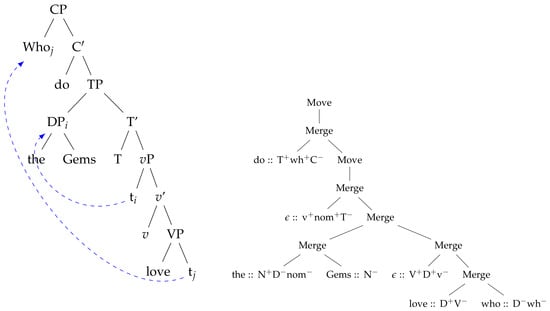
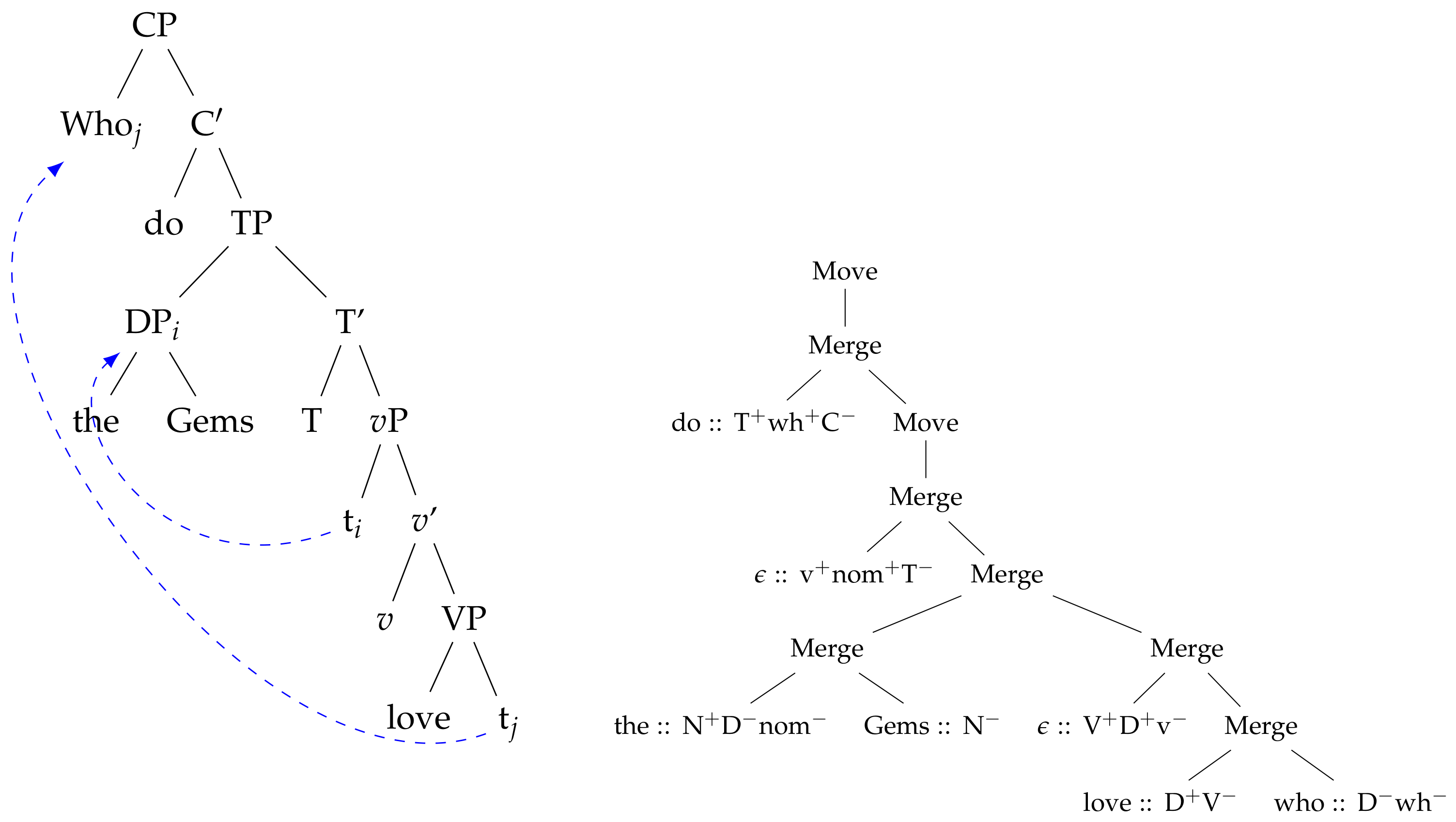
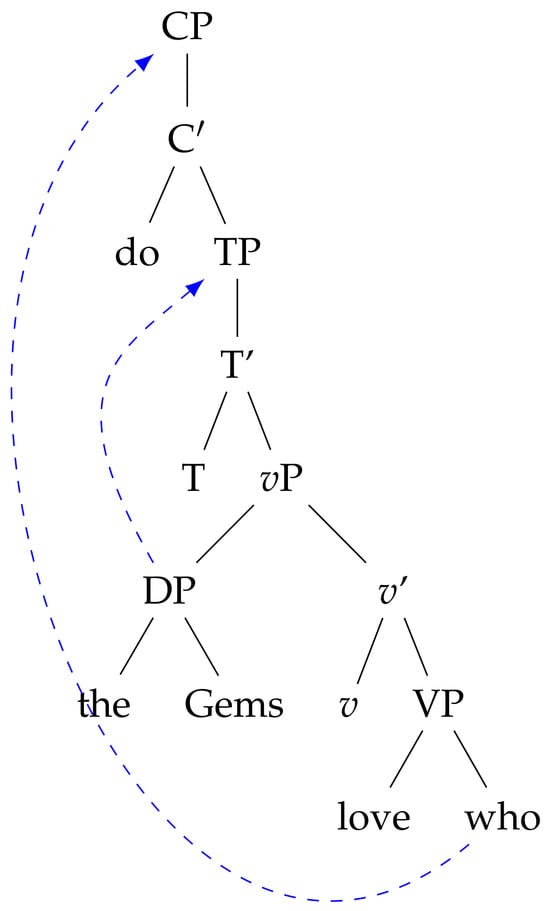
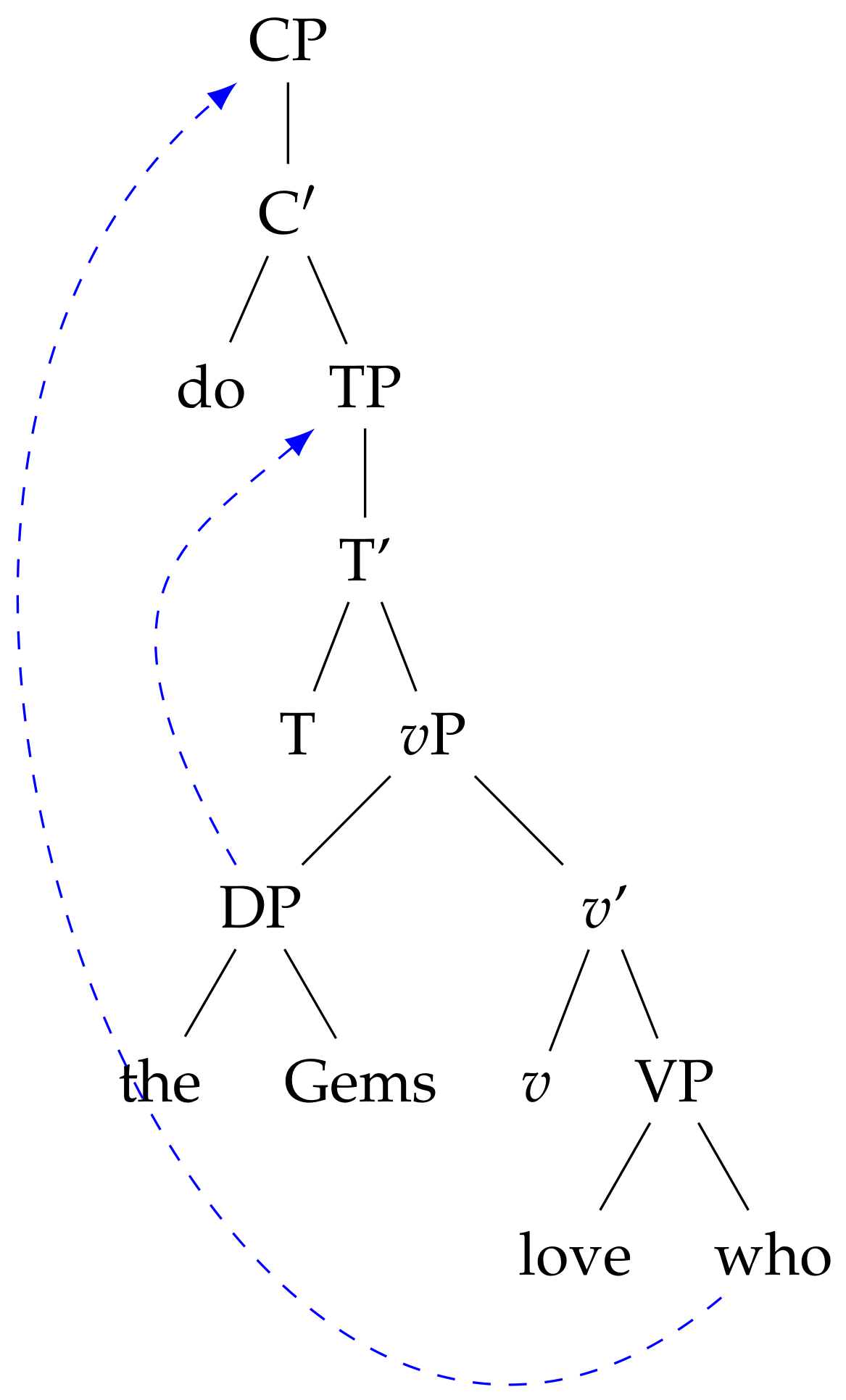
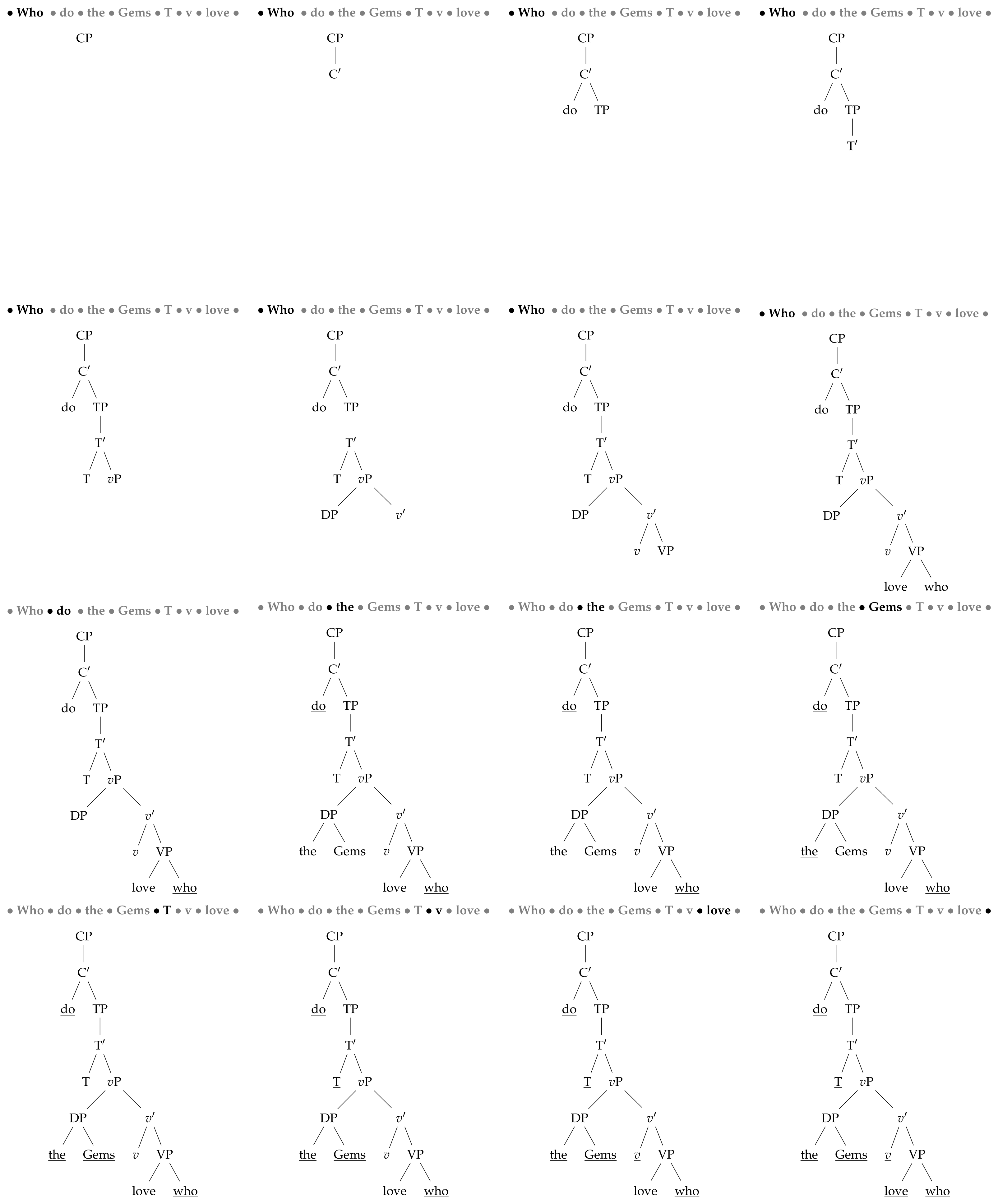
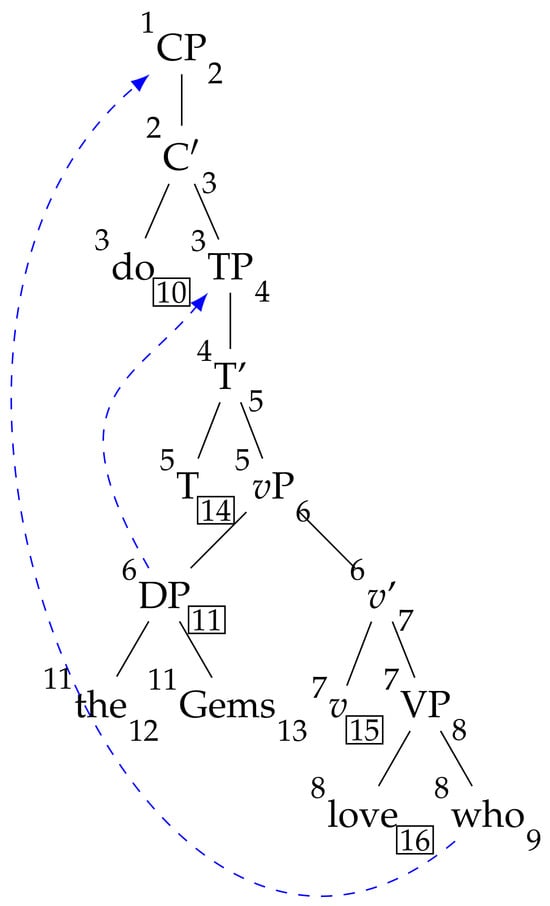
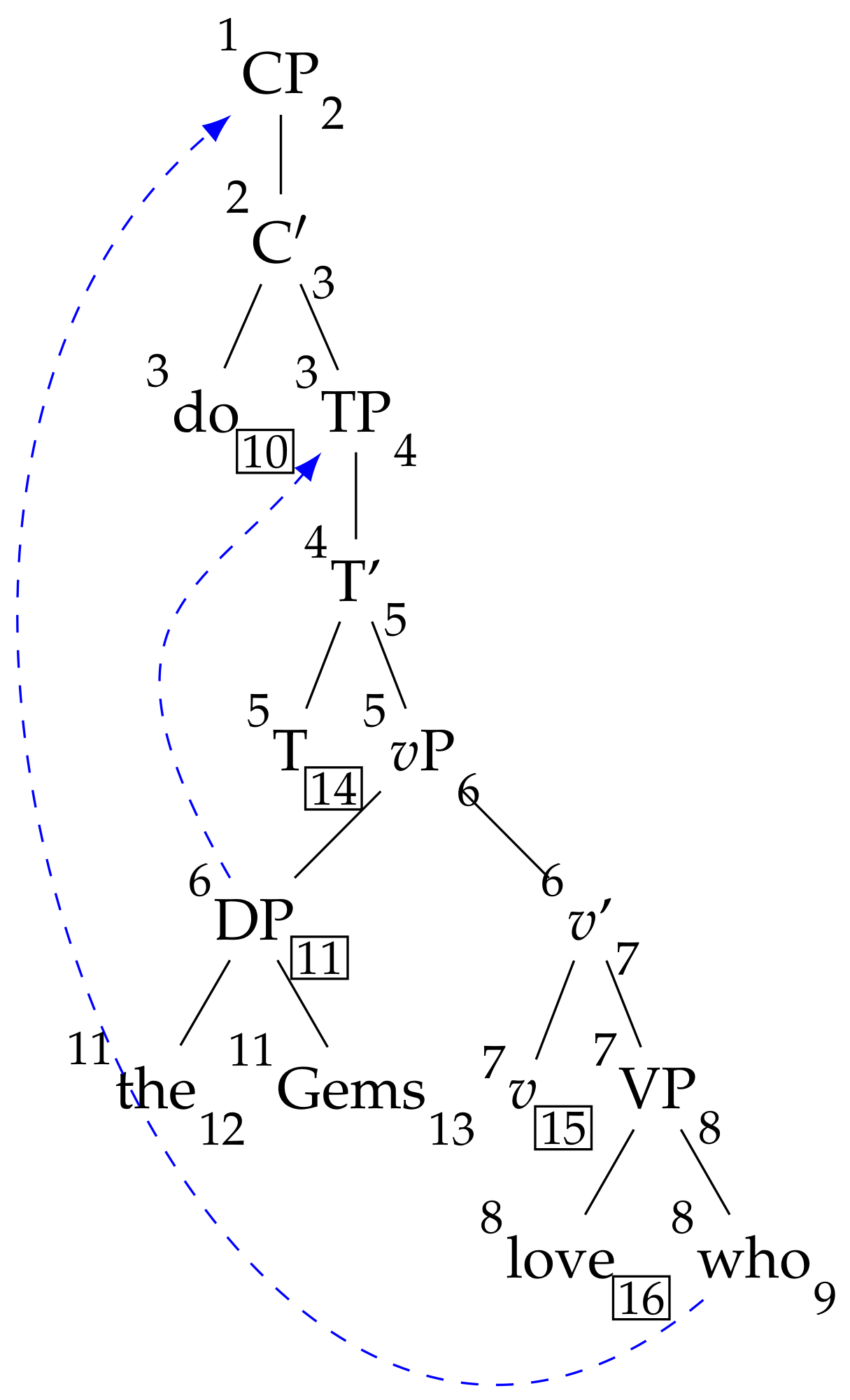
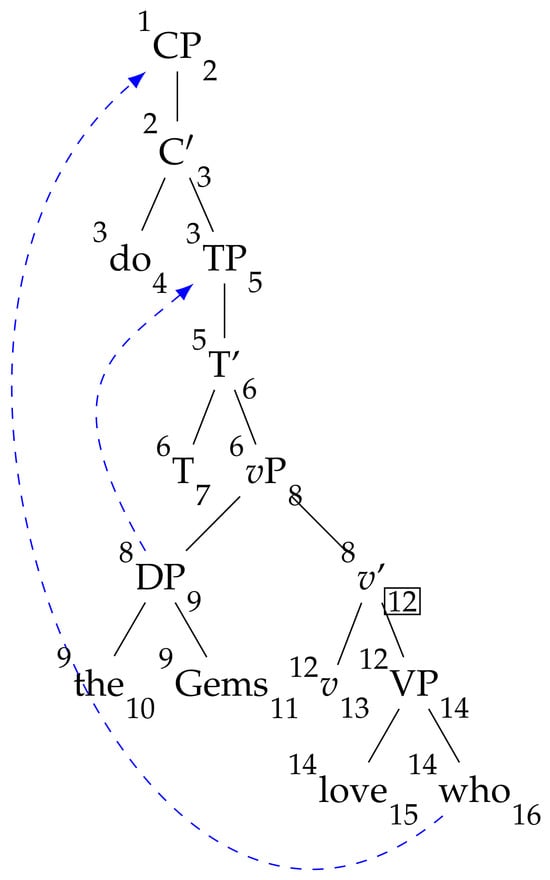
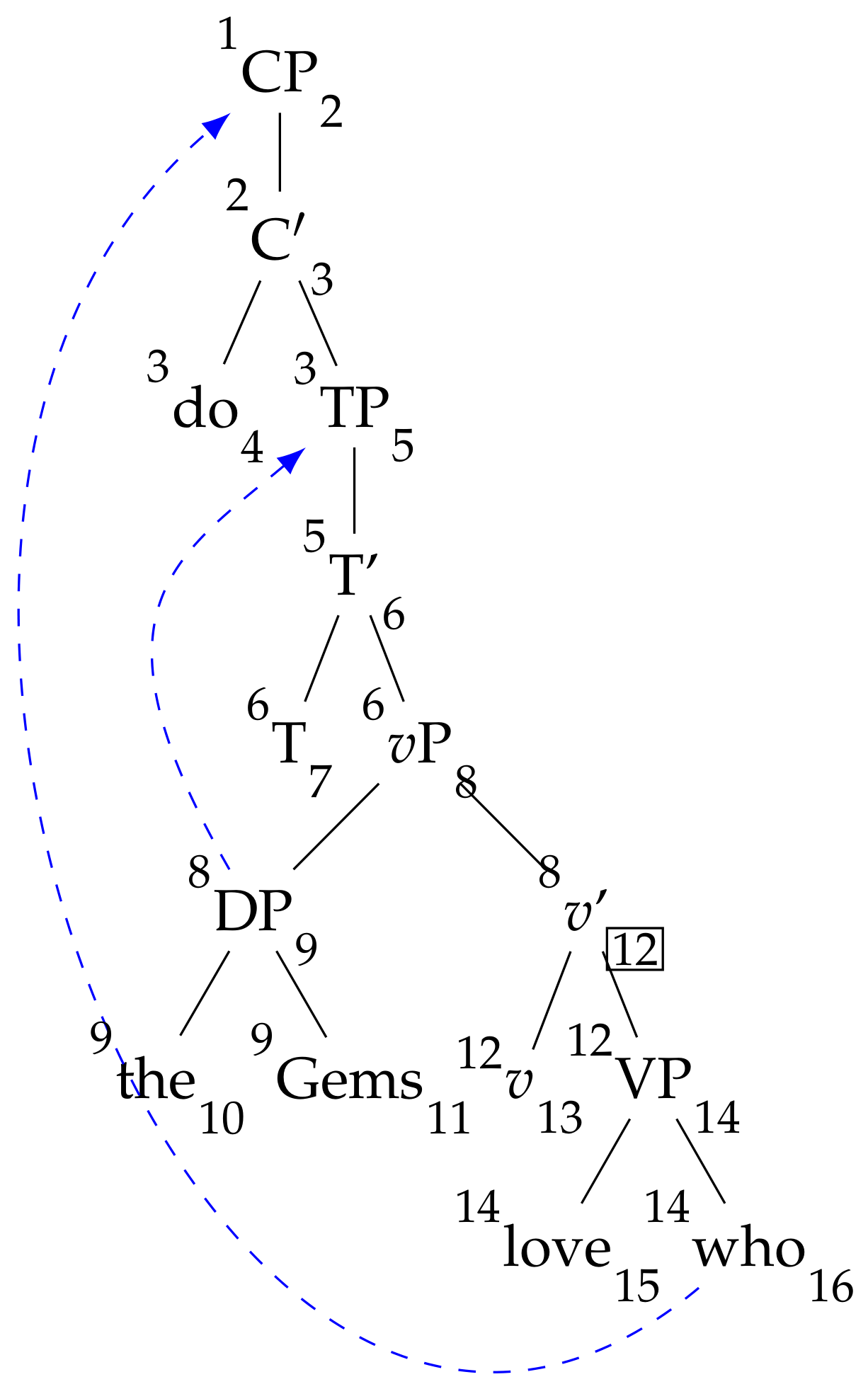
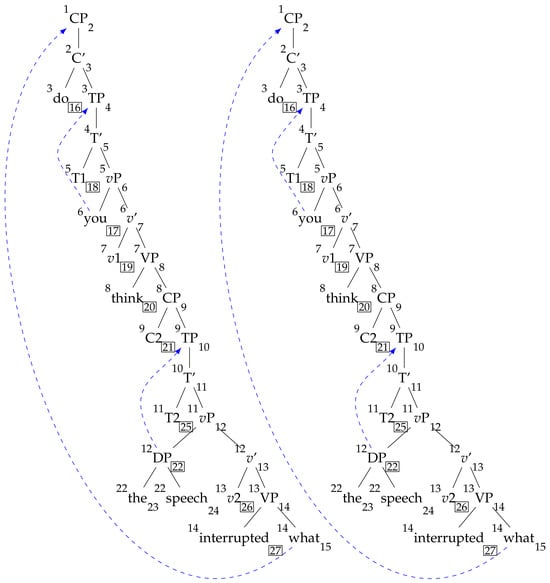
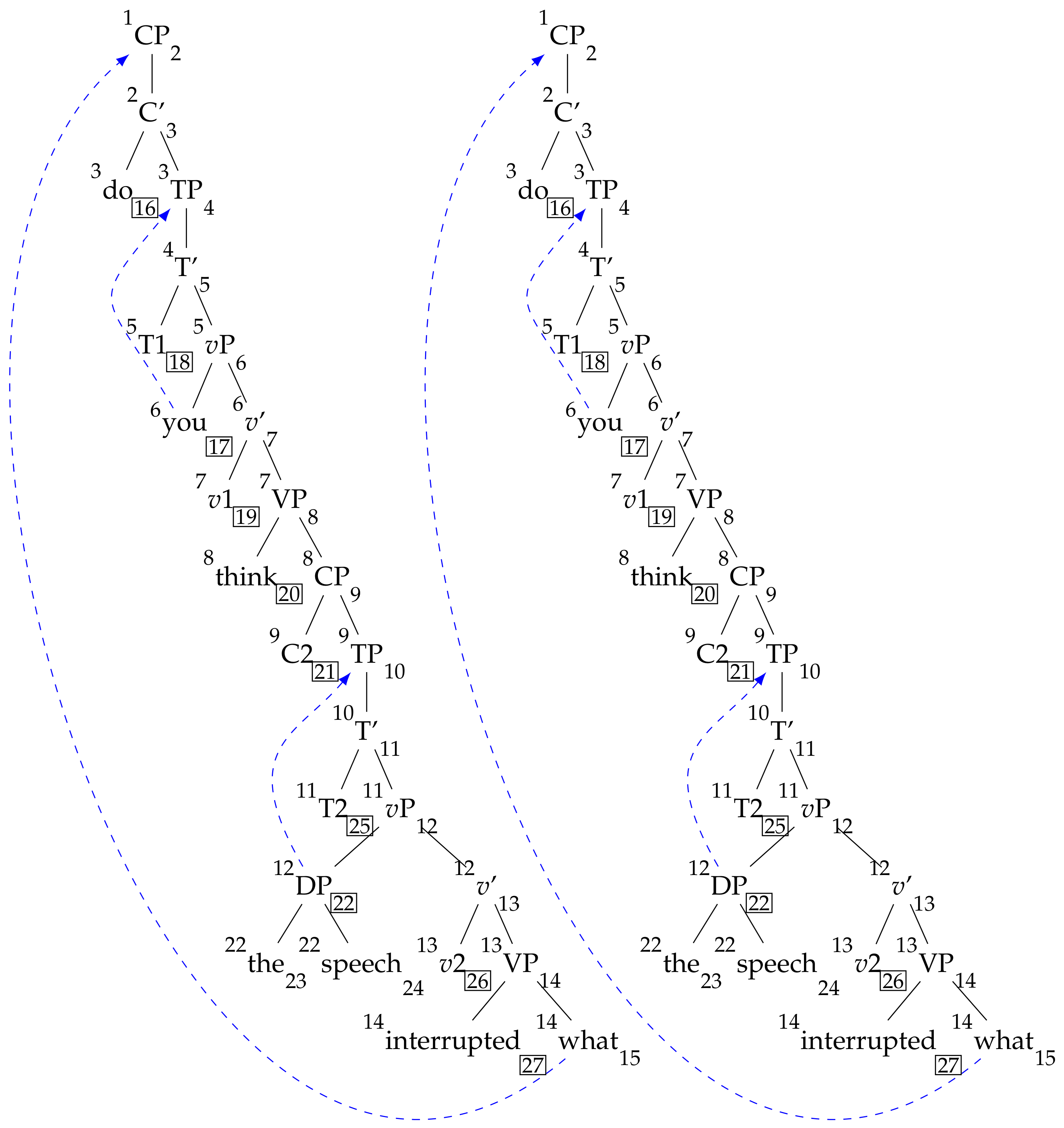
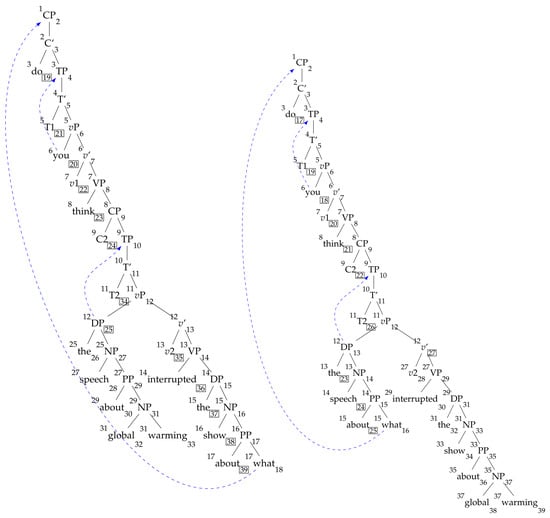
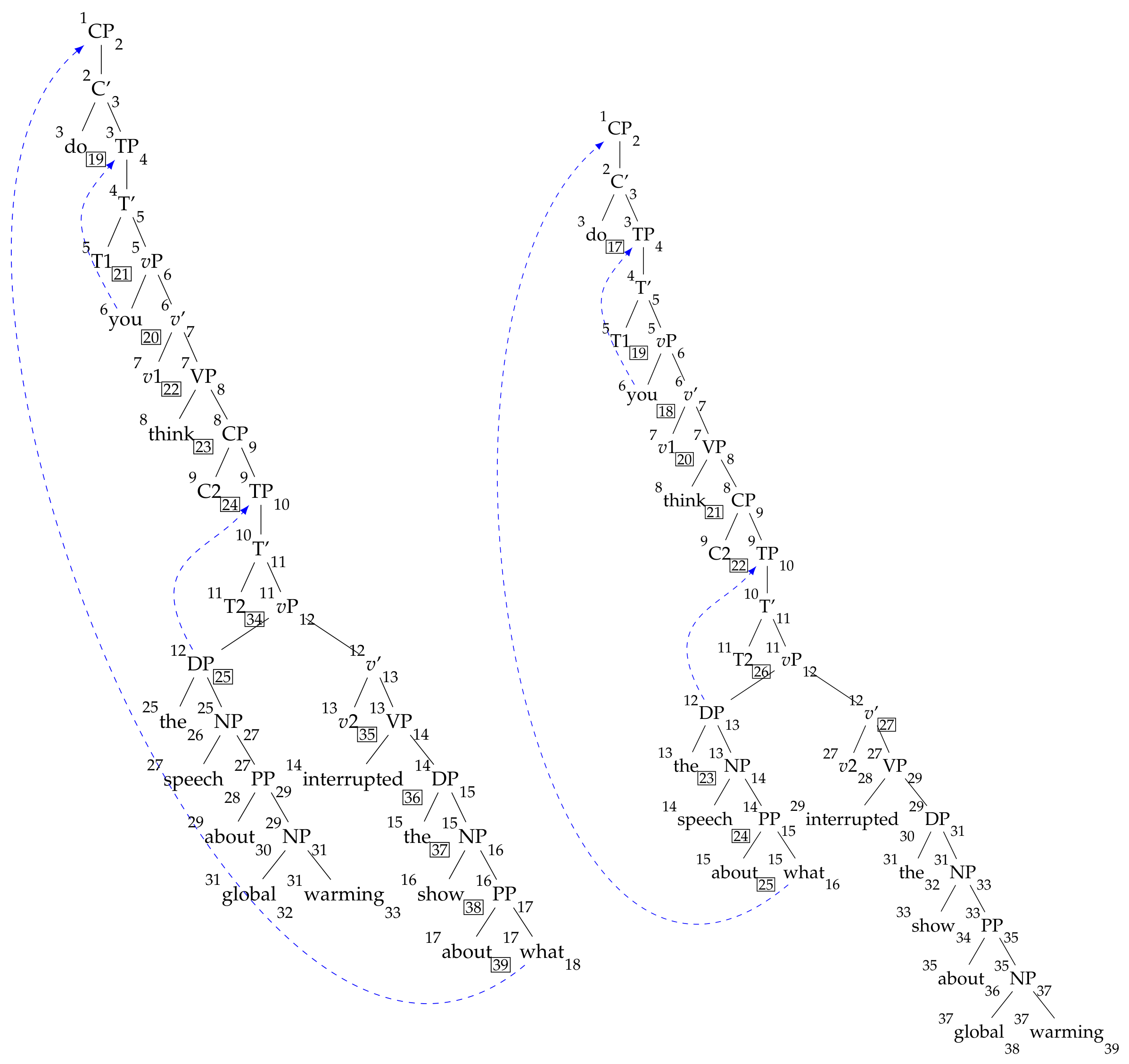

Disclaimer/Publisher’s Note: The statements, opinions and data contained in all publications are solely those of the individual author(s) and contributor(s) and not of MDPI and/or the editor(s). MDPI and/or the editor(s) disclaim responsibility for any injury to people or property resulting from any ideas, methods, instructions or products referred to in the content. |
© 2026 by the author. Licensee MDPI, Basel, Switzerland. This article is an open access article distributed under the terms and conditions of the Creative Commons Attribution (CC BY) license.