


Abstract
End-of-life mattresses constitute a bulky waste stream whose valorisation is constrained by material heterogeneity, large unit volume, and the intensity of dismantling and separation operations. Based on the experimental campaign conducted within the pilot project RESTBUILT: Valorisation of Used Mattresses as Construction Materials, this study evaluates the hypothesis that mechanical processing intensity can be treated as a design variable governed by the requirements of the receiving product. Post-consumer mattresses were selected typologically at a waste treatment facility. Starting from whole mattress shredding, two complementary experimental routes were developed, not conceived as a controlled comparative experiment: Route A, involving low-intensity processing based on coarse shredding and lightweight panels, and Route B, involving more intensive processing, with milling to ≤2 mm and incorporation of the waste into mineral matrices. In Route B, specific milling energy consumption was estimated from the rated power of the equipment and the recorded processing time, yielding 3.27–6.29 kWh/kg at laboratory scale. Volumetric substitutions of 5–10% in gypsum mortars maintained compressive strengths close to the reference (22.40–23.01 MPa versus 22.25 Mpa), although flexural strength decreased at the 10% dosage and thermal conductivity increased relative to the reference mortar. In Route A, reducing binder content prevented the formation of a continuous cementitious matrix and visually preserved a greater proportion of the porous structure of the shredded material. A non-standard comparative thermal test using a cold chamber was used as a preliminary comparative assessment of panel behaviour. Overall, the results support the feasibility of minimal processing as a process-design principle, but they do not allow differences between routes to be attributed exclusively to particle size or yet demonstrate an overall environmental advantage. The study should be interpreted as a proof of concept that identifies critical variables, experimental limitations, and subsequent validation pathways.
1. Introduction
The management of bulky waste remains one of the least resolved issues within urban collection and treatment systems. Mattresses are particularly complex because they combine a large unit volume, low compactability, a relatively long service life, and a multilayer composition. Previous research published by the RESTBUILT team synthesised the main logistical, environmental, and technological issues associated with their end of life and estimated that tens of millions of units are discarded annually in Europe [1]. This challenge is also framed by the European Waste Framework Directive and by policies promoting prevention, reuse, recycling, and the development of markets for secondary raw materials [2,3].
From a material perspective, the modern mattress should be regarded as a stratified, multicomponent product rather than as a simple polymer stream. The literature reviewed by the authors places flexible polyurethane foams at approximately 30–60% of the total mass, steel elements at around 10–20%, and textiles at up to approximately 25%, with wide variations depending on mattress type, product range, and construction system [1]. These fractions are supplemented by latex, felts, viscoelastic foams, fire-retardant or impermeable layers, and joining elements. This compositional variability affects both dismantling and the behaviour of the shredded material and constitutes a source of uncertainty that must be explicitly incorporated into the design of any valorisation process.
The problem is not solely material. The low density of the assembly penalises transport, manual handling is costly, and the unit value of the recovered fractions is limited. Consequently, a recycling strategy may be technically effective yet difficult to implement because of the intensity of the preceding operations. Analyses of extended producer responsibility schemes for mattresses show that feasibility depends on the combination of dedicated collection, infrastructure, the existence of markets for secondary materials, and the efficiency of recovery processes [1,4].
Most established industrial solutions are based on dismantling the mattress and directing steel, foam, and textiles towards separate valorisation chains. This approach yields more homogeneous streams and facilitates their incorporation into existing markets. Mechanical, chemical, and thermochemical recycling routes have been developed for polyurethane foams, ranging from shredding and rebonding to glycolysis and other recovery processes [5,6,7,8,9]. The main interferences in mechanical recycling, however, occur at material interfaces: foam–textile laminates, composite felts, pocket-spring systems encapsulated in fabric, and layers joined by polymeric adhesives, stitching, or heat sealing. These joints prevent simple fragmentation from producing pure fractions and require dismantling, separation, and contaminant control to be combined. Exhaustive separation is therefore not neutral: it requires space, labour, machinery, energy, and quality control [1,4].
Building construction provides a particularly relevant field of application for secondary raw materials with variable characteristics. Unlike sectors that require high purity, non-structural products—panels, fills, intermediate layers, prefabricated elements, or lightweight mortars—can accommodate heterogeneous materials if the product is designed around that variability. The literature has documented the use of recycled polyurethane foams as acoustic absorbers and insulation materials [10,11,12], as well as their incorporation into mortars, gypsum-based products, lightweight concretes, and prefabricated components [13,14,15,16,17,18,19]. In these applications, particle size, apparent density, compatibility with the binder, and the preservation or destruction of the cellular structure jointly govern processability and final performance.
The state of the art nevertheless shows a dominant bias towards the use of previously separated and relatively homogeneous fractions, particularly polyurethane foam. Studies on lightweight mortars and concretes commonly employ selected PU waste dosed as a partial substitute for aggregate or matrix constituents [13,14,15,16,17,18,19], whereas insulation studies focus on recovered and rebonded foams [10,11,12]. A specific gap therefore exists between two decision scales: on the one hand, complete dismantling aimed at maximising fraction purity; on the other, the design of products capable of accepting multicomponent waste with deliberately reduced preprocessing. This study addresses that intermediate condition and considers processing intensity not as a fixed requirement, but as a variable that must be justified in relation to the final application.
In parallel, recent research on polymer waste valorisation has expanded towards advanced chemical processes capable of treating real and mixed streams with reduced requirements for prior separation. Xu et al. [20] demonstrated the catalytic depolymerisation of polyolefin waste using liquid alloys, including post-consumer plastic mixtures, as an example of a strategy that addresses waste heterogeneity through high technological process intensity. Although this approach is not directly comparable with the mechanical recycling analysed here, it is relevant because it illustrates two complementary trends: increasing process sophistication to recover high-purity chemical feedstocks, or adapting the receiving product to accept less-processed secondary raw materials. The present study explores the latter strategy in the field of construction products.
The research is formulated around this question. The starting hypothesis is not that minimal processing is always preferable, but that the optimum degree of processing may depend on the function to be performed by the secondary raw material. Additional particle size reduction can improve homogeneity, dosing, and repeatability, but it can also increase processing time and energy demand and remove functional characteristics of the waste—such as the cellular structure and air volume of the foams—that may be beneficial in thermal or acoustic products. The scientific problem is therefore framed as a trade-off between feedstock control and the preservation of potentially useful properties [2,3,5,6,7,8,9].
An initial phase of the project established the state of the art regarding mattress manufacture, management, and recycling [1]. The present article examines the subsequent experimental campaign, developed as an exploratory pilot study, and uses its results to evaluate the technical coherence of the minimal processing principle. It does not seek to replace material-specific characterisation or to present a complete industrial inventory; rather, it aims to identify which process variables govern the transition from heterogeneous waste to technically manageable construction products and which limitations must be resolved before scale-up. The panel and mortar lines are currently being further developed through more specific experimental campaigns and contacts with industrial stakeholders to assess their technological and commercial feasibility.
The research question can therefore be formulated as follows: what level of transformation does an end-of-life mattress require in order to become a secondary raw material compatible with a specific construction application? To address this question, two complementary experimental cases were investigated: a coarse shredding route intended to preserve waste morphology and reduce processing operations, and a fine-processing route intended to improve homogeneity and dosing in mineral matrices. These routes do not constitute a controlled factorial experiment—they also differ in product type, binder, equipment, and testing protocols—and their comparison is therefore used to discuss process-design criteria rather than to causally attribute performance differences to a single variable.
2. Materials and Methods
2.1. Research Framework and Approach to the Real Waste Stream
RESTBUILT was developed as a pilot research project on the valorisation of used mattresses as construction materials within the European Circular Ecosystems project (ref. 0035_CIRCULAR_ECOSYSTEMS_6_E), co-funded by the ERDF through Interreg VI-A Spain–Portugal (POCTEP) 2021–2027 and promoted by Valladolid City Council in collaboration with the University of Valladolid Foundation. The campaign combined documentary review, contact with sector companies, visits to treatment facilities, sample collection, prototyping, and laboratory testing. The project provides the experimental framework for the present article; the scientific analysis focuses on the relationship between processing intensity, secondary raw material characteristics, and the requirements of the receiving products.
The diagnostic phase included manufacturers, distributors, waste managers, and national and international recycling experiences. The models reviewed confirmed two predominant strategies: component dismantling/separation and mechanical shredding. They also showed that the implementation of circular schemes requires, in addition to technology, dedicated logistics, quality control, and stable markets for the recovered fractions [1,4,5,6,7,8,9]. This diagnosis justified exploring a route that reduced dependence on manual dismantling operations and explicitly accepted heterogeneous feedstock.
The experimental design should be characterised as exploratory and proof-of-concept oriented. No statistical sampling of the mattress stock was conducted, nor was a multifactorial design established to isolate the effect of each variable. Contrasting typologies were selected, realistic processing operations were tested, and representative formulations were analysed to identify mechanisms, constraints, and decision parameters. This methodological scope is relevant to the interpretation of the results: the conclusions refer to preliminary technical feasibility and process-design criteria, not to definitive optimisation or a causal comparison between routes.
2.2. Waste Collection and Initial Treatment
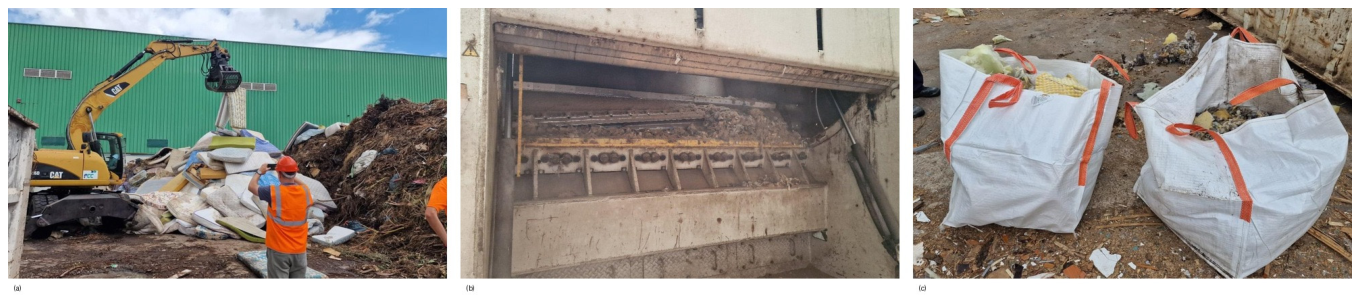
Material for the experimental phase was obtained through collaboration with the waste-management company FCC Medio Ambiente (Madrid, Spain) and the Municipal Waste Treatment Centre in Alicante. Selection was carried out on site with the support of facility staff and was typological rather than statistical. Two post-consumer mattresses with contrasting compositions were selected: a relatively homogeneous polyurethane-foam mattress and a spring mattress with viscoelastic padding and a mixed structure. This selection was intended to incorporate two common configurations with different processing complexities. During the visit, deformed, damp, contaminated, or partially deteriorated mattresses were also observed, precluding any assumption of homogeneous feedstock and reinforcing the need to define acceptance criteria for any future industrial application (Figure 1).
Figure 1.
Selection, shredding, and classification of mattress waste at the Alicante Waste Treatment Centre (CTR). (a–c) Representative stages of the treatment process. Source: authors’ own elaboration based on original photographic documentation obtained during the RESTBUILT campaign.
The first treatment consisted of coarse shredding of the whole mattress. Metallic elements were removed or separated when required by the mechanical operation, while the mixture of foams, textiles, felts, and soft layers was deliberately retained. The industrial shredded material exhibited an approximate dimensional range of 10–100 mm. An indicative manual classification of the coarse fraction placed approximately 10% below 25 mm, 20% between 25–50 mm, 20% between 50–75 mm, and 50% between 75–100 mm. For panel manufacture, fragments of approximately 30–60 mm were preferentially used because they were compatible with mould filling and with preservation of foam morphology. This classification is not a standardised particle size distribution: the particles are compressible, irregular, and multicomponent, so the intervals are used as an operational size descriptor.
A portion of the waste was subsequently subjected to additional processing at the University of Burgos by cutting and milling in a Retsch SM 100 cutting mill (Retsch GmbH, Haan, Germany) fitted with a 2 mm screen. The particle size reduction produced a dosable fraction suitable for characterisation by density measurements, elemental analysis, TGA, laser diffraction particle size analysis, and SEM. Preparation time was recorded per kilogram. Specific milling energy was estimated by multiplying the nominal power of the equipment (1.5 kW) by the effective milling time: 4.19 h/kg for waste A and 2.18 h/kg for waste B, corresponding to 6.29 and 3.27 kWh/kg, respectively. These values characterise the laboratory procedure and should not be directly extrapolated to an optimised industrial installation.
For future commercial implementation, the minimum conditioning sequence should include, in addition to size reduction and essential metal separation, a sanitisation stage. As a technological development hypothesis, a combination of thermal treatment and subsequent ozonation of the shredded waste is considered. This operation was not experimentally validated in the campaign reported here and is therefore regarded as a pending process requirement to be parameterised in terms of temperature, time, ozone concentration, energy consumption, and microbiological effectiveness.
2.3. Methodological Strategy: Two Processing Intensity Routes
The experimental design was organised into two complementary routes (Table 1). Route A sought to preserve heterogeneity and cellular structure through coarse shredding and localised agglomeration; Route B increased particle size reduction to facilitate dosing in mineral matrices. In this study, “minimal processing” is operationally defined as the shortest sequence of operations capable of producing a feedstock compatible with the requirements of the receiving product. It is evaluated through four indicators: number of operations, particle size achieved, processing time/energy, and either dosing capability or morphological preservation, depending on the application.
Table 1.
Methodological comparison of the two experimental routes. The routes constitute complementary case studies rather than a controlled comparative experiment.
The comparison between routes is used only at the level of process strategy. The observed differences cannot be independently attributed to particle size because the selected waste typology, binder, final product, equipment, and testing protocols also change. The results are therefore interpreted as two proofs of concept within a common valorisation framework rather than as levels of a single experimental factor.
2.4. Route A: Panels Based on Coarse-Shredded Waste
The panels were manufactured in moulds of approximately 300 × 300 × 60 mm while maintaining a constant shredded waste volume of about 5.4 L. The mass of this fraction was not recorded during the original campaign; therefore, the formulations are expressed exclusively using the quantities that were actually documented, and no waste-to-binder mass ratio is established for this series. Three main formulations were tested: (A1) a cement-rich saturating matrix with 5 L of volumetrically dosed cement and 2.5 L of water; (A2) a reduced formulation with 0.5 kg of cement, 300 mL of water, and PVA equivalent to 5% of the cement mass (25 g); and (A3) an unsaturated polyester-resin matrix with 600 mL of resin and 15 mL of MEKP catalyst. A clay soil formulation was additionally explored but was not included in the main quantitative analysis (Table 2).
Table 2.
Main formulations of Route A. Waste is reported using the volume actually recorded; neither the mass of the shredded material nor the compaction pressure was measured during the original campaign.
The available records document moderate compaction for A2 and A3, equivalent to an approximate volumetric reduction of 30–40%, but not a standardised compaction pressure. The environmental curing conditions for this series were also not retained with sufficient traceability and are therefore not reported as experimental parameters.
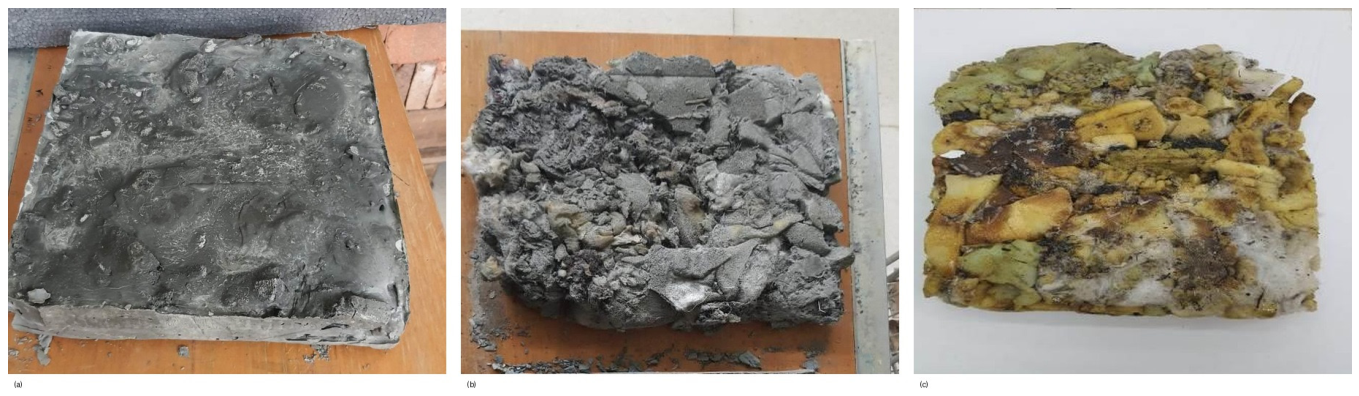
This phase was assessed technologically and comparatively within the same family of prototypes. Cohesion, ease of mould filling, stability after demoulding, relative densification, behaviour during curing, and visual preservation of the porous structure were examined. Neither open nor total porosity was measured, and no standardised mechanical testing campaign was performed; accordingly, the term “porosity preservation” is used here only in a morphological sense and should be distinguished from a porosimetric determination. The aim of the campaign was to identify formulations capable of stabilising the shredded waste without transforming it into a dense matrix (Figure 2).
The thermal response of the lightweight formulation was assessed using a non-standard experimental device constructed at ETSAVA. The system uses a cold chamber and a panel positioned between the controlled enclosure and the external environment; temperature sensors continuously record conditions on both sides of the element for approximately one week. The setup allows the relative thermal evolution of the prototypes to be compared, but the available records do not include direct heat-flow measurement or a sufficiently defined set of boundary conditions from which thermal conductivity could be derived with metrological traceability. Consequently, the test is interpreted only as a preliminary comparative assessment and is not used to assign a λ value to the material. Quantitative thermal characterisation of the panels remains to be completed through a standardised test in accordance with UNE-EN 12667 [21].
Figure 2.
Evolution of coarse-shredded panel prototypes: (a) cement-rich saturated formulation; (b) reduced formulation with cement and PVA; (c) resin prototype, with lower binder occupation of the voids. Source: authors’ own elaboration based on original photographs from the RESTBUILT experimental campaign.
2.5. Route B: Fine-Processed Waste and Mortars
The line developed at the University of Burgos investigated the two wastes selected in Alicante: A, obtained from the spring mattress with viscoelastic padding, and B, obtained from the polyurethane mattress. Both were processed in a Retsch SM 100 cutting mill fitted with a 2 mm screen. After processing, waste A had an apparent density of 71.84 kg/m3 and a true density of 1096.87 kg/m3; for waste B, the corresponding values were 68.36 and 1078.31 kg/m3. Laser particle size analysis gave median D50 values of 344.8 µm for A and 312.1 µm for B, with D90 values of 902.0 and 797.9 µm, respectively. Elemental analysis yielded C = 59.87%, H = 7.85%, N = 3.83% for A and C = 61.96%, H = 9.09%, N = 5.58% for B, with no sulphur detected in either case.
Characterisation included apparent and true density, CHNS elemental analysis, TGA, laser diffraction particle size analysis, and SEM. Five gypsum formulations were subsequently prepared—one reference and four containing 5% and 10% volumetric substitutions with waste A or B—together with a parallel series of cement mortars. A water-to-binder ratio close to 0.46 was maintained in the gypsum mixtures: the reference contained 1000 g of gypsum and 460 g of water; Y5A and Y10A incorporated 5.18 and 10.93 g of waste A; Y5B and Y10B incorporated 4.92 and 10.41 g of waste B. The 10% value should be understood as the highest percentage investigated in this campaign, not as the maximum feasible limit. Consistency and setting were evaluated in accordance with UNE-EN 13279-2 [22], water vapour permeability according to EN 1015-19 [23], and thermal conductivity using a FOX 50 apparatus (TA Instruments, New Castle, DE, USA following the EN 12667 procedure [24]. Fire response was addressed through a preliminary non-combustibility test, and the results were interpreted using the classification criteria of EN 13501-1 [25]; this is not considered a complete regulatory certification in the present article (Table 3).
For the mechanical testing of the gypsum mortars, three prismatic specimens measuring 40 × 40 × 160 mm were prepared for each formulation in accordance with UNE-EN 13279-2. After 24 h, the specimens were demoulded and kept for a further six days under laboratory conditions (20 °C and 50% relative humidity), completing 7 days; they were then dried at 40 °C and equilibrated in a desiccator before testing. Flexural strength corresponds to the mean of three specimens. The two fragments obtained from each flexural failure were subsequently tested in compression, yielding six determinations per formulation. The retained records contain the final mean values, but not the individual readings required to reconstruct standard deviations. For thermal conductivity, 50 mm-diameter specimens with two thicknesses, 22 and 12 mm, were prepared, conditioned for 7 days, and dried at 40 °C before testing in the FOX 50 apparatus. The experimental record retains a single λ value for each formulation, with no individual series from which dispersion could be estimated; these values are therefore reported without standard deviation (Figure 3).
Table 3.
Summary characterisation of the finely processed wastes. Milling energy was estimated as nominal mill power × effective milling time and refers only to laboratory scale.
Figure 3.
Fine processing of the waste at the University of Burgos: from left to right, cut and milled viscoelastic-mattress waste, followed by cut and milled foam-mattress waste. Source: original photographic documentation produced by the GIIE, University of Burgos, during the experimental campaign.

3. Results and Discussion
3.1. The Mattress as a Heterogeneous Feedstock
The first result is methodological: a mattress can be transformed into a manageable feedstock by shredding without exhaustive dismantling of all its soft components. The campaign worked with only two typologies deliberately selected for contrast, so representativeness should be regarded as typological rather than statistical. Despite this limitation, the coarse-shredded waste retained visible differences in colour, texture, density, and elasticity and allowed cohesive prototypes to be manufactured. Heterogeneity therefore ceases to be treated solely as a defect to be eliminated and instead becomes a boundary condition that the receiving product must be capable of accommodating.
This approach differs from research aimed at recovering high-purity foams or textiles, which is necessary when the secondary material must meet strict specifications. The literature on polyurethane recycling and its reuse in construction nevertheless demonstrates a plurality of possible destinations [5,6,7,8,9,10,11,12,13,14,15,16,17,18,19]. The results of this study suggest that processing decisions should consider two opposing mechanisms: homogenisation facilitates dosing, dimensional control, and characterisation, whereas intensive processing can simultaneously consume energy and destroy functional features of the waste, such as the cellular structure of the foams. Processing intensity should therefore be evaluated against a target performance rather than treated as a quantity to be maximised by default.
3.2. Panels: Binder Effect and Morphological Preservation of the Porous Structure
The prototypes show that binder quantity and nature are decisive variables. Formulation A1, with 5 L of cement and 2.5 L of water for 5.4 L of shredded waste, produced an almost continuous matrix that filled the voids and resulted in a heavy, rigid element. Although cohesion was achieved, lightness, local deformability, and air volume were lost. The test is informative as a limiting condition: for an insulation or absorption application, increasing binder content until the shredded waste is saturated contradicts the functional objective of the product. The exact cement-to-waste mass ratio cannot be reconstructed because the cement was dosed volumetrically and the waste mass was not recorded; this shortcoming is therefore included as a reproducibility limitation of the original campaign.
Formulation A2 reduced the cement content to 0.5 kg, used 300 mL of water, and incorporated 25 g of PVA (5% of the cement mass). Moderate compaction, on the order of 30–40% of the initial volume, stabilised the element without expelling material or producing a continuous matrix. The resulting panel was manageable and visually preserved voids between particles. Formulation A3, with 600 mL of polyester resin and 15 mL of MEKP, produced more localised bonding and good geometric stability. These observations do not constitute a porosity measurement; they indicate that reducing binder volume decreases the macroscopic occupation of voids and better preserves the morphology of the shredded material.
From an architectural perspective, Route A is consistent with low-mechanical-demand applications—interior panels, lining systems, fills, acoustic absorbers, or lightweight cores—in which the preservation of air volume and cellular structure may be functional. The literature confirms that porosity and cellular structure govern the acoustic and thermal behaviour of recycled foams [10,11,12]. The ETSAVA cold chamber campaign allowed the relative thermal response of the prototypes to be followed for approximately one week; however, because neither direct heat-flow measurements nor sufficiently controlled boundary conditions were available, it is not used to derive the thermal conductivity of the material. Commercial rebonded PU-foam panels declare values of 0.037–0.039 W/(m·K) [26,27]; these values are retained only as references for future standardised validation and not as a basis for quantitative comparison with the RESTBUILT prototypes.
3.3. Mortars: Behaviour of the Fine-Processing Route
Route B produced a feedstock with greater dimensional control and dosability. Volumetric substitutions of 5% and 10% were investigated in the gypsum mortars. Flow-table consistency remained within 178–190 mm, compared with 183 mm for the reference, while initial setting time decreased from 9 min for mixture Y to 7 min 20 s–7 min 45 s for the waste-containing formulations. At 7 days, compressive strength remained between 22.40 and 23.01 MPa, compared with 22.25 MPa for the reference. Flexural strength was more sensitive: 9.05 MPa for Y5A, 7.99 MPa for Y5B, and 7.34 MPa for both 10% formulations, compared with 9.29 MPa for Y. These data show that increasing waste content did not cause mechanical failure within the investigated range, although it did reduce flexural strength by approximately 21% at the 10% dosage.
The thermal conductivity of the mortars increased from 0.4959 W/(m·K) in the reference to 0.5424–0.5549 W/(m·K) in the waste-containing formulations, i.e., by approximately 9–12%. In this matrix, therefore, the waste did not improve thermal insulation; its principal effect was to enable partial substitution and modify density, workability, and mechanical behaviour without a significant loss of compressive strength. The water vapour diffusion resistance factor µ increased from 5 in the reference to 7–11 in the waste-containing mixtures. These results reinforce a methodological conclusion: fine milling facilitates homogenisation and dosing but does not guarantee simultaneous improvement of all performance indicators (Table 4).
Table 4.
Results for Route B gypsum mortars. Flexural-strength values correspond to the mean of three specimens and compressive-strength values to six determinations on the half-specimens resulting from the flexural test. The individual records were not retained; therefore, standard deviations cannot be reconstructed. Thermal conductivity corresponds to the value recorded for each formulation in the FOX 50 test.
The Burgos line is used in this article as preliminary quantitative evidence of the feasibility of a fine-processing route rather than as an exhaustive characterisation of all mortars developed. Only representative results sufficient to verify processability and basic behaviour are presented. The complete series on density, absorption, adhesion, TGA, SEM, reaction to fire, and cement formulations form part of a specific ongoing investigation. This delimitation strengthens the evidence presented here without conflating the objective of the current work—comparing processing strategies at proof-of-concept scale—with the detailed optimisation of a specific family of mortars.
3.4. How Much Processing Is Necessary?
The joint reading of the two routes indicates that the degree of processing cannot be evaluated independently of the application. Fine milling provides dimensional control, improves dosing, and allows standardised characterisation procedures to be applied, but requires additional operations. In Burgos, specific milling energy consumption was estimated using the nominal power of the mill (1.5 kW) and effective processing time: 4.19 h/kg for A and 2.18 h/kg for B, equivalent to 6.29 and 3.27 kWh/kg. By contrast, industrial coarse shredding operates on a time scale of seconds per mattress—approximately 15 s in the plant observation used as an operational reference—but effective power, processed mass, and electrical consumption were not measured during the campaign. Consequently, no directly comparable kWh/kg value is calculated and no energy advantage is quantified beyond what the available data can support (Table 5).
Table 5.
Preliminary comparative processing inventory. The table does not constitute an industrial energy balance: Route A lacks specific electrical measurements, while Route B values are estimates based on nominal power and laboratory processing time.
The results support, but do not universally demonstrate, that there is no single optimum degree of mechanical recycling. For a mortar application, increasing processing until a dosable fraction is obtained may be reasonable; for a panel intended to exploit cellular structure, the same reduction may remove part of the morphology that the product seeks to preserve. The process-design principle derived from this proof of concept can be stated as “process until the required performance is achieved, not until the maximum possible transformation is reached”. Its validity must be tested through controlled studies for each product family.
From a process-engineering perspective, lower processing intensity does not automatically imply lower environmental impact. Assessment must encompass the whole system: shredding energy, binder consumption and type, recovery yield, transport, sanitisation, durability, the potential for repair or subsequent recycling, and product service life. In particular, a resin-based formulation may reduce densification and facilitate panel manufacture while increasing embodied energy or hindering end-of-life treatment. Similarly, energy-intensive milling may be justified if it displaces a higher-impact product or enables a long-service-life application. The present campaign does not provide a sufficiently complete inventory for a robust environmental or economic comparison; any environmental advantage is therefore formulated as a hypothesis to be tested through LCA and techno-economic assessment using industrial-scale data.
3.5. Scalability, Quality Control, and Pending Requirements
Minimal processing does not eliminate the need for quality control. At the Alicante CTR, mattresses are managed as bulky waste and the campaign did not establish a dedicated rejection protocol for product manufacture. Future construction-related valorisation will require independent acceptance criteria: absence of visible biological contamination, moisture control, exclusion of mattresses affected by oils or other chemical contaminants, identification of flame retardants or potentially problematic additives, and limits on residual metals. Heterogeneity of the waste stream should not be confused with the absence of specification; the industrial objective should be to accommodate variability within a previously defined acceptance domain.
Sanitisation is also a necessary operation before a commercial outlet for the shredded waste can be considered. The proposed technological scheme combines thermal conditioning and ozone treatment, although process parameters and microbiological effectiveness must be specifically validated. For the panels, standardised tests are still required for reaction to fire, emissions of organic compounds, water absorption, dimensional stability, thermal resistance, sound absorption, durability, and biological behaviour. A broader characterisation campaign is available for the mortars, but a greater number of replicates, optimisation of the cement line, and durability studies remain necessary. The fire assessment performed at UBU should be regarded as experimental screening rather than full product certification.
Scalability will also depend on logistics and on the balance between centralisation and pretreatment close to the collection point. The low density of untreated mattresses penalises transport and storage, whereas shredding close to the source reduces volume but requires distributed infrastructure and hygiene control. Industrial feasibility cannot be inferred solely from the ability to manufacture a prototype; it requires the integration of input rates, metal separation yield, conditioning, binder costs, supply stability, and demand for the final product. RESTBUILT provides a proof of concept and a decision framework, not a closed demonstration of industrial profitability.
3.6. Transferability of the Strategy
Although this work focuses on mattresses, the methodological principle may be relevant to other multicomponent wastes: products for which exhaustive separation is costly and certain applications can tolerate variability. This transferability must nevertheless be framed as a hypothesis rather than as a demonstrated conclusion. Each waste stream has different risks, contaminants, scales, and regulatory requirements. The generalisable contribution is the decision procedure: characterise the real waste, identify which properties should be preserved, define the minimum processing level, and design the product around that feedstock rather than assuming a priori that maximum purity is always the objective.
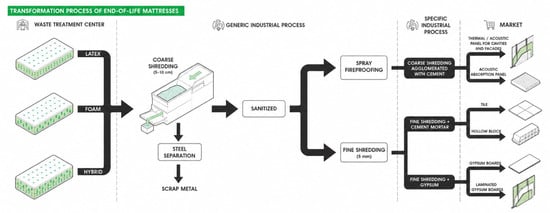
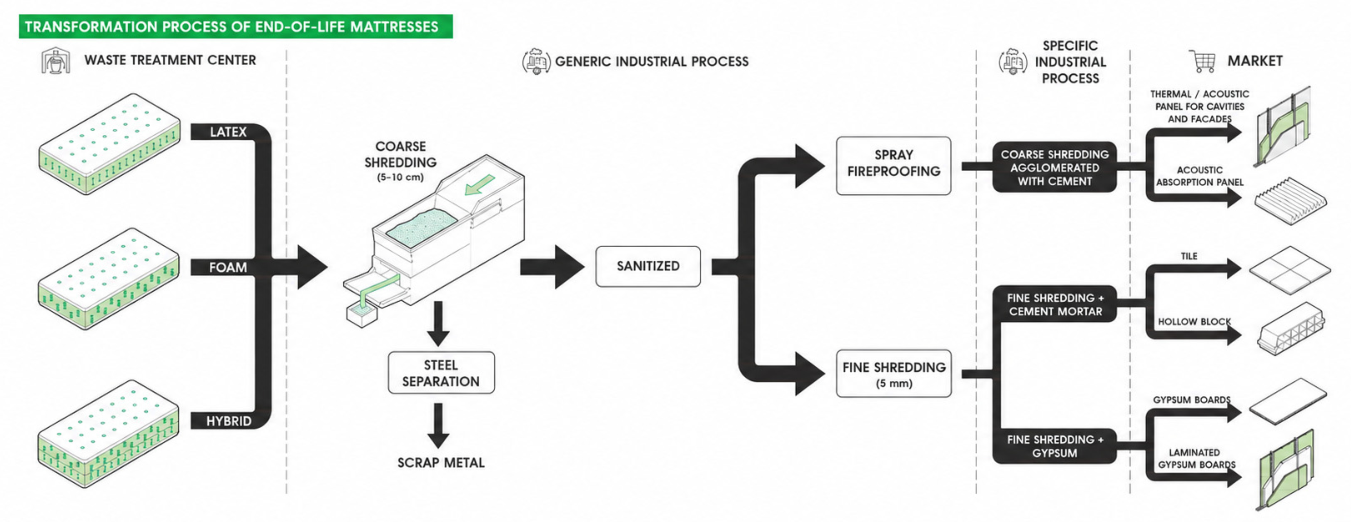
Figure 4 summarises the transformation chain derived from the research, from mattress reception to different product applications. It should be read as a process and potential-transfer scheme: it combines tested operations with conditioning stages required for future industrial implementation, without implying that all the solutions represented have reached the same degree of experimental validation.
Figure 4.
Overall transformation pathway for end-of-life mattresses and potential applications in construction products. Source: authors’ own elaboration. The diagram distinguishes experimentally tested operations from potential industrial conditioning stages.
4. Conclusions
At proof-of-concept scale, the experimental campaign demonstrates that end-of-life mattresses can be converted into secondary raw materials for construction products without complete dismantling of all soft components being a prerequisite. The evidence obtained is limited to two mattress typologies and to laboratory prototypes/batches and should therefore be interpreted as preliminary feasibility rather than general industrial validation.
The two routes tested exhibit technically different responses but do not constitute a controlled comparative experiment. Route A shows that a drastic reduction in binder content prevents the formation of a continuous cementitious matrix and better preserves the morphology of the shredded material; Route B demonstrates that the waste can be milled to ≤2 mm and incorporated at 5–10% by volume in gypsum mortars. In the latter, compressive strength remained between 22.40 and 23.01 MPa compared with 22.25 MPa for the reference, while flexural strength decreased to 7.34 MPa at the 10% dosage. Thermal conductivity increased from 0.4959 to 0.5424–0.5549 W/(m·K), confirming that greater processing or greater waste incorporation does not automatically improve all performance indicators.
The main scientific contribution is to propose processing intensity as a design variable linked to product function. Minimal processing is not defined as the lowest possible degree of processing in absolute terms, but as the shortest sequence of operations capable of satisfying a target performance and a sufficient level of feedstock control. The proof of concept suggests a trade-off between homogeneity, dosability, and processing energy, on the one hand, and morphological preservation of the waste, on the other. The quantitative validity of this principle must be verified through controlled experimental designs specific to each product family.
The main limitations are the small, non-statistical sample, the absence of a comparable energy balance for coarse shredding, the comparative and non-standardised nature of the panel thermal test—which does not allow a thermal conductivity value to be assigned—and the absence of individual records from which the statistical dispersion of some series could be estimated. An integrated LCA and industrial economic assessment are also not yet available. Before commercial application, sanitisation, reaction to fire, emissions, moisture, durability, and waste-acceptance criteria must also be validated. Future research should complete standardised thermal and acoustic characterisation of the panels, optimise lower-impact binders, develop the complete mortar and prefabricated-product series, and test the minimal processing hypothesis through life-cycle assessment and techno-economic evaluation using industrial-scale data.
Author Contributions
Conceptualization: J.A.M., J.A.B.R., L.-A.B., I.D.G., L.A.C.-R. and R.A.S.; methodology: J.A.M. and I.D.G.; analysis: J.A.M. and I.D.G.; writing—original draft preparation: J.A.M. and I.D.G.; writing—review and editing: all authors. All authors have read and agreed to the published version of the manuscript.
Funding
This work was developed within the pilot project “Valorisation of Used Mattresses as Construction Materials” (2024–2025), as part of the European Circular Ecosystems project (ref. 0035_CIRCULAR_ECOSYSTEMS_6_E), co-funded by the European Regional Development Fund (ERDF) through the Interreg VI-A Spain–Portugal Programme (POCTEP) 2021–2027, and promoted by Valladolid City Council in collaboration with the University of Valladolid Foundation.
Data Availability Statement
The representative experimental data used in this article derive from the technical documentation of the RESTBUILT project and from laboratory campaigns conducted at the Universities of Valladolid and Burgos. Additional datasets and original records may be made available upon reasonable request to the corresponding author, subject to institutional conditions and the preparation of specific experimental publications.
Acknowledgments
During the preparation and revision of this manuscript, generative artificial intelligence tools (ChatGPT, version GPT-5.6, OpenAI) were used to assist with language review, text structuring, and editing. The authors independently reviewed, verified, and validated all data, scientific interpretations, references, and conclusions and take full responsibility for the final content of the article.
Conflicts of Interest
The authors declare no conflicts of interest.
References
- Arias Madero, J.; Balmori Roiz, J.A.; Basterra Otero, L.-A.; Diaz Gonzalez, I. Discarded Mattresses: From Environmental Problem to Recoverable Resource. Sustainability 2025, 17, 8371. [Google Scholar] [CrossRef] [Scilit]
- European Parliament and Council. Directive 2008/98/EC of 19 November 2008 on waste and repealing certain Directives. Off. J. Eur. Union 2008, L312, 3–30. Available online: https://eur-lex.europa.eu/eli/dir/2008/98/oj (accessed on 15 September 2026).
- European Commission. A New Circular Economy Action Plan: For a Cleaner and More Competitive Europe; COM(2020) 98 final; European Commission: Brussels, Belgium, 2020; Available online: https://eur-lex.europa.eu/legal-content/EN/TXT/?uri=CELEX:52020DC0098 (accessed on 15 September 2026).
- Geyer, R.; Kuczenski, B.; Trujillo, M. Assessing the Greenhouse Gas Savings Potential of Extended Producer Responsibility for Mattresses and Boxsprings in the United States. J. Ind. Ecol. 2016, 20, 917–928. [Google Scholar] [CrossRef] [Scilit]
- Zia, K.M.; Bhatti, H.N.; Bhatti, I.A. Methods for Polyurethane and Polyurethane Composites, Recycling and Recovery: A Review. React. Funct. Polym. 2007, 67, 675–692. [Google Scholar] [CrossRef] [Scilit]
- Simón, D.; Borreguero, A.M.; de Lucas, A.; Rodríguez, J.F. Recycling of Polyurethanes from Laboratory to Industry, a Journey towards the Sustainability. Waste Manag. 2018, 76, 147–171. [Google Scholar] [CrossRef] [Scilit] [PubMed]
- Kemona, A.; Piotrowska, M. Polyurethane Recycling and Disposal: Methods and Prospects. Polymers 2020, 12, 1752. [Google Scholar] [CrossRef] [Scilit] [PubMed]
- Gama, N.V.; Ferreira, A.; Barros-Timmons, A. Polyurethane Foams: Past, Present, and Future. Materials 2018, 11, 1841. [Google Scholar] [CrossRef] [Scilit] [PubMed]
- Yang, W.; Dong, Q.; Liu, S.; Xie, H.; Liu, L.; Li, J. Recycling and Disposal Methods for Polyurethane Foam Wastes. Procedia Environ. Sci. 2012, 16, 167–175. [Google Scholar] [CrossRef] [Scilit]
- del Rey, R.; Alba, J.; Arenas, J.P.; Sanchis, V.J. An Empirical Modelling of Porous Sound Absorbing Materials Made of Recycled Foam. Appl. Acoust. 2012, 73, 604–609. [Google Scholar] [CrossRef] [Scilit]
- Haigh, R. A Review and Thermal Conductivity Experimental Program of Mattress Waste Material as Insulation in Building and Construction Systems. Constr. Mater. 2024, 4, 401–424. [Google Scholar] [CrossRef] [Scilit]
- Thompson, L.; Alam, M.M.; Tamaddoni Jahromi, F. Valorising End-of-Life Mattress Waste into Sustainable Construction Insulation Materials. Materials 2025, 18, 647. [Google Scholar] [CrossRef] [Scilit] [PubMed]
- Gómez-Rojo, R.; Alameda, L.; Rodríguez, Á.; Calderón, V.; Gutiérrez-González, S. Characterization of Polyurethane Foam Waste for Reuse in Eco-Efficient Building Materials. Polymers 2019, 11, 359. [Google Scholar] [CrossRef] [Scilit] [PubMed]
- Gadea, J.; Rodríguez, A.; Campos, P.L.; Garabito, J.; Calderón, V. Lightweight Mortar Made with Recycled Polyurethane Foam. Cem. Concr. Compos. 2010, 32, 672–677. [Google Scholar] [CrossRef] [Scilit]
- Mounanga, P.; Gbongbon, W.; Poullain, P.; Turcry, P. Proportioning and Characterization of Lightweight Concrete Mixtures Made with Rigid Polyurethane Foam Wastes. Cem. Concr. Compos. 2008, 30, 806–814. [Google Scholar] [CrossRef] [Scilit]
- Ben Fraj, A.; Kismi, M.; Mounanga, P. Valorization of Coarse Rigid Polyurethane Foam Waste in Lightweight Aggregate Concrete. Constr. Build. Mater. 2010, 24, 1069–1077. [Google Scholar] [CrossRef] [Scilit]
- Santamaría Vicario, I.; Alameda Cuenca-Romero, L.; Gutiérrez González, S.; Calderón Carpintero, V.; Rodríguez Saiz, Á. Design and Characterization of Gypsum Mortars Dosed with Polyurethane Foam Waste PFW. Materials 2020, 13, 1497. [Google Scholar] [CrossRef] [Scilit] [PubMed]
- Arroyo, R.; Horgnies, M.; Junco, C.; Rodríguez, Á.; Calderón, V. Lightweight Structural Eco-Mortars Made with Polyurethane Wastes and Non-Ionic Surfactants. Constr. Build. Mater. 2019, 197, 157–163. [Google Scholar] [CrossRef] [Scilit]
- Kountouris, A.; Efstathiou, K.; Kostoglou, N.; Manolakos, D.; Rebholz, C. A New Recycling Technology to Produce Premixed Thermal Insulating Mortars from Polyurethane Waste Foams. Polymers 2025, 17, 2233. [Google Scholar] [CrossRef] [Scilit] [PubMed]
- Xu, C.; Yan, H.; Wang, P.; Li, J.; Wen, H.; Wang, X.; Ma, J.; Zhang, Q.; Zhang, X.; Tang, D.; et al. Interfacial Configurational Entropy Tuning Strategy Enabling Liquid Alloys for Efficient Depolymerization of Polyolefin Waste. Nat. Commun. 2026, 17, 3852. [Google Scholar] [CrossRef] [Scilit] [PubMed]
- UNE-EN 12667:2002; Products of High and Medium Thermal Resistance. AENOR: Madrid, Spain, 2002.
- UNE-EN 13279-2:2014; Gypsum Binders and Gypsum Plasters—Part 2: Test Methods. UNE: Madrid, Spain, 2014.
- EN 1015-19:1998; Methods of Test for Mortar for Masonry—Part 19: Determination of Water Vapour Permeability of Hardened Rendering and Plastering Mortars. CEN: Brussels, Belgium, 1998.
- EN 12667:2001; Thermal Performance of Building Materials and Products—Determination of Thermal Resistance by Means of Guarded Hot Plate and Heat Flow Meter Methods—Products of High and Medium Thermal Resistance. CEN: Brussels, Belgium, 2001.
- EN 13501-1:2018; Fire Classification of Construction Products and Building Elements—Part 1: Classification Using Data from Reaction to Fire Tests. CEN: Brussels, Belgium, 2018.
- Geopannel. SOUNDMATT 120: Semi-Rigid Bonded Polyurethane Foam Panel; Technical Datasheet, Version 0; Geopannel: Spain, 23 February 2024. Declared thermal conductivity: 0.037 W/(m·K). Available online: https://geopannel.com/wp-content/uploads/2024/02/SOUNDMATT-120.pdf (accessed on 15 September 2026).
- arkiMAT. Bonded Polyurethane Foam Panel; Product Datasheet AGET.S2/J1.00096; arkiMAT: Spain. Declared Thermal Conductivity: 0.039 W/(m·K). Available online: https://arkimat.eus/es/arkimat/00096-es/ (accessed on 15 September 2026).

Disclaimer/Publisher’s Note: The statements, opinions and data contained in all publications are solely those of the individual author(s) and contributor(s) and not of MDPI and/or the editor(s). MDPI and/or the editor(s) disclaim responsibility for any injury to people or property resulting from any ideas, methods, instructions or products referred to in the content. |
© 2026 by the authors. Licensee MDPI, Basel, Switzerland. This article is an open access article distributed under the terms and conditions of the Creative Commons Attribution (CC BY) license.